Welcome to our community

Be a part of something great, join today!

  • Hey all, just changed over the backend after 15 years I figured time to give it a bit of an update, its probably gonna be a bit weird for most of you and i am sure there is a few bugs to work out but it should kinda work the same as before... hopefully :)

Describe the 1970's cinematography

Jason Ing

Well-known member
Joined
Apr 3, 2007
Messages
1,684
Reaction score
0
Points
0
Location
Los Angeles
How would you describe the cinematography of the 70's? Also, films of Scorsese, Cassavetes, Sidney Lumet in the 70's? Maybe Cinema Verite? Some other terms or more detailed descriptions? I was thinking of duplicating that style and also wanted to communicate it to the director and producers. Know any films that capture it? Or maybe old magazine articles?

thanks for any help.
 
If there was ever a question for Mullen here it is. That guy's an encyclopedia.

Remember the 70s saw the Steadicam come online - I presume you mean before that.
 
Whatever would capture the 70's feel (steadicam or not). Not just camera work, but filters, lighting styles, colors, stocks, and what they did in "post" etc. I'm thinking they were influenced by the french film movement as well.

I'm hoping David will pop in and give his two cents (which, from him, roughly converts to $20K). So he's a pretty generous guy, you know. :)
 
The 1970's encompasses quite a range of looks. For one view of trends, take a look at what got nominated for Best Cinematography at the Oscars:

1970
Ryan's Daughter - Freddie Young (winner)
Airport - Ernest Laszlo
Patton - Fred J. Koenekamp
Tora! Tora! Tora! - Charles F. Wheeler; Osamu Furuya; Shinsaku Himeda; Masamichi Satoh
Women in Love - Billy Williams

1971
Fiddler on the Roof - Oswald Morris (winner)
The French Connection - Owen Roizman
The Last Picture Show - Robert Surtees
Nicholas and Alexandra - Freddie Young
Summer of '42 - Robert Surtees

1972
Cabaret - Geoffrey Unsworth (winner)
1776 - Harry Stradling Jr.
Butterflies Are Free - Charles Lang
The Poseidon Adventure - Harold E. Stine
Travels with My Aunt - Douglas Slocombe

1973
Cries and Whispers - Sven Nykvist (winner)
The Exorcist - Owen Roizman
Jonathan Livingston Seagull - Jack Couffer
The Sting - Robert Surtees
The Way We Were - Harry Stradling Jr.

1974
The Towering Inferno - Fred J. Koenekamp; Joseph F. Biroc (winners)
Chinatown - John A. Alonzo
Earthquake - Philip H. Lathrop
Lenny - Bruce Surtees
Murder on the Orient Express - Geoffrey Unsworth

1975
Barry Lyndon - John Alcott (winner)
The Day of the Locust - Conrad L. Hall
Funny Lady - James Wong Howe
The Hindenburg - Robert Surtees
One Flew Over the Cuckoo's Nest - Haskell Wexler; Bill Butler

1976
Bound for Glory - Haskell Wexler (winner)
King Kong - Richard H. Kline
Logan's Run - Ernest Laszlo
Network - Owen Roizman
A Star Is Born - Robert Surtees

1977
Close Encounters of the Third Kind - Vilmos Zsigmond (winner)
Islands in the Stream - Fred J. Koenekamp
Julia - Douglas Slocombe
Looking for Mr. Goodbar - William A. Fraker
The Turning Point - Robert Surtees

1978
Days of Heaven - Néstor Almendros (winner)
The Deer Hunter - Vilmos Zsigmond
Heaven Can Wait - William A. Fraker
Same Time, Next Year - Robert Surtees
The Wiz - Oswald Morris

1979
Apocalypse Now - Vittorio Storaro (winner)
1941 - William A. Fraker
All That Jazz - Giuseppe Rotunno
The Black Hole - Frank V. Phillips
Kramer vs. Kramer - Néstor Almendros

Obviously there are some famous omissions, "The Godfather" being the most famous.

Except for "Lenny" and "The Last Picture Show" which were b&w, the rest were all shot on 100 ASA Kodak color negative film. The first 100 ASA film was introduced in 1968, a stock called 5254. Kodak tried to make a major change to negative processing in 1972-3 with ECN-2 and had to create a new color negative film to work with the changes -- 100 ASA 5247.

5247 was supposed to be sharper, finer-grained. But it couldn't be push-processed without going greenish, so it was rejected by most Hollywood cinematographers, though Kodak proceeded to introduce it in Europe. Finally in 1976, Kodak revamped 5247 (fixing the problem with push-processing) and finally obsoleted 5254. So there was about a three-year period from 1973 to 1976 where movies were being shot on either 5254 or the new 5247. '47 was a little more contrasty and saturated; '54 had a softer, more pastel look. "Close Encounters" was caught right in the transition period -- the 35mm anamorphic footage was shot on the new 5247 but the 65mm efx photography used 5254.

Push-processing was popular in the 1970's in order to shoot in lower light levels. There was a variation in NYC at TVC Labs called Chemtone, a chemical flashing / pushing process used for movies like "Taxi Driver" and "Taking of Pelham 1 2 3".

"The Godfather" for example, was shot on 5254, underexposed one and half-stops (250 ASA instead of 100 ASA) and push-processed one-stop to compensate.

The 1970's were a transition period in style as Hollywood movies began to incorporate some of the styles of cinematography coming out of Europe in the 1960's. There was also some rejection of the look of studio movies up until then, which had that sort of Technicolor look: sharp, clean, crisp, saturated, and high-key.

British cinematographers like Ozzie Morris and Geoffrey Unsworth were experimenting with Fog-type filters, smoke, soft lighting, underexposure, to soften the colors of the film stock (actually Ozzie Morris was doing it as far back as "Moulin Rouge", an atypical 1952 3-strip Technicolor movie that he shot with smoke and Fog filters, much to the horror of the Technicolor folks.) Look at Oscar winners like "Fiddler on the Roof" (shot through brown pantyhose) and "Cabaret" (shot with Fog filters and smoke). You start to see a number of U.S. productions copying that approach, like in "Summer of '42". Period movies went nuts with Fog-type filters.

Meanwhile in NYC, you saw the emergence of a grittier semi-documentary look in movies like "French Connection" and "Taxi Driver", involving fast lenses, push-processing, minimal lighting with mixed color temps, etc.

Of course, you also saw, conversely, the embrace of the zoom lens, despite the fact that they were slower than prime lenses and therefore demanded more light. DP's and directors were enamored of the things, which accounts for a certain degree of softness in those movies -- most of Vilmos Zsigmond's movies for Robert Altman, like "McCabe and Mrs. Miller" (1971), and even his work for Spielberg on "Sugarland Express", used anamorphic zoom lenses, which had a maximum aperture of f/4.5.

But a number of cinematographers of the 1970's were trained in the studio era and represent a transitional style -- you see both old-fashioned hard lighting, soft lighting, heavy diffusion, etc. -- sort of a semi-glossy, semi-gritty hybrid approach. Look at Geoffrey Unsworth's work like in "Cabaret" and "Superman" for example. One moment and the lighting is pure high-key 1940's era and the next, it's a modern soft-lit look. Or look at Douglas Slocombe's work -- he was a master of hard-lit, deep-focus, high-contrast b&w photography and he kept a lot of those techniques even in his color work like "The Great Gatsby" (despite all the heavy net diffusion), "Julia", and ultimately "Raiders of the Lost Ark."

And of course you started to see studio movies shot by European cinematographers coming out of the new trends started in their own countries, people like Storaro, Nykvist, and Almendros. You can definitely see a certain painterly "art" aesthetic in their work, inspired by the study of classic art but combined with New Wave lighting trends in their own countries.
 
no thesis. glad i'm not in school. it's for a writer/producer friend who wants the 1970s look but doesn't know how to articulate it to others. as david pointed out, there's a lot of looks so maybe that is part of the reason. it's not like he can say, give me that 70s look and everyone will nod in realization.
 
I always vaguely assumed there was some kind of leap in technology midway through the 70s when you started getting more modern-looking films like Close Encounters, Superman etc (looks like, as David says, this may be down to new Kodak stocks like 5247 coming out), but I wonder if there were new lens series coming out around then too that helped to make things look sharper and crisper than earlier films? What was happening in the lens world around this time?
 
I always vaguely assumed there was some kind of leap in technology midway through the 70s when you started getting more modern-looking films like Close Encounters, Superman etc (looks like, as David says, this may be down to new Kodak stocks like 5247 coming out), but I wonder if there were new lens series coming out around then too that helped to make things look sharper and crisper than earlier films? What was happening in the lens world around this time?

I don't think it has to do with lens quality so much as filtration. Look at Citizen Kane- that's pin sharp and it's from 1941. In the '70s heavy lens diffusion and soft light was very in among certain cinematographers.

Noah
 
Jason

Yeah, there were a lot of looks, from Godfather to Annie Hall (both Gordon Willis) to Rocky with the first widely seen Steadicam, to Barry Lyndon which is utterly unique, especially in its use of long, slow zooms, to MASH and McCabe which are soft and gauzy to Jaws and Apocalypse which are crisp . .

So I think the 70's are all over the place, visually. What you might do is really nail down what the director actually means by 70's. I once went to great lengths to create a look that I thought was what everyone wanted but then found out that the producer hated what I was doing, and I think that what I might have done was show actual frames from a number of films to the creative group, and make sure that we were all on the same page (or frame).

I remember Beda Batka who taught cinematography for many years at NYU would show half a dozen film clips to his directors and ask them which one they wanted for their movie. Now maybe that seems too narrow, but it's better than saying something that is open to interpretation, like crisp, high key, back lit, dreamy, moody, flat, desaturated, 70's, etc.
 
I always vaguely assumed there was some kind of leap in technology midway through the 70s when you started getting more modern-looking films like Close Encounters, Superman etc (looks like, as David says, this may be down to new Kodak stocks like 5247 coming out), but I wonder if there were new lens series coming out around then too that helped to make things look sharper and crisper than earlier films? What was happening in the lens world around this time?

There were new lenses coming out all the time... the decade started out with the intro of the 20-100mm Cooke zoom, then there were the Canon primes and zooms, then the Zeiss Super-Speeds, plus new anamorphic lenses from Panavision (C-Series), Technovision (using Cooke spherical elements and Japanese anamorphic elements), higher-speed Todd-AO anamorphics, super-long zooms from Angenieux...

So yes, there were gradual improvements in lenses throughout the decade, but what you really saw was a stylistic shift away from the Fog Filters, flashing, push-processing of the early 1970's, as filmmakers started to re-embrace crisp images -- partly due to the higher-contrast, sharper work of people like Vittorio Storaro like for "Last Tango in Paris", "1900", and then "Apocalypse Now". Also, a lot of the European cinematographers, other than the British, were not so much into lens diffusion, just soft lighting.

I remember the AC article on "F.I.S.T." (1978) where Lazslo Kovacs proudly declared that he was shooting the movie as crisp as possible, no lens diffusion. There was also the article on "Three Days of the Condor" (1975) where Owen Roizman said he was moving away from push-processing to get a cleaner image.

I also remember an interview with Gordon Willis, who said he'd like to take a hammer to all the Fog Filters being used out there (despite the fact that he occasionally used similar filters, like for the period scenes in "Godfather II", the difference being that he felt he had a good reason to use the filter...)

John Alcott, in the AC article on "Barry Lyndon" said that he was using Low Contrast filters instead of diffusion, though it can be argued that Low Contrast filters are a form of diffusion.

Geoffrey Unsworth, the king of Fog Filters, started to use less heavy filter effects on his last movie, Polanski's "Tess", but he died after shooting for two weeks, and the rest of the movie is mostly unfiltered.

By 1981, you saw the first higher-speed negative stocks arrive, first a 250 ASA stock from Fuji used on movies like "Sharkey's Machine", "Das Boot", "Star Trek 2", and "Room with a View" (two of those were nominated for Oscars for their cinematography, the first time a non-Kodak color negative movie was nominated) and soon after that, a 250 ASA Kodak high-speed stock. But it was discovered that older filters like Fog and Low-Con had a tendency to make these early fast films look even grainier (you can see this in the original "Terminator" shot with Low Cons -- the sequel was shot clean.)

The mid-1970's also saw the end of Technicolor dye transfer printing, with its richer blacks and stronger colors; diffused or underexposed movies worked better when printed that way, but didn't look quite as good when printed using CRI's and Eastmancolor print stock, as was the norm in the later 1970's. CRI's (using reversal film to make intermediate dupes) turned out to be such a bad idea that they were abandoned in the 1980's.
 
Also, a lot of the European cinematographers, other than the British, were not so much into lens diffusion, just soft lighting.

Thanks, David, for your usual great insight - I wonder how much of that "British"(?) look of heavy diffusion/fog filters etc was due to a) our native "pea-soupers" [terrible smog/pollution - still known by the likes of Unsworth et al] and b) the influence of some of our great smoggy artists like Turner (and even visiting foreign artists like Whistler observing our lovely moody, atmospheric smog :sarcasm:). I also remember reading about Ridley Scott recounting how some of the Blade Runner scenes of smog and fire were based on his own recollections of growing up in the industrial environment of Teeside (although, conversely, that film was sharp as hell :whistling:)
 
Well, Geoff Unsworth was known for having very smudgy eyeglasses and claimed that if anyone ever cleaned them, that would be the end of his career...

Yes, it is sometimes noted that Northern European cinematographers find softer colors more "natural" to their eyes compared to cinematographers raised in very sunny countries closer to the Equator. Part of that is due to the quality of light in the far north countries, particularly the wetter ones.

Back in the 1950's when 3-strip Technicolor was at its height in Hollywood, a Japanese film shot on Eastmancolor called "Gate of Hell" (1953) was praised for its "delicate" use of color, partly done by underexposing the negative (which unfortunately has made the negative more prone to show the affects of aging). It's quite striking in its use of color, sometimes bold (like the image of black roosters fighting in the foreground of red flames from a burning house) but mostly you see some beautiful pastels.

Even the 3-strip Technicolor movies made in Great Britain were more restrained in their color design -- one of the best-looking being "Black Narcissus", which uses color quite elegantly, saving strong colors like red for special moments.

A lot of my early cinematography heroes were British: Unsworth, Cardiff, Morris, Young, Francis, Watkin, Alcott...
 
What strikes me most about the 70's is the use of different styles in a somewhat unabashed, confrontational way, i.e. those who liked diffusion kept using it to an exacerbated level whereas those who liked the sharper images embraced the new optics and stocks fervently. But it's interesting how some of those opposing styles came from unexpected sources. Doug Slocombe, one of the oldest DP's, and somebody coming from the B&W days, was shooting things like Raiders, which was beautifully sharp, super saturated, in deep focus and lit for maximum contrast, which made that adventure film so satisfying to watch. His approach was far more "modern" than any of the younger guys. On the other hand, people like Jack Cardiff or Nestor Almendros represented a masterful combination of both styles, with films that were neither super crisp nor sharp and with colors that felt natural and pleasing at all times, never overly saturated or desaturated. Cardiff used filters more for color effects than for sharpness/focus, a great example is how great he made the gray British landscapes or the Norwegian fjiords in "The Vikings" and that's actually a 1958 film, but with a style that predates the sharper, more natural look of the 70's and 80's at a time where diffusion and fog filters were the norm in color work.
 
Push-processing was popular in the 1970's in order to shoot in lower light levels. There was a variation in NYC at TVC Labs called Chemtone, a chemical flashing / pushing process used for movies like "Taxi Driver" and "Taking of Pelham 1 2 3".

"The Godfather" for example, was shot on 5254, underexposed one and half-stops (250 ASA instead of 100 ASA) and push-processed one-stop to compensate.

David, I remember Gordon Willis saying somewhere that he used this technique to achieve greater "translucence" in the Godfather films - a kind of simultaneous transparency and depth. Have you ever tried it?
 
I've always been afraid of thin negatives -- you have to be dead-on with exposures to work that way (as Willis was). The fact that the first two Godfather films were released originally in dye transfer prints, which have deeper blacks, probably gave Willis more comfort in underexposing, plus with a 100 ASA film stock, it helped him shoot in more natural light levels.

Note that when Willis shot "Godfather III", he used high-speed stock and rated it slower, as opposed to using slow film and rating it faster as he did on the first two movies.

I think the look of a thinner negative, with the "dirtier" grain and softer blacks, helped keep "The Godfather" from looking too modern -- plus Willis used older lenses, I think either Baltars or Panchros, for those two movies. All of this helped make the movie feel that it took place in the past without the use of filters (though he used Low Cons for the flashbacks in "Godfather II".)

Old lenses can do a lot to make material shot seem older -- look at "Far From Heaven", shot on modern Kodak stocks, exposed normally... but mostly shot on old Cooke Panchros.
 
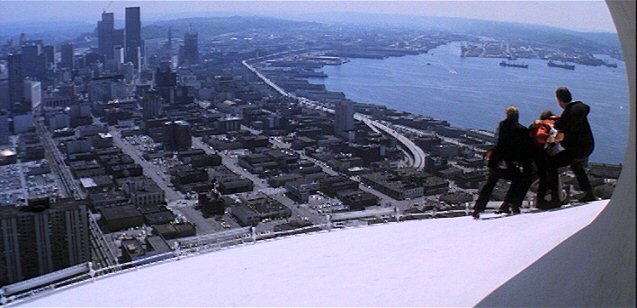
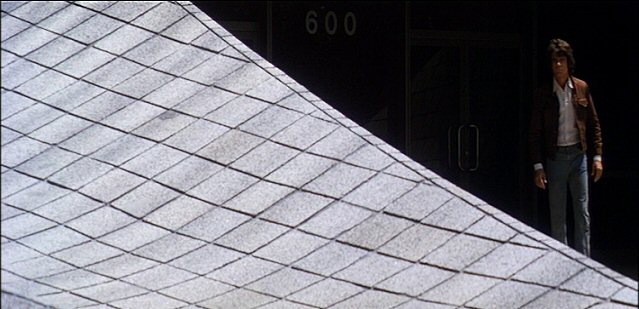
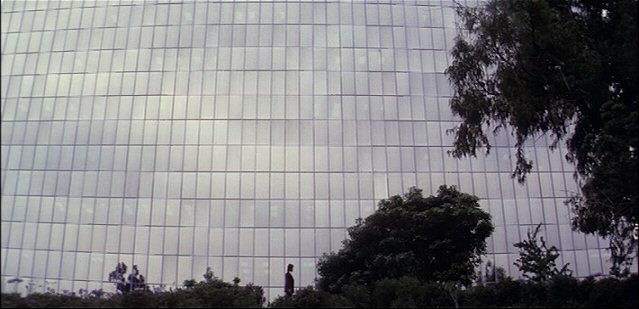
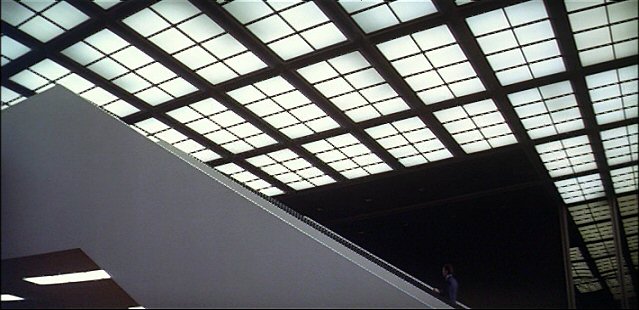
One of my favorite examples of 70's cinematography is "Parallax View" -- Willis makes great use of the anamorphic frame for a modernist, alienated de-humanized feeling:

parallaxview1.jpg


parallaxview4.jpg


parallaxview6.jpg


parallaxview7.jpg
 
I've tried to contribute a couple of times to this thread but, as is often the case, Mr Mullens post a more coherent and usefull post that make my half written post redundant. I hope people appreciate what a resource his posts are.

The only thing I would add, which is actually implicit in his posts, is that when trying to evoke a past cinema period try not to use lenses (unthinkingly) that were less available. I shot something in Italy recently (that steals a little from past Italian films) and I wrongly put a too wide a lens on the camera...

regards

Michael L

PS


'Parallax view' (like much of willis's work) is fantastic!

"Black Narcissus' disturbed me as a young teenager. It was the first time I asked myself important formal questions about cinema.
 
Back
Top