Welcome to our community

Be a part of something great, join today!

  • Hey all, just changed over the backend after 15 years I figured time to give it a bit of an update, its probably gonna be a bit weird for most of you and i am sure there is a few bugs to work out but it should kinda work the same as before... hopefully :)

DEEP ATOM is almost HERE!! Under Water will never be seen in the same way again...

Deep Atom will look even more amazing when filled with 2 Epic's and one Atom... ;)

Counting the weeks to get this baby deep down to get some astonishing images in the Seas, Oceans, Lakes and Cenotes of the WORLD... ;)

Ketch, It's great to hear that you are so enthusiastic about filming underwater.

But, as impressive as Atom and two Epics may sound, flat ports produce poor (like very poor) results underwater no matter what is behind the port. You can expect resolution lower than standard definition on the edges and strong distortions with focal lengths 50mm or wider (anything other than macro subjects). It is unfortunate that underwater ports so greatly affect the performance of otherwise impressive lenses and cameras.

Other limitations are that convergence can not be set because the lens must be exactly at 90 degrees to flat port. Otherwise, you will get beautiful rainbows everywhere, not to mention massive geometric distortions.

While all those limitations can be somewhat reduced in software, when there is no resolution to start with, the results are never going to be great. Also remember that, what looks like a great picture on the Internet, may not look that flash on a big screen.

There is heaps of reading material and samples on the Internet. Here are some:

http://home.swipnet.se/marinls/domeuw.html

http://www.hydroflex.com/site/helphints/flatdome.html

http://www.camerasunderwater.info/optics/lenses.html

http://www.camerasunderwater.info/equipment/olympus/c8080/index.html

Instead of putting a beam splitter behind a flat port, a solution great for macro subjects only, I'd consider making a finely selected dome system for optimal angle of view, focusing distance, interocular distance range, etc... It will most likely be limited to a single specific lens but, underwater, you don't usually change focal lengths, you use the widest lens possible and, if it is too wide, you just get closer to the subject.

Remember that anything more than 2-3m away, will be rendered muddy, low contrast and soft underwater as water is poor optical medium.

As I mentioned before, test, test and do more test. Why not to shoot a resolution chart through a flat port (aquarium glass) and see what you are going to get from your Deep Atom? Takes couple of hours to do and the results will give you a lot of food for thought.

What I'm trying to say is that there is no point putting a Ferrari V-12 engine on a cart with wooden wheels. It's not going to go any faster regardless of how impressive the engine may be and how much money you spend tuning that engine. :smile5:

You can probably achieve much better results with smaller chip cameras because it is easier to design correct sized underwater optics allowing smaller dome port and shorter interocular distances. Underwater, it is the port that is the limiting factor, not what is behind it. There are less challanges to overcome with smaller chip size (1/3" to 2/3") than it is with S35, which requires large ports that are too large for practical stereoscopic (3D) imaging.

Best Fishes,

Pawel
 
Something I'm working on.

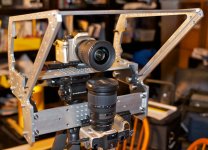
Ketch, Pawel is pretty spot on with the issues for underwater. Here's a little preview of the lightweight rig I was working on when you were here. Since the main reason for a beamslitter rig underwater is for macro, where you need very narrow interaxial, I will be using a scaled down version of this rig for underwater with only an inch or two of IA adjustment and a small mirror. This way the housing can be much more compact. I will be doing some of the experiments Pawel speaks of with this larger rig once I get back from NAB where I plan to introduce the full size rig.

The beauty of this rig is threefold: one, it is very lightweight at just 8.8pounds including 14x10 mirror and camera mountplates 2) it is very flexible in terms of being adjustable for various cameras and even different mirror sizes - since you can simply use shorter or longer cross pieces, and there are 8 different height/camera to mirror distances built in to the side pieces (plus the adjustment possible with various mounts and 3) most importantly it is very solid and square - most of the lowcost beamsplitter rigs like the hurricane and others use rods with a not so robust attachment point that leaves room for flex, or very heavy 80/20 style extrusions, and they typically require careful adjustment to get them square. Because of the way the AquaVideo™ Aero™ rig is laid out on the CNC mill it is virtually perfectly square with itself when you assemble it.

Obviously this is shown unanodized ad without the side/top panels and flags. Tentative introductory price for the abovewater Aero™ rig is $3995 - no price yet for the underwater Aquarius™ version.
 

Attachments

  • AER3DBeamSRig640.jpg
    AER3DBeamSRig640.jpg
    84.4 KB · Views: 0
... Here's a little preview of the lightweight rig I was working on when you were here. Since the main reason for a beamslitter rig underwater is for macro, where you need very narrow interaxial, I will be using a scaled down version of this rig for underwater with only an inch or two of IA adjustment and a small mirror. This way the housing can be much more compact. I will be doing some of the experiments Pawel speaks of with this larger rig once I get back from NAB where I plan to introduce the full size irig...

looking good, Mike: small and simple. Keep up the good work :)
 
Thanks for the great input Pawel,

this is a render and still pretty much under development, Gates, Evergreen and I will continue to take all considerations under advisement till final design,
most likely a Dome front could end up been a preferable solution no doubt, but there is always to consider flexibility as well,
as each Dive might have specific needs, and the use of more then just one lens will be a must.

I trust Gates to come up with a finalized model that will accomplish the goal well, and the goal is to capture the sharpest and most clear 3D images possible.

Keep in mind that this is not the first UW3DH made with a flat front port... Just the smallest and most advance one for Epic/Atom... ;)

Watershot3D_0206TimCalver1920x800.jpg

The issues are the same, wide angle of subjects with important items on the periphery are going to have problems no matter which way you go, dome or flat. The good news is many subjects, like your photo here are center weighted and that can still be quite sharp and take advantage of high resolution. This type of peripheral softness is pretty common even in regular movies when using anamorphics - so it's not necessarily a deal killer, but something to be aware of.
 
Pawel what I meant was that a Dome solution would be a preferable solution for 2D, for some reason the rest of the text didn't made it.

I am confident that the studies and test done at Gates have proven beyond doubt that the design choice with the flat port is the way to go with 3D,
remember that 2D and 3D are completely different animals, especially underwater.

Issues with visibility at 10' are only in muddy waters to begin with, in Costa Smeralda Sardegna Italy were the rig will reside and in many other waters visibility is way further,
and water particles in front of the subject in focus and or behind will make for a very nice effect in 3D.
 
Domed ports on a underwater beamsplitter rig are almost impossible engeneering problem to solve. Since basically the lenses will virtually frequently be inside of each other.

I my mind I have a possible solution....

In the end of the day we are just stuck with domed ports for underwater. We just have to deal with the issues this presents.

I cannot see how this can be any different, Which is why gates is naturally also going with flat port.

Which is too bad since a split level shot in 3D would just KILL!!!
 
Back
Top