Welcome to our community

Be a part of something great, join today!

  • Hey all, just changed over the backend after 15 years I figured time to give it a bit of an update, its probably gonna be a bit weird for most of you and i am sure there is a few bugs to work out but it should kinda work the same as before... hopefully :)

Cutting through the hype surrounding Light Emitting Plasma (LEP) lamps

Seems like Hive's Apiary Retrofit Program does just that... And I can buy a used 2K or 1K quartz fixture for less than $100 on Ebay almost anyday of the week... given that I can buy a DIY LEP kit and a used 2K fresnel for less than $1,000, even as low as $800 and build my own in an afternoon.

I am not that familiar with how Hive retrofits tungsten heads, but by the pdf that you refer to it looks like they are putting a complete housing including lens inside the can of a Mole 412 rather than just putting the LEP emitter behind the lens of the 412. I would think that would have to be the case given that the RF drivers that power plasma emitters run at 900MHz, so the emitter housings have to be specifically designed to contain the RF. As Robert Rutherford, the other co-creator of the Hive lights explains in another of their pdfs: “It’s like a microwave… keep the door shut and everything works fine. Unfortunately, this does mean that you can’t just put a plasma emitter in any old head. Without our proper shielding, the RF energy, even though it’s less than 0.1 milli-watts, can do some very funny things to wireless mics and walkie talkies.” It would appear that they are in fact using custom manufactured components not available to the average user. So, I doubt that it is something you can do on your workbench with an old quartz Fresnel and $700 DIY Plasma Projector Kit. Even if you could, you would not have a head that could burn in all orientations. While it is true that in most applications heads burn tilted down, in many applications heads are tilted up, and what’s the point of having a head that you can only use in some orientations.

As far as I can tell, the head manufacturers of LEP lamps for motion picture lighting applications have been able to address the issues of lamp orientation, UV emissions, RF interference, ignition time and restrike within the framework of a light that makes practical sense for motion picture production because they can manufacture custom components. It reminds me of a story I heard on public radio about a bike enthusiast who set out to build from scratch his ideal bike for everyday riding (not racing). In the end it cost him $7000.00 for something very similar, but not exactly the same, as he could have bought off the shelf for $1500.

- Guy Holt, Gaffer, ScreenLight & Grip, Lighting Rental & Sales in Boston
 
Thanks Guy. You make some good points. There are definite advantages of LEP technology over HMIs. However, I still have no idea of the price for the Helio or Photon Beard. Nor are there any prices for the plasma lamp that may need to be replaced at either 5 or 10K hours. Until those are known, its going to be impossible for anyone to make an informed choice between new Chinese HMIs, used name brand HMIs, or LEP fixtures. I personally think that a price point between $1200 and $1500 will hit a huge sweet spot in the market. But that is going to require a large investment and a gamble.

The apparent prices for the three (Helio, Hive, Photon Beard) might pick off a few early adopters or gear geeks who have to have the latest, but that is a small market, within the already small film market. Its a cool technology with lots of advantages over other hard lights, to be sure.
 
I just learned about LEP's, I know it feels like i lived in a cave but the LEP' are very interesting.
And a very good alternative to HMI's. Specially for the indie filmmaker.

Personal i don't think Photo beard hasn't much of a future if they keep the price so high.
The lamp cost (as I could find) about $650 and the electronics about $350. There is no way to justify $3000 for the fixture and labor (it even looks like the fixture is a knock of from china, sorry but that's what i think).
Specially if it is possible to fit LEP's into excisting fixtures, as ex. modified source 4 (and not the ones from Source4 LEP with color changers).

Some fast ideas popping up in my mind:
-Brute or Dino like lamps with a dozen LEP's to light large areas while running it on small generators, or even wall sockets. (return of the Dino!..hehehe)
-I would love to see how they hold up in a large parabolic reflector.
- in half chinaballs or softboxes.
 
Personal i don't think Photo beard hasn't much of a future if they keep the price so high.
The lamp cost (as I could find) about $650 and the electronics about $350. There is no way to justify $3000 for the fixture and labor (it even looks like the fixture is a knock of from china, sorry but that's what i think). Specially if it is possible to fit LEP's into excisting fixtures, as ex. modified source 4 (and not the ones from Source4 LEP with color changers).

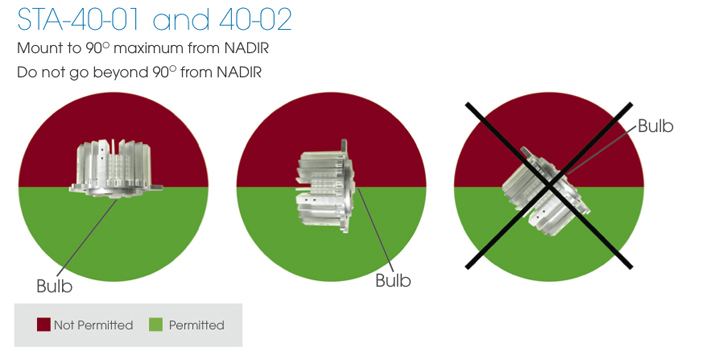
I have researched LEP lamps extensively and as far as I have been able to ascertain there are a lot of design considerations that go into building a LEP lamp for motion picture applications that makes it impossible for just anyone to do on their home workbench with an old quartz Fresnel and a $700 DIY Plasma Projector Kit. According to the manufacturer’s developer’s kit instructions the emitters as available online from DIY plasma projector kits will not burn in a tilted up position (see illustration below from Luxim’s developer’s kit instructions.) While this specific Luxim emitter is suitable for applications such as street lighting or aquarium lighting (a straight down burn position) or projector (horizontal burn position) it is not suitable for motion picture lighting instruments – what good is a light that you can’t tilt up?

Plasma_Bulb_Orientation.jpg

Another consideration that DIY hobbyists have to deal with is the UV emissions. Plasma lamps emit some light in the UV part of the spectrum. Enough that designers need to incorporate UV filtration into the safety glass of street lights and aquarium lights (the lenses of projectors provide sufficient UV filtration.) And then there is the issue of RF. The RF drivers that power plasma emitters run at 900MHz, so the emitter housings have to be specifically designed to contain the RF. As Robert Rutherford, the other co-creator of the Hive lights explains in another of their pdfs: “It’s like a microwave… keep the door shut and everything works fine. Unfortunately, this does mean that you can’t just put a plasma emitter in any old head. Without our proper shielding, the RF energy, even though it’s less than 0.1 milli-watts, can do some very funny things to wireless mics and walkie talkies.”

As you can see there are a lot of design considerations that go into building a LEP lamp for motion picture applications. It would appear that you have to use custom manufactured components not available to the average user. So, I doubt that it is something you can do on your workbench with an old quartz Fresnel and $700 DIY Plasma Projector Kit. Even if you could, you would not have a head that could burn in all orientations. As far as I can tell, the head manufacturers of LEP lamps for motion picture lighting applications have been able to address the issues of lamp orientation, UV emissions, RF interference, ignition time and restrike within the framework of a light that makes practical sense for motion picture production because they can manufacture custom components (given the benefits of manufacturing economies of scale) not available to the average user. It reminds me of a story I heard on public radio about a bike enthusiast who set out to build from scratch his ideal bike for everyday riding (not racing). In the end it cost him $7000.00 for something very similar, but not exactly the same, as he could have bought off the shelf for $1500.

Where LEP is radically new technology there is a lot to get your head around. For more details about LEPs see our newsletter article at http://www.screenlightandgrip.com/html/emailnewsletter_generators.html#anchorHigh%20Output%20LEPs.

Guy Holt, Gaffer, ScreenLight & Grip, Lighting Rental & Sales in Boston
 
Michael,

Thank you for both your posts, some really good points and questions.

1st - we are selling replacement bulbs for our systems (that includes our labor to put them in with the proper RF blocking) at $500 so that can help you crunch payback numbers.
2nd - I hear you on prices, and I'm very sympathetic, we hope to bring prices down in the future but honestly those prices are what we need to sell our lights at for the amount of R&D and overhead our new company has. With a larger purchase we will offer price breaks and we intend to take care of our early adopters, with upgrades and services, we hope each of our units should last you're filmmaking lifetime, beyond the bulb, we built our housings to last. As far as payback the other benefits we hope come from each Hive unit you buy is also saving you money on renting generators, and extra cabling, as well as renting or buying 9 lights, maxis and any other individual light that can now be created with our linking system.
3rd - Finally we are coming out with a Par, and an open face, as well as a soft-light and a retrofit for Source 4s.
4th - Finally with any retrofit, it is a custom job, and we created the program with the hope of giving independent owner/ops a way to get in on the ground level if the new units were too expensive, but if you really want to try and make one yourself I will happily give you some advice (the first being be careful, there is more than meets the eye, Guys analogy to the bicycle is spot on, it's pretty close to how we started the company...) to help you avoid some pitfalls and also see if we can't find a price that works for you. Feel free to email me directly jmiller@hivelighting.com.

That goes for anybody on the board by the way, but I think if it is a general question and people might be interested it is more informative if it stays in what has been a great message thread.

Cheers

Jon Edward Miller
Director of Photography
www.jonedwardmiller.com
 
Jon: Thanks for refreshing the discussion. I contrast your post with Guy's post just behind it. Guy has basically been reposting the same thing over and over in this thread. Its really sounding like advertising rather than a discussion. Its boring and starting to be obnoxious. Guy has brought a lot of good info to this and other boards though, so I respect his wisdom.

Glad to hear that you are coming out with other options as I am interested in the technology.

Clearly, you anticipated a maxi-brute style application when you designed stackable housings. Very forward thinking. I am very much a tinkerer, or like the magazine, a Maker, so I bet I will try a DIY fresnel as I have 4 2Ks just laying around. The lamp replacement at $500 will help recover costs over a longer period. Thanks

I am on the East Coast. Any plans for shows out that way?

Elmer: I like your thoughts. Sounds your mind was racing, as was mine.
 
I jumped way to fast into my conclusion. And for that i am sorry for that.
I know it is expensive to make a new product and adapt new tech to standards we use.
But then again i see a lot of new company's fail succeed because of short term business models.
At the price point of around $4000 it is not a competitor for hmi. Sure it safes on energy and lamps,
But it is new tech and there for not as proven in real production value as hmi. As it would be on spare parts, if a lamp got broken in a production.

It is ofcouse great to see LEP's as a good alternitive to hmi's, but if you want to be a competitive and fight into the market cost must go down. I know of the R&D and over head costs, you'll earn it back faster if you market it proper and sell more units.
If not, someone else will do someday without compersize quality

I am sorry if i sound a bit harsh, I mean well!
 
Elmer you are totally right. If you look at Jon's video from Cinegear, his price point is actually $5600, not $4000. I can buy an ARRI 575 watt HMI + FF ballast for $4,000, full retail, 24/7. No more than 1/2 of that used, and a quarter of that for a new Chinese HMI or 1/30th if I snag a bargian. (Last week I purchased a pair of 200 watt HMI's with FF ballasts for $320!!!!).

Studios that pay for electricty and rental houses that constantly turn around rentals may, I say may, be interested. But this is still way to expensive for the average indie filmamker given the alternatives. Especially since indies think in terms of project to project, rather than a long term investment.

I am sure that Jon has a well conceived head, but there will quickly be new competitors with cheaper lamps and Jon will either have to reduce features to lower price or piss off his early adopters by simply dropping them to match, or invent new features that somehow justify the extra expense (which also piss off early adopters if its timed to closely). You simply have to spread your R&D over a larger number of units or you will hit the techonolgy/economy wall.

Is anybody renting these? I am interested in hearing the rental prices and how clients are reacting to the technology.


I like this lighting option for purchase at $1200 to $1500/head.
 
He Micheal great we on the same plane.

I was more thinking around the LIFI-ENT-31-02. I see no point of putting a projector lamp in a moving image light
It has less output but have over come most of the issues previous posted here.
Robe use it in there scanlights, so it can tilt in any direction and is RF shielded. Unfortunately Source 4 has it only with a color changer build in there profile spots.
I think it would be very interesting to experiment with it, even if the final result cost twice as much.
It sure push the market forwards, and knowledge gathered in experimentation can earned back later.

I still think the indie market is very underestimated, i see a shift around clients.
More and more clients don't want to pay for big crews and huge catering trucks,
but just some sandwiches or Mc Donalds.. (as way of speaking)
I recently had a conversation with a CEO of a furniture retailer, and he was fed up with the over priced agency's.
Specially because the price/quality is not always as it should be.

As in film i point out to "black swan". Just as most people declare 16mm dead..there pops-up this 16mm feature.
With a budget of $13 million and a indie approach of making it, it must piss people of it has a revenue $320,649,553
and on top of that it wins a oscar (or at least the actress does)

What i mean to say is that with different business models there is a good return on investment to achieve.
Analise the potential market and ramp up production and logistics.
The indie market is huge and we see much more that this is the market of first adapters.
 
Last edited:
Elmer,

Thank you for your kind words, but don't worry, if you can't take criticism as a manufacturer, stay off the message boards! Trust me I am here, to hear what you don't like, and your concerns about price are taken seriously. We want to support indie filmmakers and if purchases are out of the question perhaps we can help you find either rental houses as we expand our distribution or set up a direct rental with us if you have an upcoming project.

Michael,

Just gonna take a bit of issue with your pricing on the the Arri 575w head, a complete ballast and head package sells for $5,669 + $209 for the bulb ( http://www.bhphotovideo.com/c/product/72165-REG/Arri_Compact_HMI_575W_Fresnel.html ) As for the used heads, well done! That is a heck of a deal if they are in working condition! Sorry, guess that doesn't really change your point, which is, the light may be better but in your opinion it is too expensive, a fair point, I just gotta take my swipes at Arri when I can :) , I'm sure you understand.

As for rental houses, we are in talks right now, our product is brand new and we aren't shipping till September although we are renting directly already. In fact I am demoing units in the UK this week, and we will be doing some demos in New York in July.

On those 4 2ks to retrofit, in all seriousness, if you want to DIY it yourself more power to you, but figure out what you plan to spend to do it and I'll happily do my best to match. I genuinely believe you will be happier with the results you get from me, in fact, I think that once you purchase the RF Driver, Plasma Bulb, AC/DC, RF blocking components, design a mounting system, create a reflector system, etc...I will save you money.

Cheers,

Jon Edward Miller
Director of Photography
www.jonedwardmiller.com
 
Elmer,

Thank you for your kind words, but don't worry, if you can't take criticism as a manufacturer, stay off the message boards! Trust me I am here, to hear what you don't like, and your concerns about price are taken seriously. We want to support indie filmmakers and if purchases are out of the question perhaps we can help you find either rental houses as we expand our distribution or set up a direct rental with us if you have an upcoming project.

www.jonedwardmiller.com

He john, that is some great attitude as a manufacturer!
I 100% support manufacturers that are open for debate and concerns of potential clients.
Of course as long it all stays reasonable and respectful (both manufacturer and clients).
I will keep a close eye on the new LEP's and hope to see yours on the next IBC.

I guess if Micheal and I had all the money to spent we would be the first ones to jump in (but I speak for my self of course!!!).
Maybe if I had some spare time I would do a DIY project but only for the fun of it, and have a great laugh even if i fail.

I'll keep following your great effort to push new technology (LEP) in to the market!!!
 
I concur with Elmer. Jon has a great attitude and, although I may not think this is the right time for me to purchase Jon's Hive LEPs, Jon has established an excellent rapport with the RED community. I must also say that Guy has been an excellent contributor of his vast G&E knowledge. I hope you both continue to share updates on LEP technology. Jon, I see you have a long list of upcoming products. I hope to be in LA in July. Maybe I'll stop in and check on the progress.
 
I must also say that Guy has been an excellent contributor of his vast G&E knowledge. I hope you...continue to share updates on LEP technology. Jon, I see you have a long list of upcoming products. I hope to be in LA in July. Maybe I'll stop in and check on the progress.

Thank you for you kind words. Here are some further updates on LEP technology. First, the Academy of Motion Picture Arts and Sciences is extending their Solid State Lighting Project to include LEP technology as well as LED technology, so we should expect them to weigh in on this technology in the near future. Second, Helio is planing to come out with a Space Light fixture latter this year. And, also has plans for a open face fixture that will have a greater output than their Fresnel.

And as far as not being able to point the DIY lamp upwards.... first its probably just a cooling issue, nothing that a heat sink or a drill can't fix - if one found the need to overcome this.

I'm been researching the burn orientation issue further and here is an update on that subject. Apparently, when the emitter is pointed above horizontal the plasma becomes unstable because a temperature differential develops inside the bulb. As you tilt the emitter up, the light first begins to pulse (not flicker) and, if you continue to tilt it up, it will eventually just shut off. Since the temperature differential that causes the pulsation is inside the tiny bulb a "heat sink or drill can't fix" it according to the product specialists at Luxim.

- Guy Holt, Gaffer, ScreenLight & Grip, Lighting Rental & Sales in Boston
 
He Micheal great we on the same plane.

I was more thinking around the LIFI-ENT-31-02. I see no point of putting a projector lamp in a moving image light
It has less output but have over come most of the issues previous posted here.

So far as I can see the Photon Beard spec specifically mentions Aquarium and street lighting and also 14,000 initial lumens in their spec so it may be the LIFI-STA-40-02 not the ENT version at 12,000 Lumens. Im no expert in this but would be interested to know the difference as it appears that PB amy use the STA version. The spec on the Luxim site says the both operate in any position.

http://www.luxim.com/pdfs/ENT 31-02.pdf

http://www.luxim.com/pdfs/STA 40.pdf

Could John share which is the Hive preference of emitter ? and also his take on if there is an orientation issue point ing up more than horisontal ?

Hey Dave, this is what I recently found out.. I hope it might shine some light on it ;-)

I am not sure about the STD version but ENT version can be pointed in any direction.
The differences as i can see in the specs, is that the ENT is more rugged and rated for real like situation there for life lamp is rated at 10 000 as after it can shift color render (Guy pointed out).

The ENT sure can be pointed any direction as it is used in ROBIN® 300 Plasma Spot witch is a moving head.
http://www.robelighting.com/products/article/robin-300-plasma-spot

For RF shielding copper or nickel is widely used, for very high frequencies (like gsm etc.) Kapton can be used, there are also paint that have RF blocker (copper/nickel particles) in it.
RF is rated in dB, shielding depends on how much the light is emitting.

UV filter is like the same as with a HMI, with HMI bulbs the glass is mostly coated with a UV blocker I don't know if Luxim does the same.
I also don't know if there is an IR filter/blocker needed. But both can be coated (IR and UV) in the same glass filter.
 
Hey Elmer, Thanks for the info its very helpful. Our interest is for underwater use so may differ a little in what others are looking for. We do want to use them for 'normal' surface work too but my guess is we will buy off the shelf fixtures for the Freznel and PAR fixtures. Im also interested in using one in to a large PLM parabolic reflector and lanterns but not sure we can stretch to Brieze but would be great if we could.

Just in the last couple of hours a LIFI-STA-40-02 turned up here. What I can say is the quality of light is very nice to the naked eye, I realise thats no scientific test, we used a 6mm Borosilicate glass in front of it to cope with the UV. The light out put for amps in is impressive. We don't have an ENT version to check out. As yet Im looking for more info on burn position but the spec says universal. Guy might know more and Im intending calling Luxim so will feed back anything we hear.
 
As yet I’m looking for more info on burn position but the spec says universal. Guy might know more and I’m intending calling Luxim so will feed back anything we hear.

I don’t mean to repost “the same thing over and over in this thread”. And it’s not meant as “advertising rather than a discussion.” I know “its boring and starting to be obnoxious,” but no matter how many times I post the illustration for the allowable burn positions for the Luxim STA 40-02 emitter (below) that I took directly out of the “Developer’s Kit” provided to me by Luxim for the STA 40-02 emitter, certain readers of this forum still question the facts.

Plasma_Bulb_Orientation.jpg

I have researched LEP lamps extensively and there are definite restrictions on the burn position of some of their emitters. Where I have not had the opportunity to test all of them, I can only go by the information that Luxim provides. The illustration from the “Developer’s Kit” provided to me by Luxim for the STA 40-02 emitter is pretty unambiguous; where as, the specification for “Orientation” (whatever that means) as “Universal” from the cut sheet for the STA 40-02 that Dave references is, in my opinion, very ambiguous.

I think that the manufacturer’s developer’s kit instructions make it pretty clear that the emitters available online from DIY plasma projector kits (the STA 40-02) will burn unevenly and pulsate in a tilted up position - but that shouldn't stop you from spending $700 to find out for yourself. While this specific Luxim emitter gives consistent output for applications such as street lighting or aquarium lighting (a straight down burn position) or projector (horizontal burn position), in my opinion, it is not suitable for motion picture lighting instruments because, as I said before, what good is a light that you can’t tilt up?

I know it is hard for some individuals to accept, but as far as I have been able to ascertain there are a lot of design considerations that go into building a LEP light for motion picture applications that makes it difficult for just anyone to do on their home workbench with an old quartz Fresnel and a $700 DIY Plasma Projector Kit. I may be wrong, but I only know what I have read in the twenty page Developer’s kit provided by the manufacturer.

For more details about LEPs see our newsletter article at http://www.screenlightandgrip.com/html/emailnewsletter_generators.html#anchorHigh%20Output%20LEPs.

Guy Holt, Gaffer, ScreenLight & Grip, Lighting Rental & Sales in Boston[/QUOTE]
 
Last edited:
UV filter is like the same as with a HMI, with HMI bulbs the glass is mostly coated with a UV blocker I don't know if Luxim does the same.

The speculation on this thread is starting to become reckless. With the notable exception of the old style (now obsolete) sealed beam Par 64 1200W HMI bulbs and Par 36 575W HMI bulbs HMI BULBS DO NOT HAVE UV FILTRATION BUILT INTO THEIR QUARTZ ENVELOPES, for this reason UV FILTRATION MUST BE BUILT INTO THE LAMP HOUSING and an IGNITION KILL SWITCH MUST BE INSTALLED to prevent exposure to unfiltered HMI light if the lamp housing is opened or the lens breaks. Luxim does not build UV into the quartz envelope of the bulbs either - UV FILTRATION MUST BE BUILT INTO THE LAMP HOUSING.

I am sorry to sound like a broken record, but there are a lot of design considerations that go into building a LEP lamp for motion picture applications. It would appear that you have to use custom manufactured components not available to the average user. So, I doubt that it is something you can do on your workbench with an old quartz Fresnel and $700 DIY Plasma Projector Kit. As far as I can tell, after extensive research, the head manufacturers of LEP lamps for motion picture lighting applications have been able to address the issues of lamp orientation, UV emissions, and RF interference within the framework of a light that makes practical sense for motion picture production because they can manufacture custom components (given the benefits of manufacturing economies of scale) not available to the average user. If you want to play around with a DIY projector kit be sure to wear eye protection that filters UV.

- Guy Holt, Gaffer, ScreenLight & Grip, Lighting Rental & Sales in Boston.
 
Last edited:
LEP is great and all but when I played with the dimmer it got really blue when I went 100% LEP is interesting technology it is not that hot and has a great punch. I really like these CINESOFTS there not LEP but LED. The thing about them is that they emit no green spectrum and use little power less then 1.5 amps! Using true tungsten and Daylight Diodes you can change the color temperature to like 2600 to 6500k using the on board dimmer.

Check out these lights http://www.cinemills.com/cinesoft.html the photo-metrics are there... Also check out the product demo here http://www.youtube.com/user/Cinemills#p/a/u/2/i2BBTz7GDcI. This is the way of the future. I have seen a lot of LED technology, CINESOFT is by far is the best quality. Also the LEDZ line is really good for key lights. CINESOFT great for a flood source... Deadly combo! =)

I can light a subject or scene really easy fast and efficiently
 
Back
Top