Welcome to our community

Be a part of something great, join today!

  • Hey all, just changed over the backend after 15 years I figured time to give it a bit of an update, its probably gonna be a bit weird for most of you and i am sure there is a few bugs to work out but it should kinda work the same as before... hopefully :)

Controlling light when outdoors

JustinGD

Well-known member
Joined
Feb 26, 2007
Messages
143
Reaction score
0
Points
0
I'm looking for some advice on shooting outside. There are a lot of books and online tips on how to use lights inside, but what about outside?

To those DP's with more experience than I have (that's most of you), do you have any tips on how best to use reflectors, silks (and in the case of low budget) cardboard and bed sheets? How do you achieve those beautiful outdoor close ups?
 
To those DP's with more experience than I have (that's most of you), do you have any tips on how best to use reflectors, silks (and in the case of low budget) cardboard and bed sheets? How do you achieve those beautiful outdoor close ups?

Closeups are actually pretty easy. It's the wide shots that can get challenging.

For cheap solutions try something like Home Depot and look in the insulation section. They'll have white bead board and probably some with aluminum on one side and white on the other in a 4'x8' sheet. $10 or so.

I've also used foam core, white coroplast and of course photoflex style reflectors. On bigger things with more help we'll have 4' shiny boards and big 20' reflectors. I often like what we call a Lisa Marie (gold and silver checkerboard).

I think it's mostly about the time of day and compositions you choose. Like fishing, you'll have a lot better luck at dawn and dusk. Also, the clothing you choose... white reflects bright daylight and will blow pretty fast. Avoid that... or shoot it at magic hour.

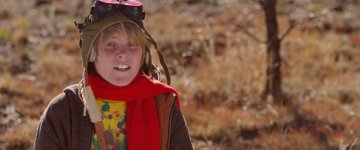
I shot this a couple days ago on RED. Sun behind, a white card to the right and a soft silver on the left. (Looks like Jannard has a kid out there somewhere doesn't it?)
 

Attachments

  • jimskid.jpg
    jimskid.jpg
    67.6 KB · Views: 0
That's great, thanks Joel. Great frame grab too, I think those are the exact same goggles in JJ's profile picture.

This is a great example of what you can do when the sun is behind the subject, but what if your background determines your camera angle? Or if you have a long scene to shoot? How to you work around changing light conditions, squinting, bright sun with dark shadows etc?
 
I would love to know if there is a book or DVD on this particular subject? Or maybe just a very good article with diagrams?

BTW, I remember seeing Kurosawa with some epic bounce setups in a BTS vid about "Ran."

ran-kurosawa.jpg
 
Outdoors...

Outdoors...

It seems to me that more should be said in books about lighting outdoors than indoors since it is much harder to balance the lights to the ambient and direct, overcast, skylight K values. (And with digital the IR/UV part of the light as well.)

In a studio you can simulate outdoors much better and all your lights have the same K value and you can balance everything to your key lights.

That's why I went into using the prism gizmo to shoot HDR on RED ONE at 4.5K mode, having an extra 4 stops outdoors can give you a more film like look to the end result. See my recent posts for a drawing of that.

The Arc lights used in the original "Planet of the Apes" for the outdoor shots always looked obvious, they just did not have enough wattage to use scrims.

Another option is to shoot outdoors at night and light it for day, you can put up a lighting grid over everything and shoot down angles etc.
 
I'm looking for some advice on shooting outside. There are a lot of books and online tips on how to use lights inside, but what about outside?

To those DP's with more experience than I have (that's most of you), do you have any tips on how best to use reflectors, silks (and in the case of low budget) cardboard and bed sheets? How do you achieve those beautiful outdoor close ups?

The solutions used to control exterior lighting depend a lot on your budget. There are several ways to modify light on exteriors. Generally speaking, you have three main tools. Bounce, over head rags, and lighting instruments. On a small crew, with a tight budget, the grip package might have a 12x, and a 6x. If that's all you have to work with, then I would say that Griflon, and silver lame are going to be your best friends. For close up's, it may be time to fly a silk over the leading lady. Also keep in mind that negative fill, using solids, can help shape soft light very effectively on overcast days.

When using bigger rags, you can fly them from condors, or rig them from buildings, or trees. If you are in the woods, you can rig some pretty effective overhead rags using blocks and lines that can be moved around.

Lighting outside using lighting instruments, takes a little foresight. If it is overcast, think about where the sun is going to be if it comes out from behind the clouds. You have to decide if you have enough fire power to fake sunny if the sun goes behind the clouds. Close ups are easy to match sunny or cloudy, so it's a good idea to get your wide shots first and then match to those.

As far as lighting instruments go, the one thing you are going to need is a lot of amps. Much depends on where you are shooting. You are going to have a different lighting package for shooting on the beach in Miami than if you are shooting in a forest in northern Europe. Big pars through silks or 4x4 frames, big fresnels through diffusion, or direct, Maxi Brutes can work great as daylight fill (corrected of course), there are a lot of different options that can be manipulated a lot of different ways.

I suggest getting a big old fresnel instrument, some action figures or toy soldiers or what have you, and a 24x36 solid, silk, and some foam core. Do some scale tests on your kitchen table. These are the same tools you'll be using out side (the fresnel is the sun). Experiment until you know what you are doing and why.

Two quick notes on grip. A good key grip will have all the frames built and skinned up leaning against the grip truck first thing in the morning. That way when you call for a 12x12 Griff, it's ready to go right away. Second, 4x4 mirrors are really useful, and should always be on the truck.

Nick
 
4 x 4 mirror boards bouncing sunlight through silks or diff frames can be very effective. You do need crew to keep the mirror in the right place as the sun moves.

You can use them in relay to get natural light into dark corners of exterior locations.
 
Yeah great replies!

Here is another set of options from a complete different angle, that being Post-Production.

In the case you are filming under an overcast lighting scenario, having the sky to blow out because you are exposing for your subject might actually be not too bad. Having the sky to withe-out will make it easy to pull a Luma Key* to create an alpha channel so you can do a sky replacement or comp a matte painting behind your plate. Nuke, Digital Fusion, After Effect, Combustion will offer the tool. You can always get a trial copy to do the job quick.

I know this is not the type of answer you were probably expecting but it is a very frequent procedure on features film post production work as sometimes, time is running on set and what you get is what you get. An those are the 911 fixes we call.

Color Grading can also go a long way too in terms of designing your key to fill ratio. Managing the intensity of your key, or rim or whatever can be easily pushed around playing with the gain of your plate and using Gamma for you mid-tones.

As far as the practical techniques, it seems it's always about reducing the intensity of the sun using diffusers and lightning up the shaded areas using bounce card, mirrors and additional lights. Just make sure you diffuse your lighting when brighting up the shadows as shadowed elements should be lit* completely soft. Using a mirror to lift your shadows might cast a very sharp light pass. I'd suggest using a diffuser in front of the mirror.

Maybe you can try graded filters too if you are shooting an establishing shot with no close subject. Knocking down the sky/sun a stop or two leaving the ground portion of the frame with the regular exposure might give you more latitude but I find this a bit rigid as the graded separation on the filter is a straight line that might not fit the design of the horrizon line on your shot.

In a nutshell, I usually under expose a bit to make sure I have details in my highlights and try to fill everything important that goes too dark with bounce or additional lights. But no matter what, I'll always fix it even more in DI. i.e. Color Grading. The Raw format recording has a fairly "nice" range. If you push the values around you'll find information in there...

-J
 
This could be "one of those stories" but I remember hearing David Watkin would use the sides of the white lighting/grip trucks for bouncing light onto large areas (on "Out Of Africa" I think).

[I also like how they named the Wendy light after him :thumbsup:]
 
Default
This could be "one of those stories" but I remember hearing David Watkin would use the sides of the white lighting/grip trucks for bouncing light onto large areas (on "Out Of Africa" I think).

The old grip truck bounce works like a charm, if you have a white grip truck (which is why they should all be white ;-)
 
but what if your background determines your camera angle? Or if you have a long scene to shoot? How to you work around changing light conditions, squinting, bright sun with dark shadows etc?

There are some great answers in this thread - check 'em out and read 'em again.

When one wide angle is critical you should scout the location very well and try to figure out the direction you like and the time of day it photographs best. Shoot photos on your scout. Then shoot all your wides at that time and direction on the day.

Once you get into closeups you can use every trick mentioned in this thread to match the lighting or simply make people look pretty. Moving people is usually easier than moving the planet.

Frankly, I've seen some pretty bizarre lighting changes in big movies from wide to closeup. You can get away with a lot because our minds don't calculate that kind of continuity problem well. (Unless you're a DP looking for it while you watch)

The luma key trick is a good idea. Replacing skies is common and pretty easy to do. I'd recommend shooting the real sky at your location properly for later compositing so the light and atmosphere are right.

Tom's pic earlier in this thread reminded me of a friend of mine who bought 6 4'x8' insulation boards with aluminum on one side. He lined them up to fill a pretty big area of the desert so a whole group of actors could be backlit and filled. Cool, but they do need to be adjusted. Bring your suntan lotion. :-)

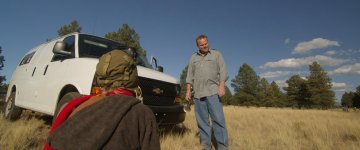
Finally, don't forget simply shooting downsun. Everything is lit up at the same exposure. Easy. Here's a reverse of the shot I posted earlier. Not the best time of day but it still worked out. A big wide the other direction would have been pretty fairly ugly by comparison.
 

Attachments

  • jimskid_reverse.jpg
    jimskid_reverse.jpg
    75.4 KB · Views: 0
I was watching this to see if we had any big out side light set ups. About a third of the way in, there is a scene where we are using a 12 light dino. Actually two scenes. In one scene it is coming through a 12x12 china silk, as a soft key (overcast rainy), and in another it is playing as an edge. Almost all of the exteriors on this show were lit. It's a pretty good behind the scenes too.

http://www.gardnerfilms.com/movies/citiesoflight_makingof.mov

Nick
 
How bout a white lighting truck for bounce & a black grip truck for negative fill :thumbsup:?

And maybe the Goodyear Blimp for an overhead.

I did once know a gaffer called Phil...everyone called him "Negative Phil", and he had a girlfriend called Polly but she was much brighter than him...

:nonod:
 
When people rig big silks on bright days do they rig netting or some other sneaky ND across the background to even out the exposure?

It depends on the background. If the BG is dark probably not, if it is light colored, depending on your focal length and stop, you can get away with a net behind the person.

Nick
 
Back
Top