Welcome to our community

Be a part of something great, join today!

  • Hey all, just changed over the backend after 15 years I figured time to give it a bit of an update, its probably gonna be a bit weird for most of you and i am sure there is a few bugs to work out but it should kinda work the same as before... hopefully :)

Continuing the discussion of why ETTR is bad when shooting HDR

Thanks Phil, I always appreciate your valuable input!
 
It's like Phil and Les Hillis says. Applying a zealous ETTR philosophy to every shoot is a recipe for failure. Each scene and capture has to be evaluated for its own exposure technique. And, that's the danger with those who blindly use ETTR every single case. There's many ways to expose a scene, ETTR is just one of them. Each scene has to be evaluated on whether one wants to protect the shadows or the highlights. It's valid to say HDR is a different beast. Yet, what makes a "good" HDR image is still hotly debated. So, just make an educated choice without following blind dogma.
 
Last edited:
It's like Phil and Les Hillis says. Applying a zealous ETTR philosophy to every shoot is a recipe for failure. Each scene and capture has to be evaluated for its own exposure technique. And, that's the danger with those who blindly use ETTR every single case. There's many ways to expose a scene, ETTR is just one of them. Each scene has to be evaluated on whether one wants to protect the shadows or the highlights. It's valid to say HDR is a different beast. Yet, what makes a "good" HDR image is still hotly debated. So, just make an educated choice without following blind dogma.

A recipe for failure? Seriously? Erik Messerschmidt won an Academy Award for Best Cinematography on Mank.The title of the thread is "Why ETTR is bad when shooting HDR"; and reading the article, it doesn't hold up. In fact, the writing is quite poor. For example, he writes, "As you move up into the brighter areas of the picture, the colours narrow and become less saturated," whereas they actually appear more colorful as luminance is increased (the Hunt effect). He uses the word overexpose, which is not correct. ETTR is not overexposure. Not only that, but the author's got a pretty slim portfolio. Does he have any HDR movies on Netflix or elsewhere? I couldn't find any. Exposing for middle gray, as the author of the referenced article recommends, does not always work in practice, as Art Adams and John Brawley take pains to explain. And tossing around words like 'zealous', 'failure', 'danger', 'blindly', and 'blind dogma' makes it seem like those who utitlize ETTR are part of a weird cult or something.

Yet, what makes a "good" HDR image is still hotly debated.

While there certainly is debate about HDR in online forums, when it comes to actual films and TV shows, colorists appear to have a pretty good grasp of what constitutes an aesthetically pleasing image.

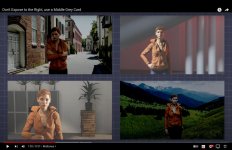
In his video, the author uses crappy CGI rather than real video. Any consumer camera could handle these scenarios with ease.
Click image for larger version  Name:	Screenshot 2023-07-22 at 10.31.53 PM.jpg Views:	0 Size:	106.5 KB ID:	3820579
 
Last edited:
My main goal when it comes to reading or watching any of these articles or video's or opinion pieces or bits of information is to keep their specific points in a wider context and to determine their relevance or importance to my particular interests or aims.

That includes recognizing why the article or information is being presented in the first place.

Nowadays, a lot of information that's presented is motivated just as much by the need to produce content as it is to actually inform or share knowledge.

That can result in an over-emphasis on specific details or aspects of a process that don't really need to be given that much attention in order to get them across to the audience. In some cases, it results in the explanation of a core principle being surrounded by a lot of time-wasting irrelevance, or the same core principle or point being surrounded by related information that could itself be interesting and accurate (or not) in it's own right, but which is still not necessary (and which runs the risk of confusing or muddying or even re-contextualizing the main point).

In some cases too, not only is information presented out of a need to produce content, but it can also be presented in a way that's intended to generate repeat or shared views of the article or video or comment. Click-baity titles are an obvious form of that, so is content added to the main point of the article or video that generates its own interest, which can range from using sexy models to expressing controversial opinions or even deliberately making errors that will evoke corrections, along with other more subtle well-meaning or nefarious ways of generating views or engagement with the 'product' (the article or video etc.).

All of this is stuff that a person has to negotiate now when trying to learn or keep up to date with all the different aspects of modern media creation. Especially when doing so outside of the structure of formal education or training.

The formal and informal methods of learning each have their pro's and cons, and they're not mutually exclusive, but there's one aspect of the formal method that is in my opinion very valuable, and that's the structured approach where the more general principles and aims are presented, then broken down into the methods and techniques implemented to achieve those general aims, then those methods and techniques are actually put into practice on student projects. So, basically, if the formal training is actually effective, a person learns how to translate the imagined into the real and how the real can be used to express the imagined.

The downside to that kind of structured learning is if the application of the techniques and processes becomes inflexible. Not that you can't also get that if informal self-taught techniques and methods become inflexible to the point of being counter-productive. In both cases, it can definitely be destructive to a project, especially when there's crucial collaboration involved, and even more so when there are strict deadlines and budgets and real money (and reputations) involved.

Nothing wrong with planning and setting firm shooting rules and priorities, it's going to be done anyway, to some extent at least, and could be considered essential and fundamentally important.

But as it's been said...

"The best laid plans of mice and men often go awry." - Robert Burns.

Or...

“No plan survives first contact with the enemy. "- Helmuth von Moltke

Or...

“Everyone has a plan 'til they get punched in the mouth.” - Mike Tyson.


So, yeah, need to be careful choosing which hill to die on, creatively speaking.


Another thing to consider, when it comes to watching or reading the videos or articles or forums regarding media creation (or any other subject), is the 'info-tainment' aspect of it, which is something that, imo, should be taken into account, not only when considering the motivation behind the article or video but also when considering why I'm engaging with it in the first place. Sometimes the entertainment aspect alone of that kind of media makes it worth watching or reading. Likewise, sometimes the craft and skill that goes into making information-for-entertainment content can be appreciated in it's own right.

Similarly, sometimes I'll watch a test video just to see how they did the test, as testing methods and practices are a skill and craft in themselves, and I find it interesting to see how different people and teams choose to go about the actual testing and presenting of the lens or camera (or whatever) test results. Likewise with reviews of equipment, or demonstrations and explanations of colour-grading techniques or tools.

So, taking all that into consideration, I wasn't going to comment on the article linked in the original post.

I think everyone here knows what ETTR is, along with the pro's and con's of using it, or could know that, if they wanted to spend fifteeen minutes finding out what it is.

HDR is a new and varied thing.

I read the article looking for something new that might come in handy when shooting for HDR, as it relates to why or when I might choose to ETTR.

Didn't see it.

Saw some other stuff.

"...When you Expose To The Right, you’re prioritising the brightest part of the image, which is less important. It causes inconsistent exposure of the mid-tones, which can lead to problems when grading the project..."

Yeah, nah.

I'll decide how important the brightest part of the image is, thanks. Likewise, I'll decide how problematic inconsistent exposure of the mid-tones is.

"...It (ETTR) creates inconsistent picture noise between shots...Making some shots brighter in the grade has increased noise. While making other shots darker has reduced it. The differences might be obvious or they might be more subtle, but these variations will be picked up by the audience and it can make the film feel less professional..."

Yeah, nah.

Varying levels of film grain or digital noise can also be used to add to the 'feel' of the film too, in ways that could also make it appear more 'professional' (whatever that means). Noise-reduction and adding noise in post is also a thing btw.

"...Once you’ve set the mid-tones, you can use lighting techniques to control the shadows and highlights in the picture. You can increase brightness in the shadows with artificial lights and you can decrease highlights by using flags or nets..."

Yeah, okay, WTAF.

At the end of the article, there's a brief mention of the more fundamental aspect of lighting and exposure that should have been used right at the start in the preface for the discussion of the use of ETTR as an exposure technique.

Controlled vs. uncontrolled lighting.

Like Audy pointed out above, your lighting conditions and options are going to play a big role in your use of ETTR. Expose strictly for the highlights, or the mid-tones, or the shadows, and you're screwed, if you can't light for them.

And this is where I see again, the pushing of a technique, with no regard for the context it's in or the process it's part of.

Explain the technique, in this case ETTR as it relates to HDR. Show what it does if it helps with the explanation, and even how and why it does it if you want to get into that. But don't tell people how they should or shouldn't use the technique or method.

People naturally want short-cuts and paint-by-the-numbers set-and-forget recipes. Nothing wrong with that if seen as a natural tendency to make things easier or simpler, but the end result (the creative output) is either achieved by applying the technology and skills and techniques towards that result, or the end result itself follows and is determined by the application of those technologies, skills and techniques. Both approaches can be 'successful' in their own right, but I'd argue there's more chance for that if they're attempted deliberately either way.

Learn the thing, so you can choose to apply the thing to what you're doing, or not.

Sorry for the big wall of text, not trying to teach my grandmother how to suck eggs or to be critical of peoples attempts at learning or teaching, just writing it down to get it clear in my own mind as much as anything else.
 
Les, I don't think one could write it any clearer. Precise, and it was about time to state this. Thanks!
 
No worries Alex, thanks for the feedback and your other contributions here.
 
Back
Top