Welcome to our community

Be a part of something great, join today!

  • Hey all, just changed over the backend after 15 years I figured time to give it a bit of an update, its probably gonna be a bit weird for most of you and i am sure there is a few bugs to work out but it should kinda work the same as before... hopefully :)

Compact Primes CP2 on Si2K at night.

Robert Hart

Well-known member
Joined
Feb 26, 2012
Messages
1,258
Reaction score
3
Points
38
Last night, there was a pickup shoot of an action scene involving two cameras. For the second camera a 50mm and 85mm were regarded as desirable but not in the kit of Super16mm lenses we had with us.


Fortunately, one of the crew had brought his own 50mm and 85mm CP2 compact primes for 35mm cameras "just in case they might be needed". As fortune would have it, I have a Canon IMS mount for the SI2K.

I had my doubts as to how they would perform wide-open. We were lit for T2 on the T1.3 lenses. The director wanted it to be lit for T1.3. There are practical limits to creative licence. My idea of "gritty" does not include horizontal noise bands across the image. So I became sneaky and deceitful and turned the HMI light up very slowly. No one noticed and images were saved.

As for how the CP2 lenses would cope wide-open? - O me of little faith -. Those lenses may be T2 at their widest but their performance at T2 is very, very honest and clean.

When considering that the SI2K is a Super16mm format sensor versus the 35mm format sensor the CP2 lenses are designed for, they were as sharp and clean as any other lenses I have used on the SI2K so far in such circumstances. I now would like to see how they do in better daylight conditions.

As I am on NDA I cannot provide frame grabs. I do recommend the 50mm and 85mm CP2 lenses for 2K crop on the strength of what I saw last night. At 2K they become telephoto lenses. I can't speak for how the wider CP2 lenses will shape up as I did not try them.
 
Last edited:
You are using the center of the lens, so theoretically the sharpest part. It doesn't surprise me that they performed well actually.
However, was the 50mm the Macro version or the standard 50mm (T2.1 as well)? If it was the latter, that would be surprising as it has always been the dog of the lineup when shot wide open at f1.4 in it's original iteration as a photo lens and then later as a modern "superspeed".
 
QUOTE: "However, was the 50mm the Macro version or the standard 50mm (T2.1 as well)?" END OF QUOTE. - I regret I did not observe what the 50mm was as I was busy stressing about making two cameras more or less match whilst at different viewpoints relative to the falling man and the "moon" we were faking with a HMI through treetrunks, 4 metre scrub and bushes. I just know they were very similar in appearance and were much larger than my Cinema Products Ultra T* lenses. The 50mm seemed to perform similarly to the 85mm. We had the Super16mm lenses wound back to T2 to try and stay sweet but the CP2s had to shoot wide-open for the lighting we had. If the 50mm could open wider, then I suspect that Daniel our cameraman closed it to the setting he used on the 85mm as the exposures appeared the same in playback back home here.
 
Last edited:
Funny, reminds me of how Contax glass was so often paired with the original S16 Super Speeds. It seems like that was a "thing". To pimp out your 9.5, 12, 16, 25 set (in aaton mount) by adding on a modded Contax set 35, 50, 85....getting you 1.2/1.4 btw 9.5 to 85, all with relatively matching Zeiss coatings.

Meaning...people have being doing exactly what you did Robert, throwing on Zeiss stills glass on S16, for a while now! Welcome to the club!

I did the OPPOSITE. I went and bought a 9.5 and 12mm Super Speed primes, and intend to get them EOS leitaxed so I can add them to my Contax set (I know sounds like blashpemy to rip of an Arri B mount and replace with EOS, but I hate changing camera mounts in the field).

Anyway. I love this entire methodology of "mixing formats" - using glass on sensors they were never originally designed for...I think it creates lots of unusual anomalies that we rarely see in digital anymore...which is exciting!
 
Last edited:
Here is a contradiction in terms then. This clip is through an old Angenieux T3.9 25mm-250mm zoom built for 35mm film cameras. I got this back in the days of groundglass 35mm adaptors on an eBay auction for a batch of two lenses for $US600, a Kinoptik 9.8mm and the Angenieux. I was after the Kinoptik. This lens was the poor brother, bare metal in several places, dents from something grubscrewed onto it, absolutely full of fungus and very tight. It had been lubed by somebody with something and whilst there were spider webs of fungus all inside, the fractions from the grease had gone across the elements in the travelling group and the rear of the big front element and seem to have protected the glass. It must have been stored upright as some of the lube ended up pooled and had set again on the inside of the front element. It was a dog to clean and was not much chop when I tested it, so I put it away. The last time I got it out, there were signs that fungus was making a comeback. I took off the front element, cleaned the nearby elements again and dabbed a quick almost dry fingerprint of dilute bleach solution on a sidewall in hope of slowing the fungus down until I could get to it again and then put it out in sunlight for a day for a bit of ultraviolet which is supposed to give fungus a bit of a fright. I stashed it away and forgot it until very recently. The fungus did not seem to have come back but I don't recommend bleach solution as it is corrosive - PLEASE DON'T DO IT. I offered it onto the SI2K with a PL adaptor, expecting it be soft, which it is but not to the extent that I thought it would be. At T4-T5.6, it actually returns sharpness numbers up to 71 with good light but only in the mid to 2/3rds of zoom travel. At the long and wide ends the image is rather soggy. In bright daylight real-world environments requiring T16, it goes softer. However the other SI2K owner-operator here loves it, doesn't want to buy it but does not want me to sell it either.

http://www.youtube.com/watch?v=MmD11er0tSw

 
Last edited:
The coating on that zoom Robert is so fun...the highlights are almost blooming...and you are right...it's not critically sharp...but it looks quite analog and filmic....the roll off of the focus and the highlights is very subtle which I like...
 
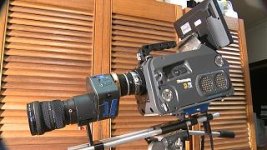
The other owner remains quite fond of softer lenses and also the 35mm groundglass adaptor aesthetic as am I, up to a point. I even fitted them up to the SI2K and can get the Letus Extreme and Cinevate with its varifocal relay for the SI2K up to the real-world "apparent" sharpness of the camera system. Needless to say, if my cargo plane came home and I won the lotto, I would have a dragon for a house pet. In the interim I must live within my means. Now here's a monstrosity for you. An interesting side-effect was there seemed to be slight breakthrough of infrared affecting the greens. An IR-750 filter made it go away. I also tried the same rig on a CP16R film camera, probably the one and only time it was ever done.
 

Attachments

  • LETUS%20ON%20SI2K.JPG
    LETUS%20ON%20SI2K.JPG
    18 KB · Views: 0
Alas a heritage artifact it has become. Mr. Jannard saw us off into the sunset with the RED when he observed the aspiration towards 35mm imaging and this was not a bad thing.
 
You would probably like the Kinoptik 5.7mm T2 for cropped sensor 2K. It is not the sharpest kid on the block and requires about 35 sharpening points to match it to 25 on the other primes. It is a rectilinear lens which means straight lines remain straight but corners are stretched into. In Super16mm the look is more extreme, especially if you pan, tilt or track. Faces look all skinny. For a while it became referred to as the "Rodriguez" or "El Mariachi" lens. The Pan-Cinor Som Berthiot zoom, I forget the actual range, something like 17mm- 85mm or thereabouts mostly covers the 2K crop. It has a zoom lever rather than a ring. You have to be fairly gentle with it or you might break the handle but controllable crash-zooms are a breeze to achieve. I think it pre-dated the Angenieux 12-120 for news work on older Auricon 16mm film cameras. It has its own optical split viewfinder, a bit tricky to focus through the eyepiece but doable. For the reflex focus through the lens to work, the lens must be correctly collimated to the camera sensor.
 
You would probably like the Kinoptik 5.7mm T2 for cropped sensor 2K. It is not the sharpest kid on the block and requires about 35 sharpening points to match it to 25 on the other primes. It is a rectilinear lens which means straight lines remain straight but corners are stretched into. In Super16mm the look is more extreme, especially if you pan, tilt or track. Faces look all skinny. For a while it became referred to as the "Rodriguez" or "El Mariachi" lens. The Pan-Cinor Som Berthiot zoom, I forget the actual range, something like 17mm- 85mm or thereabouts mostly covers the 2K crop. It has a zoom lever rather than a ring. You have to be fairly gentle with it or you might break the handle but controllable crash-zooms are a breeze to achieve. I think it pre-dated the Angenieux 12-120 for news work on older Auricon 16mm film cameras. It has its own optical split viewfinder, a bit tricky to focus through the eyepiece but doable. For the reflex focus through the lens to work, the lens must be correctly collimated to the camera sensor.

Haha. I have the Kinoptik. Getting it converted to EOS as well. It's so small, I love it. I believe it's hyperocal too right? I don't believe my copy even has a focus ring. Just aperture. I know some covered S16 as well...
 
Back
Top