Welcome to our community

Be a part of something great, join today!

  • Hey all, just changed over the backend after 15 years I figured time to give it a bit of an update, its probably gonna be a bit weird for most of you and i am sure there is a few bugs to work out but it should kinda work the same as before... hopefully :)

Cine Gear - Weapon 8k Preview

though this is very interesting, and i read every bit of Ketchs FB post about it... i still am more interested in how 8k will work with lenses i can actually buy to own...the cheap stuff like Xenons, Cp2s, compact zooms...

Maybe RED will get back into the glass game ;)
 
I know some people get a little bit picky when someone says 4k when it is really UHD. (4096 vs. 3840), so just want to point out the display was Quad UHD. By that I mean it was 7680x4320 and not 8192x4320. The content had letterbox bars on the top and bottom.

Mike Nagel said:
this glimpse of 8K looked nice but the (clear) limiting factor was the screen... as Phil mentioned its a custom build Chinese prototype, they didn't calibrate it (who knows what CMS if any it has), and obviously there's no 8K LUT box...

I thought it was a great demo. I am torn between it and the Sony SDR vs. HDR demo next door. When I jokingly asked Megan about an HDR version, she pointed out that the demo could be considered HDR in that it was ~500 nits. I think she said that they graded the 8k content on that display as well, if so then that would negate needing a calibration. Michael would need to confirm. Also, they don't need an 8k LUT box since the LUT can be done in SW/GPU by the Pablo system. That is the beauty of professional software like Resolve, SCRATCH, Baselight and Pablo. They can provide a true output/monitor LUT using the GPU. This is where Adobe and Avid fall down today as they don't have a concept of a monitor/display LUT. At least not in their current software.

The footage was a lot of mountain footage and then some city skylines. Wish it would have had more people in it. The best part of the mountain footage was when the people came in and you could see make out the facial expressions.

I wish I could have had some time to speak with Michael. Megan was gracious and I was very happy to speak with her. It was a popular demo as Michael was constantly busy speaking with people. I did see him zoom into the footage to show someone else some stuff, though I did not hear the conversation. So much detail! Michael and co are always so gracious!
 
I think she said that they graded the 8k content on that display as well, if so then that would negate needing a calibration. Michael would need to confirm. Also, they don't need an 8k LUT box since the LUT can be done in SW/GPU by the Pablo system. That is the beauty of professional software like Resolve, SCRATCH, Baselight and Pablo. They can provide a true output/monitor LUT using the GPU.

IIRC, I was told they edited and graded on a 4K display. They did not have an viewing/output LUT active, I asked.

It was really cool seeing 8K pixels in action, but the screen had some of the stuff I mentioned above... I've seen much more stunning Dragon 6K footage on a great display... ;-)

Another thing that was very obvious - again - is that the perceptual difference between 4K and 8K (--> ur own visual perceptual limit vs. physical pixel size) is not that high, or very very little unless u get ultra close to the screen or you have a VERY, VERY large screen... as in large theater projection.

the jaw dropper was that the new Pablo handles and grades 8K in real time, full res debayer................. that is nuts ;-)
 
Mike Nagel said:
IIRC, I was told they edited and graded on a 4K display. They did not have an viewing/output LUT active, I asked.

In that case, yeah, calibration would have been important. :-) Did see some noise in the image. Not sure if it was the display or the content. Really wanted to see that on a much larger screen for the visceral impact.
 
In that case, yeah, calibration would have been important. :-) Did see some noise in the image. Not sure if it was the display or the content. Really wanted to see that on a much larger screen for the visceral impact.

For pixel peepers and real IQ analysis of 8K VV W it was hard to tell, due to the screen... I stepped real close to the screen at one point, the data is there, u can see real fine detail...

The PV 70 lenses were the star, from the footage u could see: none or very very little distortion, no CA, sharp...

Would have loved to see more super wide angle footage, demonstrating the very wide FOV 8K VV W captures... more shots on the PV 70 24mm, which equals ~ 21mm on FF35 or ~ 14.6mm on S35... I think the wide angles were not used that much in the footage, IIRC...
 
It was impressive, very impressive. Seeing detailed faces in a moving aerial wide shot of a mountain top was very impressive to say the least. Color and dynamic range was impressive as expected being part of the Dragon family. 8K has a definite clarity and detail to it that I can't explain better than saying it's like looking out a window. Far more so than 4K. Very excited for the future. Shoot 8K, finish 4K. You will thank me later. Keep the R3D's and output 8K when the time comes a few years down the road. Photos do not do it justice but wanted to share, sorry... The only downside to the whole demo was that the Airstar booth was directly across from the Panavision/Light Iron booth and their lights were reflecting in the glossy 8Ktv.

Cioni1.jpg

8Kcomparison.jpg

8K2.jpg

RED8KPanavision.jpg
 
Behind the curtain you see this:


The custom box consists of several NVIDIA Quadros, 8X SDI to DVI converters, 10,000 RPM RAID, etc... This was driving the 8K display, which is a prototype and about 110" if I recall correctly.

Haha reminds me of the Dalsa "refrigerators" few years ago ;-)
 
Panavision has a little PDF for those lenses on their site that states:

"... perspective is a property ofthe focal length and is independent of sensor size. The perspective of a 40mmwill be the same on a F55 as it is on a Dragon 6K."

"Let’s assume that the central Field of View of human vision has an angle of about45 degrees, with Perspective corresponding to roughly a 40mm lens. To get thesame Field of View in Super 35 you need to shoot with a 27mm lens, or thereabouts,but then the perspective will feel a little exaggerated. To get a similarField of View with a Dragon 6K, you would shoot with a 35mm, which is closer to40mm and would yield a less exaggerated, more natural perspective."

This sounds like those large format nutters. It's also totally completely false, and should be to anyone who has used different formats yet it somehow eludes even the best. Perspective is a relationship in space, how far away you are from the subject. Focal length and format size change magnification and nothing else (well... depth of field for a given f stop as well). I hear this all the time from amateur photographers but it blows my mind to see it on a panavision document.
 
Panavision has a little PDF for those lenses on their site that states:

"... perspective is a property ofthe focal length and is independent of sensor size. The perspective of a 40mmwill be the same on a F55 as it is on a Dragon 6K."

"Let’s assume that the central Field of View of human vision has an angle of about45 degrees, with Perspective corresponding to roughly a 40mm lens. To get thesame Field of View in Super 35 you need to shoot with a 27mm lens, or thereabouts,but then the perspective will feel a little exaggerated. To get a similarField of View with a Dragon 6K, you would shoot with a 35mm, which is closer to40mm and would yield a less exaggerated, more natural perspective."

This sounds like those large format nutters. It's also totally completely false, and should be to anyone who has used different formats yet it somehow eludes even the best. Perspective is a relationship in space, how far away you are from the subject. Focal length and format size change magnification and nothing else (well... depth of field for a given f stop as well). I hear this all the time from amateur photographers but it blows my mind to see it on a panavision document.


I`m curious about this. I know that Field of View is not a lens property, and thus, a 40mm will not have the same field of view in two different sensor sizes. But isn't perspective something different? Isn't the perspective associated with the nodal point of a lens? Let's say we put a 50mm o a 7D and a 80mm on a 5D (they would have the same field of view on both cameras) and then we place the bodys in a way that the pan would be at the exact center of the sensor and then, we pan on both cameras. Won't the both cameras have different shifts in perspective, due to diferente nodal points? even if they have the same field of view? I figure that this diference would be irrelevant, tough... But I`m not sure what I`m saying, I could be wrong...
 
I`m curious about this. I know that Field of View is not a lens property, and thus, a 40mm will not have the same field of view in two different sensor sizes. But isn't perspective something different? Isn't the perspective associated with the nodal point of a lens? Let's say we put a 50mm o a 7D and a 80mm on a 5D (they would have the same field of view on both cameras) and then we place the bodys in a way that the pan would be at the exact center of the sensor and then, we pan on both cameras. Won't the both cameras have different shifts in perspective, due to diferente nodal points? even if they have the same field of view? I figure that this diference would be irrelevant, tough... But I`m not sure what I`m saying, I could be wrong...

I believe the wider angle lens would have a stretching (or squeezing?) effect, not talking about distortion, Can't locate the video but there is a good video example out there that references what you talking about. If i was better with words, I'd continue.
 
Last edited:
Great reference, thanks Humberto. Man what a work of art. Interesting how they explain in detail the film plane, and why their lenses really need to come with a custom mod for the dragon. The close focus distance of these lenses is amazing. It also makes sense to me why these lenses really need to be rented, very one off and something where you need a experienced tech with detailed knowledge of lens/camera configs to make sure everything is set up perfectly. Shooting VV with the Primo 70's with an entire A level workflow is truly something for me to aspire toward.
 
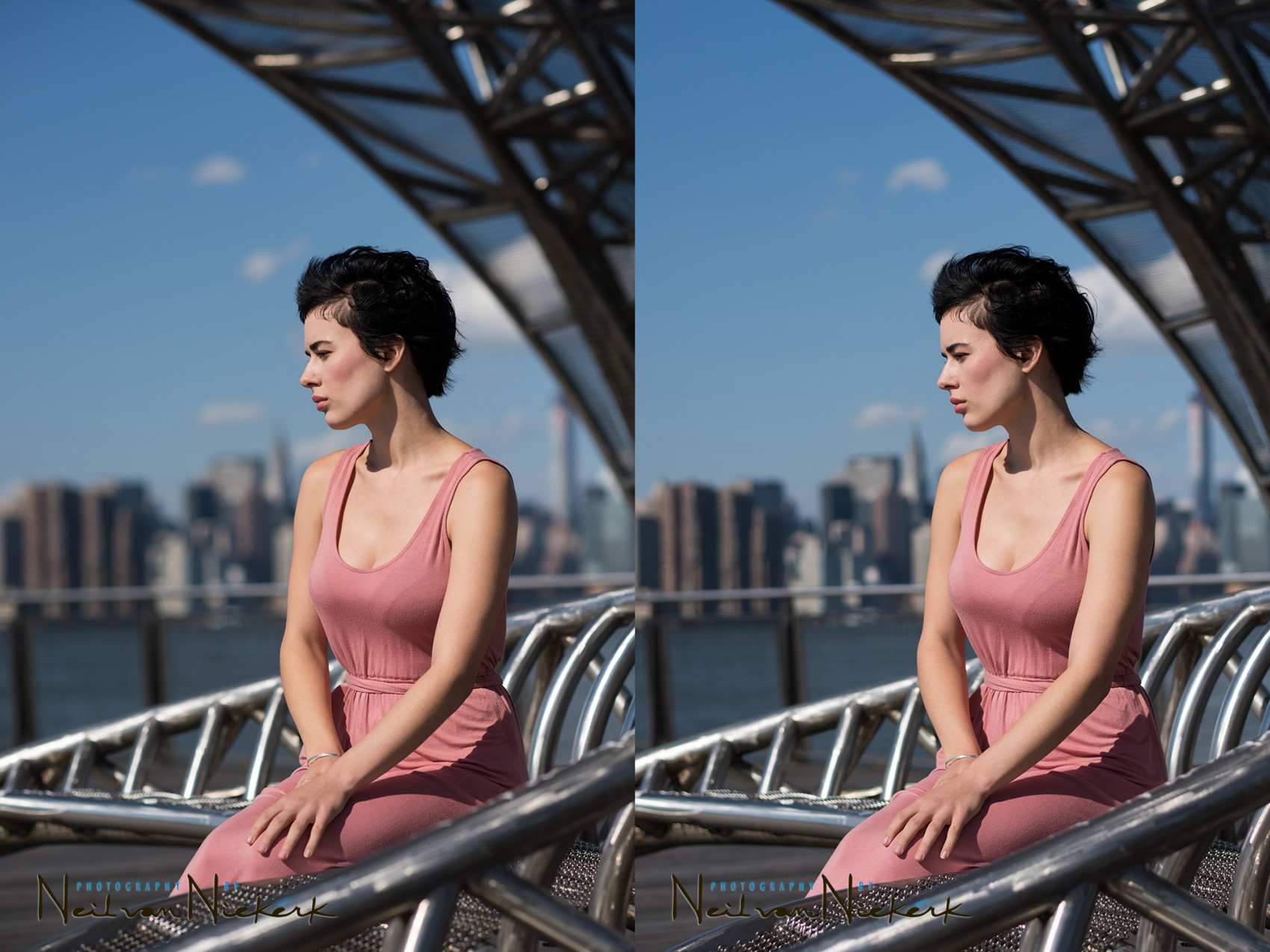
DSC_3196-3198-edit_1700px.jpg


To the left is a full frame camera with an 85mm, and the right is a 1.5x crop factor with a 58mm lens. (1.5*58=87). Same aperture, f1.4, and same camera position. Only thing I can notice is a difference in the depth of field.

from: http://neilvn.com/tangents/full-frame-vs-crop-sensor-cameras-comparison-depth-of-field/

Larger sensors, like the 8k dragon sensor, potentially get you more resolution and finer grain, or larger photo-sites for better sensitivity, and definitely make a shallower depth of field for the same field of view and aperture.

For example, a 35mm master prime at f1.2 on a super 16 camera would create exactly the same image (depth of field, field of view, and perspective) as a 100mm on a full frame camera at f3.6. The only difference would be, the exposure of the f1.2 lens is obviously more than 8x faster. This is one benefit from Red's cameras cropping in for higher framerates, you can open up your lens to compensate the faster shutter and maintain a similar depth of field.

Longer lenses are easier to manufacture with less distortion, more even illuminations, better MTF, and to some degree wider apertures. Smaller formats can make use of the center of lenses for larger formats which can help to make up this difference.

Basically the 8k sensor gets you two things the 6k sensor cannot. Shallower depth of field and greater resolution.

edit: Diffraction also sets in earlier on a smaller format.
Also, imagine this situation: Take some 8k Vista Vision sized footage on a nice zoom lens (parfocal, no distortion, constant aperture, etc). While filming, zoom out by 4x magnification, e.g. 200mm to 50mm. Later, in your editing software, keyframe resizing the footage to exactly cancel out the zoom, i.e. 100% to 400%. Resizing your footage is the same as changing the crop factor, 8k to 2k. Do you imagine that watching your footage, after this procedure, you will see anything other than a static shot? Actually, all you should see is your depth of field get wider and wider.
 
Last edited:
Basically the 8k sensor gets you two things the 6k sensor cannot. Shallower depth of field and greater resolution.

the larger sensor, if u can afford the overall costs involved, is always the better choice.

we had a nice discussion about this in another thread, but the IQ differences u'll run into when u want to match a shot (especially when u have to use shorter focal length to match) are:

lens distortion, CA, lens resolution

besides the obvious: sensor resolution

Larger sensor always wins, unless u're shooting with crappy lenses on the larger format, then the smaller sensor with high quality cine glass can easily compare...

but shoot a wide shot with a 24mm PV Primo 70s on 8K W VV and lets compare that to an equivalent shot on 5K Dragon S35 with MP... ;-))))
 
Also, imagine this situation: Take some 8k Vista Vision sized footage on a nice zoom lens (parfocal, no distortion, constant aperture, etc). While filming, zoom out by 4x magnification, e.g. 200mm to 50mm. Later, in your editing software, keyframe resizing the footage to exactly cancel out the zoom, i.e. 100% to 400%. Resizing your footage is the same as changing the crop factor, 8k to 2k. Do you imagine that watching your footage, after this procedure, you will see anything other than a static shot? Actually, all you should see is your depth of field get wider and wider.

I would imagine that there is some way of doing it with the Motion mount... Maybe there could be a way to sync it with lens with i thecnology and program it to compensate exposure for aperture changes...
 
Back
Top