Welcome to our community

Be a part of something great, join today!

  • Hey all, just changed over the backend after 15 years I figured time to give it a bit of an update, its probably gonna be a bit weird for most of you and i am sure there is a few bugs to work out but it should kinda work the same as before... hopefully :)

CFL "Balloon Lights"

I cast my vote for posts like Guy's as they are full of valuable information, particularly on a thread where the topic is DIY lighting gotchas. My theory is, only people who are interested in building such rigs are even on this thread and could easily overlook many of the issues described in Guy's posts.

Cheers - #19
 
Test your CFL's on a household circuit - I bet it would work. I don't have as much experience with CFL's, but I would bet the problem is not as severe as Guy indicates. (Sorry Guy, just my opinion. And while I didn't read this particular post of yours, I have read the page on your site, and your posts on CML, both of which I believe cover pretty much the same ground.

I know you think my post is tediously long. But, I find again and again that because of the brevity of the posts, online forums like this are filled with a lot of miscommunication. Since a little knowledge can be a dangerous thing when it comes to handling electricity (case in point), I felt it necessary to explain briefly (yes that was brief) why Isabelle’s set up as she envisions it will not work and even be hazardous. For a more detailed explanation, I did suggest readers follow a link I provided to an article I wrote for our company newsletter on the use of portable generators in motion picture lighting. In the article, was a more detailed explanation of the basic electrical engineering principles behind power factor. But, of course, you wouldn’t know that because you didn’t read my post, but still felt qualified to comment on its contents.

... I bet it would work. I don't have as much experience..., but I would bet the problem is not as severe ..., just my opinion. ... while I didn't read this particular post of yours ... I believe ....

Your response – “Test your CFL's on a household circuit - I bet it would work” – is precisely the uninformed speculation that is dangerous when it comes to electrical matters (Sorry Charles, just my opinion.) If you had bothered to read my post you would know that the harmonic currents CFLs generate stack on the neutral, and since there is no over-current protection on the neutral, can lead to overloading of the neutral and a fire like the one that occurred in Vice President Dick Cheney's suite of offices in the historic Eisenhower Executive Office Building next to the White House on December 19, 2007. The cause of the fire that started in an electrical closet on the building's second floor was found to be the result of uninformed staff replacing all the incandescent bulbs in the complex with CFLs.

I recently presented on harmonics to the electrical department of IATSE Local 481 as part of the “Advanced Power and Generation for Set Lighting Technicians Seminar” offered by Russ Saunders of Saunders Electric (the provider of power generation services for the Academy Awards since 1952 and a recipient of a technical Emmy). Several licensed electricians in my IATSE Local told me at the seminar that new requirements for wiring buildings as a result of fires started by CFLs is a part of the continuing education they are required to take to maintain their licenses.

But, I detect in your post a note of skepticism regarding my “claims.” If you won’t take my word that the harmonics created by SMPSs can cause excessive current on the distribution system neutral, perhaps you will take Kino Flo’s. On their website Kino Flo cautions users of their older style fixtures, that the ballasts “will draw double the current on the neutral from what is being drawn on the two hot legs. On large installations it may be necessary to double your neutral run so as not to exceed your cable capacity.”(FAQ “Why is the neutral drawing more than the hot leg”.)

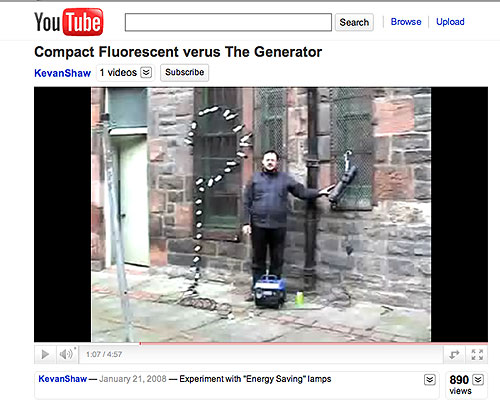
And if you don’t believe me when I say that CFLs will draw twice their rated load and generate harmonic currents that have a severe adverse effect on the governing systems of generators, perhaps you will believe Lighting Designer Kevan Shaw. In his You-Tube video, “Compact Fluorescent verses the generator,” at http://www.youtube.com/watch?v=LeCqreRMzKM, he compares the effect of equal wattages of CFLs and Incandescent lights on a small portable generator. In his test, he first operates a 575W ETC Source Four Leko with Quartz Halogen bulb on an 850W two stroke gas generator without problem. However, when he tries to operate an equivalent wattage of CFLs (30-18W bulbs) the generator goes berserk. Only after turning off half the CFL Bulbs does the generator operate normally with a remaining load of 15 - 18W CFLs (270 W.) What accounts for the erratic behavior of the generator in this video under a smaller load of CFLs? It is a combination of the poor Power Factor of the CFL bulbs and the harmonic currents they generate.

Even though the 15 CFL bulbs have a True Power of 270W, the Watt indicator on Kevan's generator indicates that they draw twice that in Apparent Power (535W), or have a Power Factor of .5 (270W/535W =.504.) The fact that CFL bulbs consume double the energy (Apparent Power) for the 18 Watts of light (True Power) they generate, is only half the story here. Kevan Shaw’s video also clearly demonstrates the severe effect that leading power factor loads - like CFLs, HMIs, & Fluorescents - can have on the governing systems of conventional AVR generators.

CFL_vs_Gen_Dem.jpg

When Kevan turns off the 18W CFL bulbs one at a time until the generator stabilizes, he is not only demonstrating that 15 – 18W CFL bulbs has roughly the same Apparent Power (535W), according to the generator’s Watt meter, as a 575W incandescent light; but, also that the maximum Leading Power Factor load a 850W conventional generator can operate satisfactorily is 270 Watts (15 – 18WCFL bulbs). Looked at from another angle, 576 Watts of Apparent Power with a Leading Power Factor (16 - 18W CFL bulbs) overloaded the generator, while 575 Watts of Apparent Power with a Unity Power Factor (the 575W Quartz Leko) did not. What accounts for this difference? Since the load is almost the same (576 & 575 Watts of Apparent Power respectively), the only factor that can account for the generator going berserk with the equivalent load of CFL lights is the harmonic currents that they generate, that the Quartz Leko does not. Without a doubt, Kevan Shaw’s video is a clear demonstration of the adverse effect that harmonic currents have on the governing systems of conventional AVR generators.

For the same reason that Kevan Shaw was not able to operate more than 270 Watts of CFL bulbs (15–18W bulbs), it has never been possible to reliably operate more than a couple of 1200W HMIs with non-PFC electronic ballasts on 6500W conventional AVR generators. The adverse effects of the harmonic currents they generate, so
graphically demonstrated in Kevan’s video, limits the total amount of Leading Power Factor loads, as compared to Unity Power Factor loads, that can be reliably operated on conventional AVR generators. If a reader of this post still doesn’t entirely understand what I am saying, I would encourage them to read the article I wrote for our company newsletter on the use of portable generators in motion picture lighting before attempting to build their own lights. In it, is a more detailed explanation of the basic electrical engineering principles behind Power Factor, harmonic distortion, and it’s adverse effects on generators. The article is available on our website at http://www.screenlightandgrip.com/html/emailnewsletter_generators.html

Guy Holt, Gaffer, ScreenLight & Grip, Boston
 
Last edited:
In the words of forum readers everywhere, Guy, TLDR - too long, didn't read.

You may think my posts verbose, but I am only trying to raise an awareness of the adverse effect that an increase in harmonic noise as a result of a change in lighting technology - the introduction of Switch Mode Power Supplies (SMPS) - is having on set power. But, don't just take my word for it: apparently, harmonics generated by SMPSs is enough of a problem to warrant several sections in the third edition of the "Set Lighting Technician’s Handbook." To quote Harry Box (Page 337 under "Power Problems from Electronic Loads"):

"Much of today's lighting technology relies on electronics such as DC rectifiers (electronic HMI ballasts), silicone-controlled rectifiers (SCRs), capacitors (magnetic & electronic HMI ballasts), and high-frequency switching power supplies (the IGBTs of electronic ballasts). These kinds of load can have undesirable effects on the current waveform, revealing themselves in the form of overheating or failing equipment , efficiency losses, circuit breaker trips, excessive current on the neutral wire, interference and instability with generators, noisy or overheating transformers and service equipment, and even loosened electrical connections. In the following sections, we discuss the power factor and current harmonics and look at their effects. Your awareness of these effects will help you to build systems that avoid or mitigate problems and show how to test for problems.(the parenthesis are mine)"

Now does this sound like harmonics is not a problem. The problem exists. Now you can, either deny it and be worse off for it; or as Harry Box suggests, you can accept it and "your awareness of these effects will help you to build systems that avoid or mitigate problems (on set.)" Which, incidentally is what I try to do in the article I have written for our company newsletter on the use of portable generators in motion picture lighting.

In the article, I set out to demonstrate that through an awareness of the effects caused by harmonics it is possible to build a system that mitigates the problems they pose. That through a substantial reduction in line noise, as a result of using Power Factor Corrected (PFC) ballasts (both HMI & Fluorescent), it is possible to create a new math when it comes to calculating the load you can put on an electrical circuit or on a portable gas generator. According to this new math, it is possible to maximize the load that you can safely put on a circuit, or the continuous load that can run off of portable generator, by using HMI and Fluorescent lights with Power Factor Corrected (PFC) ballasts.

Where, in the past we had to de-rate portable generators because of the inherent short comings, so graphically depicted in Kevan Shaw’s You-Tube Video, of conventional generators when dealing with the harmonic noise generated by non-PFC electronic ballasts (both HMI & Fluorescent); now an inverter generator can be loaded to capacity with PFC ballasts. According to this new math, when you add up the incremental savings in power to be gained by using only PFC HMI ballasts, add to it energy efficient sources like the Power Factor Corrected Kino Flo Parabeam fixtures, and combine it with the pure waveform of low impedance inverter generators, like the Honda EU6500is, you can run more HMI lights on a portable gas generator than has been possible before. For example, the 7500W capacity of our modified Honda EU6500is Inverter Generator can power a lighting package that consists of a PFC 2.5kw HMI Par, PFC 1200, & 800 HMI Pars, a couple of Kino Flo ParaBeam 400s, a couple of ParaBeam 200s, and a Flat Head 80. Where an informed awareness of the effects of harmonics will enable you to operate more HMI & Fluorescent lights on a portable gas generator than has ever been possible before, uninformed speculation only creates a fire hazard.

Guy Holt, Gaffer, ScreenLight & Grip, Boston
 
… I have never had problems running a flicker-free 1.2k HMI off of 15A circuits (even with some other small draws on the same circuit) despite the fact that he claims it would draw 19A.

That may be because it is harder to know the amperage of the circuit that you are plugged into than it is to know the amperage of the light you are plugging in. To know the amperage of the circuit with any confidence you have to methodically trace it by shutting of breakers to isolate the outlet in question or use a live wire tracer. Unless you take the time to trace it you can never be certain of the amperage of the circuit you are plugged into. Whereas, to find the amperage of the light you are plugging in all you have to do is look at the manufacturer’s nameplate on the back of the ballast.

ArriEBL1200_Ballast_Nameplate.jpg
​


Above is the nameplate from an Arri 575/1200 Electronic Ballast with DMX Control. You can see that it is clearly marked that it will draw 18A of current ("I") at 125 Volts ("U"). According to my math that works out to be roughly 19A at 120V. You will also notice that it states that the ballast has a cos@=.6 which mean that the Power Factor is .6. Given how easy it is to determine how much power this ballast will draw, if I had to speculate, I would bet that you were plugged into a 20A circuit.

Guy Holt, Gaffer, ScreenLight & Grip, Boston
 
You can make this work...
The electronic ballasts of self ballasted CFLs, ... are essentially AC-to-AC power converters in that they convert line-frequency power from the utility line (60Hz) to a high-frequency AC power (20’000-50’000 Hz) to excite the gases in the fluorescent lamp so that they glow continuously.

This gave me the idea to use CFLs as practical bulbs for high speed work, but raised some questions that I have yet been able to get answered. I’m gaffing an upcoming realty show that uses a lot of high-speed cinematography. They shoot with the Red at 600 FPS and the Phantom at 1000FPS. They want to use of practical fixtures (table lamps, floor lamps, etc.) on the set for the first time and I am not certain how to approach it. I am looking for suggestions on how to treat the practicals so that they look realistic.

I find that practical lamps never look convincing unless one treats the lampshade as well as boost the bulb wattage. I find that after stopping down to keep the shade from burning out that the output of the practical, on the table it sits on or the wall its on, looks rather anemic. Years ago Walter Lassally, BSC, instructed me to balance practicals such that an incident reading of the direct output one foot away from the bulb is one stop over exposure. I have found that rule of thumb gives a realistic output to the practical - the light emitted downward onto the table top and upward onto the wall or ceiling is realistic - but it usually requires lining the inside of the shade with ND9 so that the shade does not become too hot.

To follow that same rule of thumb for high speed would then require practical bulbs of considerably higher wattage than 211, 212, or 213. Without larger practical bulbs, the output of practical fixtures is nullified by the light levels required for high speed which usually requires 5Ks, 10Ks, and even 20Ks. The use of multiple high CRI Compact Fluorescent bulbs in a practical lamp if the shade provides sufficient space was discussed as a possible solution in a CML thread on this same topic. But no one on CML had any practical experience (excuse the pun) using CFLs in high speed cinematography to say if they will flicker.

Lowel states on their website that “our 80 Watt daylight fluorescent lamps (provide) high output with accurate color. Its high frequency ballast is designed for flicker-free hi-res digital still, video, and slow-motion cinema use.” And, according to Guy’s posts here the screw base CFL bulbs contain tiny electronic ballasts that apply high frequency output, around 40 kHz or higher, to the lamp tube which means that they may very well be flicker-free at 1000fps. At those frequencies the period of time between the off and on pulse of each cycle is so short that the illuminating phosphors in the lamp tube may not decay in light output enough to cause a flicker. Like the 'thermal inertia’ of tungsten bulbs - metal glowing white hot - that keeps them emitting light for a short time after the power drops off, the phosphors continue to glow after the power drops off as it switches at high frequency making them possibly flicker free.

Lowel and others provide CFL bulbs with screw bases in both 3200 and 5500 Kelvin with a CRI of 90+. Where a 80W CFL has the equivalent output of a 400W tungsten bulb, three of them in the shade of a large table lamp will give the equivalent of 1200Watts of tungsten light – which just might be enough to read at high speed – yet not melt the shade because they generate very little heat. Of course as Guy has pointed out, the lamp will have to be rewired to accommodate the poor power factor of CFL bulbs. Has anyone tried using CFLs in high speed and know if they will flicker?

Isabelle Landers, Gaffer, Nashua, NH
 
Has anyone tried using CFLs in high speed and know if they will flicker?

I have successfully used smaller tungsten fixtures (1ks & 2ks) as kickers or backlights for high speed by using three heads together and pluging each head into a separate phase of the distro. This way the rise and fall in the output of individual heads is averaged out to a continuous output between the three heads. I wonder if the same approach would work with CFLs. If the rise and fall in the output of the phosphors of individual CFL bulbs will be averaged out between bulbs in a single practical. If that were the case, you could rewire the practical fixture so that each bulb had it’s own plug end? That way you could plug each bulb into a separate leg of the distro.

Eileen Ryan, Gaffer, Boston
 
Back
Top