Welcome to our community

Be a part of something great, join today!

  • Hey all, just changed over the backend after 15 years I figured time to give it a bit of an update, its probably gonna be a bit weird for most of you and i am sure there is a few bugs to work out but it should kinda work the same as before... hopefully :)

Camera and airport security?

- unlimited < 160Wh (it is stated as "a reasonable amount" - always check with your airline before bringing batteries)

Little typo error here. I think you meant - unlimited <100Wh (it is stated as "a reasonable amount" - always check with your airline before bringing batteries)

Pat
 
Ok that's not very descriptive. They will take them from you if they are checked in? The law?

They could see it in th X-ray of your checked in baggage and then stop the bag and call you to take it out. You probably could loose your flight as this procedure takes some time.

I've forgotten 1 spare LitePannel battery in my checked in bag in Germany and they asked me to open it. I was lucky not to loose my flight. I was also lucky that they didn't fine me...

Pat
 
Here's a trick that has served me well for getting through security. Take your camera out of the case and put it through the x-ray first. That way, the person manning the screen will know that what follows is part of a camera kit - batteries, cables etc. This was told to me several years ago by a TSA agent and has gotten me through security without any further searches 90 percent of the time.
As far as batteries are concerned, alway carry them on, never ever check them.
 
Here's a trick that has served me well for getting through security. Take your camera out of the case and put it through the x-ray first. That way, the person manning the screen will know that what follows is part of a camera kit - batteries, cables etc. This was told to me several years ago by a TSA agent and has gotten me through security without any further searches 90 percent of the time.

As far as batteries are concerned, alway carry them on, never ever check them.

WOW. Amazing advice. Thanks Shane.
 
All you need to know about batteries: http://phmsa.dot.gov/safetravel/batteries Note under 100wh installed on a device checked is legit. Although I haven't tried yet.

I've printed these pages out before just to be safe, "Well, your own site says..."

If you're even more paranoid, PAG's batteries are certified to UN flight standards. Can't expect a TSA agent to know anything, but hey, the stamp is official :P https://www.paguk.com/about-us
 
Last edited:
I once had 2 REDs with 8 Vmount Batteries in a Carry on Pelican Case, the rule is to pack your case in a very organized manner (so they can see everything) if anything looks shady/dirty/messing they are more likely to pull you to the side and check your gear piece by piece (which has happened when it was messing/unorganized and its not fun and takes a lot of time) I use Trekpak organizers they keep it clean and professional looking!!! Also get there very early so if things happen in security you won't miss your flight (i Get there sometimes 3-4 hours early if I have a ton of expensive gear)
 
Excellent advice in this thread, thank you to all who have shared their experience and insight.

One of my most recent purchases was a Think Tank Photo Airport International V 2.0. This bag is the perfect size for carrying all the related items needed for a shoot. The reason I went with an international size was due to an overly aggressive security agent in Paris. Because my bag was a standard US size for carry-on, it did not meet the requirements of international airlines.

It was a stressful flight in France and I swore to never go through that experience again.

The Think Tank is deep enough for my WEAPON-CF and the related accessories.
 
On most airlines you can check check dry batteries in the hold, if they are not lithium.

The use of carnets applies to professional goods even if they are for personal use.
If you are going to travel outside of the USA for the first time seek professional advice about customs.
If using a Carnet my advice is to have someone on the crew who knows the ropes. Some customs officers do not know how to complete the form and will wave you through, so you need to have the confidence to demand to be seen by another officer.
Some customs offices close when the last arriving flight has landed, so if you are departing after the last flight you'll be stuffed.

Your insurance will not cover equipment seized or delays caused by customs officers.


If hand carrying camcorders make sure lens cap stays on so you are not accused of covert filming.

Be prepared, be professional.

Mike Brennan
 
Last edited:
If you're trying to be inconspicuous and cramming a camera with extra batteries and lenses etc. into carry-on bag/rucksack/backpack, the people manning the x-ray can get frustrated/pissed off if you've layered too many items and they can't see through them all. In which case they'll probably question you and get you to remove some of the items and re-scan them separately. To avoid that, lay the bag down so there are no parts stacked on top of each other when they go through the scanner, which again may require removing some items and getting them scanned separately.

Even more importantly, if you do have to separate items, make sure you keep track of them and get them back again, which is easier to do if you separate them yourself beforehand. Some officials won't even let you touch the bag after they've decided some items need to be removed and the bag re-scanned. In that case, make doubly sure that what they take back to get re-scanned actually comes back without anything 'missing'.
 
Will charging a batt only half way, that's over 95 wh, get you through customs if the battery has a way (lights that show charge) to prove it?
 
I don't think so Elsie. As I understand it, the battery size limits are set in relation to the amount of combustible material in the battery, with the idea being to limit the size and duration of the fire should an individual battery ignite (for whatever reason), and to limit the amount of individual batteries that could go off.

I think if a lithium battery can be ignited by external forces as well as internal failure, and if, once set off, it will burn just the same regardless of how much it was charged up beforehand, then the regulations are more about treating the batteries like containers of fuel than actual batteries. It just so happens that with the current technology, more watt-hours means, literally, more fuel for a potential fire, so it's the watt-hours that are used as the main measure of safety, in conjunction with the physical state of the batteries and the amount of them.

Not sure, but the batteries would probably still be considered dangerous even if they were totally dead.
 
Hey Guys, I was just asking some battery questions yesterday and got this response from B&H about shipping batteries to Australia and the change of air travel regulations:

Thank you for contacting the E-Mail Sales Department at B&H Photo Video and Pro Audio.

I am sorry but we will not be able to ship the batteries to Australia.


There are international shipping rule changes for batteries taking effect on April 1st, 2016. U.S. D.O.T. has a standing rule to follow and copy the rules released by IATA.

http://www.iata.org/whatwedo/cargo/dgr/Documents/lithium-battery-update.pdf

Effective April 1st 2016, stand-alone batteries (i.e. batteries not installed or shipped physically in the same box with equipment using that battery) must be shipped at a State of Charge no more than 30%.

Not more than three standalone batteries can be shipped to one address at one day.

Standalone batteries are not allowed on passenger aircraft.

Many manufacturers have already publicly committed to following this rule.

Please let me know if you require any further assistance.

Thank you for choosing B&H.


So I cant get individual batteries shipped to me but also no individual batteries allowed on passenger aircraft certainly makes things difficult!!
If you had a vmount battery attached to your Red I guess you could take that on but because it is installed but not a spare as its classified as 'individual'??

How the hell are batteries going to get anywhere now!? :001_tt2:
 
Last edited:
I've been fine with moving kit around the EU no problem, that's is without getting a Carnet, which is seen as passport for your kit, not sure of the minimum cost of the equipment is to require one, but I've picked up the habit of carrying a document with the all the serials numbers, which can be a pain when I have to use rented kit, but better that than get the kit seized or having to pay massive fines.

The 1st time I traveled outside the EU, which was to Israel for a job, which was where I learnt the hard way to have these habits and didn't help the last minuteness of the job, we didn't have a carnet or a serial number list, and we had to pay a massive duty on the kit, and on the way out they, asked to see some of the footage we had shoot, previous work, websites, contact list, it was an experience, fun shoot not so fun getting in and out.

BA's Batteries Regulations
http://www.britishairways.com/cms/global/pdfs/lithium_battery.pdf

My advice:
1. Get a Carnet
2. Carry a Equipment list with Serial number where possible i.e Anything that has one write it down.
3. Throw the Multi-Tool, in what ever bag you check, to be safe.
4. Be ready to show your work.

Anyone feel free to add to the list :001_smile:, am sure there are more to make sure everyone can get their kit where it needs to be but those are just my habits.

With the UK being part of the EU (at the moment) there is free movement of goods, which means you don't need a carnet or paperwork when travelling from one EU country to another. This is a big deal for those of us who regularly travel around Europe for various jobs.

If the UK votes to leave the EU in a few days we would then be at the mercy at whichever customs arrangement comes in, which could include a carnet for expensive goods like camera equipment. Carnets are a necessary hassle for travelling to non-EU countries, to have to use them every time we travelled within the EU as well would get very expensive fast, not to mention the extra time and hassle of customs at either end of the journey.

Not wishing to politicise the discussion but personally I like being able to travel around Europe with minimum fuss so I know which way I'll be voting.
 
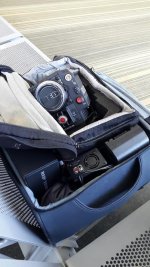
Carry-on is fine, they do however moan about the alen key set or any other sharp metal objects. The French are the worst, had to assemble the camera and show them that each lens works. There rest of EU had no problem .
 

Attachments

  • 11150641_368341960030039_2055965287021192554_n.jpg
    11150641_368341960030039_2055965287021192554_n.jpg
    87.9 KB · Views: 0
...... So I cant get individual batteries shipped to me but also no individual batteries allowed on passenger aircraft certainly makes things difficult!!
If you had a vmount battery attached to your Red I guess you could take that on but because it is installed but not a spare as its classified as 'individual'??

How the hell are batteries going to get anywhere now!? :001_tt2:

Anton Bauer published this document that might help clear up some of the confusion:

http://www.antonbauer.com/dam/jcr:f...3792d705d/Lithium Battery Transport_Final.pdf

The new regs instituted apply to Air Cargo - not passenger flights.

It does not impact the rules we have been following to date.
When air cargo is required, there is a road path for manufacturers and suppliers - they need to catch up (as AB is doing).
 
Back
Top