Welcome to our community

Be a part of something great, join today!

  • Hey all, just changed over the backend after 15 years I figured time to give it a bit of an update, its probably gonna be a bit weird for most of you and i am sure there is a few bugs to work out but it should kinda work the same as before... hopefully :)

BMPC6k vs Komodo...

Jason Cha

Member
Joined
Oct 29, 2020
Messages
11
Reaction score
0
Points
0
Hello all! I have preordered Komodo and waiting for it to arrive...
In the meantime, I'm seeing quite a lot of comments comparing Komodo and BMPCC 6k and people are bashing about how Komodo is not worth its price in terms of image quality.
I've been using mirrorless up until now (Sony a7s3 and Panasonic s1h..) and I'm excited to get my new cine cam which is the new Komodo!! However, at the same time, I'm kind of confused whenever I look at these comparison footages uploaded on Youtube..
 
* Red RAW.

& ease of menus, build quality.

I wish more people would weigh in though. I’m hoping to go Komodo and I most likely will but yes it’s 3-4xthe price.

Thanks Andrew!! :D
I believe I will learn a ton from using Komodo for sure. Since you mentioned its build quality, is Red camera known for good build quality?? I did look up for any build quality issue in this forum but I could not. I guess that means it's reliable and hoping same for Komodo :D
 
I haven’t used black magic but I can confirm everything is shit compared to red. I promise your confidence will go up because your back is COVERED with red. It is not the same with mirror less as I have learned on my first recent non red products.

BIG DIFFERENCE THERE.


However I think black magic sits in the middle.

jeez....
 
Hello all! I have preordered Komodo and waiting for it to arrive...
In the meantime, I'm seeing quite a lot of comments comparing Komodo and BMPCC 6k and people are bashing about how Komodo is not worth its price in terms of image quality.
I've been using mirrorless up until now (Sony a7s3 and Panasonic s1h..) and I'm excited to get my new cine cam which is the new Komodo!! However, at the same time, I'm kind of confused whenever I look at these comparison footages uploaded on Youtube..

Because most YouTubers are just YouTubers who earn money on ads. They are not photographers, they are not cinematographers and they tailor their content towards the same thing as any other click-bait business out there. There are very few true quality creators on YouTube and very few who are also true artists and professionals.

Just because someone has a channel with thousands of followers doesn't mean they have anything of value to bring to the table. This is the reality of the times we live in now; anyone can create and upload, anyone who can spin the wheels of marketing can market themselves to be more than who they are. YouTube is all about marketing yourself and your content, NOT to produce good content. Only a few put up their content on YouTube as a means of sharing their actual art and craftsmanship.

All of this has created a generation of wannabes whose main skill is about creating the illusion that they are much more than they actually are and everything is about maintaining that illusion while followers act like cultists who agree with everything they say because of their YouTube fame rather than the knowledge they provide.

Finding out who is worth listening to and following on YouTube requires research into who they are, which most people won't ever feel they have the time to do. The democratization of content creation through channels like YouTube has put a huge responsibility on the viewer being critical and knowledgeable of how to navigate information online. Something that is heavily ignored in the world today.
 
Totally agreed... May be I was expecting too much from the Komodo's new sensor. ;)

So the 3 stops more of DR and global shutter is not... more? Stop listening to BS YouTubers and do your own research. Go down to a rental service and test both cameras.
 
I haven’t used black magic but I can confirm everything is shit compared to red.

That's some real solid intel right there...

I own a P6K. It captures a competitive image in a number of frame rates, notably 6K@50 fps or 60 fps if at 2.4:1. The compressed raw codec, .braw has both 'constant quality' and 'constant bitrate' flavors. The clips can be trimmed and still stay .braw. to reduce footage footprint after a shoot. The Blackmagic Design color space and Blackmagic Film log curve are large enough and flat enough, respectively, to not get in the way.

I would not recommend anyone to buy a Komodo based on the notion that it will create better looking images.

The Komodo has a slightly larger sensor than the P6K and a more modern RF mount. While the larger sensor isn't large enough to make a meaningful difference per se, I like the idea of a closer match between mount and sensor. By this I mean that the EF and RF mounts are designed for FF and with a smaller sensor you are giving away part of the image circle. Here the RF-mount proves to be more versatile: you can use ND-adapters and Speedboosters. And even if you want to use the mount straight up, or with a straight up EF-RF dumb adapter, you still have the option to use modern RF glass going forward.

The Global Shutter aspect of the Komodo is pretty huge for some.

I would argue that practical stuff like that is worth considering, plus the brand name RED itself—since it's very established in commercials and films.

Apart from that, if someone just wants a personal camera that shoots professional quality footage, I would not hesitate to recommend the P6K with a Kinotehnik BM5 loupe. It can't be beat in terms of performance per $.
 
So the 3 stops more of DR and global shutter is not... more? Stop listening to BS YouTubers and do your own research. Go down to a rental service and test both cameras.

Three stops more than what? You've got to go rather a long way back in time to find a camera with a full three stops less DR than Komodo.
 
Can’t say anything about the p6k, but I’ve been shooting on p4k for nearly two years now. It’s an amazing camera. Braw is super versatile and lightweight if you need it to be, and holds up at high compression ratios. colours are excellent, and the UX is next level intuitive. Seriously, I think Komodo is going to be a big step backwards in terms of user friendliness on the camera’s operating system. The pocket feels cheaply built but I haven’t had any reliability issues, and it’s shape is a little awkward. For most people, I think it’s an incredible camera, and having not used a Komodo, I don’t know if I could recommend spending almost 3x the budget to someone who isn’t going to earn it back pretty quickly.

I’m going Komodo for the global shutter, the RED name, and from what I hear, the colour science/codec. I’ll confirm that difference later. But the real big difference is going to be client impressions—I’ve lost work in the past because I’m not shooting on RED, and that’s ultimately what justifies the expense for me, in addition to the global sensor and the colours
 
I love the black magic iq but hate the form factor and ergonomics. I like Red iq a little better and the ergonomics much better. My high end clients are used to Red quality and I can give that with komodo.
 
You'll find haters on both sides, but the truth is that they're both excellent cameras. Their image quality is excellent, and so is their build quality, though in my case I don't yet have hands on experience with a Komodo to base that on, but knowing what my DSMC2 cameras is like and the kinds of situations that Red tested the Komodo in during development leave me confident on that.

The form factors are very different, and I definitely like the Komodo's better -- its shape will be much easier to gimbalize. The Pocket 6K has a mini-XLR with phantom power, which is a plus. The Pocket 6K has a bluetooth control option, but it doesn't have a video feed option built in.

Both have excellent codecs, both have excellent image quality, and frankl you wouldn't go wrong with either one.

I'm going Komodo partly for the form factor and also Red does have an edge in customer service and durability, but also because it's a better match for my DSMC2 camera. The Pocket 6K has a lot of dynamic range, plenty for filmmaking, but it looks like the Komodo is closer to the Helium in that department, and Helium definitely has more dynamic range than a Pocket 6K, so that is a nice fringe benefit.

The global shutter and autofocus are both also features that Black Magic doesn't offer yet.

Hopefully that helps.
 
Three stops more than what? You've got to go rather a long way back in time to find a camera with a full three stops less DR than Komodo.

Uhm... the Pocket 6K is 13 stops, the Komodo is technically 16 stops.
 
I have the BMPC6K and I came from mirrorless cameras which I still do have. First, my background... I started as an amateur photographer. I was first inspired to dive in because of my exposure to professional photographers and videographers at WWE (World Wrestling Entertainment). I learned a few things from these people and took a greater interest in learning the ins and outs of taking photos and later video with the first Sony mirrorless cameras. I even had a pro-consumer Sony camcorder (I forget the model).

When Black Magic came out with the BMPC4K, I was intrigued but didn’t jump onboard until they came out with the 6K. The mobility, BRAW, ease of menu navigation, and versatility is what I liked the most about it. I won’t get into all the technicalities of color science because that’s not really my forte but will say that BM offers great control of color grading and how you want to video capture (frame rates, HFR, etc.). On the downside, it has no image stabilizer (whether its actual IS, IBIS or global shutter). Its form factor while great for lightweight lens setups, loses its appeal when attaching larger lens. The screen is fixed and suffers in direct light. The battery life is abysmal, you either need a ton of batteries or rig it with an alternative battery mount. I like to travel “light” so when you want rig it out, the form factor does make it cumbersome to pack it in a backpack or carry-on without taking it mostly apart.

This is where I made a decision to buy the RED Komodo (aside from its price point and name recognition). It’s modular form lends to easier packing with most of the gear still attached (grab and go). Image stabilization (global shutter in this case) is what I missed with the Mirrorless cameras (although it is rolling shutter) and throwing in a gimbal to compensate that was just another added weight and space eater.

EDIT: Totally forgot one of the biggest selling points for the Komodo: continuous autofocus... that’s a big deal to me too.

Just my .02 from a person coming from a “amateur/enthusiast” background.
 
Last edited:
Because most YouTubers are just YouTubers who earn money on ads. They are not photographers, they are not cinematographers and they tailor their content towards the same thing as any other click-bait business out there. There are very few true quality creators on YouTube and very few who are also true artists and professionals.

Just because someone has a channel with thousands of followers doesn't mean they have anything of value to bring to the table. This is the reality of the times we live in now; anyone can create and upload, anyone who can spin the wheels of marketing can market themselves to be more than who they are. YouTube is all about marketing yourself and your content, NOT to produce good content. Only a few put up their content on YouTube as a means of sharing their actual art and craftsmanship.

All of this has created a generation of wannabes whose main skill is about creating the illusion that they are much more than they actually are and everything is about maintaining that illusion while followers act like cultists who agree with everything they say because of their YouTube fame rather than the knowledge they provide.

Finding out who is worth listening to and following on YouTube requires research into who they are, which most people won't ever feel they have the time to do. The democratization of content creation through channels like YouTube has put a huge responsibility on the viewer being critical and knowledgeable of how to navigate information online. Something that is heavily ignored in the world today.


Amen sir! Preach it! NEVER base your purchase on what a YouTuber says PERIOD.
 
Three stops more than what? You've got to go rather a long way back in time to find a camera with a full three stops less DR than Komodo.

Well, based on manufacturers specs, the Pocket 6K has 13 stops of DR and the Komodo has "16+".

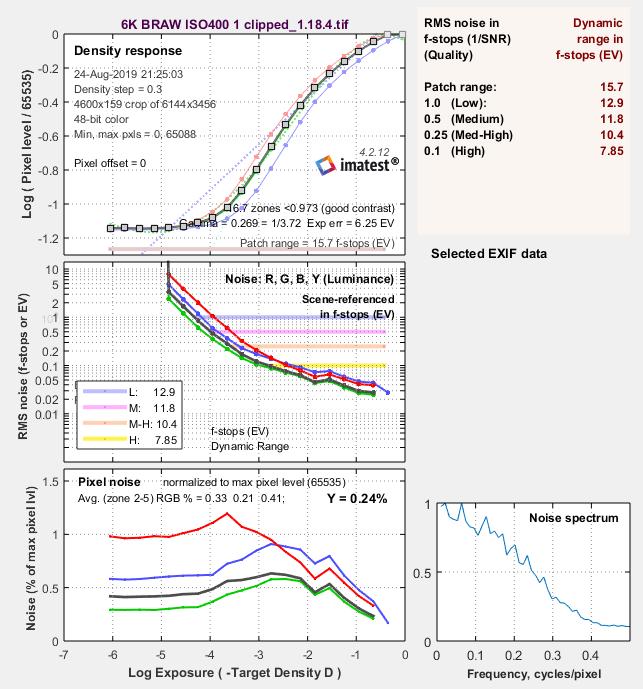
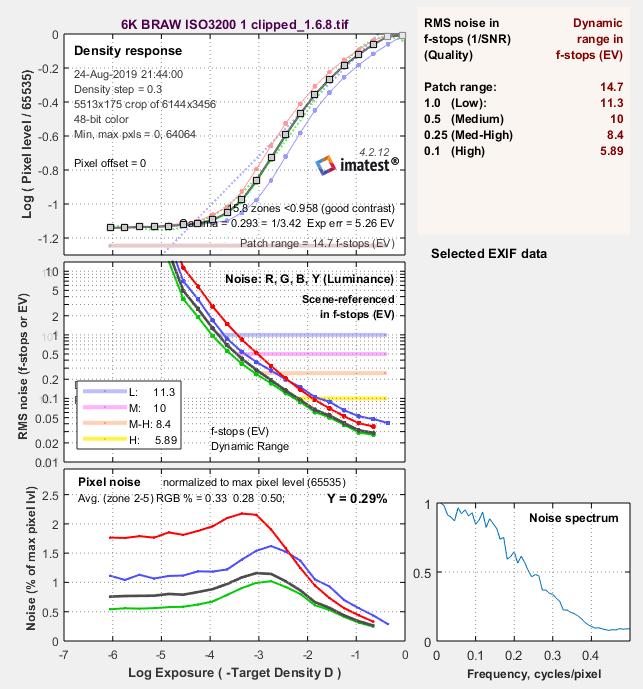
Based on more conservatives measurements from CineD, the Pocket 6K offers around 11.8 stops of what they call "usable dynamic range" (and around 10 at 3200 ISO).
DR-Result-BMPCC6K-6K-BRAW-ISO400-1-clipped_1.18.4_Step_2.jpg

DR-Result-BMPCC6K-6K-BRAW-ISO3200-1-clipped_1.6.8_Step_2.jpg


Still according to the findings of CineD, the Pocket 6K has a rolling shutter around 19.8ms in full sensor readout.

Now for the Komodo, according to our very own Phil Holland, it has a very similar DR to Helium 8K.
phfx_RED_KomodoHeliumXyla_JarredLoren.jpg


A while back, Jarred said in the (very long) Komodo thread that it has somewhere around "less than half a stop less DR than Helium".
DXO Mark measured Helium at 15.2 stops of total dynamic range SO we can assume Komodo is around 14.7 stops of total dynamic range. Give or take.
v25zmGh.png


And obviously, Komodo has a global shutter.

Everything is to be taken with a grain of salt because anyone of these findings can lack accuracy and if those datas really matter we should not just take one source into account.

One thing the Pocket 6K has over the Komodo is a better recovery... But it's like saying that one camera is better than the other because you can work without knowing what you do or without doing it right and still get a good result and I've always found that a tad dumb of an advantage. (no matter what brands are concerned)
 
One thing the Pocket 6K has over the Komodo is a better recovery... But it's like saying that one camera is better than the other because you can work without knowing what you do or without doing it right and still get a good result and I've always found that a tad dumb of an advantage. (no matter what brands are concerned)

What do you mean - better recovery? When I've tested Ursa Mini g2 vs Epic MX - it was like +- same DR with recovery turned on on post. Without it it was less, and as far as I can understand - with recovery turned off you don't get the total DR the camera offers. And in case p6k the totals were measured with recovery on, I assume.

Second, all BM cameras (except for Ursa12) are lacking DR in color channels. If you try to light a subject with an Astera Titan tube and try to do all the basic colors - you'll see they are going to clip much sooner, compared to Epic MX. Also the difference between pink - magenta - red will be all magenta. But I've tested them way long ago and there's new color science in BM, maybe something got better from that moment.

Last - you don't have an IR cut and OLPF at all. This thing only ruins your footage much more than anything else - everything looks sharpened and you don't see a clear focus plane - on wide lenses objects that are out of focus seem like they are in focus. I've done some side by sides of P4K and Scarlet MX on a same lens, P4K was with a speed booster - so +- same dof, and the Pocket was much, much sharper in out of focus areas. Say, if you try to shoot it with Cooke Ana 2x - it'll totally ruin the look.

I did a couple of projects with p4k and p6k - they are amazing cameras, especially considering their value. Simply you can't beat that, and it was unimaginable even 5 years ago to have such a capable camera in this price range. But for bigger projects - I can't imagine choosing any of BM cameras over an Alexa, Venice, Mostro or Gemini. Maybe the Ursa 12k is going to change that somewhat, hope so.
 
Well, based on manufacturers specs, the Pocket 6K has 13 stops of DR and the Komodo has "16+"

Well, as you can see the P6K has a 'patch range', or what we can call "reduser stops", of 15.7. Let's call it 16-. So, 16- vs 16+?

Or, we can just discount the "internet stops" that start somewhere around 14 and above and realise that the meaningful difference is absolutely zero. In that regard.

There are many other differences between the cameras though, playing to both their strengths and weaknesses respectively.
 
What do you mean - better recovery?

When it comes to science, it's not as clear cut as you might think. On one side you have 'Trump science' and on the other there is 'science science'. And then there is a pretty big spectrum that is all "science". Or, it's more like in... was it Game of Thrones where the Dothraki say "Me nem nesa". It means 'it is known'. This is the area where we find "shadow DR" and "highlight DR" and some other very interesting things.
 
Back
Top