Welcome to our community

Be a part of something great, join today!

  • Hey all, just changed over the backend after 15 years I figured time to give it a bit of an update, its probably gonna be a bit weird for most of you and i am sure there is a few bugs to work out but it should kinda work the same as before... hopefully :)

Blackmagic Design is rumored to announce a new L-mount cinema camera on September 14

Here is a newbie question folks. The image enclosed is not to scale but drawn for illustrative purposes. I have included a lamp and a side table in the shot to represent the footage that is being shot. Let us assume this new BMCC 6K Full Frame camera is shooting open gate 3:2 6K using the complete 36mm x 24mm Full Frame sensor. An anamorphic lens is not used and the operator wants to use a prime lens. In (A) below, green is the 3:2 image and it is framed for 2.39:1 aspect ratio as shown by the blue horizontal lines. The intent is to downsample the 6K in post to a 4K image and finish with a 2.39:1 aspect ratio movie. I am paranoid that when the post production process is done that rather than achieving the output as shown in (B), instead one would end up with a result as shown in (C) below, which is not the desired output. As I mentioned, anamorphic lenses are not an option in this shoot and open gate 6K is chosen to maximise the full sensor photosite potential, thereby when it is downsampled to 4K, we want to preserve the quality with that downsample. We don't want to shoot 4k in the first place because it will crop the sensor and use a smaller portion of the sensor therefore.

With the above said, here is the newbie question:

What is the workflow that is commonly used or a workflow that has been tried and worked in the above example for one to shoot in 3:2 6K and output or finish in 2.39:1 4K? I am asking this question because I am of the mindset that if one acquires the footage in 3:2 6K and downsamples to 4K then the footage will look like 3:2 4K.

Thank you!

1.jpg
 
Here is a newbie question folks. The image enclosed is not to scale but drawn for illustrative purposes. I have included a lamp and a side table in the shot to represent the footage that is being shot. Let us assume this new BMCC 6K Full Frame camera is shooting open gate 3:2 6K using the complete 36mm x 24mm Full Frame sensor. An anamorphic lens is not used and the operator wants to use a prime lens. In (A) below, green is the 3:2 image and it is framed for 2.39:1 aspect ratio as shown by the blue horizontal lines. The intent is to downsample the 6K in post to a 4K image and finish with a 2.39:1 aspect ratio movie. I am paranoid that when the post production process is done that rather than achieving the output as shown in (B), instead one would end up with a result as shown in (C) below, which is not the desired output. As I mentioned, anamorphic lenses are not an option in this shoot and open gate 6K is chosen to maximise the full sensor photosite potential, thereby when it is downsampled to 4K, we want to preserve the quality with that downsample. We don't want to shoot 4k in the first place because it will crop the sensor and use a smaller portion of the sensor therefore.

With the above said, here is the newbie question:

What is the workflow that is commonly used or a workflow that has been tried and worked in the above example for one to shoot in 3:2 6K and output or finish in 2.39:1 4K? I am asking this question because I am of the mindset that if one acquires the footage in 3:2 6K and downsamples to 4K then the footage will look like 3:2 4K.

Thank you!

View attachment 3829059

***update***

I saw this image and it seems there is a 6K 2.4:1 resolution option that one can select. I believe this will solve this riddle of mine. Is it correct to say that if that circled option is selected, the entire full frame sensor will be used and framed to 2.4:1 aspect ratio, hence the viewable acquired resolution will be 6048 x 2520? And is it further correct to say that that output can then be downsampled to 4K resolution at 2.4:1 which would give a viewable image of 4096 x 1706 scope aspect ratio?


2.JPG
 
The short answer is yes, what you said in your second post is correct.

The longer answer is, there are different ways and reasons why you would capture and end up with a 2.4:1 AR non-anamorphic deliverable, so there isn't one specific way of doing it, but a variety of options depending on your own preferences and priorities.

Looks to me like you've got your particular capture and post workflow figured out already, more or less.

You want to capture with the largest and highest resolution image possible, at the highest quality, but you have a deliverable that requires downsampling to 4K and cropping into that larger image to give you the final AR you want.

So the question is, at what point do you downsample and crop that image.

You can capture everything 6K Open Gate and do all your cropping and downsampling in post.

Or you can do the crop in-camera (and perhaps downsample as well if the particular camera allows it), using that 6K 2.4:1 setting you've pointed out above.

Capturing everything in 6K Open Gate gives you most options in post, but it also means you have to do more adjustments in post. It can also come at the cost of losing access to higher frame-rates and having to use more compression at the point of capture, along with the probability of ending up with larger file sizes per shot.

Capturing with the camera set at your final AR reduces your reframing options in post. While downsampling in-camera (if the camera can do it) also means you can't downsample in post again, using potentially more options in terms of how you process the image. But it will usually give you smaller file-sizes and can cut out post-processing that could just be an extra burden you don't want to have to deal with anyway.

Partly mentioning this because these are questions I'm always re-evaluating too. Sometimes it's a matter of shooting anamorphic and non-anamorphic and capturing at various resolutions and using different degrees of cropping all at the same time.

And of course, whatever you choose, shoot something and take it through your post pipeline first if you can, just to be sure.
 

A simple camera is a great camera.


By
Blaine Westropp


Blackmagic Design Cinema Camera 6k Full Frame demonstrated
 

I am a Muay Thai Fighter - Blackmagic Cinema Camera 6K

BY

Thierry Gibralta


"Today I am sharing with you a project I worked on using the BlackmagicDesign Cinema Camera 6K FF."
 
The short answer is yes, what you said in your second post is correct.

The longer answer is, there are different ways and reasons why you would capture and end up with a 2.4:1 AR non-anamorphic deliverable, so there isn't one specific way of doing it, but a variety of options depending on your own preferences and priorities.

Looks to me like you've got your particular capture and post workflow figured out already, more or less.

You want to capture with the largest and highest resolution image possible, at the highest quality, but you have a deliverable that requires downsampling to 4K and cropping into that larger image to give you the final AR you want.

So the question is, at what point do you downsample and crop that image.

You can capture everything 6K Open Gate and do all your cropping and downsampling in post.

Or you can do the crop in-camera (and perhaps downsample as well if the particular camera allows it), using that 6K 2.4:1 setting you've pointed out above.

Capturing everything in 6K Open Gate gives you most options in post, but it also means you have to do more adjustments in post. It can also come at the cost of losing access to higher frame-rates and having to use more compression at the point of capture, along with the probability of ending up with larger file sizes per shot.

Capturing with the camera set at your final AR reduces your reframing options in post. While downsampling in-camera (if the camera can do it) also means you can't downsample in post again, using potentially more options in terms of how you process the image. But it will usually give you smaller file-sizes and can cut out post-processing that could just be an extra burden you don't want to have to deal with anyway.

Partly mentioning this because these are questions I'm always re-evaluating too. Sometimes it's a matter of shooting anamorphic and non-anamorphic and capturing at various resolutions and using different degrees of cropping all at the same time.

And of course, whatever you choose, shoot something and take it through your post pipeline first if you can, just to be sure.
Thank you Les; very informative!

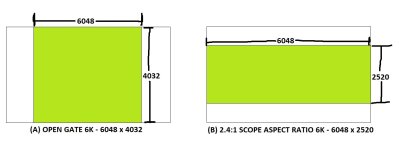
I have another question for you or anyone that can assist. Let us hypothetically assume footage was shot with this BMCC 6K and played back on a 6K projector or 6K monitor. Green represents the footage. As you can see below, in (A) - because the image is taller at 4032 pixels, it cannot fill more screen space horizontally and theoretically, that horizontal image space in (A) is 6048 pixels. However in (B), since the footage was shot and finished in scope aspect ratio, more horizontal screen space is filled and theoretically horizontally it is also 6048 pixels.

The question:

If both A and B represent a horizontal image space of 6048 pixels, would the image produced in A be a bit sharper or higher quality than the image in B? Being 6K I also assume the image in B will also be high quality and sharper but not as sharp as in A?

Your thoughts? 25.jpg
 
Probably just me, but I don't know why you're saying more horizontal screen space is filled by (B).

Isn't (B) still just a crop of (A)?

If you project or screen both at 6K (6048x4032), then shouldn't (B) just look like (A), but minus 756 pixels cut from the top and bottom of frame (2520 + 756 + 756 = 4032)?

If you shrank (A) down to the vertical size of (B), while maintaining the same AR and ending up with black bars on the side, they'd look a little different, but that's not what you were talking about doing.

BTW, on the BM website, there are some 6K sample clips available you can download and experiment with, if you want to see for yourself some of the image quality differences with downsampling and cropping etc.
 
Thank you Les; I see what you mean. Because, if you remove the top and below of A, you can fill the sides of B.
 

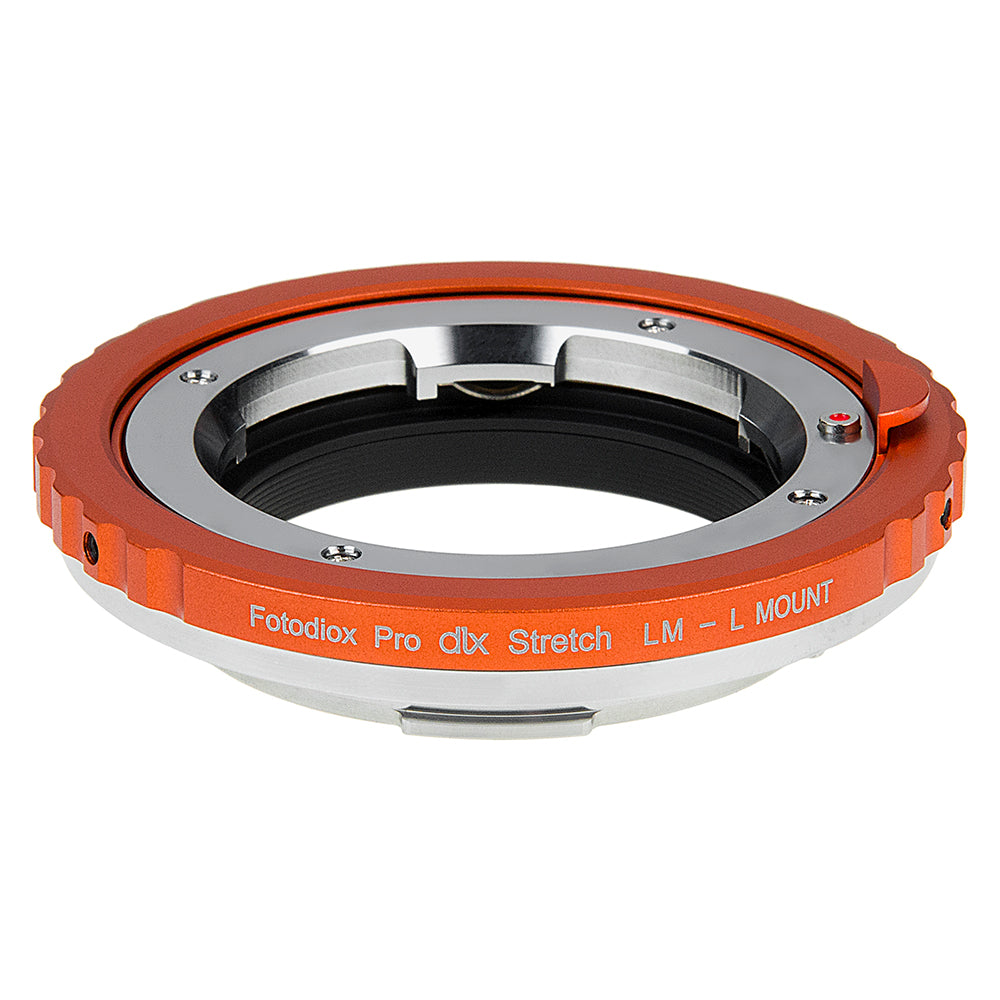
A Leica Macro Adapter for the Blackmagic Cinema Camera 6K

By

Fotodiox Inc

Fotodiox Website


In the article below regarding this camera, there is the quote which I also include below. What does it mean by the focus will be razor thin at low f stops? Does it mean there will be less cinematic shallow depth of field? I thought low f stops on a long lens for example with a full frame will produce nice shallow depth of field?

https://nofilmschool.com/bmcc-6k-review

Here's the one issue I have with the full-frame sensor, and it's more of a difficulty than an issue. Your focus will be razor-thin at anything below f/4. Even at f/5.6, getting perfect focus is challenging.
 

Happy Anniversary - Shot on Blackmagic 6k Full Frame Cinema Camera

By

EJ Productions


Blackmagic Cinema Camera 6K Review | The Artist's Cinema Camera


By James Jackson Films


(Rec.709) Blackmagic Cinema Camera 6K Test

By

HDR FILMMAKER


The Best Image from Any Camera I've Ever Used | Blackmagic Cinema Camera 6K 6 Month Review (BMCC6K)


By Of Two Lands


Blackmagic Cinema Camera Full Frame 6k Test Clips


By Daniel Jeremiah


Cinematography


By Suyorukun


Camera - Blackmagic Design Cinema Camera 6K Full Frame

Settings - 6K DCI 12bit Braw

Lens - Viltrox Epic Anamorphic 35mm 1.33x
 

The Dolomites with the Blackmagic Cinema Camera 6k | Open Gate 3:2


By directedbymo


Back
Top