Welcome to our community

Be a part of something great, join today!

  • Hey all, just changed over the backend after 15 years I figured time to give it a bit of an update, its probably gonna be a bit weird for most of you and i am sure there is a few bugs to work out but it should kinda work the same as before... hopefully :)

Black Shading Frequency on RED DRAGON

Karim Hussain

New member
Joined
Feb 14, 2009
Messages
2
Reaction score
0
Points
0
Location
Toronto, Canada
Hi all,

I will be shooting a feature on the RED DRAGON in the New Year, very excited about the camera and its possibilities. I was wondering if anyone had any information / experience with regards to the amount of Black Shading frequency to retain clean blacks on the new Dragon Sensor, compared to the MX Sensor when it was needed to Black Shade when speeds were changed or major temperature changes took place, not only after software upgrades.

Any help or stories would be appreciated!

Thanks!

Karim Hussain, CSC
 
The majority of people doing black shadings probably do more harm than good. What is important is the camera is black shaded when the camera is at full working temperature, then until something significant happens should be left alone. I always BS at 43 degrees & 1/100 second as this gives the biggest useful range. The lights will be green 99% of the time, if the lights are Yellow a significant amount of time or red then the camera needs BS.

Every time my camera gets rented out, the BS is done badly i,e at 37 degrees after just turning on the camera, so every shot they do after 30 minutes is sub optimal. I shot a feature & did 1 BS in 32 days of shooting.

Hi all,

I will be shooting a feature on the RED DRAGON in the New Year, very excited about the camera and its possibilities. I was wondering if anyone had any information / experience with regards to the amount of Black Shading frequency to retain clean blacks on the new Dragon Sensor, compared to the MX Sensor when it was needed to Black Shade when speeds were changed or major temperature changes took place, not only after software upgrades.

Any help or stories would be appreciated!

Thanks!

Karim Hussain, CSC
 
I always BS at 43 degrees & 1/100 second as this gives the biggest useful range. The lights will be green 99% of the time, if the lights are Yellow a significant amount of time or red then the camera needs BS.

Every time my camera gets rented out, the BS is done badly i,e at 37 degrees after just turning on the camera, so every shot they do after 30 minutes is sub optimal. I shot a feature & did 1 BS in 32 days of shooting.

What? What are you talking about with the green/yellow/red lights? Do you actually see a difference in the raw at the different temps? In my testing, the only time I saw a difference was when I did long exposures without a new BS.
 
What? What are you talking about with the green/yellow/red lights? Do you actually see a difference in the raw at the different temps? In my testing, the only time I saw a difference was when I did long exposures without a new BS.

More noise, very very very obvious by the time the sensors go red, you will see it on the monitor if you look :D
If you cap the camera & increase the ISO you will see the black is not evenly coloured either ( if Red)
 
screen cap

screen cap

2013-12-28_1813.jpg

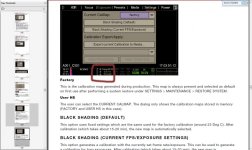
page 149 on the epic guide document.
 
The "T" changes color to signify temperature deviation from calibration and the "E" changes color to signify deviations in exposure time.

Ahhhh. I thought Stephen was talking about the stop lights (clipping). I am surprised that in having an Epic I haven't noticed it in the manual before I seen it mentioned somewhere. On the Exposure, does it make that much of a difference when you are at 5k 24fps and flip to 60fps with a 1/100 shutter? I've never noticed any noise issues going faster, just when you go to a slower exposure (especially time-lapse.)
 
Hi all,

I will be shooting a feature on the RED DRAGON in the New Year, very excited about the camera and its possibilities. I was wondering if anyone had any information / experience with regards to the amount of Black Shading frequency to retain clean blacks on the new Dragon Sensor, compared to the MX Sensor when it was needed to Black Shade when speeds were changed or major temperature changes took place, not only after software upgrades.

Any help or stories would be appreciated!

Thanks!

Karim Hussain, CSC

Hey Karim -

It's all about doing the black shade at the temp. the camera is consistently running. if you don't make a significant framerate/exposure time change - and you are maintaining running temp of the camera - there is ZERO reason to black shade again.

Now, this is much easier with the new fan settings and the new fan upgrade - as you can set a target temp and the fan does it's magic to get to, and stay at, that target temp. I'm not sure what RED recommends and I would need to verify what variance changes the warning color indicators on the T/E - but I like to see less than +/- 4 degrees - which is totally possible with the new fan settings.

Further, you can now store multiple black shades on the camera - and the first characters in the filename of the saved black shade profile is the temp at which the black shade was created - so if you wanna be a bad ass ninja - you create and save several black shades before the production based on different temps. (I suggest 4/5 degrees below and above your target temp, etc.) - as you can recall and load them instantly.
 
Thanks for the useful advice! Think loading various black shadings at various temps and speeds during prep will save tons of on-set time, great idea... As with any new sensor, it'll be a case of massaging it until I find what works best for me, but definitely excited about the Dragon and how it can step up all our games.
 
Back
Top