Welcome to our community

Be a part of something great, join today!

  • Hey all, just changed over the backend after 15 years I figured time to give it a bit of an update, its probably gonna be a bit weird for most of you and i am sure there is a few bugs to work out but it should kinda work the same as before... hopefully :)

Base v. Pro I/O Module

If you want full size XLR connectors the Pro I/O Module is the one for you.The Pro IO Module has full sized XLRs inputs, while the base one only has mini-XLR connectors. So if you went for the base module you'd need adaptors.
 
So, does this mean that on the Basic, there's no Headphone output at all?

I really hope that "no audio output" is referring to a balanced, XLR-type output, and not headphone... if there's audio input, audio monitoring is a NECESSITY... just as we would never shoot without being able to see the image on at least a viewfinder, for people who are using the camera for their audio systems (run-and-gun doc makers, for instance), NEED to be able to hear what they are recording.

Thanks for listening!
 
Pro I/O vs base I/o : weigth and size ?

Pro I/O vs base I/o : weigth and size ?

Any idea on the pro module's weight ?

I second that question, and I'd also like to know the size.

Everybody is head over heels about how small the Epic brain is, ans so am I, but once you start to add modules : the module adapter, an I/O module, and recording medium module (CF, SSD, or whatever) a battery module, an H.264 module, man that camera is gonna be big...

So I don't need those all the time, and that's the wonder of modularity, but when you do need averything, modularity makes things bigger.

So back to the above questions, those are important to me to know which one I need.

Cheers,
Damien
 
Pro I/O vs base I/o : weight and size ?

Pro I/O vs base I/o : weight and size ?

Any idea on the pro module's weight ?

I second that question, and I'd also like to know the size.

Everybody is head over heels about how small the Epic brain is, and so am I, but once you start to add modules : the module adapter, an I/O module, a recording medium module (CF, SSD, or whatever), a battery module, an H.264 module, man that camera is gonna be big...

So I don't need those all the time, and that's the wonder of modularity, but when you do need averything, modularity makes things bigger.

So back to the above questions, those are important to me to know which one I need.

Cheers,
Damien
 
System

System

Size is one of the reasons to adopt the mini-XLR, having a Base I/O with mini-XLR and a Pro I/O with full size XLR gives options.

Even with "all modules" though, neither EPIC or Scarlet are as long as a RED ONE body. And the RED ONE is pretty small.
 
Size is one of the reasons to adopt the mini-XLR, having a Base I/O with mini-XLR and a Pro I/O with full size XLR gives options.

Even with "all modules" though, neither EPIC or Scarlet are as long as a RED ONE body. And the RED ONE is pretty small.

What is the issue with the mini-XLR some people seem to have ?
Is it that they tend to fall out...whereas the full XLR is rock solid..
 
What is the issue with the mini-XLR some people seem to have ?
Is it that they tend to fall out...whereas the full XLR is rock solid..

3 negatives about the mini-XLRs. They generally will require an XLR-adapter cable to run to a sound mixer. They don't have the same locked-in solidity that XLRs have so they can pull out. And they are fragile.

The plus is they are very small. They are used a lot on sound mixers/recorders like Sound Devices. But that end of the line doesn't take anywhere near as much abuse as the camera end which is getting yanked in and out dozens of times a day.

I'm not entirely clear on the huge benefits of sending AES/EBU to the Epic. I guess it bypasses sub-optimal in-camera A-D converters, in favor of the better ones in the mixer? Plus they have in-bedded TC? If that's the case, and four channels cover everything, then the camera recording will be equally hi-quality as the mixers if its recording 48/24bit. OK, guess I answered my own question here. But if I missed something I'd love to hear it.
 
Size is one of the reasons to adopt the mini-XLR, having a Base I/O with mini-XLR and a Pro I/O with full size XLR gives options.

Even with "all modules" though, neither EPIC or Scarlet are as long as a RED ONE body. And the RED ONE is pretty small.

Are you sure of this ? I saw the mock-up Epic at IBC, with, if I'm not mistaken, the module adapter, a pro I/O, a CF module and a battery module, and it sure seemed longer than a Red One, and this was without an H264 module, and I'm sure the CF module is smaller than the SSD module.

This : http://www.reduser.net/forum/showpost.php?p=488548&postcount=12
cannot be shorter than a Red One body.

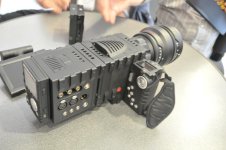
The picture below (by S. Williams) is from IBC, without the battery module, it is already as long as, or longer than, a Red One body.

Cheers,
Damien
 

Attachments

  • DSC_0364.jpg
    DSC_0364.jpg
    88.5 KB · Views: 0
You can definitely make the EPIC longer than a Red One if you really wanted to... or much smaller if you wanted to. Stuart is just talking about the base stack.
 
I think the layout of connectors on the Pro module is a little "awkward"... I know you guys are probably waaay ahead in the development of this module, but I have an idea that might be worth looking into. Would it be possible to make some kind of recessed and 45-degree angled connectors (facing down or backwards) so that there wouldn't be any cables sticking out of the camera to each side?

Maybe the Pro I/O module could actually be split into two different modules - an audio and a video module - and maybe even split those into different modules? I know, I know - just askin' ;-)
 
I think the longer length looks really promising, particularly for shoulder mounted work. There might be enough weight off the back to give a nice centre of balance.
 
Back
Top