

- Banned
- #1
Guy Bryan Holt
Banned
- Joined
- Sep 20, 2009
- Messages
- 149
- Reaction score
- 0
- Points
- 0
I really like these CINESOFTS … Using true tungsten and Daylight Diodes …..
You have to be wary of all the claims made by head manufacturers. Whenever a new lighting technology comes on the market, the manufacturers put a little spin on the scientific data which has a tendency to cloud issues such as color output. For instance, if you compare the spectral power distribution graphs of LEDs below to that of a Tungsten source you can see that there is no such thing as a true “Tungsten” LED diode (the same is true of Daylight LED Diodes – see my newsletter article for details.)

A spectral power distribution of a lamp indicates how much energy is present in each part of the spectrum. As you can see above, Tungsten lamps have a continuous spectrum. Given how they produce white light, even high CRI Phosphor White LEDS have a discontinuous spectral quality that is unlike that of Tungsten lights. In the case of the 3200K Phosphor White LEDs above, the phosphors added shape the spectral distribution by enhancing certain colors in the spectrum to simulate the spectral distribution of incandescent light. As a result, the spectral distribution of Phosphor White LEDs resembles a series of peaks and valleys. There is a big spike at about 465nm (the blue LED) and a broader bump between 500 and 700nm produced by the phosphors. Even though the spectral power distribution has these peaks and valleys, the human eye perceives the light as white light.
While the discontinuous spectral distribution of high CRI Phosphor White LEDS may appear white to the eye, and the color of objects illuminated by it appear natural to the eye, to film emulsions and digital imaging systems designed to reproduce accurate color under continuous spectrum light sources (like daylight or incandescent lamps), the color of the same objects will appear unnatural on screen (as the illustrations below make clear.) That is, the hue of an object being illuminated by this "white light" can be drastically different than expected when it appears on the screen. For example, below is a "Macbeth chart" contrasting the resulting effect upon different color swatches of studio tungsten light and a representative high CRI Phosphor White LED lighting instrument.

Split Macbeth chart: each color patch shows the visible effects of studio tungsten light in the top half of the patch, and a representative Phosphor White LED lighting instrument in the bottom half.
A common test chart used for assessing color performance of motion picture imaging systems, the chart above would be more accurately called a "split Macbeth chart" because each color patch shows the visible effects of the two light sources; studio tungsten in the top half of the patch, and the Phosphor White LED instrument in the bottom half. Although your computer display is not likely to be a calibrated reference monitor, the wide variations in color patch hue caused by the discontinuous spectral distribution of the Phosphor White LED should be readily apparent.
What accounts for these results? First, as you can see from its' spectral power distribution above, Phosphor White LEDS, compared to continuous light sources, have no output at wavelengths shorter than about 425nm, which means that violet colors don't render well. Second, there is minimal output in the medium blue-cyan-turquoise range from about 465-510nm, which is why the aqua-type colors don't render well either. Lacking these complementary colors within the spectrum, skin tones and warm, amber-yellow colors don't stand out. Third, with the long-wavelengths cutoff in the high-600 nm range, pinks, reds, oranges, and other long wave-length colors tend to look a little dull under Phosphor White LEDs, compared with how they look under continuous spectrum light sources (daylight, HMI, Tungsten) which extend all the way out on the long-wavelength end. Finally, as you can see from the gray scale at the bottom, this particular Phosphor White LED Luminary has an overall magenta bias. While you can white balance out/time out this magenta bias in digital video cameras/digital film intermediate, the camera/timer is not able to replace the parts of the spectrum that are missing all together. And since gels only rebalance the spectral distribution of a light source by passing the wavelength of the color that they are, gels cannot correct for these deficiencies because there is not much light of those wavelengths to pass in Phosphor White LEDs to begin with.

Left: Tungsten source, Right: White Phosphor LED source.
This inability of Phosphor White LEDs to render color accurately is very visible in tests recently performed by The Academy of Motion Picture Arts and Sciences (AMPAS) as part of their “Solid State Lighting Project Technical Assessment.” (see http://www.screenlightandgrip.com/html/emailnewsletter_generators.html#anchorHigh Output AC LEDs for details.) In one (above) a model was photographed wearing a dress that had a number of different blue tints. Footage was shot with both a true tungsten source and a White Phosphor LED source. The tungsten-lit footage displayed all of the subtle differences in blue tones in the fabric, while the LED-lit footage, lacking cyan output, showed just a nice blue dress, without the same richness of hue. You can also see above that, absent cyan, the skin tones don’t stand out because that complementary color (cyan) within the spectrum is not present. Since the light doesn’t put out much cyan, the camera/film simply can’t record it. And, as Cinematographer Daryn Okada, ASC, discovered the hard way, color gel packs, camera white balance, or digital intermediate timing can’t bring it out if it isn’t there to begin with.
Like many of us, Daryn Okada uses LEDs as “touch up” lights to add a little something where key lights don’t cover. Needing to touch up a face on one talent mark, he once hid a small LED unit behind a chair, to add some glow to an actress’s face when she reached a mark where the keys had fallen off. “The manufacturer claimed the unit to be a ‘tungsten LED source’” he recounts. “She stopped right in the doorway, where I had this LED, and looked fine. But when I got the dailies back, her face was totally magenta.”; What’s worse, Okada says the image could not be repaired in post, because there wasn’t enough of the right color of light in the scanned negative for a color timer to bring out. This is a good example of the fact that, the bottom line is that, simply by nature of their discontinuous spectral distribution, even high CRI Phosphor White LEDs will never accurately reproduce colors on screen regardless what can be done in post. To make matters worse, common color meters, like the Minolta III F, are completely useless with LEDs in determining what gels to use. The meter makes its calculation of the color temperature based on an assumption that the light source has a continuous spectrum. Color readings of an LED have been shown to be misleading for both correlated color temperature and green/magenta shift. And, manufacturer’s CRI ratings are not necessarily the best indicator to judge the color rendering capability of LED fixtures because it is a measurement that can be messaged by manufacturers to give high readings without giving good results.
I really like these CINESOFTS ….. you can change the color temperature to like 2600 to 6500k using the on board dimmer.
The idea that you can achieve a nominally correct CCT for any color temperature from tungsten to daylight using only two sets of LEDs is also a bunch of marketing hype. While it intuitively makes sense that you can achieve an intermediate color balance by balancing the output of “Tungsten” and “Daylight” LED diodes, this approach does entail a compromise non-the-less.

If on the chromaticity diagram above, you were to plot the color point of two illuminants, all the colors that are possible by mixing the two colors of light will be located on the straight red line drawn between the two points. However, the line (black line above) that would be charted by heating a black body radiator (as it turns red, orange, yellow, white, and finally blue as it is heated) is not a straight line, so it is not possible to create light that remains neutral in terms of their green/magenta shift, while mixing only the two colors.
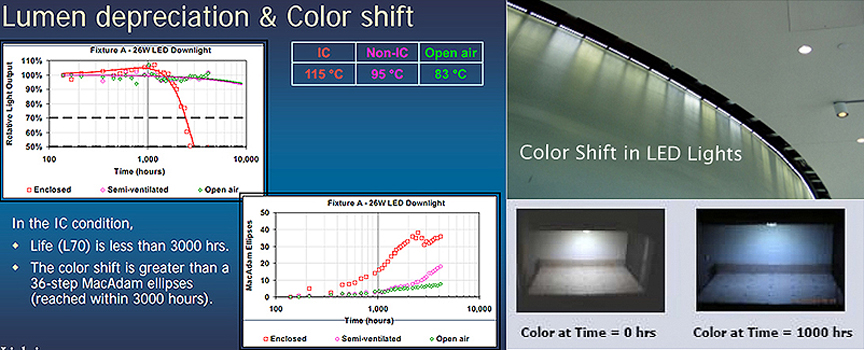
Another drawback to White Phosphor LEDs that broadcast studios lit exclusively with them are finding out is that, as illustrated below, their output depreciates overtime and their color shifts much faster than the manufacturers say.
As I said at the outset, you have to be wary of all the claims made by head manufacturers. Whenever a new lighting technology comes on the market, the manufacturers put a little spin on the scientific data which has a tendency to cloud issues. For this reason, to pick the right LED luminary for a particular job it helps to have a thorough understanding of the technology. For our company newsletter I have put together an overview of the technology and what LED products are available for motion picture lighting (available at http://www.screenlightandgrip.com/html/emailnewsletter_generators.html#anchorHigh Output AC LEDs.)
Guy Holt, Gaffer, ScreenLight & Grip, Lighting Rental and Sales in Boston.
