Welcome to our community

Be a part of something great, join today!

  • Hey all, just changed over the backend after 15 years I figured time to give it a bit of an update, its probably gonna be a bit weird for most of you and i am sure there is a few bugs to work out but it should kinda work the same as before... hopefully :)

Are Cinematographers allowed to be creative?

Peter Hodgins

Well-known member
Joined
Jan 1, 2009
Messages
271
Reaction score
0
Points
0
Let's have an honest appraisal of this DOF preference?
In the history of filmmaking, how did DOF preference come about?
Did the early equipment and lighting capabilities not determine DOF?
Was a specific DOF chosen or forced on Cinematographers because of equipment capabilities?
Now with newer better equipment capable of many different DOF's can a daring creative Cinematographer emerge to show us new "looks" afforded by our new equipment?
I don't mean stuff like ridiculous unnecessary camera motion to flaunt the fact you cannot afford a steadycam.
I mean camera work to fully utilise the capabilities of the new equipment.
Anyways, this is the way I am going to shoot.
 
What DOF preference?
Maybe I smoked too much pot growing up because I have no idea what you are talking about.
 
Peter I have been in the industry for over 30 years.
I know what depth of field is.
I just don't know what your point is.
 
Your subject line seems to have only tangential relationship with the specific questions, but it's a nice rainy day, so I'll jump in...

First, are cinematographers allowed to be creative? Of course. Those whose creativity pleases viewers, and more importantly, whomever is hiring them, can continue to do so.

If you are referring to limited depth of field, the practice certainly did not start with motion picture films; artists, painters, have always used shallow depth of field in addition to light and shadow to draw our attention where desired.

What role does new, more capable equipment play? Of course it can offer new possibilities, for example, higher ASA can offer greater depth of field, but just because one may do a thing, it's not necessarily the right thing to do.

You may certainly shoot however you wish and enjoy the accolades or suffer the unpleasant consequences that may result from your work.

Good shooting and best regards,

Leo
 
Did the early equipment and lighting capabilities not determine DOF?

Yes of course. 16mm had more DOF than 35mm. 70mm has less than 35. More foot candles from better lighting sources allows for more DOF if desired. Faster film stocks, same thing. Faster lenses stopped way open allows for less DOF, if desired.

Was a specific DOF chosen or forced on Cinematographers because of equipment capabilities?

No. There are always different ways to approach desired DOF.

Now with newer better equipment capable of many different DOF's can a daring creative Cinematographer emerge to show us new "looks" afforded by our new equipment?

I don't think (aside from faster lens T stops) that there are any newer, better technologies that have revolutionized how Directors and Cinematographers can use DOF in the last 25 years. This isn't a new phenomenon. Aside from isolating what is in focus and what isn't, DOF on its own merits really isn't offering new "looks".

If your comparing say video cameras to the RED, the RED allows for more of a cinematic DOF look because the sensor size is much larger. By more cinematic I mean shallower DOF, if desired.

I don't mean stuff like ridiculous unnecessary camera motion to flaunt the fact you cannot afford a steadycam.

This has nothing to do with DOF.

I mean camera work to fully utilise the capabilities of the new equipment.
Anyways, this is the way I am going to shoot.

Good, but I suggest you brush up on DOF theory first. Consult the American Cinematographers Manual and pay close attention to the DOF charts. Go rent "The Searchers" for a text book example of deep space depth of field. Then go rent "Breathless" for textbook shallow DOF.

DOF is important to telling the story, not just getting a "look". It's about selectively using focus to do many things.
 
I think people get much to rapped up with DOF & Film look, many films have been shot with a deep DOF & look nothing like video.
 
Early 35mm b&w film stocks were so slow that people shot fairly wide-open except in sunlight, so deep focus interior photography was not possible, nor did many filmmakers take advantage of it, though there are exceptions.

Then by the late 1920's, through the mid 1930's, stocks had improved in speed but the popular look of the day was very soft, diffused, and shallow-focus. This changed by the late 1930's, particularly led by Gregg Toland's experiments in deep focus, which some directors took advantage of in staging.

Also, in 1938, there was a doubling of film stock speeds, plus new high-intensity arc lighting developed for 3-strip Technicolor photography, that allowed cinematographers to stop down the lens more. So deep focus b&w photography became the style of the day, sort of as a reaction against the softness of the 1930's.

But as color became more and more dominant, there was a move back to shallower focus since color stocks were fairly slow compared to b&w. Plus the large negative formats of the 1950's made deep focus harder to achieve.

Then in the 1968, we had a 100 ASA color negative stock, but lighting trends were heading towards more naturalism and lower light levels, keeping the shooting at wider apertures.

Anyway, one issue to consider is that color is a layer of picture information that b&w doesn't have, so deep focus in color tends to risk more visual distraction due to unwanted background colored objects coming into focus. This is one reason why shallow focus looks "prettier" in color photography.
 
After reading the subject of the thread, I was hoping it dealt more with the issue it promised instead of how and why DOF considerations got implemented. It is, however, interesting to note what David refers to, the fact that prevailing styles and equipment limitations have very important roles and that each of them are directly related to each other.

However, I wonder really, how often and under what circumstances does a DP get to shoot a movie based solely on his ideas or instead just follow "orders" from the director, rendering him into nothing more than a camera operator? Obviously, in the real, practical world, a combination of both to varying degrees is what happens most of the times, but it would be interesting the percentage of directors that want absolute say over the look of their films and vice versa. I know directors like Ridley Scott for example, who has a very strong visual style and knows how to operate a camera as good as any DP, basically dictates the look of his movies from the very beginning, so the flexibility for his DP's is rather limited, and then there are directors who focus mostly on acting, like Sam Mendes who comes from the theater, where I can feel the style of his DP "showing through" more. People like David and others out thee who deal with this as part of your professional lives, what do you think?
 
Well, I have some good examples from my experiences. In my undergrad, the film program had a small film festival just for the students. Everybody used the school's cameras or, at most, an XL2 or, the best at the time, Sony FX1. Hardly anyone tried for shallow depth of field or a "film look", with the exception being a lazy splash of Magic Bullet Looks here and there. Now, come senior year, everybody suddenly starts rocking 35mm adapter rigs and doing heavy color grading beyond a lazy splash of Magic Bullet Looks, although that was probably mixed in as well. Were the films better than they were the years before? No, not at all, if anything they were less creative, in my opinion. Did they look better? Certainly many of them did benefit but others could have easily dropped the 35mm depth of field without affecting the film's performance at all.

Now that I'm at Chapman, nearly everyone wants the 35mm look but I haven't heard of anybody using a 35mm adapter setup anywhere. Right now, it's me and one other person filming with D90's, the other person being inspired from my project last semester, so we're the only ones rocking the 35mm depth of field and actually getting that "film look". Even so, I've just gotten through being crew for my group's assigned homework films and none of them asked to use my D90, instead they opted for the school's HVX200 cameras. Apparently the whole "film look" thing doesn't matter as much to them. But hey, that's their choice, I certainly can't wait to see what their films look like compared to mine as I noticed that they had a different thought process when using the HVX200 versus when I used my Nikon D90. I was all about static shots and more conservative traditional angles but when the guys used the HVX200, they were all about handheld shots and multiple angles. Maybe it's lazy camerawork or maybe it's just different styles, I don't know, but it will be interesting to see how it all cuts together.
 
By the way...
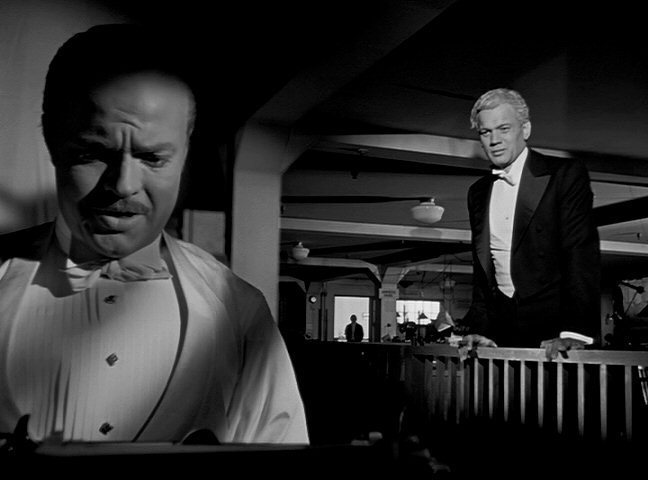
Citizen Cane was shot with special made split field lenses that could have focus at two distances simultaneously.
That is what I learned at film school. Nothing to do with big DOF.
 
Then whoever told you that was incorrect. There were no special split-focus lenses used on "Citizen Kane". In fact, the camera package that Toland brought from Goldwyn is listed in Carringer's book "The Making of Citizen Kane."

Many of the deep focus shots were made on a 25mm lens stopped down as much as f/16. This became possible due to advancements in lens coating, faster Kodak b&w film (Super-XX), and new arc lighting from Technicolor.

Besides that, there were extreme deep focus shots created in post and in-camera with optical printer composites and double-exposures (the spoon in the f.g. as Kane bursts into Susan's bedroom after her suicide attempt is a good example). Perhaps that is what your professor actually told you.

Here is an example which may have involved an in-camera double-exposure:

citizenkane1.jpg


Barry Salt's book "Film Style & Technology: History and Analysis" does mention Hal Mohr experimenting with a slant-focus lens, the precursor to the Arri slant-focus and other similar devices, but not on "Citizen Kane".

There is no lens that focuses on two different distances simultaneously. You'd need to use a split-diopter filter for that. There has never been any evidence though that such filters were used at the time of "Citizen Kane" -- the first examples I've ever seen were in some 1950's movies by Nicholas Ray.

Toland explained all of his tricks in an American Cinematographer article he wrote called "Realism in Citizen Kane". Most of the details are in Carringer's book. There was simpler article, less technical, that Toland also wrote for a photography magazine:
http://3cp.gammadensity.com/index-3-Learn-Toland.html
 
David, you beat me to it!
Slow day in LA?
:)
Cheers,
Harry
 
As I mentioned, deep focus adds more information in the frame for the viewer to process. Color is also another layer of information, so deep focus + color gives the viewer an awful lot to look at.

This is why control is critical to avoid a garish, tacky free-for-all assault of detail and color, and control can be hard for the low-budget filmmaker who can't dress and detail everything in the shot.

Plus you need a director who understands how to use deep focus for narrative power, rather than visual distraction. And not many directors can stage shots with that in mind. So you end up with ordinary shots but with deep focus, causing unimportant things in the frame to become as prominent as important things.

Deep focus can be a powerful visual tool if you know how to use it.

A good example to think about is Bogdanovich's "The Last Picture Show" and its sequel "Texasville" -- both were shot with wide-angle lenses in deep focus, but many critics complained that the second one, shot in color, looked tacky compared to the first one, shot in b&w. Part of that was intentional, but on the other hand, it's hard to be tacky in b&w -- Nestor Almendros once said that it was like wearing a black evening dress or tuxedo, b&w is instantly classy.
 
DOF is definitely been around for many, many years, and dates back as far as the first drawings were done with color, (well B&W as well but never as clear as the color ones).

This was done obviously to take the viewer attention to what matter most to the Artist, so the use of DOF was utilize to have less to concentrate on and take the attention immediately to what was in focus, as we Human tend to be captured by what is in focus first.

Today, both photography and cinematography make great creative use of DOF, with a variety of tools, been Super Speed lenses, Tilt Shift lenses, Bellows, and as well as special effect lenses such as LensBabie.

I personally couldn't see my self creating any type of creative Photography or Cinematography footage if DOF was not here.

My favorite way of shooting my subjects been doing so close to the subjects while the subject is further away from the background, with long lenses wide open to further exaggerate the DOF effect.

ciao
 
Speaking of split focus. I just watched Heroes Season 1 and they employed some really interesting focus techniques.

Lots of split focus which I haven't seen much of elsewhere.

But they also shot one shot through a glass pane door which had little round bumps on it. The effect was essentially a wall of microlenses so everything on the opposite side looked halftoned and had infinite DOF. Looked like a 1960s comic thanks to the lensing. Very interesting work.
 
Are cinematographers allowed to be creative? Any director who does not rely on the DOP to bring a collaboration, an approach, style or creative input is a fool IMHO and better be able to shoot it themselves.

On DOF: If you walk into any room or space, and use your eyes like a camera--cut to various aspects of that room, people, interactions, objects.. Focus clearly on the subject, the content of what you have isolated, wide, medium, tight. Do your eyes see everything in complete sharp focus from foreground to background? When you look at the horizon do you also "focus" on what is right in front of you? I think it's a natural way of seeing and observing.
 
Back
Top