Welcome to our community

Be a part of something great, join today!

  • Hey all, just changed over the backend after 15 years I figured time to give it a bit of an update, its probably gonna be a bit weird for most of you and i am sure there is a few bugs to work out but it should kinda work the same as before... hopefully :)

Any successfully "remote" a Kino-flo Diva fixture?

Stephen Pruitt

Well-known member
Joined
Sep 14, 2007
Messages
3,309
Reaction score
40
Points
48
Website
www.thetreemotionpicture.com
Hi all. . .

I have a couple of Divas and use them all the time. They are out go-to lights for a lot of circumstances. The trouble? You can't remove the 55-watt biax bulbs.

Now, Gyoury makes a remote ballast for their light wands, and that's exactly what I want to do with my Divas. I want to be able to draw the power from the Divas but run it to a 55-watt biax bulb. (We want to be able to put two 55-watt biax bulbs on the sun visors of a Jag to reduce the dynamic range of the scene for a car shot.)

Here was my idea: Has anyone ever taken a biax bulb, sawed off the glass, then attached some wires that base and run those wires out to a second, complete biax 10 feet away? It seems to be that there shouldn't be any issue with this at all, but I'm curious if there might even be a commercially available "biax base" that does exactly that. Result: Full dimming control "light wands" for the cost of four dead biax bulbs and a couple of hours of wiring.

Any thoughts?

Thanks.

Stephen
 
Think toxic mercury gas inside the tubes. Not a good idea and thats really the complicated solution to the problem.

Making a remote ballast would not be all that hard. Buy one or more 2G11 sockets. Then buy either a 1x55w 55w ballast or a 2x55w ballast which can be wired as only a 1x55 (some can and some can't). Then run the number of wires between ballast and socket as specified (can be anything from 4 wires to 2 wires. Fulham makes such ballasts as does Advance and Universal.
 
Hi there, Richard. . .

First of all, I used to PLAY with a lot of mercury when I was a kid. And then eat a peanut butter and jelly sandwich after doing so. . . without washing my hands. (Come to think of it, that might explain a lot.)

:-)

Can you point me to the ballasts you are talking about? I need high frequency ballasts, as I don't want to run into flicker issues. I can't imagine it could be that easy, though, as Kino and Gyoury ballasts cost a fortune. I mean, if there was ever an economic opportunity to exploit, this would be it.

Thanks.

Stephen
 
Hi Stephen,

It really is simpler than most people think. There are lots of suitable electronic ballasts out there capable of driving a fixture for non-dimmable. When you get to dimmable then the range shortens a bit of whats available and the price goes up because of the extra complexity. All the good electronic ballasts drive the tubes at 25,000 to 40,000 hz which is more than enough to keep flicker out of the equation. You can find some really cheap ones that don't drive fast enough and flicker would be an issue. Our own fluorescents use some good ones and that's a big part of the cost difference between our non-dim and dimming range. We have a dimmable ballast separately available for 2x55w but its higher cost than our non-dimmable at more like $80 each. I believe it has to be wired with two tubes though so its a bit of a problem for this use.

Other sources of non-dimmable. Just do a google search for these part numbers. I believe most of these can be wired for 1x55w use.

Fulham Workhorse 3 120v version is a good ballast and very small.

Advance Centium ICN-2S54 Intellivolt model which works from 110 to 277v so it can work anywhere in the world.

Universal B254PUNV-D also universal input voltage.

Sylvania Quicktronic QTP2X54T5HO/UNV (universal input voltage)


Dimmable:

In dimming we have two categories: the 0 to 10v which require a control voltage from a special dimmer to operate them or the Inductance type which you can actually use an inductance dimmer or motor speed controller on the 110v or 220v going into the ballast like you can with a tungsten light--as you do so, you get dimming on the fluorescent lights being driven by the ballast. Very cool stuff but rare to find and very expensive. The 0 to 10v are still very expensive but less rare and available from more sources.

Dimming (0 to 10v models)
Advance Mark 7 RZT-2S54 120v (or 277v for other countries than USA)
Sylvania Quicktronic QT2x54/120 PHO-DIM (or QT2x54/277 PHO-DIM outside of USA)

Dimming (inductance type)
Advance Mark 10 REZ-2S54 120v (inductance dimming version)

Hope this helps.
 
Thanks much, Richard. . .

Stephen
 
Okay, I decided that Richard's approach was too hard. So, I'm doing exactly what I proposed.

The first thing I did was break open a couple of 55-watt biax fixtures at the top (Osram, as it happens, as I do not like their color!). I then was able to wiggle the glass off (there is some sort of a urethane foam holding the glass to the mount). If you're lucky, there will be a little wire sticking out of each of the four electrodes on the lamp socket. If not, you'll have to insert the wire into the holes and keep them stable with epoxy or by just pinching the terminal/electrodes down a bit (which is how they were originally assembled.) (There is no way to solder them from the inside, as all you'll see is plastic.)

Next, solder your extension wires to the little wire leads (easy), run that wire out to shielded alligator clips, clip the alligators to the lamp, clip in your doctored biax base, and stand back and be amazed. Dimmable, beautiful, and tiny as can be. Perfect for strapping into tight spots like car sunvisors (which is why I'm going through all this in the first place!)

It three or four hours work and it's done. I'm glad I did it.

Stephen
 
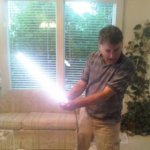
Here's a shot of my new "light sabre". . .

Here's a shot of my new "light sabre". . .

Yeah. Pretty cool, huh? My daughter took this shot with her cell phone (obviously).

:-)

Basically, it's now just a Gyoury light wand, but uses the a Kino or a Mole for the ballast. I have four of these leads of varying lengths.

Works like a charm.

Stephen
 

Attachments

  • Picture 1.jpg
    Picture 1.jpg
    12.4 KB · Views: 0
Back
Top