Welcome to our community

Be a part of something great, join today!

  • Hey all, just changed over the backend after 15 years I figured time to give it a bit of an update, its probably gonna be a bit weird for most of you and i am sure there is a few bugs to work out but it should kinda work the same as before... hopefully :)

Any INDY features shot with a SINGLE Prime Lens?

Thanks David,

yeah had only shot few times on RED and with RED or UP or Superspeeds, I have used my 85mm Still lens on RED with the first Birger, no controls, but not in off to fully appreciate the field of view offered.

So yes next month will do extensive testing of the various scenes with different focal length such as the 50 f/1.2 the 85 f/1.2 and the 135 f/2 and see what I like best.

Thanks for the info and confirming my calculations, I do understand that it is more about not calculating and rather finding the proper lens by using it and testing it before end.

ciao
 
My one lens choice is 50mm.

I can talk only about still glass on RED.

Daylight: Leica-R Summilux 50mm f/1.4

Daylight close-up: Canon FD 50mm Macro f/3.5

Available light/nightshot: Canon FD 50mm L f/1.2 (or better Leica-M 50mm Noctilux f/0.95) + Formatt LIGHT BLUE FILTERS 82.
 
Ketch,

S2 is coming up next year.

Probably early spring.

Also as I wrote that 50mm has may options, perfect daylight and portrait, excellent close up or macro, amazing for an available light, all that in just one focal length.

Plus with Leica 50mm Summilux shooting portraits you get also very good 3D feeling, gorgeous color rendition and bokeh that is almost the same as you would shoot with anamorphic lens.
 
If memory serves me (and it may not) THE LAST PICTURE SHOW was shot with a single prime lens -- 28mm I believe.

As has been pointed out, sometimes deliberate or imposed limitations of choice, can inspire the imagination or help definie a style.
 
Much like Ozu, Robert Bresson, to the best of my knowledge, shot almost all his movies with only a 50mm lens. Both made some incredible movies.
 
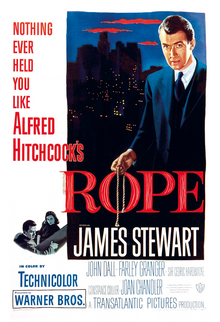
"Rope" wasn't shot that way, so I'm not sure what 2-camera movie Martin is referring to.

And the movie does open with a scene with intercutting.

Basically once everyone arrives in the apartment, Hitchcock wanted to give the appearance of a single take. However, he knew that a film mag only ran 10 minutes and a projector reel only ran 20 minutes. So he decided to hide the film mag changes with an invisible cut, often by dollying behind a piece of furniture or something to make the cut point on... but every 20 minutes when there would be a projector changeover, there is a visible cut in the movie to a new camera angle. I think the cut to the discovered rope in Jimmy Stewart's hard is one of those moments.

As for focal length, I'm sure Hitchcock stuck to one lens for most of the movie, something that could serve for both wider and tighter frames. "Rope" was a 3-strip Technicolor movie and those cameras generally could not use wide-angle lenses due to a limited flange depth from the prism block, so most 3-strip movies used a 35mm lens for wide shots and a 50mm lens for closer shots, with some variations. I'm not sure which Hitchcock used, but being on a soundstage, working with a 50mm lens and being able to pull back enough to get wide shots was less of a problem, so I suspect it was the 50mm.

Reloads took so much time with a 3-strip camera that basically they always had a second camera loaded and ready to go in while they were reloading the first camera.
 
Thanks David, for adding so much more to my more-than fragmented memory from film-school. It was indeed "Rope" I was referring to. Over at wikipedia there is an interesting article about the film, with a list as to when the "cuts" occur.

Rope2.jpg


Talking of film school, we once had the honor of having a visit from Christopher Doyle, who talked about Chunkin Express. My memory wants me to believe that most shots were done on a singe, wide angle lens. David?
 
Oy.
I've often wondered how long it would take to "lace up" a 3-strip camera.
Didn't two colors run in bipack? Top layer with no backing?
Could the loader screw up which type of ortho film went in which race?
And wasn't there some sort of punch for the zero frame on each roll?
AND you had to wear a shirt and tie on a sweltering stage lit for ASA 6.
That's when ACs were ACs, my lads!
Cheers,
Harry
 
existenz

existenz

David Cronenberg's Existenz is shot entirely with a 28mm lens as far as I can remember.

Randy Wedick
Band Pro
 
Back
Top