Welcome to our community

Be a part of something great, join today!

  • Hey all, just changed over the backend after 15 years I figured time to give it a bit of an update, its probably gonna be a bit weird for most of you and i am sure there is a few bugs to work out but it should kinda work the same as before... hopefully :)

Aaton Penelope2, 6k digi-mag

That camera doesn't have to necessarily be useful 15 years from now - it just has to pay for itself over the next three years or so.

I don't see the idea of "digital mags" as being DOA -- if someone has spent a lot of money on 35mm cameras, like an Arri-435, and everything goes digital someday, you will see more after-market conversions like that rather than junk all those cameras. It may not be as commonplace as buying a new digital camera, but it will probably be one aspect of the camera business over the coming decade.

The truth is, the argument that film will soon be gone actually makes me want to go out and shoot more film, not less -- before it's gone!
 
My point about distribution is simply that any shift in the setups of theatres on a global scale, other than 3D will be to 4k projection. That is what is currently anticipated in the market and generally seen as the equivilent resolution of 35mm film. The purpose of a 6k sensor would be to simply discard a portion of that data every time you do a film out, and seemingly will be for the foreseeable future. Offering better latitude over more resolution would be a far greater asset. It also requires you to downsample your footage every time you go through post, rather than just working with a 4k sample from start through to finish. With 4k monitoring and projection on the horizon it makes little sense in my opinion to be working with 6k.

I was not aware of any software truly built for 6k. I always thought resolution independent was a term used liberally, but rarely truly lived upto. Do you know which software supports 6k out of interest?

I see the needs of acquisition and distribution are different.

You want as high quality as you can get on the acquisition side because chances are you're going to be losing a good amount of it in your distribution end.

You're likely going to downconvert or transcode your source media somewhere in your workflow, even if you shoot 4k.

While most independents may find 2k and 4k more than enough, higher budget productions may embrace the idea of 6k acquisition, especially if there is a lot of vfx or image manipulation involved.

Since some summer movies like to have IMAX releases, having a 6k version that's not uprezed from a 2k or even 4k source would be appealing.

Last year I went to a Siggraph talk about IMAX vfx production, and a common workflow workaround was that all the IMAX scans had to be downrezed from 5k to 4k because it was too hard to work in 5k. I suspect by 2009, it would be much easier to work in 5k or 6k.

A full resolution Vistavision scan is 6k. I've also seen matte paintings created in higher than 4k resolution for various reasons.

Photoshop, After Effects, Combustion can handle 6k. I would suspect Shake and the major 3D apps can handle 6k. It's all about having a bunch of fast boxes with lots of RAM.

Editing in 6k may not be possible at the moment, but we didn't have editing in higher than HD resolutions until recently.
 
That camera doesn't have to necessarily be useful 15 years from now - it just has to pay for itself over the next three years or so.

I don't see the idea of "digital mags" as being DOA -- if someone has spent a lot of money on 35mm cameras, like an Arri-435, and everything goes digital someday, you will see more after-market conversions like that rather than junk all those cameras. It may not be as commonplace as buying a new digital camera, but it will probably be one aspect of the camera business over the coming decade.

The truth is, the argument that film will soon be gone actually makes me want to go out and shoot more film, not less -- before it's gone!
I love the look of film because I grew up watching films. I hope it never goes away.

Soon there will be a generation who will become used to content created by digital cameras (which match the quality of film). There is a chance then that film will be relegated....

When I was in film school (training to be a director) I wandered into the editing room. There was a Steinbeck available. I just picked up some rolls of film and started editing.

The feel of film in your hand as you start splicing and joining is just amazing. I never forgot that first time. So I understand when you say you feel like shooting on film just because some people say it will be no more..
 
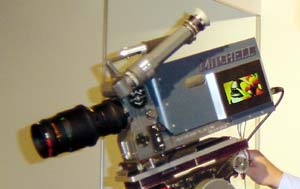
As the new higher resoulution video cameras adopt some of the features of the film cameras, (such as speed ramping combined with aperture following) they will surley replace celluoid as the capture medium of choice. An as view finders increase in resolution the difference in viewing thru a mirrored reflexed camera will lessen. But I think that if only for the spining mirror viewer with it's inherent "depth" look that adapting cine cameras to video capture is a valid idea.
 
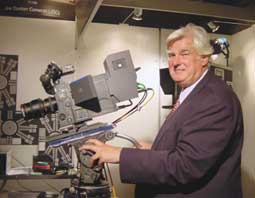
They aren't the first to try this. I seem to recall that Joe Dunton (sp) in the UK attempted this with some already established cine camera.

http://images.google.cz/imgres?imgu...rev=/images?q=Joe+Dunton&gbv=2&svnum=10&hl=cs

JoeDunton-ibc04.jpg
dunton.jpg
 
Back
Top