Welcome to our community

Be a part of something great, join today!

  • Hey all, just changed over the backend after 15 years I figured time to give it a bit of an update, its probably gonna be a bit weird for most of you and i am sure there is a few bugs to work out but it should kinda work the same as before... hopefully :)

A look at anamorphics on the mx and the possibilities

1.33X anamorphics are somewhat of an enigma anyway. They only give a portion of the optical effects inherent to anamorphics as we think of them and other than the optical characteristics, there is no reason to shoot anamorphically on the current selection of digital sensors. Or film stocks, for that matter.

Well it is a matter of personal preference but this might be true.

I will test this next week as I have rented a 1.33 lens.
1.33 might not be wide enough to be really interesting in terms of field of view gain and might not be worth the extra work.

Looking forward to test this next week and illustrate the thread.

I expect that on the mx the happy medium is a 1.5 squeeze.
Enough of a field of view gain and ana characteristics, while having a nice increase in sensor utilization as demonstrated in topic number 5 on the first page.
(6.4 to 8.4 mega pixel of recorded information increase)
 
What do you mean there's no option for it? When you shoot with 1.33X anamorphics, you want a 16:9 aspect frame. After the 1.33 de-squeeze (or stretch, as it should be called), you get a 2.36:1 image. 4K 16:9 on the RED One actually handles 1.33X anamorphics very well.


Exactly. Hence the reason there is no specific option for it. It would be an option by name only or another label on what already exists.


We do. Vertical resolution on EPIC is 2700 pixels high or another 396 lines of resolution. For 1.33X anamorphics, we would shoot 4800x2700 to get a 16:9 frame on EPIC. Although, most of the time, people will just shoot the 5KFF area of 5120x2700 to give a little extra side to side shift in post and guaranteed 2.40:1 framing. After the de-squeeze, we get 6810 x 2700 images to work with if we don't want to throw away any detail. They make for nice super-sampled 4K at the end of the post chain, even though they're a bear to work with along the way.

1.33X anamorphics are somewhat of an enigma anyway. They only give a portion of the optical effects inherent to anamorphics as we think of them and other than the optical characteristics, there is no reason to shoot anamorphically on the current selection of digital sensors. Or film stocks, for that matter.


What i meant is that there is no monitoring option in the camera ( unless i use a 3rd party evf or monitor to unsqueeze 1.33 or 1.5) , also in red cine x .
This is a feature red can easily add in . Please add this option.
 
What i meant is that there is no monitoring option in the camera ( unless i use a 3rd party evf or monitor to unsqueeze 1.33 or 1.5) , also in red cine x .
This is a feature red can easily add in . Please add this option.

oh. :oops: Yeah, I suppose those different monitoring options would be welcome additions. :)
 
This notion that anamorphics are for the extra field of view isn't really accurate -- if you want more field of view, you pick a shorter focal length, and there are shorter focal lengths in spherical than there are in anamorphic if you really want to go crazy. You can put a near fish-eye spherical lens on the camera, crop it to 2.40, and get a wider field of view than the widest-angle anamorphic on the market.

The first CinemaScope movies were limited to using a 50mm anamorphic, with the equivalent horizontal view of a 25mm spherical in 35mm Academy, which was a typical wide-angle lens in the 1950's (the wide-angle shots in "Citizen Kane" were done on a 25mm). Even today, the most common wide-angle 2X anamorphic used is a 40mm, with occasionally a 35mm used, and rarely something even shorter unless you are Michael Bay.

In the Hawk 1.3X anamorphic line-up, the shortest focal length is a 20mm, which would be like shooting with a 16mm in Super-35, or the 35mm in 2X anamorphic -- that's fairly wide-angle, enough to get you that Kubrick-esque look unless you want that 9.8mm Kinoptic look.
 
I have to say this is one of the best threads I read recently. Thank you for starting this. I've learned so much.
 
This notion that anamorphics are for the extra field of view isn't really accurate -- if you want more field of view, you pick a shorter focal length, and there are shorter focal lengths in spherical than there are in anamorphic if you really want to go crazy. You can put a near fish-eye spherical lens on the camera, crop it to 2.40, and get a wider field of view than the widest-angle anamorphic on the market.

The first CinemaScope movies were limited to using a 50mm anamorphic, with the equivalent horizontal view of a 25mm spherical in 35mm Academy, which was a typical wide-angle lens in the 1950's (the wide-angle shots in "Citizen Kane" were done on a 25mm). Even today, the most common wide-angle 2X anamorphic used is a 40mm, with occasionally a 35mm used, and rarely something even shorter unless you are Michael Bay.

In the Hawk 1.3X anamorphic line-up, the shortest focal length is a 20mm, which would be like shooting with a 16mm in Super-35, or the 35mm in 2X anamorphic -- that's fairly wide-angle, enough to get you that Kubrick-esque look unless you want that 9.8mm Kinoptic look.

I think this is not exactly true.
I might be wrong but I have to test this ASAP and I will get back in here with the results

I have to say this is one of the best threads I read recently. Thank you for starting this. I've learned so much.

You are very much welcome.
It is a wip and thanks to many contributors it keeps getting better.
I personally have a few more topics in the works that I will do ASAP

Can we get a group to push for this very doable simple request?

I will add this to the features request with the frame sizes.
Just need to calculate the best possible ones again with the academic standard ratio this time
 
I think this is not exactly true.
I might be wrong but I have to test this ASAP and I will get back in here with the results

I'm not sure why you think that anamorphic lenses have some sort of extra field of view that spherical lenses can't match. It's just an issue of focal length. A 2X anamorphic sees double the horizontal view of a spherical lens, so a 40mm anamorphic is similar to the horizontal view of a 20mm spherical. But you can find 35mm cine lenses are short as 5mm or 6mm, but it's hard to find 2X anamorphic lenses that are 10mm to 12mm, not that people need lenses that short generally.
 
This notion that anamorphics are for the extra field of view isn't really accurate -- if you want more field of view, you pick a shorter focal length, and there are shorter focal lengths in spherical than there are in anamorphic if you really want to go crazy. You can put a near fish-eye spherical lens on the camera, crop it to 2.40, and get a wider field of view than the widest-angle anamorphic on the market.

The first CinemaScope movies were limited to using a 50mm anamorphic, with the equivalent horizontal view of a 25mm spherical in 35mm Academy, which was a typical wide-angle lens in the 1950's (the wide-angle shots in "Citizen Kane" were done on a 25mm). Even today, the most common wide-angle 2X anamorphic used is a 40mm, with occasionally a 35mm used, and rarely something even shorter unless you are Michael Bay.

In the Hawk 1.3X anamorphic line-up, the shortest focal length is a 20mm, which would be like shooting with a 16mm in Super-35, or the 35mm in 2X anamorphic -- that's fairly wide-angle, enough to get you that Kubrick-esque look unless you want that 9.8mm Kinoptic look.

Agreed, as it would seem the opposite to me: an anamorphic lens takes the same aperture setting and focal length and makes it wider, thus you're getting the shallower depth of field of a 50mm yet the width of a 35mm when using my 1.33x squeeze anamorphic lens. Thus you're getting a shallower depth of field for your 50mm anamorphic shot (with 35mm dimensions) than you would normally with just a standard 35mm shot at 16x9 and then cropped the tops off. Isn't this right? This is why I always found it strange that Sergio Leone's Blondie triology were all anamorphic yet he maintained such huge depths of field.
 
* updated thread with new" features request" topic number 6

if you think of anything else or think of a way to improve on those requests let me know
 
Sergio Leone's westerns were shot in 2-perf Techniscope (spherical) not anamorphic.

Wow, I never knew this, thanks for clearing that up. And this whole time his work was my biggest inspiration to shoot anamorphic more, lol. It's weird because I swear I've heard Tarantino specifically say that he likes to shoot anamorphic because of Leone.

Can you explain the differences between the two possibly? I'm reading about Techniscope on Wikipedia but it isn't too clear. Do they still shoot with this, and have you ever? I think Leone's trilogy is some of the most beautiful cinema ever.
 
2-perf Techniscope came at the end of the widescreen revolution of the 1950's. Essentially the frame is half as tall as 4-perf 35mm. Since 4-perf is 1.33 : 1 Full Aperture, 2-perf is 2.66 : 1 Full Aperture, so generally the width used is trimmed to the Academy area to get a 2.35 : 1 image. Since 4-perf 35mm anamorphic also uses an Academy (sound) aperture width with a 2X squeeze, the difference in focal lengths used to get the same 2.35 composition are exactly by half -- 20mm in Techniscope versus 40mm in anamorphic. The shorter focal lengths that can be used to achieve the same FOV made it easier for Leone to achieve his deep focus effects (and I don't want to go into another discussion as to why focal length and depth of field are not related.)

Techniscope was created in Italy with Technicolor Italia in Rome. It had to be blown-up & squeezed to 4-perf 35mm anamorphic for release in scope prints. Traditionally one would do this in an optical printer from a dupe positive (inter positive) made from the o-neg, blowing this up and squeezing this through the optical printer onto a dupe negative, but then there would be an increase in grain from the neg-->I.P.-->dupe neg-->print generations. Back in the 1960's, Technicolor could get better quality out of the 2-perf negative because they were using the dye transfer process for printing. In this case, they could go, in an optical printer, directly from the 2-perf color negative to the three (RGB) 4-perf 35mm anamorphic b&w positive "matrices" which were the basis of dye transfer printing. From the matrices you'd go to print, so the dye transfer process allowed them to skip the dupe negative step and save a generation. Plus dye transfer prints had finer grain (being a non-photographic printing process), richer colors, deeper blacks. Technicolor also offered this service at a reduced rate if you were using their Techniscope process.

Then, unrelated to Techniscope, print orders declined by the 1970's. Dye transfer printing relies on large print orders to be cost effective because most of the costs come from setting up the b&w matrices for printing. By the mid 197's, the average Hollywood release was only a couple hundred of prints at best. So Technicolor started closing their three dye transfer plants (Los Angeles, London, and Rome) and replacing the process with standard Kodak color printing. "Godfather II' was the last dye transfer print made in Los Angeles and "Suspiria" was the last movie printed with the process in Rome.

With the loss of dye transfer printing, the cost of releasing a movie shot in 2-perf Techniscope went up because it had to be blown-up to 4-perf 35mm anamorphic using an optical printer and dupes. One of the last 2-perf Techniscope movies made at the time was "American Graffiti". Unfortunately the end of Techniscope happened just before the introduction of modern sync-sound 35mm movie cameras like the ARRI BL35 and the Panaflex, so most old 2-perf camera equipment are things like Mitchells, ARRI 2c's, Cameflexes. This hindered people interested in reviving the process.

In the early 1980's you saw the introduction of 4-perf 35mm Full Aperture cropped to 2.40 -- aka "Super Techniscope" or "Super-35". The 2.40 area off of the negative was only slightly larger than the one off of the 2-perf negative since Super-35 can use the soundtrack area (as I said, 2-perf could except then the negative image would be 2.66 : 1, which is too wide, so the sides are trimmed to 2.40.) By the 1990's, you saw the rise of 3-perf 35mm for TV shooting, for telecine only.

Then in the early 2000's you saw the rise of digital intermediates. Not only did you no longer have the grain increase from optical printer blow-ups of Super-35 to anamorphic (just some resolution loss from doing the work at 2K), it didn't really matter if the negative was 4-perf, 3-perf, or 2-perf since it all got scanned into a digital format and then recorded back to film in whatever format you wanted.

So in the last few years you have seen ARRI and Panavision make some 2-perf movements for their cameras; however, there are a lot more 3-perf and 4-perf cameras out there. Recent 2-perf movies released in 2.40 include "The Fighter" and "Place Beyond the Pines."

Sorry to confuse you regarding the numbers 2.35 and 2.40 -- 35mm anamorphic was 2.35 back when Leone was making his westerns, but by the 1970s, the dimensions of the projected area of the print had changed to 2.39-ish usually rounded up to 2.40 in literature, or the old 2.35 figure is used in writing about anamorphic.
 
Wow, I never knew this, thanks for clearing that up. And this whole time his work was my biggest inspiration to shoot anamorphic more, lol. It's weird because I swear I've heard Tarantino specifically say that he likes to shoot anamorphic because of Leone.

Can you explain the differences between the two possibly? I'm reading about Techniscope on Wikipedia but it isn't too clear. Do they still shoot with this, and have you ever? I think Leone's trilogy is some of the most beautiful cinema ever.

Edit - spent too long writing this and David beat me too it - bet his descriptions better than mine, but I'll leave the post - LOL!

This is where a lot of people are getting confused at the moment - there was another thread recently were someone was presuming a movie was shot anamorphically because the anamorphic phrase was used on it's DVD packaging.

Techniscope uses half the negative (ie 2-perf rather than 4-perf). Therefore, you shoot spherical, but then the image is stretched to fill 4-per (making it ovular etc) - then, when projected through anamorphic projection lenses, the Techniscope 'derived image' that's now filling the full neg, is 'de-squeezed' - giving the traditional widescreen look.

Basically, it's a way to arrive at anamorphic 4-perf frame by stretching out your source. Obviously, this means adding a photo chemical process, but it's a clever method :)

Technicope was cheaper (less film used) and allowed for traditional spherical lenses (so less Ana mumps), it was used a lot in Europe.

What is being forgotten in these digital days are the old methods of film. There was no 'DI' - no scanning of negatives and computers etc - if you wanted widescreen, it had to be achieved in a photographic way. I remember shooting super 16mm in the early 90's and using a massive facility to get it scanned to PAL BetacamSP via a telecine... and this was many years before Digital Betacam existed (and, in turn, many years before HD - LOL!). Things have certainly changed a lot.

So, start thinking of film and anamorphic in the old ways... back then, it was the way to get your widesceen (and anamorphic print for cineram disrinution). True anamorphic projects would often shoot front ana (primes) and rear ana attachments on zooms. These would be inter cut without a thought... that was just the tools of the job back in the day.

Indeed, we're in for an interesting time now as there are lots of ana zooms (the Angie for example) on the way that are rear attachments... so you get he Ana FOV - but you don't get any oval bokeh or anamorphic aberrations (that are so loved nowadays). Obviously some of this is driven by the Alexa too - but

The de-facto method you really need to use when looking at movies and seeing if they're Anamoprhic (ie front ana) is by observing the bokeh and looking at aberrations and edge distortions. You'll also see lots of movies (1970's ones fro example) that will be a mix of front ana and rear ana zooms, as zooming was a big style element back then.

I'm sure David will give more in depth than this quick write up, but I'm seeing more and more confusion in terms of old/classic movies and Anamophic - so hopefully this helps (a bit) :)

BTW, technically Tarantino was right - the Techniscope moves are anamorphic - it's just they're derived in reverse.
 
Last edited:
I think Tarantino was just using "anamorphic" to mean the aspect ratio, not the photographic process.

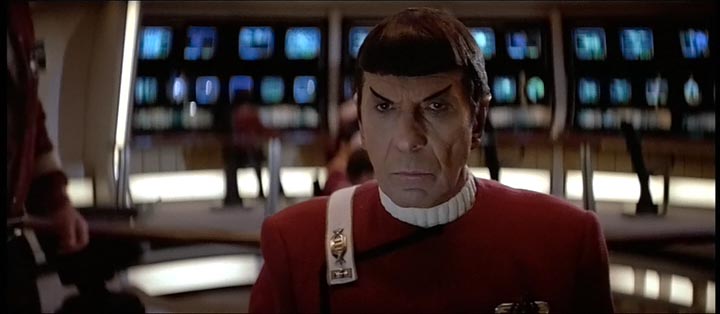
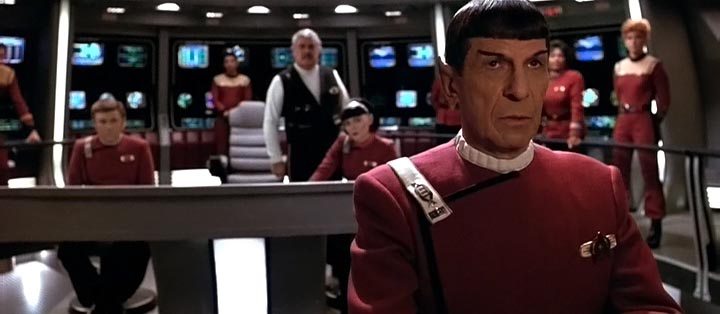
I put this comparison up before, but here's an example of anamorphic versus Super-35, from "Star Trek V" and "Star Trek VI":

Anamorphic
ana_super1.jpg


Super-35
ana_super2.jpg
 
I think Tarantino was just using "anamorphic" to mean the aspect ratio, not the photographic process.

I put this comparison up before, but here's an example of anamorphic versus Super-35, from "Star Trek V" and "Star Trek VI":

Fully agree David, the term anamorphic (or even widescreen) means different things to different people (depending on age/experience/profession etc).

There's a lot of misunderstanding at the moment, as we're now pretty much in a digital world, and the old reasons for shooting film in certain ways are no more.

Anamorphic is, IMO, a style choice now... almost like pre-deciding on a certain method of treatment for the image (ie a grade)... and grabbing the bonus of the quirks/aberrations that come with it.

In the UK I'm getting tired of seeing the most mediocre of porducts (like Supermarket chain food offers TVC's) being shot on Alexas with anamorphic lenses... it's mad... whilst the image looks very cinematic, I don't really see the need for widescreen/anamorphic in these instances. I'm sure the agencies will tire of the look soon and jump onto the next big thing.
 
I think Tarantino was just using "anamorphic" to mean the aspect ratio, not the photographic process.

I put this comparison up before, but here's an example of anamorphic versus Super-35, from "Star Trek V" and "Star Trek VI":

Anamorphic
ana_super1.jpg


Super-35
ana_super2.jpg

Thank you so much for all of this info, guys. What I don't understand though is why Leone's films have all the distinct characteristics of anamorphic qualities other than the shallower depth of field? It has the oval bokeh in what little shots are shallow and there's definitely anamorphic artifacts seemingly everywhere (as well as the distortion. They certainly don't look like the bottom shot in this comparison above, but is that really all just due to the film stock? It wasn't shot with any specialized lenses for this effect?

I mean I've seen Place Beyond the Pines and The Fighter as well as Suspiria and The Godfather and none of them seemed to have these characteristics to me. Leone's films were the first that really stood out to me visually and inspired me to produce my own look cinematagraphically.
 
i love the combined wide coverage of anamorphic mixed in with shallow DOF. An anamorphic 50mm is deceptively wide.
 
Back
Top