Welcome to our community

Be a part of something great, join today!

  • Hey all, just changed over the backend after 15 years I figured time to give it a bit of an update, its probably gonna be a bit weird for most of you and i am sure there is a few bugs to work out but it should kinda work the same as before... hopefully :)

A little confused about the 2/3 sensor chip.

Sean Lee

Well-known member
Joined
Oct 18, 2009
Messages
180
Reaction score
0
Points
0
Location
Australia
Hi all,

I've been reading through the forum learning as much as I can about the Red cameras. I'm confused about a few things that I am seeing on the forum, in a very broad general sense:

1) "If you want the film look, go for the S35 or Epic for feature films. These are the feature film cameras."

2) "The 2/3 chip Scarlett is fine for feature film-making, in fact there are a number of films made with 2/3 cameras like in Star Wars, 28 Days Later, Spy Kids, Speed Racer etc which look great."

3) "The images from the 2/3 fixed will be awesome as it is. It'll be fine for students making their first films at film school."

What are these comments referring to? The difference between level of DoF from different sensor sizes? As I understand it (correct me if I'm wrong) the 2/3 Scarlett with mini-primes is set up to be the equivalent to filming with 16mm film, or alternatively the 2/3 fixed with a widescreen adaptor would be fine (albeit with zoom/slower lens)?

I'm relatively new to the technology behind filmmaking and I don't have a point of reference to fall back on when I see the general comments made above.

Obviously films made with 2/3 chip cameras have been more than adequate for a theatrical release (after all, Star Wars falls well into the blockbuster Hollywood category). If that were the case, why wouldn't the 2/3 fixed be just as adequate too? Is it the lenses that separates the straight-to-video/small/indie release with a Hollywood blockbuster like Star Wars? How much does it matter?
 
Last edited:
People are mainly referring to the DOF differences between S35 and 2/3", but also to a lessor degree, 35mm cine optics versus HD video optics, and some resolution differences that the S35 versus the 2/3" cameras might have.

Practically-speaking, the DOF difference is an effective 2.5-stops, which hardly seems enough to me to keep a movie from looking "cinematic" or not, especially since the history of cinema is full of both shallow-focus and deep-focus movies. If you shoot an entire 2/3" movie at f/2.0, that's the equivalent of shooting an entire 35mm movie at an f/4.0-5.6 split, which is hardly unheard of or visually unusual, except for night exterior sequences.

Some people like to put everything (including other people) into hierarchies, into lists from best to worst, to say that one tool or method is better than another, and the reality is more complex than that.

To play devil's advocate, though, I would say that the devil is in the details and it's hard to speak in the abstract too much -- in theory, yes, the 2/3" Scarlet with the fixed zoom could produce high-quality cinematic images that play fine on the big screen. On the other hand, this implies that someone who knows how to create high-quality cinematic images is behind the camera, that the lighting, production design, level of sound, acting, editing, etc. are all on a professional level. That's not the say that there are no limitations with this approach (fixed zoom on a 2/3" camera) but you can be clever as to how you work around them.
 
ahh thanks for that David. That was very helpful, that was the point of reference I needed from which I can make my own judgments when I see the broad comments like those above. I thought it had something to do with the transfer from digital to film, although I didn't think that resolution came into it because 3K and 5K was more than enough to play with, with room to move.
 
Another important difference between S35 and 2/3" is the noise profile and low-light performance. S35 has a lot more room for oversampling and so you have a lot more latitude to fine tune the noise profile and more latitude in low-light. It's by no means a dealbreaker for the 2/3". Like David said it's just a matter of what each tool brings to the table. You lose some from S35 and gain some for 2/3".
 
2/3"

2/3"

And frame rates may also be a consideration.

Excluding EPIC, the 2/3" sensor offers significantly higher frame rates than the S35 or FF35 sensor based alternatives.
 
3) "The images from the 2/3 fixed will be awesome as it is. It'll be fine for students making their first films at film school."
Considering 90% of the films made by first-time students are ill conceived and poorly executed pieces of self-indulgent crap, they should be satisfied with a DVX100! Hell, I'll go so far as to say a Scarlet is too good to put in the hands of a first year student. ;-p

Give 'em the training wheels first. If they don't mess that up too badly, then let them have the grownup toys. "-)

Everybody has to start somewhere, and if they want to start on a Scarlet, then so be it. No matter what it is shot on, if the film is crap, then no one will watch it. They'll learn from their mistakes eventually.
 
The majority of Hollywood blockbuster releases are shot on 35mm, so the DOF characteristics from that are what we are used to seeing, hence the "filmic" look that gets bandied about. But as someone mentioned, things usually aren't shot wide open and using f4-5.6 is far from crazy on 35mm.

I've seen people with 35mm adapters and full-frame 5D's (which is, ofcourse, much larger than 35mm film movies are shot on) overusing shallow DOF for scenes that really don't call for it.

You should be able to pull off shooting an entire film with a 16mm-sized sensor and not have the audience get distracted by the non-35mm DOF look. It wouldn't be too hard for even a relatively amateur filmmaker (like me) to do.

Hope that helps.
 
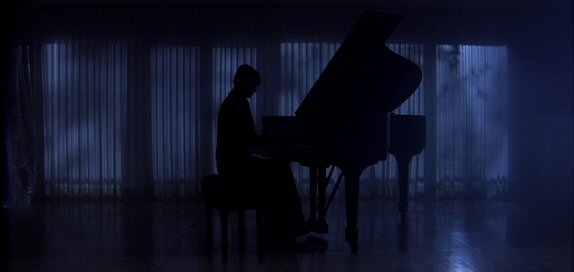
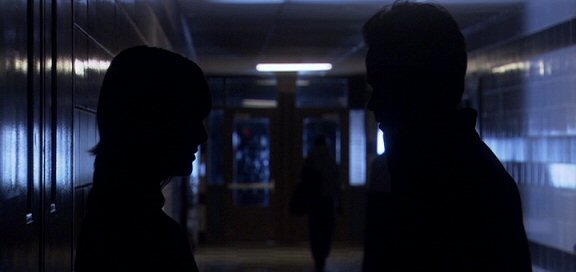
These are some frames from the DVD of the last movie I shot on a 2/3" camera, an under-1-mil feature called "The Quiet" shot on the F900:

quiet1.jpg


quiet2.jpg


quiet3.jpg


quiet12.jpg


You can see that the depth of field is not unusually deep-focus and that the look is not far off from other feature films.
 
Hey David-
Curious as to what lenses you used on the Quiet? Did you use primes, like the DigiPrimes? Wondering what the typical M.O. is for Hollywood style shooting 2/3" cameras. Thanks!
Peace,

-Harry
 
I shot the whole movie on the 8-72mm Panavision Digital Primo zoom, except for one Steadicam shot made on a Zeiss Digi-Prime.

I shot most of the movie at an f/2.8, or an f/2.0-2.8 split -- I find that most of the HD zooms that open to f/2.0 show a fall-off in sharpness when shot wide-open. Sometimes I use that to my advantage -- I might light the wide master to f/4.0 and then switch-in the internal 2-stop ND and shoot the close-ups at f/2.0 for a softer look. I also carry an ND.30 (when using these camcorders with filter wheels) so I can light to an f/2.8 or f/2.8-4.0 split and then add the 1-stop ND to shoot the close-ups at a wider stop.
 
Considering 90% of the films made by first-time students are ill conceived and poorly executed pieces of self-indulgent crap, they should be satisfied with a DVX100! Hell, I'll go so far as to say a Scarlet is too good to put in the hands of a first year student. ;-p

Give 'em the training wheels first. If they don't mess that up too badly, then let them have the grownup toys. "-)

Most student films are indeed self indulgent ill conceived and poorly executed crap (many of which I'm personally responsible for myself as are many of us). But that's mostly writing and direction. There are those who wish to become DPs, lighting directors and gaffers--for whom I see no reason to cripple with poor equipment.

A camera such as scarlet which allows for higher ISO shooting than a DVX100 will let them use smaller, more affordable lights as well as the ability to use more diffusion without the output being a noisy mess.

For those who aspire to be camera operators and ACs the scarlet will offer them something closer to the challenges and skills necessary to perform their jobs on set.

For those who aspire to be vfx artists and build a reel the scarlet will give them cleaner, more professional footage to work with.

For the remaining 'few' who aspire to direct or write--hopefully their self indulgence will be more aesthetically pleasing.
 
I shot the whole movie on the 8-72mm Panavision Digital Primo zoom, except for one Steadicam shot made on a Zeiss Digi-Prime.

I shot most of the movie at an f/2.8, or an f/2.0-2.8 split -- I find that most of the HD zooms that open to f/2.0 show a fall-off in sharpness when shot wide-open. Sometimes I use that to my advantage -- I might light the wide master to f/4.0 and then switch-in the internal 2-stop ND and shoot the close-ups at f/2.0 for a softer look. I also carry an ND.30 (when using these camcorders with filter wheels) so I can light to an f/2.8 or f/2.8-4.0 split and then add the 1-stop ND to shoot the close-ups at a wider stop.

Thanks David. That's an interesting thought about opening up for closeups, kind of using a lenses "built-in diffusion" as it were, plus the added benefit of a shallower depth of field. So that 8-72 Primo is about the same as something like a 20-180 on S35?
On another note, I just finished a short that I shot 16:9 but framed for a 2:1 "Univisium" crop, and found that I really enjoy framing for that ratio. Have you ever had a project that has allowed you to step away from the traditional 1:85 or 2:39? Thanks again!
Peace,

-Harry
 
Yes, 8-72mm on a 2/3" camera is like a 20-180mm on a 35mm camera. No, I haven't ever shot in a non-standard aspect ratio for a feature.

As far as film students using a Scarlet, I'm OK with that, the Scarlet will certainly be in the price range for film schools anyway.

But, conversely, I don't see forcing students to work with lower-end gear necessarily a bad thing... I learned by shooting Super-8 until I felt it was looking as good as most 16mm stuff out there, then I shot 16mm for a few years until I felt it was getting to look like 35mm, then I shot 35mm... You get the picture, the challenge was to make some smaller format look as good as possible, to know all the tricks that get around the limitations in the lower-rez format. And truthfully, most of those tricks work in general to make things look better. For example, knowing how to shoot Super-35 for a good blow-up to anamorphic is similar to knowing how to shoot Super-16 for a good blow-up to 35mm.

The other thing is that most students, if they graduate and then work on low-budget stuff, are probably not going to be working with the latest top-end gear, so it's not a bad thing to get them accustomed to working with lower-end equipment. Students and low-budget filmmakers often work with the previous generation of equipment, hand-me-downs. On the other hand, the lower price point of RED equipment has changed a lot of that classic paradigm, now people on a small budget can work with equipment that produces technically high-quality images. Which is why I think it's fine to use RED cameras in film schools, it's probably what they will be using outside of film school as well.

I just don't think students should get too obsessed with working with state-of-the-art gear, that's all. That's not really the point of film school.
 
I agree. I'm a student at the Savannah College of Art and Design doing visual effects and animation - with an intent to go into filmmaking. Of course, I plan on getting a scarlet, but I do think there are some good observations about learning on janky (sub-par) gear.

As much as I hated pulling a... key or move from... DVX footage - HD footage is now a breeze - literally takes 3 seconds. 1 minute if it was shot horribly. I think the progession is good though. I'd like to eventually work with more professional equipment before I get in the professional world. There's no reason to use Photoshop 1 just for bragging rights and then try to get a job upgrading to 10 versions later, it's nonsensical and a waste of valuable time to purposefully limit your options like that.

I think it's even more important for narrative filmmaking. If you can't tell a story on a handycam, or whatever you can get a hold of - getting behind a 35mm lens will not help you one bit, and in reality - may just make it that much worse for the rest of us.

That being said, and no offense to anyone - I never want to use a DVX, or any miniDV camera ever again. And definitely not for visual effects. Unless there's simply no other options - it's just irrational.

These are the thoughts from a current student, for whatever it's worth. Basically, I prefer to work with the best gear and talent I can grab a hold of - and I really think that's what it comes down to for any of us. And at that point, it's one less excuse and one more motivator for you to push yourself and your skill.
 
As much as I hated pulling a... key or move from... DVX footage - HD footage is now a breeze - literally takes 3 seconds. 1 minute if it was shot horribly.

:lol: Do you roto a 2h feature in 2hours?
 
Yeah but pulling a key with DV is usually just an effort in futility. Keying good HD footage presents a lot of new problems that DV won't ever expose you to. In fact I would go so far to say that working with DV footage encourages bad habits. You hit the limitations too soon and will be more keen on giving up before extracting perfection.
 
The shot at 0:39 in the trailer is really nice with regards to shallow DoF (pencil on locker). I have to say, wow. Thank you.

One thing that was mentioned in another thread is that using a smaller sensor means that at specific DoF settings, it requires less light than a larger format sensor. To me that would seem a pretty good thing to know and exploit.

In any case, I look forward to using a 2/3 knowing what others have achieved with it!

I think really, other than the RED parts, lens is probably going to be the hardest next step if I go with the 2/3 cinema. Clearly there is a HUGE range of lenses. I cannot even imagine what that Primo lens cost if you bought one (as opposed to renting).
 
Back
Top