Welcome to our community

Be a part of something great, join today!

  • Hey all, just changed over the backend after 15 years I figured time to give it a bit of an update, its probably gonna be a bit weird for most of you and i am sure there is a few bugs to work out but it should kinda work the same as before... hopefully :)

7D Aliasing Reduction..

anyone remembers what was the filter used to reduce the aliasing problems of a camera like 7D? I read somewhere but really can't remember..

Happy to sell you my antialias filter I purchased a while back for 5DMk2 ... but it softens the shot ... way too much for my liking.
Cannot remember details of the filter (and strenght), will send as I get back to base...

Since sold off the 5DMk2 for this very reason ... antialisaing artifacts just ruins the shots big time ! and very difficoult to predict.

Like many, I loved the portability of the Canon ... but the antialisaing was it's downfall (IMHO). I gather the 7D (and 1DMk4) are pretty much the same ... shame they cannot resolve this.

On the other hand ... Scarlet is just round the corner (I hope) HURRAY
 
Where to put it

Where to put it

The anti-aliasing filter goes between the lens and the sensor, close to the sensor, it splits the light into four "beams" so that some light from each point hits four pixel groups, that way you do not get heavy aliasing and chroma moire.

The best thing to do with the 7D is to maybe shoot at f/1.4 all the time, if you look on Vimeo most of the shots with problems were stopped down. When you are at f/1.4 the lens does not focus all the light to any single point, so acts as an Optical Low Pass Filter.

Another option is to use a DOF adapter, and set the relay lens a little out of focus, just enough to make the image spot about 1/750 the width of the frame, that should be enough for 1920x1080, the relay lens from the ground glass with act as a sharp cut off OLPF by itself, and you can control the blur radius with the relay lens focus controls.

Also do not try to sharpen the images since that will make the aliasing come back somewhat.
 
The best thing to do with the 7D is to maybe shoot at f/1.4 all the time, if you look on Vimeo most of the shots with problems were stopped down. When you are at f/1.4 the lens does not focus all the light to any single point, so acts as an Optical Low Pass Filter.

I tried this too ... but any high contrast edge will alias (cannot say for the 7D, but on the 5DMk2 it was certainly visible).

Tried to also focus critically (x10 view) and then defocus a small amount ... sometimes works, but it's very hard to predict outcome.

Basically ... lots of frigging around which defeats the purpose of it's portability IHMO ...

Good luck anyway ... lost of the web sample are reduced so it's not apparent/visible ... 1080 output and it's tell tale signs are there.
 
OLPF filter in DOF adapter...

OLPF filter in DOF adapter...

sometimes works, but it's very hard to predict outcome.

Well, there is something else that should work ALL the time, put a real OLPF in front of the ground glass in a DOF adapter, it will limit the high frequency detail so that the relay lens cannot pass any details to the sensor that might cause aliasing or chroma moire. You would need an OLPF that has the right blur radius.

Any filter in front of a normal lens will not work well because the lens will shape the edges of the image spot to have details that are too small and will cause some edge related artifacts.
 
Dan:

Are you familiar with the adapters for putting a Canon FD lens on an EF mount camera? looks kind of like a teleconverter where it has an optic in it to refocus since the flange focal lengths are the same, so an adapter is automatically an extension tube.

My question would be, would it be possible to do something like that? - i.e. an EF to EF adapter with a refocusing element and stronger OLPF at the back, to be used primarily for video where you don't need the 18MP sharpness? Thereby getting a stronger OLPF without the problems of using one in front of a lens or of the DOF adapter with ground glass (since half the attraction of the 7D, 5D is you don't need a DOF adapter?
 
Mohammed, you may have heard about the Caprock Anti-Moire filter. The manufacturer's page is http://www.caprockdev.com/antimoire.htm but I don't know what strength is recommended.

Just adding some more info to Stephen's post :-
Caprock Anti Moire filter is a fave but it is currently limited to 67mm thread. Good for primes but rules out most zooms. Think there is a 4x4 version though.

caprock thread is here
http://www.dvxuser.com/V6/showthread.php?t=189857

Also you might wanna avoid Tiffen Digital Diffusion Filters - I found them useless and ran a bunch of tests (LINK) on all strengths - sent them all back.

Another option is to slightly soft focus and sharpen in post. See M Bennets thread
http://www.reduser.net/forum/showthread.php?t=39650
 
Something that will work vs. something you can purchase

Something that will work vs. something you can purchase

Dan:

Are you familiar with the adapters for putting a Canon FD lens on an EF mount camera? looks kind of like a teleconverter where it has an optic in it to refocus since the flange focal lengths are the same, so an adapter is automatically an extension tube.

My question would be, would it be possible to do something like that? - i.e. an EF to EF adapter with a refocusing element and stronger OLPF at the back, to be used primarily for video where you don't need the 18MP sharpness? Thereby getting a stronger OLPF without the problems of using one in front of a lens or of the DOF adapter with ground glass (since half the attraction of the 7D, 5D is you don't need a DOF adapter?

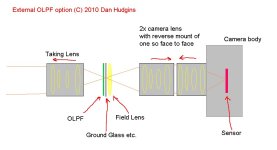
I have attached a drawing so something that would or at least should work, other half-measures will probably not work 100% of the time.

If you take the ground glass out there is no real image, so the result may not be as sharp in the corners of the image, its probably best to leave it in as it gives a real image for both the taking lens and the relay lens to focus on. You do get sharper results without the Ground Glass and OLPF there, just the field lens, but that's not the point of the device, the OLPF must blur the image on the Ground Glass to limit the high frequency image data.

With this setup, any f/ stop should be aliasing free all the time if adjusted and built right.

Edit: You may want to put the OLPF on the relay lens side of the ground glass, since the grain in the ground glass could make for some chroma moire, or put an OLPF on BOTH sides of the ground glass. The ground glass should be moving also so you don't see its grain.
 

Attachments

  • 7DOLPF.jpg
    7DOLPF.jpg
    55.1 KB · Views: 0
But if you're going to go through all that, you might as well get rid of the 7D and shoot on a video camera with a 35mm adapter.

It's all swings and roundabouts, but for me the best combo for low budget stuff is to use a 7D for the shallow depth of field or other special lens shots and an EX1 or similar for everything else. That way they'll be few, if any, aliasing issues.
 
7D price is under $2K with a lens... you get what you pay for in the end..
I'm not in a rush business that makes me pay $10K for Ex1 and $5K+ for a decent 35mm adapter..
I can save all that money for the real deal.. aka. Scarlet.. as I don't have big issues waiting.. and 7D trade offs could be worked around to get some nice results for simple stuff..
 
Matthew Bennet's post not too far down from here pegs it properly: just begin to learn how to soft focus until your aliasing vanishes, bring back the sharpness in post.

You will rarely be able to tell the difference once you've practiced this technique.

I was going to get rid of two of my 7Ds (I have four) and my 5D to get another Video Camera, but, it's been alright using this method now.

Couple that with adding NDs and a Polarizer on the camera ritually helps as well.
 
Back
Top