Welcome to our community

Be a part of something great, join today!

  • Hey all, just changed over the backend after 15 years I figured time to give it a bit of an update, its probably gonna be a bit weird for most of you and i am sure there is a few bugs to work out but it should kinda work the same as before... hopefully :)

4K is super awesome

anyway... tiny, tiny, super tiny.
Looks good option for many aplications.
 
So what happens when RED hits 5K? The whole industry is still lagging! its incredible, you'd think that when RED does all this in the open, someone at Sony or JVC goes "hey, we got a bigger R&D team and a long term of skills in video, lets leap frog and cut these guys off".
Instead they go ahead and create 4K2K, confuse consumers that its "4K" instead of as Stuart said "QuadHD"

For the life of me can't understand why so few companies can think straight...RED at least is giving 5K, definitely the last camera we'll need for a while since the industry will take sometime to catch up and probably in the process they'll create 5K3K when REDs at 6K?
 
Well, those ARE standards, they just aren't necessarily "crazy", there were some good reasons behind them originally.

I won't argue with David if 23.97 is a good reason or not. Just that the 0.03 was used for color not to get in trouble with the sound carrier when color was added to BW.

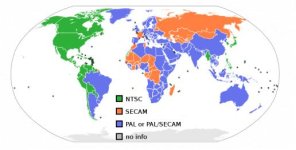
US (mainly) took that route in 1953 wich was not the case of the majority of the world. 50hz contries don't have this issue and are 24 or 25 fps.

More than 50 years later we shoot in 5k using NTSC 23.97/29.97 frame rates because of this "ingeneering error" that became a standard.


From wikipedia: http://en.wikipedia.org/wiki/NTSC

The NTSC field refresh frequency in the black-and-white system originally exactly matched the nominal 60 Hz frequency of alternating current power used in the United States. Matching the field refresh rate to the power source avoided intermodulation (also called beating), which produces rolling bars on the screen. When color was later added to the system, the refresh frequency was shifted slightly downward to 59.94 Hz to eliminate stationary dot patterns in the difference frequency between the sound and color carriers, as explained below in "Color encoding".
 

Attachments

  • 800px-PAL-NTSC-SECAM.svg.jpg
    800px-PAL-NTSC-SECAM.svg.jpg
    20.4 KB · Views: 0
So what happens when RED hits 5K? The whole industry is still lagging! its incredible, you'd think that when RED does all this in the open, someone at Sony or JVC goes "hey, we got a bigger R&D team and a long term of skills in video, lets leap frog and cut these guys off".
Instead they go ahead and create 4K2K, confuse consumers that its "4K" instead of as Stuart said "QuadHD"

For the life of me can't understand why so few companies can think straight...RED at least is giving 5K, definitely the last camera we'll need for a while since the industry will take sometime to catch up and probably in the process they'll create 5K3K when REDs at 6K?

Different companies just have their own idea of what makes a quality picture, it's possible standards also have a factor when it comes to the bigger companies like Sony who will probably come out with a 4k f35 or 23 maybe both in 2012.
Do we really want to see another megapixel race?
 
Back
Top