Welcome to our community

Be a part of something great, join today!

  • Hey all, just changed over the backend after 15 years I figured time to give it a bit of an update, its probably gonna be a bit weird for most of you and i am sure there is a few bugs to work out but it should kinda work the same as before... hopefully :)

4k / 2k PRO RES / DNxHD MODULE - who wants one.

BRAVO!!! BRAVO!!!

Obviously, Red workflow is not THAT hard, especially if you've done it once, and other cameras that get work over the red because of workflow like the alexa or 5D aren't THAT easy, but it is VERY difficult to kick the stigma for a large number of people that the red workflow is time consuming and expensive to finish. Especially for very low budget projects. And some projects are just not that interested in the raw. This would be a great way of bringing the Red onto projects with limited budgets and very tight turnarounds, which is all too familiar these days. For instance, almost all industrials are that way, and would love to use red, but hate dealing with any extra steps. This unit would enable DPs to shoot red on all kinds of work that would have otherwise just shot on an easier native format to deal with in post. Thanks for this thread!

One note: If such a unit existed I would hope it would be firmware upgradable so that it could spit out other professional grade formats other than pro res, just because we dont' know the future of Pro-Res.
 
You guys sure are making it more and more difficult for us to adhere to the vow we made late last year of not talking about products till they are ready to be released :)

heh heh heh....

until then.. there are a handful of great 3rd party products that create nice Pro-Res and DNXhd files that bolt to the back of the camera that let you record both RGB and your 5K raw files. The "record friendly" feed will be coming in not the build that is coming next week, but the build after.

Hi. I'm trying to choose if buying a Samurai today.
Am I right understanding this "record friendly feed" refers to the (actually) letterboxed image when recording on third party products?
 
Obviously, Red workflow is not THAT hard, especially if you've done it once, and other cameras that get work over the red because of workflow like the alexa or 5D aren't THAT easy, but it is VERY difficult to kick the stigma for a large number of people that the red workflow is time consuming and expensive to finish. Especially for very low budget projects.
Often, the problem with TV projects is not so much the expense, but the time. When you're outta time and the show has to air, out it goes. This is a problem when you compare Red against cameras that can instantly output native 1080.

I agree, sourcing from 4K is better, but to me, the final delivery for the project has a great bearing on how you shoot it and how the post workflow is set up. This is a particularly problem for episodic TV, where you might have five episodes in-house at any one time: one being shot, a second being off-lined, a third being conformed, a fourth being color-corrected and mixed, and a fifth actually being shipped. When you start adding up the amount of footage per day you have to keep online, even when it's 2K, it's a massive, massive amount of material. And then when you factor in the fact that most facilities are doing multiple projects at one time, they can easily get overwhelmed with hundreds and hundreds of terabytes of data.

I can recall for just one feature concert project, we had one room at Technicolor with 700,000 feet of film, all in boxes. If they needed a redo or to change a shot, we could grab that one box of film, throw it on a machine, and capture it in less than five minutes. But with data, then transfer times, network connectivity, and room availability all become major road hazards. And the last thing you want to tell a director or producer is, "sorry -- you'll have to wait two hours while we finish another, more important show that has to deliver today." Tough business.
 
i want one!! Pro/res/DNxHD and H264 wifi

Robert M. Berger
Epic-x "ED" 00274 and Red One "FRed" MX ssd 1265.
 
So, I guess the question is... why doesn't everyone here just have one of the inexpensive ProRes / DNxHD recorders (PIX, AJA, BlackMagic, Atomos) hooked up to their Epic? If the market has already provided these solutions, why ask RED to use their valuable engineering talent to develop the same product? Because it fits nicely on the back of the Epic? I don't get it...
 
So, I guess the question is... why doesn't everyone here just have one of the inexpensive ProRes / DNxHD recorders (PIX, AJA, BlackMagic, Atomos) hooked up to their Epic? If the market has already provided these solutions, why ask RED to use their valuable engineering talent to develop the same product? Because it fits nicely on the back of the Epic? I don't get it...

No clean output yet!!

Epic-X 00274 and Red One 1265 MX SSD
 
No clean output yet!!

Epic-X 00274 and Red One 1265 MX SSD

Didn't Jim or Jarred confirm that the clean output was coming soon? I'm almost certain I read that recently from them on reduser. I think that's happening in one of the forthcoming updates. Am I wrong here?

Yes, for broadcast having proxies will save a lot of time. Being able to match back to the original R3D files at the end of the project, for a final grade, is really important.
 
There seems to be a misunderstanding on how the Epic, as well as all other digital cinema cameras, function. Light hits the sensor. The sensor samples an image and converts it into 1s and 0s. This is the RAW sensor data. It is simply information. It is not an image. From here the RAW data needs to be processed into a usuable resolution, color space, and gamma curve. After processing you have a video image. Finally you need to record your image either natively at the sampled sensor rate (uncompressed) or compressed via any number of codecs.

The ingenious or frustrating thing, depending on your outlook, about the Epic is that is is designed to simply record the sensor's raw data. The camera does not attempt to fully process this data into a proper HD or 4K video output. The Epic is very much akin to a 5D in this way. It purposefully skips a step in the workflow process in order to achieve it's stated goal of 4K capture. I highly doubt that the Epic actually has enough processing power to record 4K RAW files while simultaneously debayering and recording a 1080 HD ProRes or DNxHD proxy. In fact, it seems fairly clear that the Epic is unable to even record uncompressed. The truth is that the camera is not even providing a proper, fully debayered, HD output. Why? It simply does not have the processing power to do so. That is why the workflow must be completed in post with the conforming and transcoding process.

RAW is not the end-all-be-all. RAW is only the first part of a bigger process. RAW sensor data is actually easier to work with than RGB video. That is why uncompressed 10-bit RGB video is actually larger (in file size/data rate) than uncompressed 12-bit Arriraw. The Epic is already maxing out on simply recording RAW sensor data with 3:1 compression to SSDs. It is highly unlikely that it could simultaneously offer a full debayered 1080p output. I do believe the Epic has the muscle to provide full debayered ProRes or DNxHD recording instead of 4K RAW but not both. It would be very useful to have a proper 1080p video mode available on the Epic. My sense is that the camera would need to boot into a separate firmware mode similar to how the Alexa boots into and out of its 120fps high-speed mode.
 
So, I guess the question is... why doesn't everyone here just have one of the inexpensive ProRes / DNxHD recorders (PIX, AJA, BlackMagic, Atomos) hooked up to their Epic? If the market has already provided these solutions, why ask RED to use their valuable engineering talent to develop the same product? Because it fits nicely on the back of the Epic? I don't get it...


Because what we are asking for is a way to get a very high quality RGB transcode.

Even once we get a clean 1080p feed from an Epic, its not nearly as nice as what you get when you render the same settings from RC-X - because the horsepower isn't there to do a maximum quality real time debayer and RGB display.

So, if I really truly only want proxy files, which actually is the case most of the time, then a PIX 240 can now be set up to handle that. (Maybe it already could when I posted before, and I just didn't know it?)

The thing is that the Pix 240, Samurai and other comparable solutions aren't really designed for Red. They are designed for the EX1, F3 and AF100. Cameras that have really crappy internal recorders, but output a broadcast 1080p signal with all the right adjustments done by the camera. Then they can upgrade the recording system dramatically and really deliver a whole new camera.

That same PIX 240 attached to a Red gives you an image quality that is a huge step down from the internal recorder ... and the camera does minimal internal image processing to shoot something out the SDI.

If I have to deliver from a Red using my RGB files from a PIX 240, then Red is way behind Arri as things stand today. Especially in a broadcast environment with minimal grading time.

Red is a cinema camera. This allows for some compromises. These compromises, because they are smartly chosen, have little or no impact on the way feature films are made, and actually open up creative possibilities feature film makers need.

Once you step into broadcast TV on short post cycles ... Red can really cramp your style. Nobody is doing really creative grades on "Holmes Improvement" or other reality/DIY shows or the other stuff out there on the vast cable wasteland. Cameras like the HPX 3700 and Arri Alexa let you turn around materials very quickly with no knowledge of post ... heck you can use iMovie if you want and get results from those cameras.

Ask Erich about rentals of Epics versus Alexa and F3+KiPro. Users are picking simplicity and direct quality output over ultimate top quality.

So a module I can attach to an Epic brain that can turn the camera into a selectable 5K/4K/2K/1080p RGB broadcast camera would be completely "boss."
 
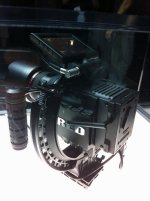
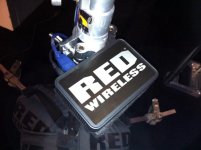
I couldn't find it announced anywhere in the NAB forum, but RED is showing a wireless video module in their booth that's just mindblowingly cool. It's not the Miezer module; this one just takes the wireless video component and puts just that into a module nearly identical in size to the module adapter. Signal is rock solid, virtually zero delay, full 1080p. The receiver unit is only HDMI capable right now (no HD-SDI), but for basic monitoring, that's no problem. I took some pictures but can't post them from where I am right now. Anyway, this is probably the most exciting thing to me on the floor right now, and since it was apparently overlooked, I thought I would mention it. I've been told by several RED employees that the price will be extremely competitive.

Note that this doesn't do proxies or anything (I never really cared about that, personally), it's just a wireless video module. But it's still very, very cool.

Häakon, hero of the day!, please some pics!
Red is listening us, as allways
Thanks!
 
Häakon, hero of the day!, please some pics!
Red is listening us, as allways
Thanks!
Hi Vico,

Thanks mate - I'm very excited about this one!

Here are two pictures for you. One of the module and one of the receiver that you would connect to a monitor or TV. It's a pretty minimal looking module, but very powerful! The receiver looks like a mini router or something.

The quality of the video looked VERY good.
 

Attachments

  • IMG_2084.jpg
    IMG_2084.jpg
    59.5 KB · Views: 0
  • IMG_2089.jpg
    IMG_2089.jpg
    62 KB · Views: 0
The video signal looked fantastic, too. Can't wait to hear more about this one as I'm thinking the full Meizler module may be too much for us right now.

Kevin
 
Oh yes... Everything we wanted in a Redmote Pro? Remote focusing with video? Connect to a deck or laptop with ultra studio, record to disk and populate LivePlay or ToDailies... Lots of things to do with this beyond simple monitoring.
​
Hi Vico,

Thanks mate - I'm very excited about this one!

Here are two pictures for you. One of the module and one of the receiver that you would connect to a monitor or TV. It's a pretty minimal looking module, but very powerful! The receiver looks like a mini router or something.

The quality of the video looked VERY good.
 
Häakon,

Did you note if it sent any metadata as well? Lens data? Timecode?
 
Häakon,

Did you note if it sent any metadata as well? Lens data? Timecode?
I didn't ask about that but I certainly can. All we could see on the floor was a monitor showing a clean, wireless feed from a camera inside a glass box (though you could wave in front of it to see the lack of any delay). I did speak with the RED guy who was responsible for its creation and he told me that it can have whatever overlays from the camera you wanted, separate from either the LCD/EVF or the HDMI/SDI feed. So, certainly you could have timecode displaying on the wireless monitor's feed if you wanted... but I'm not sure if that also comes along the stream as metadata or something.
 
I didn't ask about that but I certainly can. All we could see on the floor was a monitor showing a clean, wireless feed from a camera inside a glass box (though you could wave in front of it to see the lack of any delay). I did speak with the RED guy who was responsible for its creation and he told me that it can have whatever overlays from the camera you wanted, separate from either the LCD/EVF or the HDMI/SDI feed. So, certainly you could have timecode displaying on the wireless monitor's feed if you wanted... but I'm not sure if that also comes along the stream as metadata or something.

Thank you so much... And if you could inquire about start stop flags, file names... Any and all metadata that could accompany the stream, that would be great. I wouldn't mind being able to auto run a dailies recorder that was not on camera.
 
Jarrd's taking questions. So far he has not addressed Wireless transmitter Q's but this smells a lot like confirmation of one part...

Remote Pro is coming along.. you are seing pieces of it in things like the Meizler module. As you can tell, we are taking our time to get this one right.
 
Last edited:
Jarrd's taking questions. So far he has not addressed Wireless transmitter Q's but this smells a lot like confirmation of one part...

The Meizler module has built-in wireless control for focus/iris/zoom motors; obviously that would work hand in hand with a "REDMOTE Pro" that's designed specifically for controlling those things (a number of other third party controllers will work too). I'm not sure how that would carry over to a wireless video module with no motor controls (but maybe I'm misunderstanding what you're asking). I did confirm that the HDMI output of the wireless receiver base is a standard protocol (nothing proprietary about the signal), so it could be used for a video village monitor, into an external recorder for RGB recording, etc. But it's essentially just a video feed that you don't have to hard wire to the camera to get access to. That's what I'm taking away from it, anyway.
 
Back
Top