Welcome to our community

Be a part of something great, join today!

  • Hey all, just changed over the backend after 15 years I figured time to give it a bit of an update, its probably gonna be a bit weird for most of you and i am sure there is a few bugs to work out but it should kinda work the same as before... hopefully :)

3D and Telephoto

Drew Fulton

Member
Joined
Nov 29, 2010
Messages
23
Reaction score
0
Points
0
I am coming to the cinema world from the world of stills, working a lot on natural history projects. For a possible upcoming natural history project, we are still deciding if we will go the stereo 3D route or not. It will work beautifully for a lot of the shots with wide angle lenses and that immersive feel. However, a decent chunk of the footage will need to be shot on super telephotos, think 400mm and up. I can't quite fathom how this fits in to the world of stereoscopic 3D. Can anyone shed some light on this? The ideas I have thought of are...

A) The super telephoto shots are shot in 2D and basically give the viewers eyes a rest. Possibly there is some minor 3D effect added in post but I have no idea how that works.

B) The super telephoto shots are shot in a side by side mount but thats going to result in a pretty big distance between the two cameras due to the size of the lens. I have no idea what this would look like for the viewer.

C) Something that I am totally missing.

Thanks for any ideas or feedback. As I said, the project is in the very very early phases, basically kicking around ideas, and right now our ideas are leading to questions that need to be answered.

Drew
 
Yeah, space the cameras, but go conservative. Think of your depth budget. Also, do tests.

If you're filming something far away - and only a shallow range of depth is in the frame - try to put the cameras side by side, spaced apart from each other, so that the 3D "feel" of that object can be seen.

Depends on what is in the frame though - and how you fit it in the depth budget.

EXAMPLE A
Looking down from a hill at an elephant in scrub bush - bottom of the frame is vegetation (a few yards closer to cam), middle of the frame is elephant, back of the frame is more vegetation (a few yards further back)... distant sky can't be seen.

So then you only have to fit that within your depth budget. You can put the cameras quite far apart and get the 3D feel of the elephant so it doesn't seem like a cardboard cutout (binocular effect).

EXAMPLE B
If you're shooting a low angle (same lens, same distance, same subject matter), you can see vegetation immediately in front of elephant, elephant, vegetation immediately behind elephant AND gigantic mountain really far behind elephant.

If you film that with the same camera spacing and convergence, it will hurt the eyes if they try to look at the gigantic mountain because it is converged too far back. So you need to move the cameras closer together (decrease interocular). This makes the elephant look like more of a cardboard cutout, but is easier on the eyes.

Cardboard cutouts suck, but think about the overall picture of what are you trying to say in the shot depth-wise? In the one, it's about the elephant immersed in the vegetation. In the other, it's about the vastness of space that the elephant roams - eg from here all to that mountain way far behind.

So if the shot tells that story, the audience won't care about the fact that the elephant isn't "round" and "3D" - anyone else agree?

Bruce Allen
www.boacinema.com
 
We film alot of wildlife. Apart from the creative issues and cardboarding, minitureisation etc. Background disparity is also big problem, if you try to foreshorten depth of field you loose 3D volume and still have disparity issues. You may be able to get away with a shot if you are able to film from high up pointing at say an object on the ground, so the ground forms the furthest layer or say up against a cliff or similar so theres no great distance to the far layer to limit background disparity, That might or might not work.

Rigs need to be VERY, VERY stable. We custom built an SbS rig to do be very rigid and stable with Red One and other largish cameras and have used it with long lenses. Its very accurate and easy to operate but lining the whole issue up with lenses that long is very difficult as the vertical alignment ajustments are so small. Its be best rig I know of and even then is not easy even if you could get the 3D to work. in the field, animals and the environment being what they are and things constantly changing maintaing perfect alignment will not be possible for long.

I think Id try to pick a subject that lends it self to closer work and suits 3D limitations.
 
Telephoto lenses, as we know, compress perspective. With a 400mm lens you will likely have to use a huge amount of deviation, like upwards of 5%, to get any sense of volume at all and you're well into "hurting the audience" territory at 5%.
Regardless, what you will get with 400mm lenses at any IO and with any amount of deviation is diorama-like flat planes that seem to have no volume with wide gulfs of space between them.
 
Alright, so this is sort of what I was thinking would be the issue. How do you deal with a film where say 70% of the subjects/footage lends itself nicely to 3D and 30% (the telephoto) doesn't? Is it an all or nothing thing or is there a work around?

Thanks for the help and please excuse my ignorance.
 
I helped prep a 3D Africa project this year.....

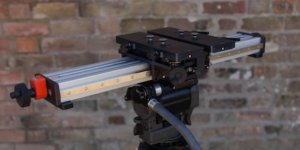
Here is the Rig...Built by Stereographer Sean Phillips and his company. This was one of 5 different rigs they took (filming is scheduled for over 1 year)

The rig is indeed very stout.

Cameras are Si-2k recording to 1 beyond wrangler unit.

Lens is Angeniuex HR 25-250mm
CMotion Cvolution lens control

IMG_2486.jpg


We went thru 7 different lenses to find the 2 that performed the best. The PL mounts on the Si's were also machined to allow us to "track" the lenses. Belive it or not after mounting the lenses from the case me and the rig tech I was training were able to Track the 2 massive lenses so that alignment held from 25 to 290 end in just a few mins! There was some horizontal movement that we could live with but most importantly we were able to track out all vertical movement.

This allowed the operator to zoom quickly (Remember wildlife....) with out any delays for re-alignment. This proved crucial.

After the first portion of the shoot I talked to the rig tech and the stereographer and they expressed the challenges they faced and the results of some of the shots. While I didn't see any of the footage, the stereographer mentioned what we all expected that some of the shots didn't work.....and some worked quite well. In fact he said they caught a few magical moments.

Like Bruce mentioned backgrounds are very important. They were shooting from a special prepared Landrover. So the camera height was helping with some of the angles and bringing the background closer.

The stereographer also mentioned that the operator/DP (highly experienced shooting africa wildlife) spent alot of time at on the longer end of that lens.

Here is the other lens set they took and used on the same rig. Since the PL mounts were machined we also were able to track these lenses just as well as the big HR's. You can see the slots with the screws in the PL mount in this shot.

Angeniuex 17.5mm-70mm

IMG_2495.jpg
 
Pedro,
Those are some nice rigs. We are thinking of going the Epic/Atom route (hence the posting here). I was thinking of using either Nikon or Canon lenses as I am already a Nikon shooter, but am unsure of how well they will work in this setup. I just don't know what exists in the cine lens world for super telephotos. For a situation like this, is it normal to basically build your own rig or will an Atom or one of the other rigs out there work with such large lenses?

Again, excuse my ignorance, what do you mean by "tracking" the lenses with the machined PL mounts? Is that part of the calibration/alignment process?

Right now, we are just trying to assess what is physically possible with either current or custom products and what isn't. As we work through the details, I know some things will be eliminated due to feasibility and our very difficult working environment. Thanks!
 
I was at the Fantastic Fest in Austin over the weekend where two 3D films were screening, 1981's Comin' At Ya and the current film Julia X. C'AY often used parallax values in the range of 20% or greater. I could feel this truly testing my eye muscles. Having far greater experience viewing 3D than the average movie goer, I was able to view it, but it was, to say the least, a bit much. Julia X stays way closer to settings more in line with today's Hollywood features.

I overheard audience members at later 2D screenings commenting that they felt Comin' At Ya was "way better" than what they are seeing in the cinema today. Without revealing that I was DP of Julia X I asked these viewers their opinions and they said they felt the 3D was just more exciting in C'YA. I will not get into agreeing or disagreeing with that, just saying to universally assign a percentage value as the maximum amount is the completely wrong approach. Also bear in mind, negative parallax values can be quite a bit larger than positive and still remain comfortably viewable for most. It is not clear to me why so many people feel like keeping all of your "depth budget" behind the screen is helpful. That is practically the opposite of what you should do.

Back to the original question, hyperstereo shooting with 400mm+ focal lengths is likely to be fraught with problems. Cardboarding and miniaturization being the most obvious artifacts. Depending on how distant your subject actually is, the necessary IA for any depth effect at all would make simply monitoring, aligning and operating really challenging practical considerations. If your show has the budget, I would recommend shooting 2D and converting. Deluxe 3D (formerly StereoD) is the top tier player in this field (in my opinion). We have reached a place with conversion technology where given enough time and ample budget, final result can be hard to discern from native photography.
 
Here you go heres our Hawk rig 520mm Max IA but usually you are working with a small IA. Manual and can be Motorised if needed. Our choice of ling lenses are Leica Telyt and Canon. There is a good point mentioned here. Might you be able to use a good 2D to 3D conversion ? Im not suggesting its ideal but given the issues it might be preferable.
 

Attachments

  • Esprit Hawk.jpg
    Esprit Hawk.jpg
    18.1 KB · Views: 0
Drew,

You and Pedro may be communicating about this off list but to answer the question here, the tracking he refers to has to do with optical de-centration while zooming. In other words, the centers of the elements of each lens are not perfectly centered. This is usually small, and in 2D totally unnoticeable, but when you have two lenses trying to do the same exact thing, small errors can become larger. As you zoom from wide to tele, elements move around and any errors in absolute center are magnified. By adding the ability to recenter the lenses mechanically as Sean Phillips did with this rig or other Angenieux lenses allow with built in mechanisms, you can compensate for the de-centration and zoom through the focal range without introducing 3D misalignments.
 
Thanks Jason. Makes perfect sense. Most of my experience in the still world is working witih fixed telephotos (600mm f4) but was thinking of about Nikon's 200-400mm f4 which is a great lens and extremely versatile.

I had posted yesterday but the post seems to have vanished. I wanted to add that this film will probably be destined for an IMAX screen (a 45min educational IMAX feature, not a full length film). I am not sure how that impacts this discussion, but I know that the IO distance is usually determined with the final screen size in mind.

I also like the idea of shooting the wide angle scenes in stereo and then the telephoto scenes in traditional 2D and then do the 3D conversion for those scenes in post production. You mentioned a couple of companies. I don't even have a clue what sort of budget this requires or how it meshes with true stereo shooting. I'll look into those but if you have any more info, I'd love to hear it.

Thanks again!
 
Id ask Tim Sassoon about 2D to 3D conversions, his work is very good and Id guess he would be able to add good info to this conversation......
 
My previous post aside.....I have to agree....on these kinds of shot "conversion" might start making lots of sense.

Like I mentioned I never actually saw any of the footage shot on those rigs. I just talked with the stereographer afterwords....

framing and parallax values for IMAX certainly have an impact. You should be considering this as you make many decisions....
 
Back
Top