


Ilya O.
Well-known member
Daniel Klockenkemper asked any info on the subject lens:
"I ... thought you might be able to help with some information on a similar uncommon Russian lens that I have. It is model 35OPF8-1, 20-120mm 1:3.5 (T4.3). It has serial number 720001...I cannot find any information about it on the internet. Parts of it look to be hand-modified, or borrowed from other lenses - the mount can be removed by a bayonet that I have seen on other Russian lenses, and this mount was probably from a 35OPF7 zoom. I think it might also be a prototype, and possibly the only one of its kind...If you have any information I would be very grateful."
He also posted some pictures of how 35OPF8-1 looks like, I re-post it here:


So I decided to answer here to make the zoom lens data available for everybody.
OPF is a short for Variable Focus Lens made for professional motion picture work. 35 designates film format. Numbers like 8-1 mean lens design number (the higher the newer).
35OPF8-1 is an early example of Soviet cine zoom lenses, I would name it second generation zoom lenses (after the 1st Gen. — TFK-4 30-120mm f2.8, Foton 37-140 f/3.5, Lenar-1 40-160mm f/3.8).
It seems to be calculated by CKBK in early 1970-s (after 1969 but before 1971). CKBK (ЦКБК) is Central Design Bureau of Cinematography, St. Petersburg, USSR). CKBK is a part of EKRAN, a major Soviet all cine gear manufacturer, so since late 70-s the protype or small batch lenses were marked as made by НПО "ЭКРАН" or NPO EKRAN.
Here is 35OPF8-1 lens datasheet and test plots (lens scheme/diagram, resolution, vignetting, aberrations...) from NIKFI Catalogue of 1973:

Daniel, your 35OPF8-1 was made at 1972 according to the serial number starting with 72. And indeed, #1 says it is a first lens of this kind, a prototype. Keep in mind that CKBK never did large batches of lenses, they usually take the test batch, let's say 10 pieces, and in case if everybody is happy with the new lens they send the blueprints to LOMO for large scale production.
I did not find any info this model ever went to LOMO for production run so I think it was never mass-produced. You have a unique lens, Daniel! At the same, there could be #720002 or 720003 in the wilds, who knows.
Why 35OPF8-1 was not mass-produced? I have no answer.
What other 2nd Gen OPF's were? And among them which were in production at LOMO?
First, I put here what 2nd Generation means. This is totally subjective classification, but I find the 2nd Gen zooms are those which where:
— calculated at CKBK from 1968 to 1972;
— 25mm on the wide side;
— typical F-stop is 3.5;
— zoom ratio 4 to 10;
— most have huge front elements yet shockingly lightweight (25-250mm f/3.5 OPF7-1 weighs 2.6kg (5.73lbs);
— internals are made to pro demands, lightweight but robust and tough aircraft heat-strengthened aluminium alloys for all CNC barrels, steel bearings for zoom group to move, PFTE/Teflon bearings for focus/zoom/iris ring smooth drag;
— coatings are rather basic so the light transmission coefficient is 63% to 70% (so the T-stop would be ~T4.6);
— poor spectral transmission in 400-500nm light range (violet, indigo, dark blue, cyan to light green) so the look is radically warm and yellow.
So these 2nd Gen where:
35OPF4-1 26-203mm f/3.5, a CKBK prototype, calculated some years before 1968. One of the first zooms after the 1st Gen.
35OPF5-1 25-150mm f/3.5, was in production at LOMO. Was also available in A-version (back anamorphic mod): 35OPF5-1A 50-300mm f/5.
Here is NIKFI 1973 grafs/datasheet:

35OPF7-1 25-250mm f/3.5, was in production at LOMO. Was also available in A-version: 35OPF7-1A 50-500mm f/5.
NIKFI 1973 test grafs/datasheet:

35OPF8-1 20-120mm f/3.5, yours, #720001, only(?) a CKBK prototype.
35OPF9-1 25-100mm f/3.2, was in production at LOMO. Weights only 1.25Kg (2.76lbs)! Was also available in A-version: 50-200mm f/4.5.
NIKFI 1973 test grafs:

35OPF10-1 25-150mm f/2.5, a CKBK prototype. I saw one with the 720003 serial. Was made with the rear split prism system to have image on both the film and the Video camera tube (pre-CCD/CMOS image recording device). Weighs 12kg (26.46 lbs.)
NIKFI 1973 datasheet:

and some 35OPF10-1 pics of an outer look:

and a 35OPF10-1 so-called 5K "test" shot (with just hand holding Canon at the back of the zoom lens, no adapter):
left is 150mm, right is 25mm

...
There also were 3rd Generation zooms, calculated at mid to late 1970-s. Main feature is macro abilities so you can focus on a subject placed at only 50mm (2'') from the first lens! Also, 3rd Gen have better overall IQ: higher resolution, less CA and lateral color, better f- and T-stops, better spectral transmission at 400-500nm range (less yellowish than 2nd Gen, but still I would say quite warm), less torque on control rings for easy move and compact (weak) lens motors usage. So they were:
35OPF15-1 25-250mm f/3.2 — was at LOMO production, occurs here and there quite often. f/3.2 (T4.1) 10x zoom at 4.1kg (9lbs) weight.
Pretty solid performer. Neutral color. Here I have 35OPF15-1 25-250mm f3.2 LOMO zoom test shot at 25mm, wide open. The pic was taken by Sony NEX-7 sensor, it's 23.5 x 15.6mm, image resolution is 6000x4000. So here how it looks like mounted, crazy:

This shot was made at 25mm, you can judge the coverage (edges) here, I placed it relatively to Helium sensor, 8k at right click - new tab:
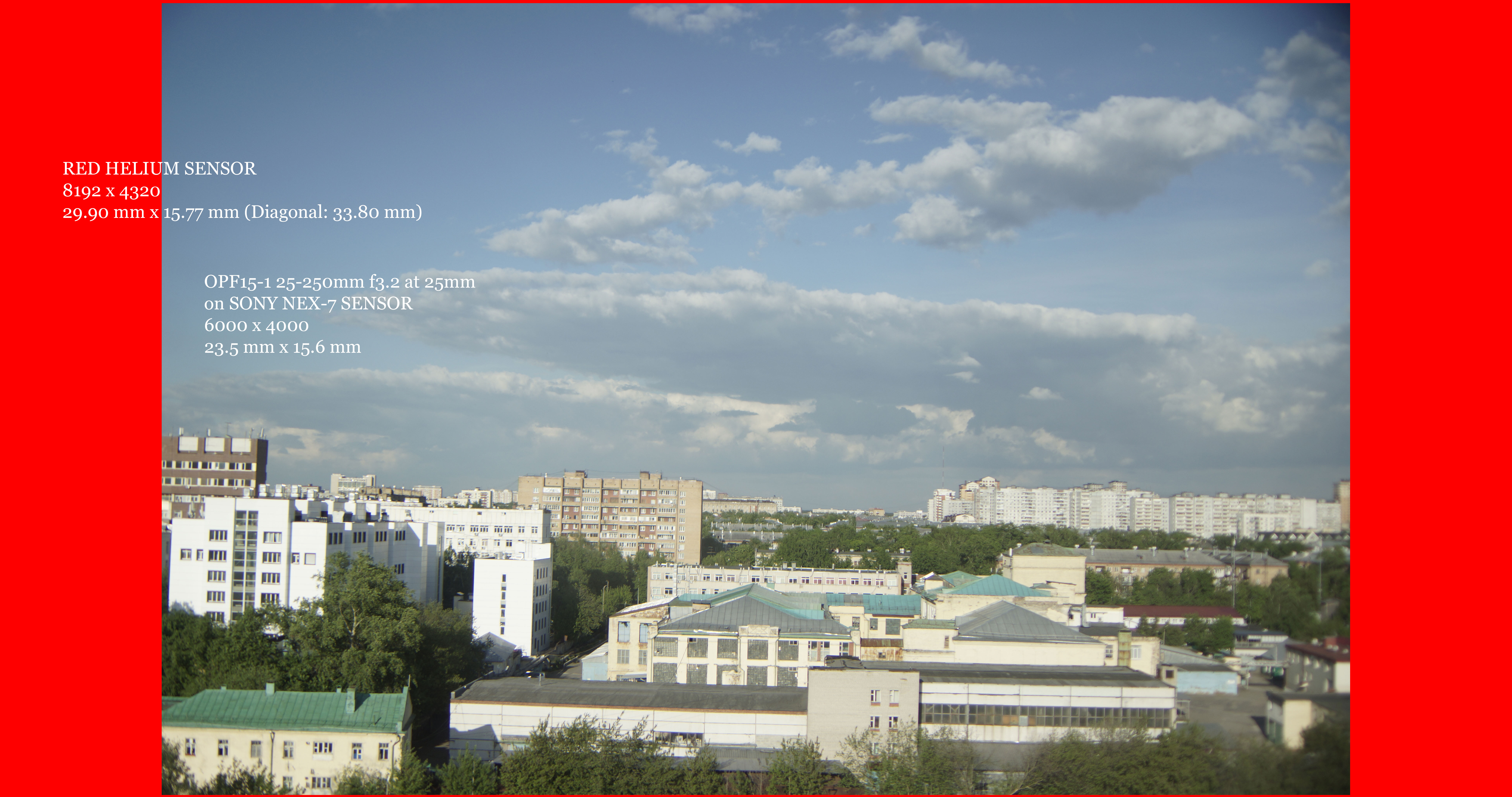
I do not see any hard portholing here, but the upper right corner shows falloff. So one can only guess or imagine what happens to the image field if expanded to the red area... It's you who decide or risk buying whether it covers or not I doubt, but who knows...
35OPF16-1 25-100 f/3.2 — seems to be very rare one. CKBK (Ekran) calculated it in 1972 and later (?) run some batch. No Lomo production I have heard of. Weighs 2,1kg (4.63lbs). It was made to advance 35OPF9-1 lens and is based on 35OPF9-1 optical design, but with some mods so it has higher IQ, macro mode, less CA, and is suited for remote lens motors (zoom & focus channel) use. I found some 35OPF16-1 pictures at Rafcamera site here http://rafcamera.com/ru/35opf16e-zoom-lens-25-100mm-f-3-2-converted-to-manual-mode and one is here:

35OPF18-1 20-120 f/2.5 — Was at LOMO production so can be found in the wilds. It is much sought after lens I see. Why? Maybe because it is a good lens which was calculated much after looking at famous Cooke Varotal 20-100mm f/2.8 lens (GB Pat. 1323221, 1973). OPF was patented in USSR with improvements over Cooke (as they say in USSR Pat. 565270, 1974) — the zoom ratio is 1.2 higher, f-stop is 10% faster (yet the T-stop is bit worse (T3.6 vs T3.2) since the coatings are less advanced than the "Varomag" multi-coating used in Cooke!). Plz notice the impressive weight of 5.9kg (13lbs).
Here's the datasheet:

[LOMO OPF18-1 20-120mm Datasheet: graphs of resolution, vignetting, spectral transmission, image shift, CA, astigmatism and main optical data]
35OPF19-1 40-120 f/2.5 (This one is mainly known in FRONT (sic!) anamorphic version).
35OPF21-1 25-500 f/3.5-4.5 — this monster weights 17kg (37,48 lbs) and has impressive 20x zoom range. I imagine such a zooming out/in shot, makes quite an impact, ha?-)
But let's leave the 3rd Gen for further input.
...
Daniel, I've found that there's an article on your 35OPF8-1 in well-known Russian journal on TV and Cine gear: search for Tehnika Kino i Televideniya, 1973, Volume 8! Google Books says it has already been digitized by the University of California So what if you try it?! I'd say it would take you maybe half an hour to go to their Library website and order .PDF scan online for maybe 10-15 bucks Sorry, I do not have this TKT volume at hand, and it would take me maybe 6 hours to find it here in Moscow and scan it to .pdf...
"I ... thought you might be able to help with some information on a similar uncommon Russian lens that I have. It is model 35OPF8-1, 20-120mm 1:3.5 (T4.3). It has serial number 720001...I cannot find any information about it on the internet. Parts of it look to be hand-modified, or borrowed from other lenses - the mount can be removed by a bayonet that I have seen on other Russian lenses, and this mount was probably from a 35OPF7 zoom. I think it might also be a prototype, and possibly the only one of its kind...If you have any information I would be very grateful."
He also posted some pictures of how 35OPF8-1 looks like, I re-post it here:
So I decided to answer here to make the zoom lens data available for everybody.
OPF is a short for Variable Focus Lens made for professional motion picture work. 35 designates film format. Numbers like 8-1 mean lens design number (the higher the newer).
35OPF8-1 is an early example of Soviet cine zoom lenses, I would name it second generation zoom lenses (after the 1st Gen. — TFK-4 30-120mm f2.8, Foton 37-140 f/3.5, Lenar-1 40-160mm f/3.8).
It seems to be calculated by CKBK in early 1970-s (after 1969 but before 1971). CKBK (ЦКБК) is Central Design Bureau of Cinematography, St. Petersburg, USSR). CKBK is a part of EKRAN, a major Soviet all cine gear manufacturer, so since late 70-s the protype or small batch lenses were marked as made by НПО "ЭКРАН" or NPO EKRAN.
Here is 35OPF8-1 lens datasheet and test plots (lens scheme/diagram, resolution, vignetting, aberrations...) from NIKFI Catalogue of 1973:
Daniel, your 35OPF8-1 was made at 1972 according to the serial number starting with 72. And indeed, #1 says it is a first lens of this kind, a prototype. Keep in mind that CKBK never did large batches of lenses, they usually take the test batch, let's say 10 pieces, and in case if everybody is happy with the new lens they send the blueprints to LOMO for large scale production.
I did not find any info this model ever went to LOMO for production run so I think it was never mass-produced. You have a unique lens, Daniel! At the same, there could be #720002 or 720003 in the wilds, who knows.
Why 35OPF8-1 was not mass-produced? I have no answer.
What other 2nd Gen OPF's were? And among them which were in production at LOMO?
First, I put here what 2nd Generation means. This is totally subjective classification, but I find the 2nd Gen zooms are those which where:
— calculated at CKBK from 1968 to 1972;
— 25mm on the wide side;
— typical F-stop is 3.5;
— zoom ratio 4 to 10;
— most have huge front elements yet shockingly lightweight (25-250mm f/3.5 OPF7-1 weighs 2.6kg (5.73lbs);
— internals are made to pro demands, lightweight but robust and tough aircraft heat-strengthened aluminium alloys for all CNC barrels, steel bearings for zoom group to move, PFTE/Teflon bearings for focus/zoom/iris ring smooth drag;
— coatings are rather basic so the light transmission coefficient is 63% to 70% (so the T-stop would be ~T4.6);
— poor spectral transmission in 400-500nm light range (violet, indigo, dark blue, cyan to light green) so the look is radically warm and yellow.
So these 2nd Gen where:
35OPF4-1 26-203mm f/3.5, a CKBK prototype, calculated some years before 1968. One of the first zooms after the 1st Gen.
35OPF5-1 25-150mm f/3.5, was in production at LOMO. Was also available in A-version (back anamorphic mod): 35OPF5-1A 50-300mm f/5.
Here is NIKFI 1973 grafs/datasheet:
35OPF7-1 25-250mm f/3.5, was in production at LOMO. Was also available in A-version: 35OPF7-1A 50-500mm f/5.
NIKFI 1973 test grafs/datasheet:
35OPF8-1 20-120mm f/3.5, yours, #720001, only(?) a CKBK prototype.
35OPF9-1 25-100mm f/3.2, was in production at LOMO. Weights only 1.25Kg (2.76lbs)! Was also available in A-version: 50-200mm f/4.5.
NIKFI 1973 test grafs:
35OPF10-1 25-150mm f/2.5, a CKBK prototype. I saw one with the 720003 serial. Was made with the rear split prism system to have image on both the film and the Video camera tube (pre-CCD/CMOS image recording device). Weighs 12kg (26.46 lbs.)
NIKFI 1973 datasheet:
and some 35OPF10-1 pics of an outer look:
and a 35OPF10-1 so-called 5K "test" shot (with just hand holding Canon at the back of the zoom lens, no adapter):
left is 150mm, right is 25mm
...
There also were 3rd Generation zooms, calculated at mid to late 1970-s. Main feature is macro abilities so you can focus on a subject placed at only 50mm (2'') from the first lens! Also, 3rd Gen have better overall IQ: higher resolution, less CA and lateral color, better f- and T-stops, better spectral transmission at 400-500nm range (less yellowish than 2nd Gen, but still I would say quite warm), less torque on control rings for easy move and compact (weak) lens motors usage. So they were:
35OPF15-1 25-250mm f/3.2 — was at LOMO production, occurs here and there quite often. f/3.2 (T4.1) 10x zoom at 4.1kg (9lbs) weight.
Pretty solid performer. Neutral color. Here I have 35OPF15-1 25-250mm f3.2 LOMO zoom test shot at 25mm, wide open. The pic was taken by Sony NEX-7 sensor, it's 23.5 x 15.6mm, image resolution is 6000x4000. So here how it looks like mounted, crazy:
This shot was made at 25mm, you can judge the coverage (edges) here, I placed it relatively to Helium sensor, 8k at right click - new tab:
I do not see any hard portholing here, but the upper right corner shows falloff. So one can only guess or imagine what happens to the image field if expanded to the red area... It's you who decide or risk buying whether it covers or not
I doubt, but who knows...35OPF16-1 25-100 f/3.2 — seems to be very rare one. CKBK (Ekran) calculated it in 1972 and later (?) run some batch. No Lomo production I have heard of. Weighs 2,1kg (4.63lbs). It was made to advance 35OPF9-1 lens and is based on 35OPF9-1 optical design, but with some mods so it has higher IQ, macro mode, less CA, and is suited for remote lens motors (zoom & focus channel) use. I found some 35OPF16-1 pictures at Rafcamera site here http://rafcamera.com/ru/35opf16e-zoom-lens-25-100mm-f-3-2-converted-to-manual-mode and one is here:
35OPF18-1 20-120 f/2.5 — Was at LOMO production so can be found in the wilds. It is much sought after lens I see. Why? Maybe because it is a good lens which was calculated much after looking at famous Cooke Varotal 20-100mm f/2.8 lens (GB Pat. 1323221, 1973). OPF was patented in USSR with improvements over Cooke (as they say in USSR Pat. 565270, 1974) — the zoom ratio is 1.2 higher, f-stop is 10% faster (yet the T-stop is bit worse (T3.6 vs T3.2) since the coatings are less advanced than the "Varomag" multi-coating used in Cooke!). Plz notice the impressive weight of 5.9kg (13lbs).
Here's the datasheet:
[LOMO OPF18-1 20-120mm Datasheet: graphs of resolution, vignetting, spectral transmission, image shift, CA, astigmatism and main optical data]
35OPF19-1 40-120 f/2.5 (This one is mainly known in FRONT (sic!) anamorphic version).
35OPF21-1 25-500 f/3.5-4.5 — this monster weights 17kg (37,48 lbs) and has impressive 20x zoom range. I imagine such a zooming out/in shot, makes quite an impact, ha?-)
But let's leave the 3rd Gen for further input.
...
Daniel, I've found that there's an article on your 35OPF8-1 in well-known Russian journal on TV and Cine gear: search for Tehnika Kino i Televideniya, 1973, Volume 8! Google Books says it has already been digitized by the University of California
So what if you try it?! I'd say it would take you maybe half an hour to go to their Library website and order .PDF scan online for maybe 10-15 bucks Sorry, I do not have this TKT volume at hand, and it would take me maybe 6 hours to find it here in Moscow and scan it to .pdf...
Last edited:

