Welcome to our community

Be a part of something great, join today!

  • Hey all, just changed over the backend after 15 years I figured time to give it a bit of an update, its probably gonna be a bit weird for most of you and i am sure there is a few bugs to work out but it should kinda work the same as before... hopefully :)

20 Year anniversary of Pulp Fiction!...but how did they do this shot?

Rome Will

Well-known member
Joined
Nov 2, 2013
Messages
303
Reaction score
0
Points
0
Location
Atlanta
In celebration of one of the best films of the 90's (I was actually too young to watch it then...I'm aging myself lol!) I have one of my favorites in rotation today- Pulp Fiction. While watching this for the 100th time though, I wondered how Tarantino did this shot after Butch was running away...before the infamous (spoiler alert for those who haven't seen this work of art yet) rape scene. A pic is below. I know Tarantino is somewhat of a "in-camera" purist, so I didn't think it was done in post, but I could be wrong. Still, I'm thinking that somehow they used a special lens/technique that was able to pull focus up close and both far away? I'm very interested to know. Thanks for anyone that can shed some light on the answer and help solve this mystery for me :001_huh:.

Oh, and it's on Netflix if you wanna join in on the fun =)

Thanks again!
 

Attachments

  • Screen Shot 2014-10-15 at 1.26.23 AM.jpg
    Screen Shot 2014-10-15 at 1.26.23 AM.jpg
    14.6 KB · Views: 0
I'm thinking split-diopter lens using the vertical edge of the wall to hide the seam.

The whole film is 35 anamorphic as far as I know, and you'd notice if a 16mm shot got thrown in there. Bear in mind the film was done in 1994, long before digital intermediates took over. Tarantino was (and is) very old school when it comes to this stuff.
 
DAVID!

Thanks for chiming in. I really appreciate you sharing your expertise!

Marc and Gunleik, thanks for your help also!

I guess the portion of the lens filter closest to the subject has a built in focal length, and the object further back, on the other side of the filter, is pulled with normal focus pulling...I'm guessing here, but I googled what the filter is and I see that the glass is literally "split" down the middle...interesting...always wondered how they did those shots.
 
It's just a diopter filter cut in half, you put the clear area over the distant subject and the close-up filter portion over the near subject. So if the background object is, let's say, 20' away, you set the focus of the lens to that and then you add whatever strength of diopter (+1, +2, +3, etc.) is needed so that the close subject comes into focus.
 
It's just a diopter filter cut in half, you put the clear area over the distant subject and the close-up filter portion over the near subject. So if the background object is, let's say, 20' away, you set the focus of the lens to that and then you add whatever strength of diopter (+1, +2, +3, etc.) is needed so that the close subject comes into focus.

David,

Understood. Thanks for breaking it down sir!
 
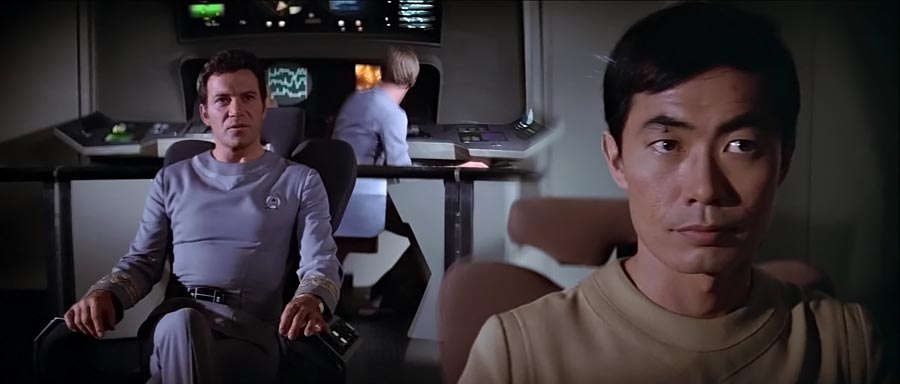
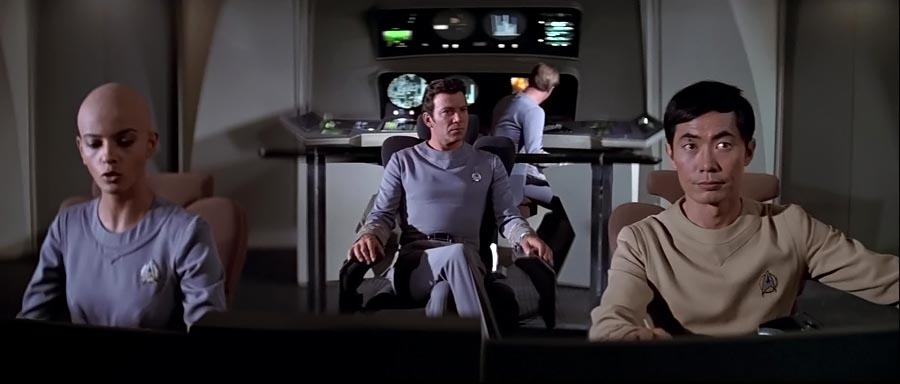
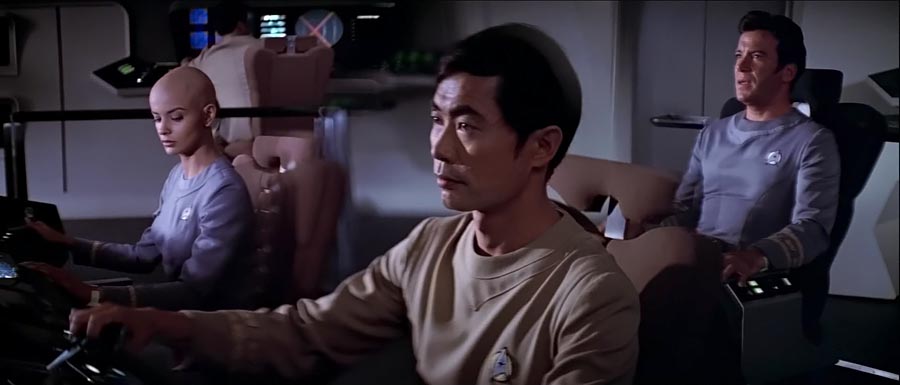
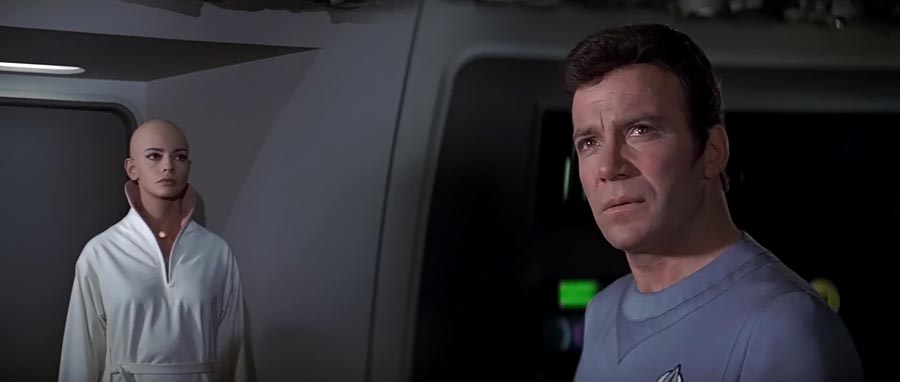
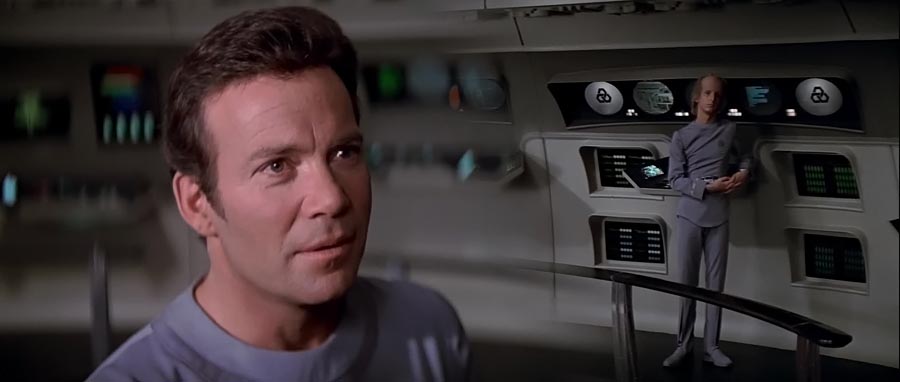
15? I counted over 70 in "Star Trek: The Motion Picture". Here's an example:

Typical split-diopter use to hold a person big in the foreground in focus:
startrekTMP22.jpg


Special made split-diopters that cover one-third of the frame, one on the left and one on the right, the center is clear:
startrekTMP23.jpg


Another special-made one that only covers the center third of the frame, the sides are clear:
startrekTMP24.jpg
 
Some more examples:

Split-diopters used to hold the back of the foreground person's head in focus:
startrekTMP25.jpg


Here the split is hard to see because it happens in the blank grey area of the wall:
startrekTMP26.jpg


But here is it pretty obvious because of how the same background changes focus, plus whenever the horizontal railing of the bridge is in the shot, the split-diopter breaks that line:
startrekTMP27.jpg


Robert Wise often used split-diopters in his movies, you see them now and then in "Sound of Music", "The Andromeda Strain" or "The Hindenburg". I think it was because he started out as the editor of "Citizen Kane" and has always been interested in deep staging and deep focus, but the low light levels needed to shoot on 100 ASA stock in anamorphic on the bridge of the Enterprise meant that the split-diopters were the only way to get a deep focus look. Part of the reason the light levels had to be low was that all the small screens on the set were 16mm rear-projection screens ("2001" did something similar for video monitors.)
 
David,

What are your thoughts on ST:TMP as a whole, from a cinematographer's stand point? Aside from "2001" I think it is one of the best photographed science fiction pictures to date. And it's much, much better done compared to the following movies.
 
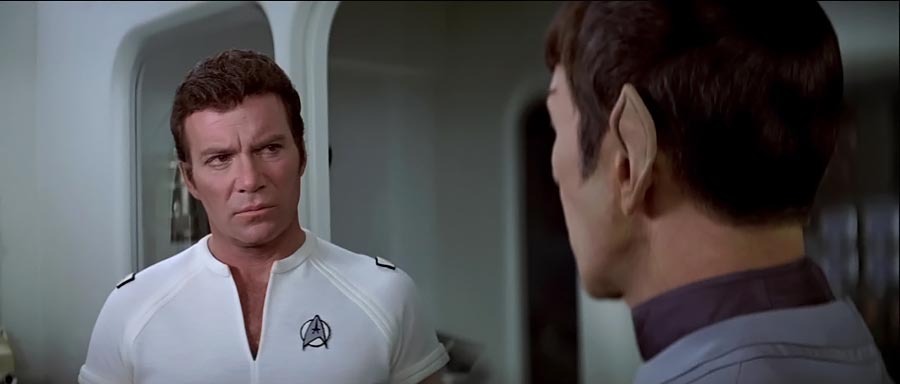
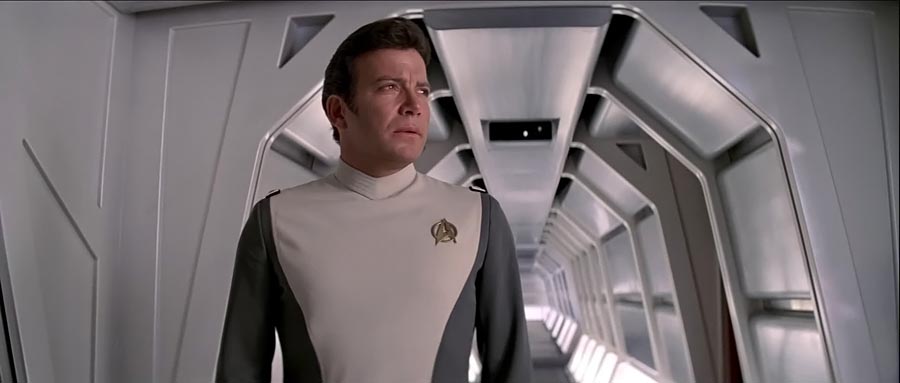
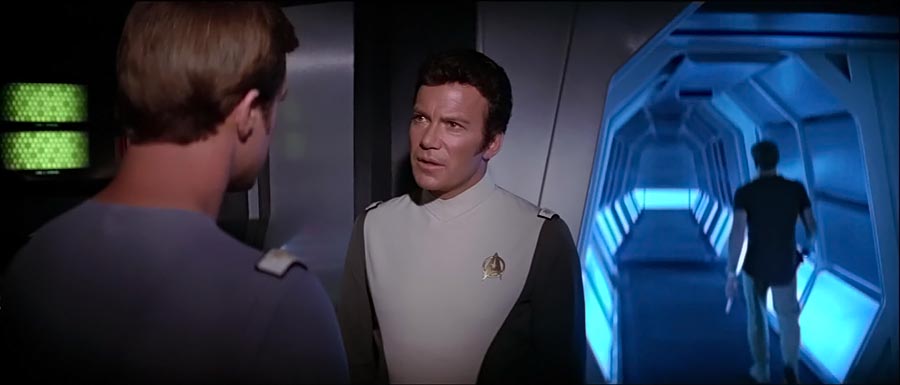
I don't want to hijack this thread too far, but "Star Trek: The Motion Picture" is a personal favorite, more of a guilty pleasure in some ways, and I can't be too objective about it being a lifelong Star Trek geek... but what I like about the good parts visually is the thing that so many people complained about, it's sterility. For example, I love how the hallways looked in these shots:

startrekTMP28.jpg


startrekTMP29.jpg


Richard Kline really knew how to light reflective metal sets, as he did in "The Andromeda Strain" as well.

The film had a rough start and stop and one problem was that the production designer inherited sets built for a planned TV series. He was able to re-clad the hallways in brushed metal, but many of the other sets, he was limited to gray spray paint on wooden flats, like with the bridge set, though he added a lot of metallic touches, but I think if he could have started from scratch, it would have been even better. And while I prefer the grays, tans, and whites for the wardrobe compared to the all-burgundy look of later movies and TNG, it gets a bit monotonous against the gray walls sometimes. But in general, I like the fact that the movie was inspired more by "2001" than by the TV series in terms of the look. The biggest weakness of that movie really was the script, it was too limited to the bridge as the Enterprise drifts through V'ger.

I'm also one of the biggest Jerry Goldsmith fans in the world and this movie is one of his best works, and along with "Alien" serves as a bridge between his avant garde / modernist work in the 1970's and his more classical work of the 1980's.
 
heja,

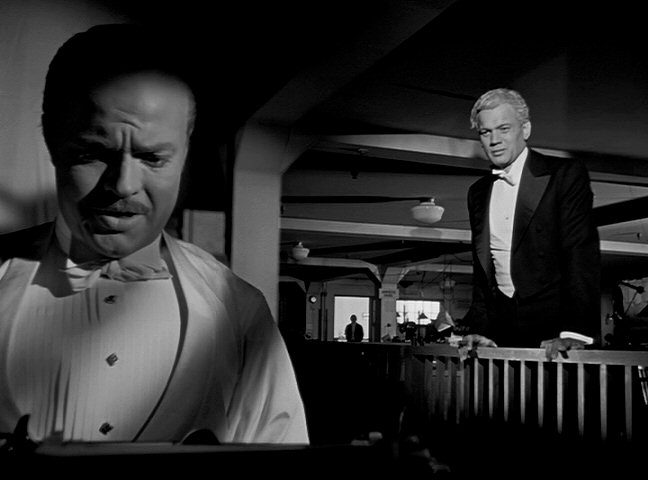
this is indeed very fascinating david... really interesting...!!! it's even more interesting when you think of what kinda magic Gregg Toland used in the 40's, e.g. Citizen Kane... this one very famous shot when Orson Welles sits in front of the camera and deep focus action happening at the far side of the room... as I understood, Toland shot this twice and the strips of film were put onto each other and printed... very, very interesting...
 
Yes, this shot of Welles at the typewriter:
citizenkane1.jpg


I believe it was an in-camera double-exposure split-screen (the wall behind Welles is out of focus, but everything on the right side of frame is in focus) -- not an optical printer created one (looks too pristine to be a duped shot). While in theory, split-diopter filters could have easily existed back then, the earliest examples I've ever found occur in the 1950's.
 
hmm, I'm really not sure David... Peter Bogdanovich gave away lots of Toland's trickery on the audio-commentary of Citizen Kane (Warner Bros.)... but it's been a while I had been listening to it... probably you're right... however - I think Toland's work still stands out in cinematographic history...
 
Of course Toland's work stands out, I'm just saying that some deep focus shots in the movie weren't just achieved by stopping down the lens, some used optical printer effects (such as the spoon & glass in the foreground for Susan's suicide attempt) and others were done in-camera with double-exposures. This shot is tricky however because there is dialogue between Kane and Leland, but clearly the wall behind Kane is not in focus. A slant focus lens could get a similar effect, though probably would not work well with Bernstein in the center of frame, but there was only an experimental slant-focus cine lens made in the 1940's and I don't think it was used on "Citizen Kane". A split-diopter could have done a similar effect except I can find no record of such a filter existing in 1940, plus clearly the shot was made at a deep stop to hold Leland and Bernstein in focus and split-diopter filters don't work well if you stop down too much on a wider-angle lens because you see the cut edge of the glass too well.

It's certainly possible, if this is an in-camera double exposure, that it's actually a triple exposure, they could have turned off the lights on Bernstein for Leland's focus & exposure pass and then done a pass with just Bernstein in the doorway lit and the focus now set deep on him as a third exposure.
 
Yes, this shot of Welles at the typewriter:
citizenkane1.jpg


I believe it was an in-camera double-exposure split-screen (the wall behind Welles is out of focus, but everything on the right side of frame is in focus) -- not an optical printer created one (looks too pristine to be a duped shot). While in theory, split-diopter filters could have easily existed back then, the earliest examples I've ever found occur in the 1950's.

Dave,

I'm just getting home but MAN! You are dropping a lot of great knowledge on us today! I (and I'm sure other Redusers) really appreciate all of your comments and examples. I never knew this shot was actuality two separate shots stitched together in post...to be honest, I didn't recognize that the shot had that deep focus you were talking about. And I definitely need to pay better attention to those Star Trek movies...there were a lot of those split-diopters being used...need to open my eyes more- thanks for pointing them out!
 
I'm so sorry David... by no means I was trying to critizise you, no sir, I wouldn't dare... it's a misunderstanding - didn't make myself clear... all I wanted to say was, that Bodganovich gave away quite a few things on Toland's work and that I do not remember all of them exactly... that's all... Toland creating his own lenses, digging holes into the floor to get his extreme low-angle shots etc...

if I offended you by means of my own incapacity to explain, I'm very sorry...

I really do appreciate your comments and examples - learned quite a lot and am very thankful...!!!
 
Back
Top