Welcome to our community

Be a part of something great, join today!

  • Hey all, just changed over the backend after 15 years I figured time to give it a bit of an update, its probably gonna be a bit weird for most of you and i am sure there is a few bugs to work out but it should kinda work the same as before... hopefully :)

16:8:8 Color Sampling?

So it seems the sensor is 1.85:1 and has a photosite resolution of 8192x2214. But we don't know if it's a checkerboard Bayer pattern or something else, unless I missed something. I did read something some months back, related to Sony, that suggests it may be something like this...
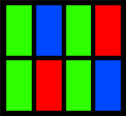
funnystripe.png

That pattern makes some kind of sense for 8768 x 2324 with them half width pixels giving 4384x2324, however, it does mean each colour pixel is (in the final image) 1/2 pixel out of alignment with the greens, whereas in the F35 they're only 1/3 of a pixel out of alignment. I guess the extra resolution gives them room to put in the correct re-sampling filters to adjust them back into alignment though.

Graeme
 
I'm constantly surprised that how every time any subsampling structure is mentioned, Reduser delves into its usual frenzy of over analyzing a simple ratio. Red constantly maintains that it is the image quality that matters, then who cares if Sony is x:y:z.

Jim himself asked people to take Sony's advance as an indication of advancement of camera technology, which direction Red also contributed. It is just 5 pages and counting of a frivolous topic, imho, that keeps coming up again and again on reduser.

Sincerely,

Joofa
 
Hi Joofa. As the one who started this thread, I thought I'd respond.

I'm constantly surprised that how every time any subsampling structure is mentioned, Reduser delves into its usual frenzy of over analyzing a simple ratio.

Well, I certainly don't know if I'm over-analyzing a simple ratio. In fact, I'm really just trying to understand it. Just as soon as I thought I had come to terms with the idea of 4:4:4, I see something about 16:8:8 - an expression I had never seen before. I'm naturally curious, and have found REDuser a great place to get information about such topics. And as it turns out, subsampling structure isn't just a simple ratio - it's a simple ratio mixed with a method of expressing spatial resolution based on sampling frequency.


Red constantly maintains that it is the image quality that matters, then who cares if Sony is x:y:z.

I agree, image quality is what matters. My questions and this thread really aren't meant to be about Sony, RED, or any other particular company. They are meant to be about understanding the use of YCbCr and why 4:4:4 isn't all there is to the picture in a world in which there are many different resolution formats.

This is important, because I wanted to know that I wasn't missing out on something on the post-end. I acknowledged the fact that YCbCr doesn't make much sense to discuss in terms of RAW or RAW-based cameras.

If 16:8:8 has been lurking around for so long, why is everyone stuck on 4:4:4...and how can anything be better than 4:4:4 which fills all the buckets, so to speak? I think I've found those answers.

A camera that records great imagery is fantastic. But if it put through a post-pipeline that is built around ignorance, it can easily be robbed of its beauty. I just wanted to make sure that I understood this aspect of codecs to make sure that I'm preserving as much image quality as reasonably possible.

It is just 5 pages and counting of a frivolous topic, imho, that keeps coming up again and again on reduser.

I'm sorry you find the discussion of YCbCr color space frivolous. My understanding is that it actually remains a fairly important fundamental aspect in the delivery of many forms of video.

This thread was not intended to (and I don't think it really has) veered too far off course in the over-zealous support of RED or senseless attacks against other manufacturers. It has focused on a concept about which, based on the discussion here, I'm not the only one to have a couple of questions.
 
...It is just 5 pages and counting of a frivolous topic, imho, that keeps coming up again and again on reduser.

Sincerely,

Joofa

Luckily participating on an internet forum is an act of free will. Feel free to not read the thread or bother to contribute to it if you find it so frivolous…
 
...why is everyone stuck on 4:4:4...and how can anything be better than 4:4:4 which fills all the buckets, so to speak? ...

I’ve always had issues with this one. My understanding of it is that 4:4:4 in relation to any given color space simply means that no subsampling is occurring. However some color spaces such as YCbCr may have other side effects in their use.

RAW resides outside of any color space and inherently has no subsampling and therefore does not require a 4:4:4 designation to distinguish it from other subsampled versions of the same color space the way YCrCb does.

Adding to my confusion was when I would see 4:4:4 RGB, where RGB as a color space is not subsampled and thus, similar to RAW, does not require the 4:4:4 to distinguish the non-subsampled version from one that is. My guess is that once the marketing guys got hold of the ratios some people felt it necessary to ensure that people knew that RGB was not subsampled by sticking a 4:4:4 in front of it.

Perhaps someone here can set me straight once and for all and tell me if I’ve got this right?

Not that it helps explain why Sony might be advertising a subsampled RAW camera?
 
Michael O. You are perfectly fine to ask a question on YCbCr space. I just commented on the sampling structure, which is a topic that comes up here frequently or at least intermittently. In retrospect, you are right, and I was wrong to question the desire to ask a question, so I appologize for that.

Reduser is not known as a forum for discussion of more advanced technical topics compared to some other online forums that focus on digital cameras and photography. And, my response was reflective of that. But, sorry again, for any question is a good question to be asked and you have the full right to talk about any topic.

Best regards,

Joofa
 
I’ve always had issues with this one. My understanding of it is that 4:4:4 in relation to any given color space simply means that no subsampling is occurring. However some color spaces such as YCbCr may have other side effects in their use.

The numbers 4 and 2 in 4:2:2 and 4:4:4 mean something very specific. They refer to the sampling rate with respect to the subcarrier frequency in component video systems. When they were introduced, they were used to describe different coding systems for standard definition video in a very specific way. 4:2:2 indicates that the luminance is sampled at 4 times the subcarrier frequency, and the chroma channels are sampled at 2 times the subcarrier. This is common in YUV based systems. 4:4:4 indicates that both the luminance and the chroma channels are sampled at 4 times the subcarrier. In some cases this is used for YUV, and in other cases it's used for RGB.

The fact that many people today have no clue as to what these numbers mean, and only regard them as a ratio, is not all that surprising, but be assured that there is an actual meaning to these numbers. As Graeme mentioned, if we were to be accurate in an HD world, the numbers themselves should be higher.
If anyone doesn't want to read the whole thread, Mike's response is the TL;DR summation and accurate at that too.

Let's wait to shoot something with Sony's new CineAlta before any more judgments are passed.
 
The numbers 4 and 2 in 4:2:2 and 4:4:4 mean something very specific. They refer to the sampling rate with respect to the subcarrier frequency in component video systems. When they were introduced, they were used to describe different coding systems for standard definition video in a very specific way. 4:2:2 indicates that the luminance is sampled at 4 times the subcarrier frequency, and the chroma channels are sampled at 2 times the subcarrier. This is common in YUV based systems. 4:4:4 indicates that both the luminance and the chroma channels are sampled at 4 times the subcarrier. In some cases this is used for YUV, and in other cases it's used for RGB.

The fact that many people today have no clue as to what these numbers mean, and only regard them as a ratio, is not all that surprising, but be assured that there is an actual meaning to these numbers. As Graeme mentioned, if we were to be accurate in an HD world, the numbers themselves should be higher.

Mike,

Thanks for this post. I really appreciate it. I know I must seem pretty daft to a lot of folks on here, and I really appreciate the persistence in getting correct information across.

As you said, there is a lot of misinformation and misunderstanding out there about N:N:N notation. And while 16:8:8 may be technically correct, I'm interested to see what the reaction is by the many (like myself) who don't really understand the fundamentals of what that means. I suspect many people will simply thing (as I did) that is has to be better - I mean, those numbers are way greater than 4:4:4, right?
 
When 4:2:2 came about, the numbers, as M Most points out references subcarrier frequencies.
When HD came along, following the same rules relating things to frequencies, that made "4:2:2" HD to be 22:11:11. The numbers were now getting silly big, so they were moved to be ratios, divorced from any reference to frequency.
Then 4:2:0 came along, breaking the whole ratio thing - the zero now meaning skipping a row vertically. And there were two 4:2:0 variants, both producing different visual results - one for interlace and one for progressive.

Then of course - we get the HDCAM / DVCProHD battle of the 3:1:1 / 4:2:2 both meaning different things, in HDCAM the chroma being one third of the luma, the luma being 3/4 of what it should be, or alternatively, the luma being 3/4 of full, and the chroma being 1/4 of full. Both working out to the same answer for resolution in pixels amusingly. DVCProHD being 4:2:2 but on a reduced raster whereas there appears to be a notion of reduced raster in the 3:1:1 of HDCAM. But that gets confused as DigiBeta was always 4:2:2 even when coming from a wide sensor for 16:9 applications with an increased horizontal raster over that of 4:3, showing, at least in the case of that and DV that raster reduction (albeit for anamorphic use, but the principle is the same) is not something that changes the ratio numbers.

So, if we take 16:8:8 to be a ratio, it should be called 4:2:2. If we talk it based on frequencies it's lower than HD's 22:11:11.

Which leaves us with 16:8:8 used without technical explanation, leaving everyone confused, not least Sony's use in conjunction with a sensor as compared to how it was designed to be used with Y'CbCr chroma compression.

Does that about cover it??

Personally I wish 4:2:2 etc would die and be buried next to interlace.

Graeme
 
.

So, if we take 16:8:8 to be a ratio, it should be called 4:2:2. If we talk it based on frequencies it's lower than HD's 22:11:11.

Which leaves us with 16:8:8 used without technical explanation, leaving everyone confused, not least Sony's use in conjunction with a sensor as compared to how it was designed to be used with Y'CbCr chroma compression.

Does that about cover it??
Graeme

Largely, but not completely, because as you say, Sony hasn't offered a deep technical explanation yet. For all we know, they might be developing the system in conjunction with a possible proposed new video recording/broadcasting system in which the subcarrier frequency is relevant to the numbers they're using.

Or not.
 
Who knows? Perhaps Mr Sony will post here and inform us :-) ???

Graeme
 
Who knows? Perhaps Mr Sony will post here and inform us :-) ???

Graeme

Since it seems that part of this thread is informing some of the newer people about video history (i.e. that 4:2:2 actually refers to something specific) I would also point out that Mr. Sony (Akio Morita) died in 1999. But he was a pretty amazing guy - an entrepreneur, innovator and rebel in his own way and time - much like Mr. Jannard.
 
I wasn't referring to Mr Morita, but more to a generic Sony person who could answer our questions. The Mr Sony, Mr Morita grew Sony up and made some fantastic products along the way. As you say a pretty amazing guy.

Graeme
 
Graeme,

Thanks for that history lesson, I appreciate the time it took to write it. It really does go to show how much there is behind this notation and, to an extent, how confusing it was made.

--

Mike,

I agree. I'm pretty curious about what Sony is going to say that 16:8:8 actually means. Maybe NAB will offer answers...

--

Michael (boy, there are a lot of us...),

Morita Sama sure had an interesting life. You post prompted me to a read up a bit about him and the history of Sony. Despite what some people may think about their current business model or products, that's definitely a company with quite a pedigree!
 
I agree. I'm pretty curious about what Sony is going to say that 16:8:8 actually means. Maybe NAB will offer answers...

My guess (NOT an educated one) is that they actually record 4:4:4, and that number refers to the oversampling ratio of the sensor: information from 16 photosites is used to create Y (or G) in each block of 4 pixels, information from 8 photosites is used to create Cr/Cb (or R/B) in each block of 4 pixels.

Dunno if that adds up, but it could. Even if it does, it's confusing as hell ;-)

As far the sampling logic goes, it's been a while but i recall the number refers to a block of 4*2 pixels.

****
****

The first number tells us how many luminosity samples there are for each row, the second tells us the number of chroma samples in the upper row, the third number tells us the chroma samples in lower row. For example 4:2:0 comes from...

YYYY
YYYY

...4 luma samples in both rows and...

C*C*
****

...two chroma samples in first row, zero in the second. 4:2:2's color would be the following...

C*C*
C*C*

...and 4:1:1 comes from this:

C***
C***

Assuming i remember correctly, of course. Sony's photosite count would be...

4444
4444

...for luma and...

2222
2222

...for chroma, in other words 16:8:8. That does sound like a lot, but as the sensor is tilted 45 degrees, the photosites likely affect more than one final pixel - and thus they get counted multiple times. It could also be that they make the calculations for HD resolution, so what you have on "tape" is not 16:8:8, you get that ratio only if you're downscaling to HD rez. As said, confusing as hell, even if true.
 
I wasn't referring to Mr Morita, but more to a generic Sony person who could answer our questions. The Mr Sony, Mr Morita grew Sony up and made some fantastic products along the way. As you say a pretty amazing guy.

Graeme

I know, like M Most, I just like to remind people that Sony isn't necessarily the evil empire. However difficult it may be to decipher all of the marketing, sales, and investor info put out by an $88 billion a year company - and figure out where their heart is (or if they still have one) - it's pretty much par for huge public companies and at least Sony was founded with some of the Red spirit.
 
Personally I wish 4:2:2 etc would die and be buried next to interlace.

Graeme

Agreed!

I think, as I've said before, that in a digital RGB world only the ratio of chroma to resolution matters.

I do want to say that the history of how these systems works isn't operationally interesting.

Interesting in a general sense perhaps. but I can't use that information on set most days, and its utility in post is decreasing as we get further and further from those origins.

I'm looking forward to the day when understanding chroma subsampling ratios as a scheme of analog frequencies is as useful to the film maker as a knowledge of equestrian arts is to the modern urban commuter.
 
Last edited:
I don't care how you cut it... 16:8:8 falls behind RAW for color flexibility. But that isn't the point. 4K is the cinema standard.

Jim
 
I swear this was from another thread where someone said that Sony was just multiplying by 4 because of the sensor to the 4:2:2 ratio to get 16:8:8

Which by the same logic meant that EPIC 617 would come to some ridiculously pointless number that would leave Sony's wishful 16:8:8 look like it was from the stone age...

Anyway point being,
Sony seems to have a mucked up logic that no one here can understand...its a real shame there is no SonyUser or someone could just post over there and paste the answer here...

EDIT:
If someone finds the quote before me or knows who to credit, do say so...

It def was on one of these boards before
 
Back
Top