Welcome to our community

Be a part of something great, join today!

  • Hey all, just changed over the backend after 15 years I figured time to give it a bit of an update, its probably gonna be a bit weird for most of you and i am sure there is a few bugs to work out but it should kinda work the same as before... hopefully :)

12k hmi

2.5kw is pretty much the highest one that can be rigged off household power and somewhat easily put together by one person. Even then (I own one), i dont bust it out that often. Now 1.2kw would be great to own a pile of
 
12k HMI

12k HMI

2.5kw is pretty much the highest one that can be rigged off household power and somewhat easily put together by one person.

The largest HMI light that can be powered off of wall outlets is a 4k HMI. How it is done depends on whether it has a magnetic or electronic ballast, and whether the electronic ballast has Power Factor Correction (PFC) or not (Arri calls it ALF for Active Line Filter.)

A multi-volt 4k electronic ballast with Power Factor Correction (PFC) will give you the most options. If you are not familiar with Power Factor Correction, a PFC circuit realigns voltage and current and induces a smoother power waveform at the distribution. As a result, the ballast uses power more efficiently with minimized return current and line noise. 4kw electronic ballasts with PFC (like the Power Gems (PG) 425CDP, the Power-to-Light (P2L) 425LVI, and Arri 2.5/4 EB w/ALF) typically have an operating range of 90–125 & 180-250 Volts. At 120V they will draw approximately 37 Amps. At 240V they will draw 18.5 Amps on each leg of a 240V single phase power supply.

These ballasts draw too much at 120V for a 20A wall outlet. But, fortunately there are a number of 240 volt outlets in a typical house, office, or industrial plant in this country that you can also use to power a 4k with PFC electronic ballast. The most common are air conditioner outlets, dryer outlets, range outlets, outlets for large copy machines in offices, and the outlets for motorized equipment in industrial plants. Many of these household and industrial 240V receptacles use a three wire system (no neutral) because they are designed to power single phase motors or heating elements that draw a perfectly balanced load and return no current because the single phase service legs are 180 degrees out of phase and cancel each other out. Where a 4kw HMI with PFC electronic ballast, operating at 240 Volts draws roughly 18.5 Amps on each leg of a single phase 240V circuit, its’ load is well within the capacity of these circuits. You will also be able to operate a non-PFC 4k electronic ballast off of most 240V receptacles like range plugs and dryer plugs because they draw 26 Amps per leg and these circuits are fused at minimally 30 Amps. Where most magnetic 4k ballasts operate at only 120V and draw 40 Amps this method is not an option with magnetic ballasts. Where 4kw ballasts are typically wired with a 120V 60Amp Bates Plug (Stage Pin), you will need a 120V Female Bates to 240V adapter. I keep an assortment of adapters because all these 240V receptacles use a different pin configuration.

The only way to power 120V 4kw HMI magnetic ballasts on wall receptacles is from 240V circuits through a 240v-to-120v step down transformer. There is a lighting rental and sales company in Dedham MA by the name of ScreenLight & Grip (SL&G) that manufactures a 60A transformer/distro for the Honda EU6500is generators that they modify. Like it does with the enhanced 240V output of their Honda EU6500is Generator, their 60A transformer/distro will convert the 240 volts supplied by these industrial and household 240V receptacles to 120 volts in a single circuit that is the sum of the two single phase legs of 30/50 amps each. In other words, out of a “30A/240v” or a “50A/240v” circuit their transformer/distro makes a 60A/120v circuit that is capable of powering bigger 120V lights, like 4kw HMIs with magnetic ballasts (even Quartz 5ks, mini brutes (5850W) or Six Light Mole Par (6000W)).

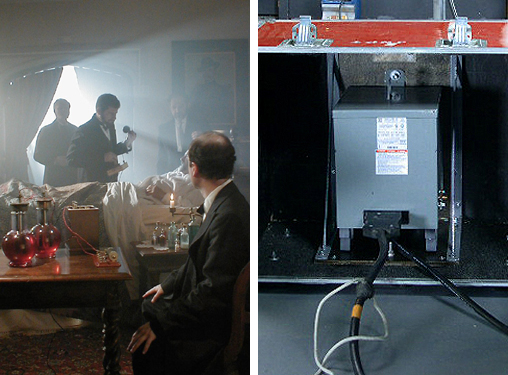
Transformer-Distro_Sam1.jpg

Scene from "Unsolved History" powered from 50A/240V range outlet through step-down transformer/distro


There are benefits to be gained by powering even 4kw electronic ballasts (PFC or not) on 240V circuits through a 240v-to-120v step down transformer. For instance, you will be able to run additional large lights (like 1.2kws) on the same circuit if, rather than plugging the 4kw electronic ballast directly into the 240 receptacle (operating it at 240V) and monopolizing it, you plug it in through their 60A Full Power Transformer/Distro (operating it at 120 Volts), you will be left with 25 - 37 Amps to power additional lights on the same circuit. That’s a lot of additional power to waste by plugging the 4k directly into the 240V receptacle. And, since an electronic ballast “ramps up” gradually during the striking phase, you don’t have to leave head room as you would with a magnetic ballast. By operating the light through the Full Power Transformer/Distro you can more fully utilize the capacity of 240V circuit. For example, since the P2L 4/2.5 LVI ballast at 120V operates a 4k HMI luminary at 37 amps, you will still be able to power an additional 1.2kw HMIs (if operated by P2L 575/1200 ballast (11 Amps)), as well as a 800 Joker HMI (if operated by a P2L 800/1200 ballast (8 Amps)), off of the same circuit. That’s a lot of additional light to be gained by not plugging the 4k directly into the 240V receptacle.

Transformer-Distro_Sam2.jpg

4k & 1.2ks HMI Pars powered from 30A/240V dryer outlet through step-down transformer/distro for Bose still shoot.

A transformer/distro will also greatly simplify your set electrics by automatically splitting the load of whatever you power through it. As long as you plug lights in through the transformer, you no longer have to carefully balance the load over the two 120V circuit/legs because the transformer does it for you automatically. If, like SL&G’s 60a Full Power Transformer/Distro, the transformer is outfitted with a 60 Bates receptacle, you can use 60A GPC extension cables, 60-to-60 Splitters, and fused 60A GPC-to-Edison Breakouts (snack boxes) to run power around set - breaking out to 20A Edison outlets at convenient points (rather than one central point.) The best part about using a transformer with a 240V receptacle in this fashion is that no matter where in the distribution system you plug in, the transformer automatically balances the additional load, so that you don't have to. It is so simple that you don’t have to be an experienced electrician to distribute power on set. Use this link for more details about using step-down transformers on set: www.screenlightandgrip.com/html/hd_plug-n-play_pkg.html

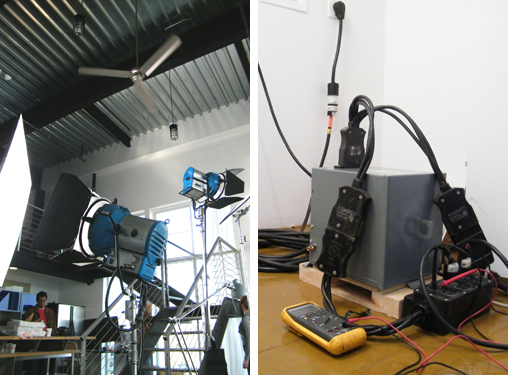
HD_PP_Demo_Transformer-Distro.jpg

A PFC 2.5 & 1.2 HMI Pars, PFC 800w Joker HMI, Kino Flo Flat Head 80, 2 ParaBeam 400s, and a ParaBeam 200 powered by a modified Honda EU6500is through a 60A Full Power Transformer/Distro

Everything I have said thus far is also true when it comes to operating HMIs off of portable gas generators with 240V outputs. Where before you could not operate more than a couple 1200W HMIs on portable generators because of their limited 120V power outlets, with SL&G’s step-down tranformer/distro now you can operate bigger lights, or more small lights, than has ever been possible on portable gas generaotors. And if the generator is one of their modified Honda EU6500is inverter generators, you will be able to run a continuous load of up to 7500W as long as your HMI and Kino ballasts are Power Factor Corrected. But, where I have covered this in another post in this forum I won’t go into more details here. For more details read my posts at http://reduser.net/forum/showthread.php?t=35706 and I suggest you read ScreenLight & Grip’s very informative newsletter articles on the use of portable generators in motion picture production. Where the power issues it discusses have been vexing set electricians for years, I highly recommend that anyone responsible for generating power on a set, whether large or small, read this article. The article is available at www.screenlightandgrip.com/html/emailnewsletter_generators.html.

- Eileen Ryan, Boston Gaffer
 
2.5kw is pretty much the highest one that can be rigged off household power and somewhat easily put together by one person. Even then (I own one), i dont bust it out that often. Now 1.2kw would be great to own a pile of

maybe in houses in Hawaii but 2.5k will throw a breaker anywhere in LA actually 1.2k is as big as you can get off house and 1 per circuit

new arri 1.8k par or Max have 19amp draw and would work too but they are new and still pricey
 
do I buy two?

Im not a gaffer.. I dont have a truck.. but i like to have my own lighting for personal spec commercials.. think i have a good price on these..

2 of them...


Hour meter reading?
You know it will run you around $3000.00 for a replacement lamp for one of them or $6000,00 to replace both bulbs.

I could think of so many more useful lighting instruments for a personal light kit.
 
Eileen, I've been reading your very well crafted comments on HMI lighting. You and others talk about the energy efficiency, but what about the added labor time to gel the lights to keep the kelvin constant----or, hopefully, is there a lot of wiggle room here before gels are needed. Thanks again for all the time you've taken to help all of us RedUser readers.
 
12k HMI

12k HMI

You and others talk about the energy efficiency (of HMIs), but what about the added labor time to gel the lights to keep the kelvin constant.

I’m not sure exactly what you mean by “the added labor time to gel the lights to keep the Kelvin constant.” If you mean gelling a 5500K source to 3200K for white “light” for night shooting, it would in fact be better to use 5500K light sources, like HMIs, for white “light”, since the Red’s native color balance is 5000K. This requires a different approach to lighting a night scene than is traditional. A gaffer I work with, Guy Holt of ScreenLight & Grip, posted on this very topic on cinematography.com. To paraphrase what he said on the topic: In the past, it was customary to use 3200K light sources for night shooting because most high speed films and video imaging systems were balanced for 3200K. With this traditional approach HMIs were used to create blue moonlight and tungsten lights were used to create white or slightly warm lamp-light. In this approach CTO gels are used to either make the HMIs less blue or the tungsten warmer.

But, using tungsten light sources for a night scene when the Red’s native color balance is 5000K doesn’t make a lot of sense. Balancing tungsten to 5000K is not very efficient because full CTB cuts the output of the light by 70% in converting it to 5000K. A 1000W 3200K light becomes a 300W 5000K light when you put Full CTB on it. A 400 W HMI will give you considerably more lumens/watt than a color corrected Tungsten 1k, and use up a lot less power available from your generator. It makes more sense to use HMIs to light for the Red’s native color balance of 5000K because they provide more lumen/watt and require less filtration with gels. In this approach raw HMI light would provide white light, Half CTB gel would provide moonlight, and Qtr. CTO gel would provide warm lamp light.

The downside to using HMIs to light for the Red’s native color balance of 5000K is they are considerably more expensive then tungsten lights to buy or rent. I find Kino Flo florescent light fixtures to be a cost effective alternative to HMIs because they can use either 3200K or 5500K tubes, are cheaper to buy or rent, and you don’t need to lose output to gelling the lights. For instance, when using 5500K tubes to light for the Red’s 5000K native color balance, you can warm the lights without losing output to CTO gels by simply mixing in 3200K tubes with the 5500k tubes.

HD_PP_Demo_SetUp_Night.jpg

A PFC 2.5 & 1.2 HMI Pars, PFC 800w Joker HMI, Kino Flo Flat Head 80, 2 ParaBeam 400s, and a ParaBeam 200 powered by a modified Honda EU6500is through a 60A Full Power Transformer/Distro

On a recent independent short shot on the Red I used a lightng package (pictured above) that consisted of a combination of HMI and Kino Flo fixtures. It consisted of a 2.5kw, 1200, & 800 HMI Pars (with PFC ballasts), a couple of Kino Flo Parabeam 400s, a couple of Parabeam 200s, and a Flat Head 80. Given the light sensitivity of the Red Camera, this was all the light we needed to light a large night exterior and the whole package was powered by ScreenLight & Grip’s modified Honda EU6500is.

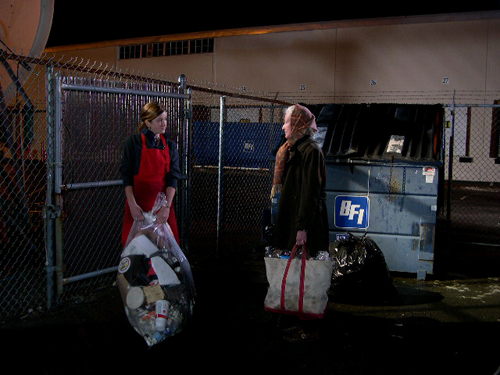
HD_PP_DemoWS.jpg

Wide Shot of Night exterior scene lit with ScreenLight & Grip’s HD P&P Pkg.

We used the 2.5 HMI par to light the deep background, the 1200 HMI par to light the near background, and the 800 Joker was mounted on a Source 4 Leko with a bug-a-beam adapter to create a window pattern on the ground from a building that doesn’t exist but you don’t see that in the movie. We used two Parabeam 400s to key the talent and a Kino Flo Flathead 80 to fill the entire scene.

HD_PP_DemoCU.jpg

Two Shot of Night exterior scene lit with ScreenLight & Grip’s HD P&P Pkg

The drawback I find to using conventional florescent light fixtures to light night scenes is that they generally have a very broad soft light output that drops off rapidly which means the units need to be positioned close to the subject they are lighting. This characteristic makes them better suited to lighting documentary interviews than dramatic night scenes. The one exception to that rule are the Kino Flo ParaBeam fixtures. The Kino Flo ParaBeam fixtures use computer aided designed (CAD) parabolic reflectors that focus the light output at about 16 feet (5 meters). This feature makes the Kino Flo ParaBeams well suited for HD Digital Cinema, because it doubles the light output of the lamps where it is needed most for lighting dramatic scenes - at a medium distance. Compared to the Kino Flo Diva-Lite, which uses the same four 55 Watt compact lamps and the same ballast, the ParaBeam 400 is twice as bright at 12' – making them a suitable key source for lighting dramatic scenes. Kino Flo also makes available for the ParaBeam fixtures a number of innovative accessories that enhance their production capabilities for HD Digital Cinema. Accessories include barndoors, a gel frame, a diffusion panel, and Honeycomb Louvers. Honeycomb Louvers are available in 90, 60 and 45 degrees and provides beam control similar to that of swapping lenses on an HMI Par.

HD_PP_Demo_Transformer-Distro.jpg


A Distro System consisting of a 60A Full Power Transformer/Distro, 2-60A GPC (Bates) Splitters, 2-60A Woodhead Box distributes power from a modified Honda EU6500is. Even though the generator is 100' away to reduce noise, plug-in points remain conveniently close to set.


We balanced the color temperature of the lights to the Red’s native 5000K color balance as follows: the 2.5 & 1200 Pars were gelled with ½ CTB for moonlight. We put half CTO on the Joker 800 to create warm window light. We mixed 3200K tubes into the Parabeam 400 on the “window” side to create a warm key source motivated by the window. The Parabeam on the other side was gelled with ¼ CTB to create a cool key source motivated by the moonlight. Finally, we lamped the Flathead 80 with only 5500K tubes to create a slightly cool fill. To see the final results, use this link - www.screenlightandgrip.com/html/hdfilmstrip4lg.html - to ScreenLight & Grip’s website where they have posted more detailed information on the lighting package we used along with production stills from the movie.

Eileen Ryan, Gaffer, Boston
 
12k hmi - Parabeam alternative Part 1

12k hmi - Parabeam alternative Part 1

I find Kino Flo florescent light fixtures to be a cost effective alternative to HMIs because they can use either 3200K or 5500K tubes, are cheaper to buy or rent, and you don’t need to lose output to gelling the lights.

I would like to mention two benefits to the new Kino Flo Parabeam fixtures that Eileen fails to mention in her otherwise very informative post. But, first in the interest of full disclosure, I should say at this point that in addition to being a gaffer, I own and operate ScreenLight & Grip – the rental house Eileen mentions that rents and sells the equipment she recommends above. If what I am about to say sounds like I’m hyping the Kino Flo product line it is not because we rent and sell them. We are dealers and rental agents for just about all the major brands. As a professional Gaffer of a lot of tight budgeted historical documentaries for PBS’ American Experience and The History Channel (see my “credit-entials” on Imbd), I think it is worth noting that the Kino Flo Parabeam fixtures are a viable alternative to HMIs when used with the new inverter generators because they offer low budget independent filmmakers a more affordable alternative to HMI lighting.

My recommendations are based upon extensive research I have done on the use of portable gas generators in motion picture production. For this research, I ran a series of tests in order to analyze the interaction of conventional AVR generators (a Honda EX5500 with Crystal Governor), as well as inverter generators (a Honda EU6500is), with the prevalent light sources available today. I have compiled the results of my tests in an article for my company newsletter and it is available on our website at:http://www.screenlightandgrip.com/html/emailnewsletter_generators.html

Based upon my research and tests, I have found that what distinguishes the Parabeam fixtures from other fluorescent lights is their throw, power efficiency, and the innovative accessories Kino Flo makes available for the fixtures. Where Eileen has already discussed their unprecedented throw and the versatile accessories Kino Flo has developed for these fixtures (barndoors, a gel frame, a diffusion panel, and Honeycomb Louvers), I would like to highlight their extreme power efficiency and lack of harmonic noise.

A Parabeam 400 generates as much light at 16’ as the 4’ 8-Tube Kino Flathead 80 fixture, yet uses less than a quarter of the power (2 Amps verses 9.2 Amps.) While the seven amp difference is not a major consideration when using house power, it can make a huge difference when your power is limited (coming from a portable generator) because you can use four Parabeam 400s for the same power as a 4’ – 8 Bank Kino Flathead 80. The Kino Flo is able to obtain such efficiency in their Parabeam fixtures by incorporating Power Factor Correction circuitry into their ballasts. As it does in HMI ballasts, this advanced electronics contributes to a more economical use of power than Kino Flo’s conventional electronic ballasts and reduces the return of harmonic currents into the power stream. With a Power Factor Rating of over .9, the Parabeam fixtures are especially well suited for use on small portable generators.

All Kino Flo fixtures are a good choice for operation on small portable generators in the limited sense that they use a quarter of the power of a comparable tungsten soft light. However, the ballasts of the older style Kino Flo fixtures that use the T-12 tubes (the Single, Double, and 4 Bank Fixtures, the Wall-o-Lite, Flathead 80, and the Image 20, 40, & 80 fixtures) are not power factor corrected and return harmonic currents into the power stream. When used in quantity, as in studio chroma key productions, they can constitute a source of considerable harmonic noise in the power streams of studios. For this reason, Kino Flo cautions users, on their website: “Kino Flo ballasts are generally not power factor corrected. They will draw double the current on the neutral from what is being drawn on the two hot legs. On large installations it may be necessary to double your neutral run so as not to exceed your cable capacity.”( FAQ “Why is the neutral drawing more than the hot leg” at http://www.kinoflo.com/FYI/FAQs.htm#2) For a detailed explanation for why harmonic currents cause unusually high neutral returns see my article on the use of portable generators in motion picture production available at http://www.screenlightandgrip.com/html/emailnewsletter_generators.html


wwaveform_no-load.jpg

Left: Grid Power w/ no load and a THD of less then 3%. Center: Conventional Generator w/ no load and a THD of 17-19%. Right: Inverter Generator w/ no load and a THD of 2.5%.​

When you plug a single 4’ - 4 Bank Kino into a wall outlet you need not be concerned about harmonic currents. As is the case with non-PFC HMI ballasts discussed elsewhere in this forum (http://reduser.net/forum/showthread.php?t=35706), the impedance of the electrical path from the power plant is so low, the distortion of the original voltage waveform so small (1-3%), and the plant capacity so large in comparison to the load of the one light, that the inherently noisy load of the 4’- 4 Bank Kino will not affect the voltage at the distribution bus.

wwaveform_kino.jpg

Left: Grid Power w/ Kino Flo Wall-o-Lite. Center: Conventional AVR Power w/ Kino Flo Wall-o-Lite. Right: Inverter Power w/ Kino Flo Wall-o-Lite.​

It is, however, an all together different situation when plugging Kino Flo T-12 fixtures into conventional portable generators. As a comparison of the oscilloscope shots above indicate, the return of harmonic currents by conventional Kino Flo T-12 ballasts can generate voltage distortion in the power stream. Given the large sub-transient impedance of conventional portable generators, and the fact that the original supply voltage waveform of conventional generators is appreciably distorted (a THD of 17-19%) to begin with , you have a situation where the return of any harmonic currents by a non-PFC electronic ballast (HMI or Kino) will result in significant waveform distortion of the voltage in the distribution system. Where I am just about out of space I will have to explain how the Parabeam Fixtures resolve this issue in a subsequent post.

Guy Holt, Gaffer, ScreenLight & Grip, Boston
 
12k hmi - Parabeam alternative Part 2

12k hmi - Parabeam alternative Part 2

Where I am just about out of space I will have to explain how the Parabeam Fixtures resolve this issue in a subsequent post.

Given the effect of just one 10–tube Kino Flo Wall-o-Lite with non-pfc electronic ballasts on a 5500W conventional generators (below), what would be the accumulative effect of a typical lighting load on a generator?

wwaveform_kino.jpg

Left: Grid Power w/ Kino Flo Wall-o-Lite. Center: Conventional AVR Power w/ Kino Flo Wall-o-Lite. Right: Inverter Power w/ Kino Flo Wall-o-Lite.​

To see, I ran a package consisting of two Arri 1200 Par Pluses with standard Arri non-PFC electronic ballasts in addition to the Kino Flo Wall-o-Lite on the Honda EX5500 (a conventional generator). And, for the sake of comparison, I ran the same package but with power factor corrected electronic ballasts on the EU6500is ( our inverter generator.) The difference between the resulting waveforms below is startling.

The adverse effects of the severe harmonic noise exhibited below left, can take the form of overheating and failing equipment, efficiency losses, circuit breaker trips, excessive current on the neutral return, and instability of the generator’s voltage and frequency. For these reasons it has never been possible to reliably operate more than a couple of 1200W HMIs on a conventional 6500W portable gas generator. Harmonic noise of this magnitude can also damage HD digital cinema production equipment, create ground loops, and possibly create radio frequency (RF) interference.

waveform_pkg_comp_AVR_In.jpg

Left: Conventional generator power w/ pkg. of non-PFC Elec. HMI Ballasts & Kino Flo Wall-o-Lite. Center: Scope time base adjusted to bring elongated waveform back on screen. Right: Inverter generator power w/ Pkg. of PFC Elec. Ballasts & Kino Flo Parabeam 400.​

Why are harmonics suddenly an issue in motion picture electrical distribution systems? First, one must appreciate that the power generation and electrical distribution systems developed for motion picture production were never designed to deal with an abundance of non-linear loads like electronic HMI and Kino Flo ballasts. It’s a problem that has only recently begun because of the increasing use of these types of non-linear lighting loads. The problem is being further compounded by the increasing prevalence on set of sophisticated electronic production equipment like computers, hard drives and HD monitors which are themselves sources of harmonic distortion. The increasing use of these microprocessor-based equipment in production has created an unprecedented demand for clean, reliable power on set.?

It is worth noting in the oscilloscope shots above that the distortion of the voltage waveform is considerably less in the case of the inverter Honda EU6500is generator (far right) than that of the conventional Honda EX5500 generator (left.) The reason for this is that, as discussed at length in my article, the original waveform of the power generated by the EU6500is (an inverter generator) has less harmonic distortion at the outset than that originally generated by a EX5500 (conventional generator.) For this reason, when your lighting package consists predominantly of non-linear light sources, like HMI and Fluorescent lights, it is important to have power factor correction (PFC) circuitry in the ballasts (HMI & Kino) and operate them on inverter generators like our modified Honda EU6500is. The combination of improved power factor and the nearly pure power waveform of inverter generators makes it possible to power larger lights, or more smaller lights, than has been possible before on a small portable gas generator.

For example, the substantial reduction in line noise that results from using power factor corrected Kino and HMI ballasts on the nearly pure power waveform of an inverter generator creates a new math when it comes to calculating the load you can put on a generator. In the past we had to de-rate portable gas generators because of the inherent short comings of conventional generators with AVR and Frequency governing systems when dealing with non-PFC electronic ballasts. The harmonic distortion created by non-PFC ballasts reacting poorly with the distorted power waveform of conventional AVR generators (as evident in the oscilloscope shots above) limited the number HMIs and Kinos you could power on a portable generator to 60% of their rated capacity (4200Watts on a 6500W Generator). But now, that inverter generators have virtually no inherent harmonic distortion or sub-transient impedance and power factor correction (PFC) is available in both small HMI and Kino Flo ballasts, this conventional wisdom regarding portable gas generators no longer holds true. Where before you could not operate more than a couple 1200W HMIs with non-PFC ballasts on a conventional generator because of the consequent harmonic distortion, now according to the new math of low line noise, you can load an inverter generator to capacity. And if the generator is our EU6500is inverter generator, you will be able to run a continuous load of up to 7500W as long as your HMI and Kino ballasts are Power Factor Corrected.

According to this new math, when you add up the incremental savings in power to be gained by using only PFC ballasts, and combine it with the pure waveform of inverter generators, you can run more lights on a portable gas generator than has been possible before. For example, the 7500W capacity of our modified Honda EU6500is Inverter Generator can power a lighting package that consists of a PFC 2.5kw HMI Par, PFC 1200, & 800 HMI Pars, a couple of Kino Flo ParaBeam 400s, a couple of ParaBeam 200s, and a Flat Head 80. And as Eileen attests above, given the light sensitivity of HD cameras, this is all the light needed to light even a large night exterior. (For more details on how this is accomplished I suggest you read my newsletter article on the use of portable generators in motion picture production. The article is available at http://www.screenlightandgrip.com/html/emailnewsletter_generators.html

Given how well Kino Flo Parabeam ballasts interact with inverter generators, not to mention their versatility (they can operate both 5500K & 3200K lamps) and their efficiency (they consume 1/10 the power of comparable incandescent soft lights), Kino Flo Parabeam lights would appear to be an ideal light source to operate off of portable inverter generators.

Guy Holt, Gaffer, ScreenLight & Grip, Boston
 
Back
Top