Welcome to our community

Be a part of something great, join today!

  • Hey all, just changed over the backend after 15 years I figured time to give it a bit of an update, its probably gonna be a bit weird for most of you and i am sure there is a few bugs to work out but it should kinda work the same as before... hopefully :)

ISO, ISO...

while talking about 2/3" and noise, will it be straighforward and not painfull to up-res from 3k to 4k (in order to be able to mix Red One, Scarlet/Epic 4/5k and Scarlet 3k footage, in the same movie)? and to what extent image quality is expected to be perceived as not inferior (3k), regarding to noise and high ISO?
Is there any rough expectation about noise and sharpeness in such an ensamble already?

To what extent it is suggested to mix resolutions in a project in order to still have a reasonable sense of homogenety? Are there any suggested limits?
I understand 28k Epic at 320 ISO and 3k Scarlet at 4000 may not match too well, but who knows? since you have recently been pushing the noise further way, week after week, I wonder if noise would ever be an issue in the future, possibly leaving resolution and/or sharpness the main (only?) difference between the different camera brains.
 
... use a touch of NR, ISO 4000 is useable. No question.

Just technical curiosity; Does it matter whether NR is made within the camera before (the wavelet) compression or afterwards in post? Or, in other words, does compression affect the character of noise?

Another related question, say one is shooting stars say 24fps. If one adds 96 consequtive frames above each other, what is (if any) the difference compared to a 4 seconds exposure? This boils down to the question, is there statistically a difference in noise between the addition of compressed frames/long exposure?

That's a really interesting question. (or rather, 2 really interesting related questions :-)
 
while talking about 2/3" and noise, will it be straighforward and not painfull to up-res from 3k to 4k (in order to be able to mix Red One, Scarlet/Epic 4/5k and Scarlet 3k footage, in the same movie)? and to what extent image quality is expected to be perceived as not inferior (3k), regarding to noise and high ISO?
Is there any rough expectation about noise and sharpeness in such an ensamble already?

To what extent it is suggested to mix resolutions in a project in order to still have a reasonable sense of homogenety? Are there any suggested limits?
I understand 28k Epic at 320 ISO and 3k Scarlet at 4000 may not match too well, but who knows? since you have recently been pushing the noise further way, week after week, I wonder if noise would ever be an issue in the future, possibly leaving resolution and/or sharpness the main (only?) difference between the different camera brains.

I would not plan on up-ressing 3K footage to match 4K. It is a much better idea to plan to use both at 2K. There are two good reasons for this:

1.) Because it uses a Bayer-pattern imager, 4K RED footage contains about 3.2K of real resolution. 3K RED footage contains about 2K of real resolution. Using both at 2K will improve the "sense of homogeneity" as you call it.

2.) Reducing the size of a digital image reduces noise. (This is essentially because some of the noise is such small detail that it is lost in the reduction.) So reducing both will improve the noise levels in both. This is a good thing in itself, but if you consider that noise is one of the most significant limiting factors for dynamic range in a digital sensor, reducing the images will (slightly) improve the dynamic range of your images.
 
okay, but in this way you are basically giving away the resolution of 4k (5k, 6k...) for a cleaner image.
Let's say the weakest ring of the chain, which is the 3k image, is already super clean (no less than the 4k).
So, if this is the case, I may be giving away resolution for what? possibly for nothing.
When uprezzing, I'm not adding details of course, I'm just making the image bigger, in order to match the size of the 4k footage.
This gives no direct advantage, but a indirect one: that is, being able to preserve all the original details in the higher resolution footage.
Further, at the very end, it might be possible to add some sharpening just to the up-ressed footage in order to compensate for the relative softness that the audience may otherwise perceive.
Also, this will be necessary only if we take for granted that the unknowing audience may be able to notice a difference between two images which are already both at a very high resolution. I'm not so sure about that.
Finally, when doing the color processing in post production, if contrast is to be enhanced, than that would be a more natural and implicit of making the image sharper anyway, and actual sharpening may even not be necessary anymore.
This is only my opinion, of course. Since I should try playing with 3k+ images in photoshop to have a better idea of how the difference between those resolutions look like really and if there is room enough to cheat the necessary bit...
Regarding noise, if using a normal, superclean ISO, I feel pretty safe.
 
3k is not extremely smaller than 4k. 4976640 pixels against 8847360. Not so bad! That is 1.7 higher resolution of moving images.

If we consider a fine, processed 3k footage "soft", than 2k projections and HD must all be considered unacceptable, being obviously softer.

With some tricks to help 3k, they might intercut well.
We are not comparing a high resolution image to a low resolution image, but high resolution to even higher resolution, so there should be no softness perceived.

at these high spatial frequency, it's not very easy for anyone to tell the "lines"
D Fuller, your solution is be the best one in cases where noise is an issue: we can cut some noise away by reducing everything to 2k.
BUT, at the same time, the noise you cut away has the same dimensions of the resolution that you cut away, so: where you were able to see that noise, now you will perceive a softness, or at leat you have lost resolution that you previously were able to see.
On the opposite, if you can't see a resolution difference after the reduction, then you wouldn't have been able to see that noise anyway.
This happens when noise you cut away and the details you cut away have the same dimension. You either see both (and loose both), or they are both too small to be seen.

But with the very recent advancement in this department, which raised the common lower bar of what is possible, I really feel and want to push, push, push, and never go back; and now that I am free from noise more than I ever imagined, I start to look at resolution challenges with more relax.
Does this make sense?
 
Just technical curiosity; Does it matter whether NR is made within the camera before (the wavelet) compression or afterwards in post? Or, in other words, does compression affect the character of noise?

Yes I would think to some degree it would be better. Wavelet compression will nuke a bit of your noise since it's the least significant details. What that really means is that the really fine noise will be polished but the more obnoxious noise will remain and get a little fuzzy and merged etc. Fuzzy noise is harder to reduce later since it is larger and appears to be real image data.

I had to work with a Red shot that was evidently shot at about 2k-3k ISO for a tv spot. Furnace_denoise did a great job on the fine noise but the larger noise was too heavily compressed and was pretty much impossible to remove without attacking important image details. If it hadn't been compressed at all the algorithm would have had an easier time on pixel sized noise.

But the best noise reduction algorithms look at multiple frames. So in an ideal world you would have no compression before noise reduction but there isn't really a practical way to do it in camera without holding a few uncompressed frames in buffer. It's also far from real-time.
 
Regarding, astrophotography possibilities with the Scarlet, I am looking forward to testing one at 4000 ISO. The issue with stellar time lapses is that to acquire enough data you need to expose between 25-27 sec per frame (no moon). At high ISO like 1500 to 3000 the results are usually to noisy to use. I have found that working at 800 ISO with the Canon DLSR (1DsMIII/5DMII) is the sweet spot for noise to exposure.

See one of our recent time lapses here: http://files.me.com/interstellarstudios/r5tqe7.mov

The prospects of shooting a Scarlet at 4000 ISO with comparable 800 ISO noise level means that the filmmaker can shoot two frames worth of footage (say 15 sec each) vs one at 27 sec. The result will be smoother time lapse when played back at 24/30 FPS. Can't wait to see it!
 
okay, but in this way you are basically giving away the resolution of 4k (5k, 6k...) for a cleaner image.

Yes. Exactly. And its a trade I would make any day. And the most important reason is that even at low, clean ISOs, noise is the factor that limits dynamic range. You can only protect highlights to the degree that you can lift the shadow detail out of the noise floor. By up-rezzing, you amplify noise, and by down-rezzing, you reduce it. If you've ever seen 16mm and 35mm intercut on TV, you're seeing a demonstration of that effect. Even though both have more resolution than the TV image, the 35mm looks better when both are scaled. A lot of that is the result of more of its dynamic range being preserved. Why? Because being less noisy (grainy) its contrast doesn't have to be increased to squash the grain, and that lets more of both highlight and shadow detail be preserved.

It is very hard to intercut footage with differing dynamic ranges and get them to feel like they're part of the same scene.

We are not comparing a high resolution image to a low resolution image, but high resolution to even higher resolution, so there should be no softness perceived.

at these high spatial frequency, it's not very easy for anyone to tell the "lines"

You are correct, and if we were making movies of test charts, that would be the end of the story. But resolution doesn't appear to the audience as "lines" in the sense that a test chart has lines, but as edge sharpness. It's the acuity that defines the crisp edge of a shape against the out-of-focus background, or that defies the texture of a fabric. Or that defines the wrinkles of an old man's face.

D Fuller, your solution is be the best one in cases where noise is an issue: we can cut some noise away by reducing everything to 2k.
BUT, at the same time, the noise you cut away has the same dimensions of the resolution that you cut away, so: where you were able to see that noise, now you will perceive a softness, or at leat you have lost resolution that you previously were able to see.
On the opposite, if you can't see a resolution difference after the reduction, then you wouldn't have been able to see that noise anyway.
This happens when noise you cut away and the details you cut away have the same dimension. You either see both (and loose both), or they are both too small to be seen.

Quite the opposite is true. Because of the pointillistic nature of noise and the linear nature of resolution, noise is reduced in all dimensions, which has the effect of reducing it overall, while acuity (the rendering of fine lines that we perceive as detail) is preserved. Even a camera as good as the Nikon 3Dx, a 24.4 MP camera, benefits from downsampling. It gets cleaner. Here's a link to an article comparing downsampled D3x images to 3D images. The difference is significant.

By all means, do some testing for yourself, and if you find that for your final output target you get better results by uprezzing, then do it. But don't be seduced by the idea that resolution is the only important aspect of photography. It's not. But starting with more resolution than you need can help you achieve improvements in those other characteristics, like dynamic range, as well. Because starting with more information than you need in the end allows you to choose what to keep and what to discard.
 
The only thing hes not telling us is that he shot this while the sensor was refrigerated to -20C ^_^
 
Even a camera as good as the Nikon 3Dx, a 24.4 MP camera, benefits from downsampling. It gets cleaner. Here's a link to an article comparing downsampled D3x images to 3D images. The difference is significant.

By all means, do some testing for yourself, and if you find that for your final output target you get better results by uprezzing, then do it. But don't be seduced by the idea that resolution is the only important aspect of photography. It's not. But starting with more resolution than you need can help you achieve improvements in those other characteristics, like dynamic range, as well. Because starting with more information than you need in the end allows you to choose what to keep and what to discard.

I totally agree, I know well the benefit of resolution downsampling for acutance. As a photographer, I practice downsampling all the time.

But I have the impression that the noise level and type play a part in what is better to do. Perhaps is noise is an atomized tempest, a little downsampling may just cut the trouble away, and than it may even be worthwhile to up-res again. Or a good noise reduction may solve it.

Anyway this is still not the case witha a super clean image, where there is no noise.
Some say that 4k with bayer is not real 4k. I partially agree, since technically it's not.
But, if the image is clean, it's so easy to make bayer 4k look as sharp as downsampled 4k or monocrome-type 4k cameras, that I'm pretty comfortable at calling it 4k.
Of corse I think the same for 3k.

That said, I think a clean 3k can be up-ressed to 4k succesfully - well at least in photoshop; I don't know what it will be like with Red Scarlet and Red One.
If there is no noise to be increased, it will not increase.

I think a given acuity, which is ALWAYS related to it's optimized image size - that's why when I up-res, the RELATED acuity decrease (the new image has less acuity), is less and and less important as the original resolution was high.
I can distinguish a person from another in a group of ten or one hundred (low resolution)
I will never be able to distinguish a person looking at a square full with a million people (high resolution).
I certainly agree with most of your theory as well as with most established theory,
but not to your conclusion:
I think for a prject that was shot 90% at 4k and 10% at 3k, I'd prefer to stay with 4k and up-ress only that little bit.
It's not like up-ressing a 10% from, say, 1 megapixel to 1,3 megapixel: even if the jump is proportionally the same, at this low spatial frequency it is much easier to notice a difference in resolution or acuity - we may just consider acuity as ratio between resolution and image size.

Also, a more trivial reason could be uniformity in the worklow and the process.
Usually, Super 16mm features were, and still are, blown up to 35 for theatrical release.
The importance of acuity, especially if not bounded to resolution, has a lot of limits, otherwise all movies shot on 35mm would be reduced to Super 16mm to gain some acuity. There is always a point where, running behind acuity, we start to loose real bits of information. That's why to me resolution is more important than acuity. You can alsways make the resolution more visible with some tricks which enphasize acuity, but you cannot gain real bits of information from acuity alone.
Yes, in a certain way I let resolution seduce me, spoil me, because if I have enough abundance of data for my eyes to be mega happy, I can do whatever I want.
To me, 3k is minimum for theatrical release, and I mean 3k videoprojection.
I can see the pixel matrix of 2k if I watch from front sits. When I saw Blade Runner remastered in high definition this happened.
But the world will skip 3k projection and will go for 4k, and this can't be bad at all.

For similar reason, I may not be able to see beyond 3k even from the front sits.
If that's the case, uprezzed 3k to 4k will be absolutely the same as native 4k for my eyes. Of course, if there was no noise is the 3k, otherwise - you're right - noise will increase.

I think it's a lot about quantity, or to be more precise, we are at a point where, quantity not only can make contingent problems dissolve in the mass, but quality now really sort of depends on quantity, is triggered by quantity.


Every time a make an enlargement of a picture, if the original file was at very high resolution and was not degraded, I can afford not to care about resolution, no matter what size I will print it at. If resolution is high, it is high.

if it was alredy fine for 2 meters high, should I enlarge a print to skyscraper size, resolution would be fine too.
If resolution was poor for an medium size print, I will be poor for everything exept for the smallersizes. Hey, acuity is highest there: but this doesn't mean they are the richest. Quite the opposite. They are poorer than the original file, because they even cut away part of the already low resolution.

If acutance is less than 100%, it doesn't matter at all, since what is perceived as rich image, richer than what we can see, it doesn't have to be optimized.
I mean: it would be worse if a size reduction cut away sothing, and anything above 100% acuity is just lost data.

Thankfully, we are past the point where big screen projection was a problem and acuity would play a dominant role, being impossibly to go over 100% as there was no high resolution to reduce.
 
I correct myself
- we may just consider acuity as ratio between resolution and image size.
yes, but with a note: beyond a certain point of reducing size - which is when acuity reaches 100% - both resolution and acquity (since acuity is always equal or lower than resolution, unless it is artificially created; but I don't like when acuity is a mere, flat simulation of edges) will start to decrease.
There is no point in downsampling beyond the point where acuity has already reached 100%. Anything further is only a definitive loss of true details.
100% acuity only means that the full potential of a given size is reached, and that's all.
 
That is fucking ridicolous. Hahaha...

...

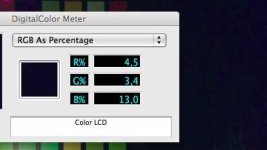
Why are the blacks so blue? Work in progress I suppose.

This is fantastic.

re-cal your mointor the trim looks black to me :biggrin5:
 
if I do a colorpic in "Digital Color Meter" it sure looks like there is some blue on the right side.

Not sure the point of beating a dead horse. As stated and seemingly not read...camera firmware in the middle of development, hacked together prototype, wrong OLPF, and I'm getting yelled at by the team for getting excited and posting these images because they insist people will pick them apart. I said "no they won't." Please stop. You're making me look stupid and I don't like it.

Jim
 
Jim, I honestly don't know why some people participate in online forums. Reading comprehension seems to be at an all-time low.
 
Back
Top