Welcome to our community

Be a part of something great, join today!

  • Hey all, just changed over the backend after 15 years I figured time to give it a bit of an update, its probably gonna be a bit weird for most of you and i am sure there is a few bugs to work out but it should kinda work the same as before... hopefully :)

Scarlet 2/3" Cinematography, the film look with deep DOF

Andrew Rieger

Well-known member
Joined
Oct 31, 2009
Messages
1,024
Reaction score
0
Points
0
Location
Pasadena, CA
In other forms, people are saying that the 2/3" scarlet will not be as cinematic as the S35. I have to disagree. Here are some great recent and old films shot using very deep DOF:

The Royal Tenenbaums
Zodiac
Collateral
Citizen Kane
The Last Picture Show
The Good German
Rumble Fish

These are recent films that I have seen that avoid shallow DOF (blurry backgrounds)

This post is intended to let other uses provide examples of a cinematic look without the shallow look that Hollywood and many indie film makers seem to be obsessed with.
 
David Mullen explained 2/3" DoF brilliantly:

Because of the shorter focal lengths used on a 2/3" camera to match the field of view on a Super-35 camera, a 2.5X magnification factor, you have an effective increase of depth of field on a 2/3" camera as if you stopped-down by 2.5-stops compared to Super-35. In other words, shooting at f/2.8 on a 2/3" camera, once you match field of view, looks like an f/5.6-8.0 split on a Super-35 camera.

So how shallow you can make the depth of field on a 2/3" camera, just as with any camera, will be controlled by how wide-open your lens aperture goes. Let's just say that an f/1.5-stop on the Mini Prime is close to an f/1.4-2.0 split. Therefore that would look like shooting at f/4.0 on a Super-35 camera.
 
Hi,

you can also focus in front of the subject, if you wish the background to be softer.

Stephen
 
Another notable film is Slumdog Millionaire (Oscar for best Cinematography). They used the SI-2K, a 2/3" camera, for most of its photography.
 
There is a huge amount of films done on 2/3" sensors. Scarlet 23 is going to look great.
 
Hi,

you can also focus in front of the subject, if you wish the background to be softer.

Stephen

And there is yet another "trick of the trade" one could use on any lens (fixed included) and format to get a shallower DOF if desired. (those versed in the arts know it well)
 
Well you could use a still camera lens for a 35mm photo cam to increase DOF. A 50mm still lens would become a 196mm lens due to the 3.93 crop factor. This would make the background more shallow for sure (not sure if it would make a significant distance over a standard Super 16mm lens or red mimi prime though).

Obvious downside is that yo need to back way up which is a problem for some situations (but may be beneficial if you are trying to film low key without drawing a lot of attention. For example, your two actors could be sitting at a cafe having a conversation and the actual camera could be a significant distance away and still look like like you were filming up close. Use a lav-mic set up to get the audio and everyone will think the actors are just talking and the camera guy is just taking pictures. People would have no idea a film was being made.)
 
Akira Kurosawa was a big fan of deep DOF and I believe many would argue that his films are quite "Cinematic". There are better examples, but these were just quick grabs.

photo-7samurai.jpg

Seven Samurai

rashomon.jpg

Rashomon

lowerkur-screen3.jpg

The Lower Depths
 
Another notable 2/3" film was "The Curious Case of Benjamin Button", granted that many of the movies shots were composites of some sort, I thought this was one of the most beautifully lensed films from last year.

screen-capture-31.png


bddefinitionbenjaminbutton-p1080.jpg


bddefinitionbenjaminbutton-m1080.jpg


curious-case-of-benjamin-button-2.jpeg


capture10.jpg


benjamin_button_2.png


benbuttonfx480.jpg
 
You're confusing wide-angle photography a bit with deep focus photography. There is a lot of the first in Kubrick's movies, and some of the second, but there are plenty of normal to shallow-focus close-ups in Kubrick's films, with soft backgrounds. Even in these medium shots, only one person is in sharp focus, though what else would you expect at f/0.7?

barrylyndon2.jpg


barrylyndon3.jpg


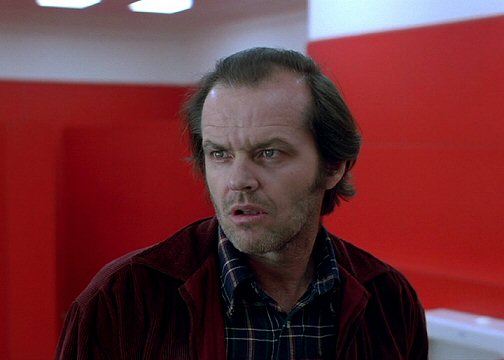
Just putting up some random frames I have, which show a conventional shallow-focus background in close-ups:

fullmetaljacket1.jpg


shining3.jpg


My point is that if I wanted to spend hours pulling frames from my DVD's, I could post hundreds of shots from Kubrick's post-2001 movies with normal to shallow-focus, so it's a bit of a stretch to say there isn't a single shot without deep focus in it. I seem to recall the twilight climax with the sniper in "Full Metal Jacket" having a lot of shallow-focus shots, particularly the slow-motion stuff.

"Deep focus" means that focus is reasonably sharp from the near foreground to the far background. Many of these "deep focus" examples people are posting only have subjects at a medium distance with no extreme foreground in focus as well. They are really wide-angle shots with compositions in depth, "deep framing", but that's not exactly the same thing as "deep focus", which only is possible with deep f-stops -- and considering Kubrick's interest in available light photography, a lot of his interior work was done at wide apertures and actually have a shallow depth of field, which is clear whenever he cuts to a close-up.

Kurosawa worked very hard to get deep focus photography in his movies, despite using telephoto lenses, but this required sometimes lighting to an f/22 stop on his sets. Kubrick was the opposite, preferring to use minimal lighting and fast lenses, so the depth of field is often on the shallow side, but the fact that he often shot with really wide-angle lenses in medium to wide framing made it harder to tell how wide-open the lens apertures were.

Staging and composing in depth, using wide-angle lenses, is a great look and a powerful narrative tool, but "deep focus" means something more specific technically.
 
Last edited:
wait a minute.. 2/3" is not as same as 35 deep dof

Roberto, I apologize if the point I was trying to make wasn't clear, because I was not trying to say that 2/3" is the same as 35 deep DOF. I was simply trying to make a point that non-shallow DOF has been used brilliantly for a long time. Then I posted the Benjamin Button frames, which were of varying depths of field, to simply show that a 2/3" camera can produce some amazingly beautiful and "cinematic" images.
 
My point is that if I wanted to spend hours pulling frames from my DVD's, I could post hundreds of shots from Kubrick's post-2001 movies with normal to shallow-focus, so it's a bit of a stretch to say there isn't a single shot without deep focus in it. I seem to recall the twilight climax with the sniper in "Full Metal Jacket" having a lot of shallow-focus shots, particularly the slow-motion stuff.

Perhaps I exagerated a bit saying you can't find them, but the frames you posted seem to me "regular" DOF that comes from lens with a longer focal distance. He doesn't seem to be intentionally making it noticeable or using it as a storytelling device as much you find these days.

If you compare these frames with the Vimeo, student short film stuff we're seeing, I consider it somewhat deep.

Kurosawa worked very hard to get deep focus photography in his movies, despite using telephoto lenses, but this required sometimes lighting to an f/22 stop on his sets. Kubrick was the opposite, preferring to use minimal lighting and fast lenses, so the depth of field is often on the shallow side, but the fact that he often shot with really wide-angle lenses in medium to wide framing made it harder to tell how wide-open the lens apertures were.

I guess you got it right there, since he shoots stuff mostly in wide shots, you can't tell it.

But I've seen so far four of his movies on Blu Ray a few times and I thought pretty much most stuff was in focus.

Since Kubrick was known to devote an extraordinary time to the production design and visual research of his films, it makes sense that he wanted us to see every detail there was on a particular set.

But yeah, I'm not a DP. =P
 
Last edited:
Well you could use a still camera lens for a 35mm photo cam to increase DOF. A 50mm still lens would become a 196mm lens due to the 3.93 crop factor. This would make the background more shallow for sure (not sure if it would make a significant distance over a standard Super 16mm lens or red mimi prime though).

Obvious downside is that yo need to back way up which is a problem for some situations (but may be beneficial if you are trying to film low key without drawing a lot of attention. For example, your two actors could be sitting at a cafe having a conversation and the actual camera could be a significant distance away and still look like like you were filming up close. Use a lav-mic set up to get the audio and everyone will think the actors are just talking and the camera guy is just taking pictures. People would have no idea a film was being made.)

DOF is a function of focal length, distance from the subject focal plane, and aperture. Unless you use a DOF adapter on a 2/3" camera to expand the field of view with 35mm lenses, you will not see any difference in DOF. A 50mm lense has exactly the same DOF characteristics on a 2/3" camera as on a 35mm camera, just a much more narrow field of view.
 
On the other end, you have Jacques Tati, going for a deep depth of field on 65mm in Play Time! Tati's films are composed entirely of wide shots, or at closest, medium shots. Not a single close-up. "Uncinematic"? Most certainly not. It was just a unique style that worked wonders.

In the end, it depends on what the director/DP feels is right for the shot.
 
Back
Top