Welcome to our community

Be a part of something great, join today!

  • Hey all, just changed over the backend after 15 years I figured time to give it a bit of an update, its probably gonna be a bit weird for most of you and i am sure there is a few bugs to work out but it should kinda work the same as before... hopefully :)

Shooting football on Red-Lens recommendations?

David Callahan

Well-known member
Joined
Jan 1, 2008
Messages
288
Reaction score
0
Points
0
Location
Oklahoma City, OK
I have the opportunity to shoot a major university football game this Thanksgiving weekend. I shot one game last year about a month after having taken delivery of our Red One. We have a Nikon mount, so I rented a Sigma 120-300 f 2.8 zoom (it was a night game) and had limited success. I missed a lot of shots b/c I couldn't zoom and focus at the same time. Since then, I have acquired a zoom motor and Preston microforce which makes things a lot easier.
This game will be during the day, so that opens up some lens options for me. I need to be fairly mobile and plan on overcranking most if not all the footage. Most likely be shooting at 3k, probably some 2k as well. I noticed on Gibby's equipment list, he mentions a Nikon 50-300 f/4.5 zoom. That seems to be a more versatile option, but I can't find one for rent anywhere... I do own a Nikon 80-200 f/2.8, but this isn't really long enough for most of the shots I'll need to do.

I would love to have some input from the community on good lens options for this game. Ideally, I don't want to change out lenses during the game, but might be able to pull it off if necessary. Will have to skip the mattebox and follow focus so will probably need some screw on NDs. Ideas?
Thanks all.
 
i think he meant the 70-300 f/4.5 zoom - i think these run about $600 - may be worth a look for its' value

80-400 sounds sweet though - i'd say this is some good glass to look through.
 
Having shot football from the sidelines, my inclination would be to Get a Red PL to B4 adapter and use a good HD ENG lens. You would have to shoot it all in 2k but that helps your slow mo. Also many ENG lenses are T1.8. Plus you would have the servo zoom hand grip in the right hand and focus with your left. If you had the light you can pop in the 2x for tighter shots. You would have to power up the ENG lens some how.

Good Luck,
Rich
 
Thanks for all the suggestions. I'm thinking I really need to stick to a fixed f/stop lens, otherwise I'll have exposure issues if I zoom in or out during a shot to follow action. Also, I'm wanting to go wider than 100/120 since I'll be shooting mostly in 2-3k to overcrank, but maybe I need to rethink that.

I've heard of some softness issues w/ the B4 mount. Anyone have experience w/ that, good or bad?
 
What about some great super 16 PL mount glass. I mean, haven't those NFL films guys captured the greatest football shots ever on that glass?

David
 
What about some great super 16 PL mount glass. I mean, haven't those NFL films guys captured the greatest football shots ever on that glass?

David

David makes a great point. 2K would increase depth of field and allow for higher frame rates. Both are important when shooting live action sports.
Best of luck.
 
I had sort of ruled out 16mm glass so as to not totally limit myself to 2k, but maybe that's not a bad idea. There is some really nice glass out there and it's definitely cheaper to rent. One thought though; I've rented a Zeiss 11mm-110mm T2.2 to shoot food commercials a couple of times, and it looked just a bit softer than some 35mm glass I've attached. Have others had a similar experience?
 
I had sort of ruled out 16mm glass so as to not totally limit myself to 2k, but maybe that's not a bad idea. There is some really nice glass out there and it's definitely cheaper to rent. One thought though; I've rented a Zeiss 11mm-110mm T2.2 to shoot food commercials a couple of times, and it looked just a bit softer than some 35mm glass I've attached. Have others had a similar experience?

Go for it, shoot 2K and 3K with that glass and you can cover a lot with 3K up to 50fps. 2k 120fps.

Since you know that you will be shooting offspeed, 2k actually has the kind of grain you would expect from 16mm, but you will be shooting in a good lighitng situation so that will reduce noise.

the super 16 glass will be lighter too, lightweight rods, a good handheld setup and the battery on your belt will be wise move as well. Use edge highlight for tight critical focus.

David
 
woody, he want´s to be mobile, don´t think the 24-290 is a run´n gun lens ;)
Same is true for the Cooke 18-100.
Id´go for 2k all the time with a nice 16mm Zoom lens.

Manuel
 
David Callahan,

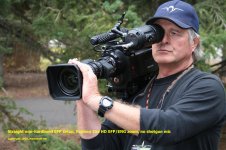
Sports have been on of my core areas of production for over 3 decades now. What you’re describing is termed as a non-hardlined EFP (electronic field production) project. By the mobility you described I’m assuming you won’t be doing hardlined EFP, lined into a truck or control room. Those not familiar with EFP production can get a quick primer on it by visiting my EFP and ENG for RED sticky at the top of the EFP/ENG and RED forum here on RED User.

You didn’t mention what your delivery medium was. Is it HDTV, standard definition TV, Blu Ray, or DVD? The delivery medium has a lot to do with the lenses, resolution, and frame rate I may recommend. You also didn’t mention if you were just doing highlights of the game, or if you were expected to cover the entire game. That is also important info I need to accurately make some recommendations to you. Whether you’re working all alone, or have an assistant also has some key bearing on what I’d recommend.

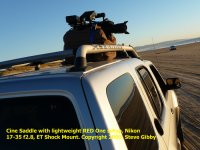
If you need mobility, then the less accessories you put on the camera, the more your mobility increases. My advice - put on the camera only what you absolutely need to get the style and quality of shots you’re after. It sounds like you need to be at times on tripod, and others shoulder held. My approach to that would be to use an ET Mantis for the shoulder held, then quickly slide the camera off the Mantis’ V plate and onto the tripod V plate, and vice versa. If you have an assistant working with you it would be a good idea to have him/her carry a Cine Saddle to use for those cool on-the-ground creative sideline shots.

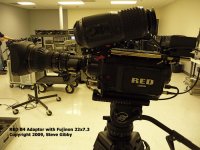
I’m going to make some assumptions here. I’m assuming that your production is just highlights for a highlight reel or highlights for a TV station sports broadcast. In terms of ergonomics and utility for this type of production, a B4 2/3” HD EFP/ENG zoom would be ideal – giving you a servozoom for shoulder held, and a servozoom controller on your tripod handle for when you’re on tripod. That’s how most of this type of production is done. That setup is possible on RED One, using the RED 12v accessory cable from the camera to the servozoom unit, renting a RED B4 adaptor, and renting a good B4 HD EFP/ENG zoom. Once again, going this route depends on your delivery medium though. This setup limits you to 2k, which IMO will be fine if your delivery is 1080i, 720p, standard def TV, or DVD. IMO the footage may be too soft if your delivery medium is 1080p (BluRay). Graeme’s figures for debayering RED footage state about 78% of the shot footage – in other words 2k shot on RED debayers out to around 1.56k. That will usually be fine for certain deliveries I mentioned above, but IMO not really ideal for a 1080p delivery.

Sure NFL Films S16mm footage is excellent – but they are shooting highly targeted highlight reel footage, not overall games. If it were I, and 2k was the resolution I wanted/needed to shoot for this, I’d eliminate S16mm lenses and accessories for this in favor of B4 2/3” HD EFP/ENG zooms because of the EFP solution’s more user friendly accessories – mainly the servozoom capability, which is much easier to operate than a zoom motor/Micro force combo. Sure, S16mm lenses would give you a slightly more crisp image in 2k on RED, but the B4 is a lot more user friendly to operate – and is lighter.

The Canon 150-600 Steve mentioned would be a good long lens if you were strictly on tripod, with no shoulder held requirement. The stock version of the lens, which I have and really like on RED, has a push/pull to zoom, twist to focus knob on the left side of the lens. When I track sports subjects or fast animals I can quickly zoom in or out, while racking focus – all with the same, quick and easy knob. My 150-600 has a Century PL mount conversion (mount only). You can find the 150-600 for rent, but unfortunately it is almost always the fully re-housed version, with 3 gears to operate.

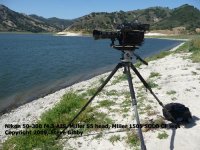
Paul Herrin – no, the lens on my list is in fact the Nikon 50-300 f4.5 AIS. If you do a Google search you’ll find the lens. The images from the lens on RED are stellar. At 4 pounds, it is light enough to shoulder hold on a Mantis, but sits really well on a tripod too. You can’t find them to rent. The lens went out of production in 1992. It was the staple lens of many nature and sports still photographers from the mid ‘80’s to the early ‘90’s. The AIS version is far and away the best version. I bought mine used from B&H a year ago for $1,300. It’s a great lens…

For most of the shooting you describe at a night-lighted football game, you should be able to shoot between f5.6 and f11 – thus real fast lenses aren’t critical. Between f5.6 and f11 is also the general “sweet spot” for most 35mm stills zooms, so that plays in your favor.

If you want to stay real light, using a Nikon mount, and can live with a 3-lens scenario, then a combo of the Nikon 14-24 (for wide creatives), 24-70 (interviews, mid length shots), and either the 50-300 or 80-400 for longer shots would be a good way to go. A 2-lens kit alternate to that would either be the 14-24 or 24-70, in combo with either the 50-300 or 80-400.

If it was me shooting this football event with RED One, for USA broadcast, and for smooth presentation of the action, I’d choose a project frame rate of 29.97 or alternately if you shoot all 3k and will create slow motion in post, maybe a project frame rate of 59.94. Quality level would be RedCode 28. If shooting 29.97, then for slow motion sequences I’d quickly go to Varispeed to overcrank up to 120fps and 1/250th second shutter if I was shooting 2k, or 60fps and 125th second shutter if I was shooting 3k.

For exposing on the run I’d use zebras and histogram – its very quick and accurate if you pay attention to the indicated values. You’ll want just a tiny amount of zebra in the brightest part of the shot, and naturally you want to watch the histogram to make sure nothing is clipping. I do all my focusing with RED One by eye, using 1:1 image magnification when time permits. Ideally you’ll have both an EVF and LCD on the camera, but if you only have one viewing option, the LCD will give you a lot more shot options than the EVF for the type of shooting you’ll be doing - high angle, low angle, shoulder, tripod, etc.

If you don’t want to shoot 2k, can’t shoot 2k, or need higher resolution for your finish, then IMO 3k would be the choice. RED One 3k debayers and resamples down to 1080p (or lower resolutions) really well – nice saturation. If 3k is the choice, then your two len type choices are 35mm stills or cine lenses. Since a high degree of mobility is needed, IMO that would eliminate cine lenses – too heavy (thus immobile) and small focal ranges for their size/weight.

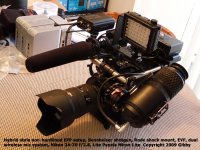
If you’re shooting 3k using 35mm still lenses, then I’d suggest to keep weight down and to increase mobility and fitting into crowds, you not use a matte box (use screw-on ND filters). Get some snap on gears for your Nikon lenses, and adapt your motor and Micro Force. Rent a Mantis for shoulder held and make sure you have a V plate on your tripod. For fill light in interviews I’d use a Lite Panels Micro Pro on the top-front of the camera. For audio I’d use a short shotgun on the camera, and if you’ll be doing interviews, a small, lightweight wireless mic system.

If I was doing the type of production you describe a few months from now, my camera choice would probably be a fixed lens Scarlet in lightweight setup, with the snap on mic, side handle, bottom handle, Lite Panels Micro, L bracket with wireless mic receiver, several of the internal batteries for the handle, and the 2x extender lens and wide angle converter lens for shot flexibility. To finish the kit I’d add in a shoulder bracket of some kind, and lightweight fluid head tripod with CF legs. IMO this Scarlet setup would be much more appropriate for the type of shooting you describe than even a lightweight hybrid RED One setup. Fun times ahead…:thumbup:

I have attached some photos of my straight non-hardlined EFP setups and hybrid 35mm still non-hardlined EFP setups.

Hope the above info helps you and helps define what your option are…
 

Attachments

  • EFP-with-Fuji-16x,-2.jpg
    EFP-with-Fuji-16x,-2.jpg
    91.8 KB · Views: 0
  • Hybrid-setup-1.jpg
    Hybrid-setup-1.jpg
    93.6 KB · Views: 0
  • Fuji-22x,-2.jpg
    Fuji-22x,-2.jpg
    92.5 KB · Views: 0
  • Nikon-50-300-for-web,-2.jpg
    Nikon-50-300-for-web,-2.jpg
    91.6 KB · Views: 0
  • Cine-Saddle-for-web.jpg
    Cine-Saddle-for-web.jpg
    90.6 KB · Views: 0
What do you set your zebra to Steve?

I'm running Build 20.1.3 on my cameras. I use the default levels for Zebra 1, which are Lo IRE 101 and Hi IRE 108. Beyond the Zebra, I also watch the histogram closely and tweak iris slightly as necessary. Clipping hasn't been a problem.

Because I do so much mobile, run 'n gun production with RED One, I've exposed using just zebra and histogram almost exclusively with RED One since August 2007 when I received my first RED One camera. I've found this very fast and accurate.
 
Thanks Steve...:thumbup1:

As you know, RED One can be setup and used in many different ways. Sometimes my "non-standard" approach to setting up and using RED One can have some very good utility - and be quite cost-effective and practical for many genres.
 
Thanks Steve...:thumbup1:

As you know, RED One can be setup and used in many different ways. Sometimes my "non-standard" approach to setting up and using RED One can have some very good utility - and be quite cost-effective and practical for many genres.

Your recommendations have been helpful to me from the beginning. When I'm working on commercial jobs and features, they often require cine gear and a full rig. But the way I like to shoot is more mobile, lightweight, and free. So, I've tried to strip the camera down as much as possible for those times, using Nikons, screw-in filters, often with no follow focus. Battery goes on my belt (with some extra bongo ties to make sure it doesn't come loose if I'm moving a lot) and I try to position the drive so it balances well in the lightweight config (using ET shockmounts of course). Sometimes I abandon the drive and go with just CF card if the situation allows. With a Nexto DI Storage Pro by my side, I can easily offload cards and verify them in the field which does allow me to go even lighter. RED does not have to be a behemoth. Certainly in cine style shooting all of the gadgetry makes for smoother operation in that environment but if it's just me and perhaps one other person on the crew, then I'm all about getting to a manageable weight.

And depending on what your shooting, you can sometimes get away with shooting on Joe average lenses. For example, in a very run and gun doc scenario where you have no idea what you're going to come across, can't swap lenses out, and just really need an all purpose lens with a wide range, the Nikon 18-200 could serve that purpose. It's a slow lens, doesn't have consistent F-stop throughout the range, not so great focusing, etc. but it could serve a need.

That's the beauty of the system. It's the ultimate camera Transformer. Cine rig one day, ultra low budget doc camera the next. Build it any way you want. And it will only get better with Scarlet and Epic.

Back to the lens for the original poster. The ENG lens is a good option if shooting in 2K. If you put on a very sharp ENG lens you stand a fighting chance of getting decent results. I've seen Ken Willinger use the camera in this mode, and he was able to squeeze enough quality out of it for the deliverable. I forget the exact model of lens he used (Fujinon for sure) but it was a very good lens. But going 1080P deliverable is definitely right on the edge of what is acceptable with this particular mode of the camera. I would suggest testing if you haven't already. make sure to run your footage through a Full Debayer at 1080P Uncompressed or ProRes 444 to see what is possible.
 
Back
Top