Welcome to our community

Be a part of something great, join today!

  • Hey all, just changed over the backend after 15 years I figured time to give it a bit of an update, its probably gonna be a bit weird for most of you and i am sure there is a few bugs to work out but it should kinda work the same as before... hopefully :)

Best film director

Lost in Translation was excellent, indeed better than Marie Antoinette, though I still think that the way she made the last was nice because none of the male directors, I suppose, would have done it this way. Ofcourse now you easily get into the drab discussion of: do women make a different kind of art?
 
I highly doubt women make a different kind of art, but I would say there are differences. There has to be. Masculine forces are quite different to feminine ones. And I am not talking about the obvious differences, but moreso the fundamental ones of creation vs destruction. But the gender is severable from the creator; even male originated artwork can take on feminine structural qualities and vice versa. In which case the piece itself assumes its own dominating gender. But theres always both a combined male and female composition to any artwork, (just as there is a male/female substance to any living form).

Would it have been different if the Godfather was directed by a woman? Surely. But I dont think in a way most would think.
 
What about Jane Campion>>>?

campion.jpg

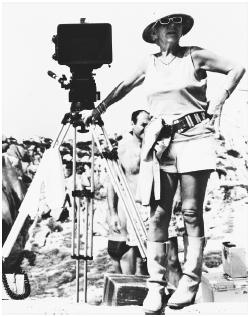
Jane Campion

jane-campion.jpg

"Jane Campion (b. 30 April, 1954, Wellington, New Zealand) is Australasia's leading auteur director. As recipient of the Palme d'Or (1993),

the Silver Lion (1990) and an Academy Award (1994), she is also one of the most successful female directors in the world..."


Read more>>>
 
What's the yardstick?

What's the yardstick?

When we Americans apply the term "Best", I find the term is applied based upon financial success, popularity, or perceived artistic superiority. So the same names always float to the top; Kubrick, Spielberg, Scorsese, Soderbergh, Malick, et. al.

Directing is the one job everyone wants and the only job that no one is qualified to have. There are many films that achieve greatness despite shortcomings in cinematography, editing, writing, music, production design, but I can't think of any great films that survived poor directing.

So by what metric do we use to judge the work of the director?

Kubrick, for example is frequently accused of being "emotionally cold and distant". Spielberg is always shackled with the "populist, manipulative, saccarine" label. What they all share is the ability to actually make a movie.

I have to disagree with most of you on Saving Private Ryan. I think that film is great at capturing a sense of combat and non-glamorized violence. In fact I often say that Spielberg was orders of magnitude more eloquent in the first twenty minutes of Saving Private Ryan, than Terrence Malick was in the whole three hours of Thin Red Line.

No slight against Malick, whom I like, just an illustration of the wide gulf between two different styles of filmmaking. I personally found Thin Red Line to be more of a literary experience than a cinematic one, beautifully shot though it is. Saving Private Ryan was visceral, utterly visual and captured the brutal ironic injustice of the battlefield and thus was a more emotionally wrenching experience, at least in the battle scenes. Thin Red Line was languid, overly dependent on narration and utterly sank under the weight of the stunt casting.

Kubrick, for my part, best embodies the qualities of a great director. For all the talked-about-already reasons. I feel like the world put so much pressure on him to be great, that he felt an oppressive responsibility to live up to our expectations and that's what, in the end, limited his output. Spielberg and Malick both are worthy successors, but we will never see another Kubrick until filmmaking is truly democratized by technology.

As for Kubrick's war films, Full Metal Jacket occupies a different place for me. Probably because he shows us a different war. But, my favorite Kubrick war film is undoubtedly Paths of Glory. It has such a humanity that I always cite it as evidence that Kubrick indeed had a heart and was very connected emotionally to his audience.

The Shining is another example of Kubrick's mastery of visceral human emotion, and Shelly Duvall's performance brilliantly captures a desperate mother coming unhinged in an impossibly bleak situation. We rarely get to see the process of great directing, but watching the behind the scenes gives us a peek into what makes Kubrick a great director, and what it took to get Duvall to bring out that performance.

I think that Lost in La Mancha best captures what it takes to do the job of directing. I'm an enormous fan of the visionary director Terry Gilliam. The reality of what it takes to get a project off the ground could easily be another component of what it takes to be the best director. Politician, Ship's Captain, employee, counselor, tyrant, torturer, sensitive artist, collaborator, conspirator, subversive, sadist, all these roles and more Gilliam must have had to play to get the project off the ground.
 
Hmm, I thought Thin Red Line was excellent, and I didn't like Saving Private Ryan at all; I loved how people became different individuals who all had their very own ways of dealing with the war, especially compared to those "we'll do the job" types that you get to see over and over again in American films; maybe there actually have been soldiers who preferred to stay with their brothers in arms instead of being sent to their parents after the news of their real brothers' deaths; but I just wish it hadn't been so in Saving Private Ryan; it was the one moment that ruined the film for me
 
One of the best war films I saw recently is "Redacted" written and directed by Brian De Palma>>>

"A montage of stories about U.S. soldiers fighting in the Iraq conflict, focusing on the modern forms of media covering the war.

This film is about the real-life rape and killing of a 14-year-old Iraqi girl by U.S. soldiers with shocking images that will leave some viewers in tears.

Inspired by one of the most serious crimes committed by American soldiers in Iraq since the 2003 invasion, it spares the audience no brutality to get its message across"
 
I have to disagree with most of you on Saving Private Ryan. I think that film is great at capturing a sense of combat and non-glamorized violence. In fact I often say that Spielberg was orders of magnitude more eloquent in the first twenty minutes of Saving Private Ryan, than Terrence Malick was in the whole three hours of Thin Red Line.

No slight against Malick, whom I like, just an illustration of the wide gulf between two different styles of filmmaking. I personally found Thin Red Line to be more of a literary experience than a cinematic one, beautifully shot though it is. Saving Private Ryan was visceral, utterly visual and captured the brutal ironic injustice of the battlefield and thus was a more emotionally wrenching experience, at least in the battle scenes. Thin Red Line was languid, overly dependent on narration and utterly sank under the weight of the stunt casting.

Sure, Saving Private Ryan "captured the brutal ironic injustice of the battlefield"... if your frame of reference is other Hollywood movies. If your frame of reference is reality and the actual human condition, then SPR is nothing but a manipulative, (again LITERALLY) flag-waving product that was slurped down by the American public like an Icee at a NASCAR race. The movie featured unrealistic, Hollywood-written scenarios played out by a Jerry Bruckheimer-inspired cardboard cast of "characters."

Comparing SPR to TTRL is like trying to compare Michael Crichton's "Jurrasic Park" to Ernest Hemingway's "For Whom the Bell Tolls." These two things are in entirely different leagues.
 
Tarkovsky (managed to get 2 films into my top 10 so he's a shoe in), Kubrick (Hit or miss. Love Full Metal and Orange--could mostly care less about everything else), Spielberg (I'm sorry but I consider craft a huge part of directing and when it comes to craft I put Spielberg at the very top of the list. Also he made Munich which is one of my top 10 films of all time--something I can't say for Malick.), Clint Eastwood, Gilliam, Malick, Hitchcock, Aronofsky, James Cameron (but I don't know if I actually like him as a director or just producer/writer), Ridley Scott, Miyazaki, Kurosawa, David Fincher (I think he's pushed film visually for the last few years), Wachowski brothers (Their writing is awful but I think their directing is good, they got a passable performance out of Keanu Reeves for gods sake! :D), Fritz Lang, Tim burton.

A few people who do direct phenomenal movies/television shows but I don't particularly mesh with their directing:

Coen Brothers
Woody Allen
Quintin Tarantino
 
Back
Top