Welcome to our community

Be a part of something great, join today!

  • Hey all, just changed over the backend after 15 years I figured time to give it a bit of an update, its probably gonna be a bit weird for most of you and i am sure there is a few bugs to work out but it should kinda work the same as before... hopefully :)

Debayer engines are not all the same.

Von Thomas

Well-known member
Joined
Jun 9, 2008
Messages
529
Reaction score
0
Points
0
Location
Los Angeles
Website
www.digitaltechnyc.com
I've been long aware that with the tools I use in still RAW debayering, differ greatly. I started using software like Phase One C1 Pro back in 2003, I used it mainly for the Phase One digital back raw files, but the program also worked very well for Canon digital raw files. Along came Apple Aperture and Adobe Lightroom. They were cheaper, and faster in processing these raw files. I've come to learn most people like cheap and faster. I compared the files processed in all three, and found that C1 Pro was much slower than the others, but the files it produced were far better that the AA or LR. The results were very clear.

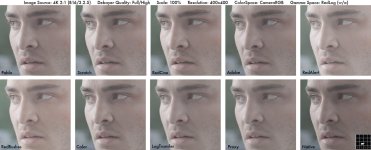
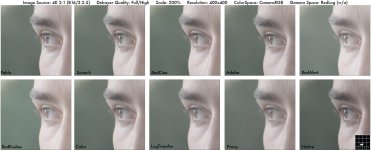
Now moving over to motion, the same thing is now facing me. In a recent test of 7 different debayer engines, you could see the difference. RedCine being one of the top three, along with Pablo and Scratch. It's not the the rest did not deliver a great picture, but that the top three delivered more detailed information, which aids in the grading and image manipulation.

Von
 
Don't they all use the same engine - the RED SDK?

I really cannot see, why Pablo debayer should differ from Baselight debayer, and from RED Alert debayer, when they all share the base - a debayer made by RED.

It was one of the reasons, why RED closed the R3D format, to avoid bad debayers messing up the camera's reputation.

Both the Matrox 4K and Speedgrade engineers had reverse-engineered the R3D format to Build 15, and were able to playback 2K half rez high in realtime.

I am not implying that they had a bad debayer, but as you say on RAW pictures, they differ greatly.


Could you please elaborate in more details, how you tested 7 debayer engines on R3D footage?
If this was on Build16 or higher you must have cracked open the R3D...
 
As I understand it, the SDK that everyone uses, is there to maintain that certain functions are included on all, but how each engines algorithm operates is the up to that particular manufacturer.

Here is the link to the comparison.

http://digitaltechnyc.com/Debayer_Comparison.png


Von
 
Last edited:
I would assume that the instruction set and algorithms based on the work of the venerable Graeme Nattress and his comrades on the Red Team, via the SDK, are not the point of differentiation.

What I find more likely is that the precision of the operations based on that rubric are implemented uniquely by each vendor. One of Von's notes was that the best de-bayer was more expensive and took longer. Perhaps, no offense to any particular company intended, some of the implementations of RedCode debayering leaned more toward speed and getting the coding done and out in the market vs maximum image quality.

FWIW, if you're creating content for theatrical distribution and have some budget then more time and money is justified to get the last bit of image quality. If you're shooting for TV and have well exposed footage then a half res, full quality debayer that happens fast is probably the wise choice. (Noisy footage should be handled with greater care as I have seen dramatic improvements when doing full res, full quality de-bayers in Scratch on underexposed footy.)

It will be interesting to see if the release of the RED Rocket™™, which presumably will take the time element out of the equation, might change the landscape. I also think that Scratch (Assimilate) had a significant head start in this race and I am not surprised that they have better optimized the de-bayering process. The Pablo is a high end system with lots of horsepower so I would expect it to go the extra mile for image quality.

I would love to hear from anyone on the Red Team who is willing to comment on Von's observations here on RedUser. Won't be surprised if they don't :rolleyes5:

The bigger issue in all this is best practices for handling RAW data from digital imagers. It is my belief that in a few years high bit depth digital files from the next generation of sensors, combined with greater computational muscle and better codecs, will usher in a new era in digital cinema image quality.

I can hardly wait :cheers2:

Cheers- #19
 

Von, isn't that Michael Cioni's (or perhaps Plaster City's, since it does seem to bear their logo) series of test images...shouldn't you attribute the source, if you're going to post it?

Since Assimilate partnered with RED to produce the original RedCine, it is logical that the RedCine output is very good and identical to SCRATCH - what will be interesting is to compare the de-bayered output of the new apps, RocketCineX and REDCine-X, since they are being produced in house by RED, independently from Assimilate...
 
It is Michael Cioni's formally of PC, now LIGHTIRON Digital. I posted this with his permission. Michael along with Ted Schilowitz are the instructors for REDucation.

Von
 
IDEAL COLOR CORRECTION - Revisited

IDEAL COLOR CORRECTION - Revisited

Hello all-
Here is the link to the original thread in which this topic was discussed back in January. A good discussion with lots of well-rounded feedback and opinions. Somehow the original uploaded JPGs were deleted, so I've re-attached them here at a higher resolution. I did this test while at my former company and it included what was (then) all the available R3D supported debayering engines. As we all know, there are a number of new additions to the R3D supported fleet, and I am in the process of obtaining results from those tools, which I will, of course, post for all to review and comment on.

http://reduser.net/forum/showthread.php?t=24699&page=3
 

Attachments

  • Full Frame.jpg
    Full Frame.jpg
    41.3 KB · Views: 0
  • Scale100.jpg
    Scale100.jpg
    86.3 KB · Views: 0
  • Scale200.jpg
    Scale200.jpg
    75 KB · Views: 0
...but after testing here, export 4K from Redcine and from RedAlert does not show that much difference as seen on this picture, i wonder why.

Antoine
 
Hello all-
Here is the link to the original thread in which this topic was discussed back in January. A good discussion with lots of well-rounded feedback and opinions. Somehow the original uploaded JPGs were deleted, so I've re-attached them here at a higher resolution. I did this test while at my former company and it included what was (then) all the available R3D supported debayering engines. As we all know, there are a number of new additions to the R3D supported fleet, and I am in the process of obtaining results from those tools, which I will, of course, post for all to review and comment on.

http://reduser.net/forum/showthread.php?t=24699&page=3

Thanks for doing this Michael. :)

Where will you be posting the results? In this thread? The one you linked to? Or will you be starting a new thread all together?
 
Results may vary...

Results may vary...

Results may vary based on multiple configuration settings, camera builds, and software versions. When I did this test back in January, I was running the "latest and greatest" at the time, but there have been numerous advancements, upgrades, and changes that will likely affect debayering quality and speed.
Once I finish my new set of tests I will probably just add them to a new thread.
michael
 
Nicelly done Michael...thank you!
waiting for the tests...
Cheers
 
Thanks for the results, but can someone explain how the "Native" picture was produced? Is that the in-camera debayered image?

Because "native" to me would mean some raw file that is still in a bayer pattern. Thanks..
 
That is the question :)

Thanks Yousuf for staying alert :)

Antoine
 
In my opinion, on the XCU of the eye, nothing beats native. How did you acquire the native image without running it through any software?
 
Back
Top