Welcome to our community

Be a part of something great, join today!

  • Hey all, just changed over the backend after 15 years I figured time to give it a bit of an update, its probably gonna be a bit weird for most of you and i am sure there is a few bugs to work out but it should kinda work the same as before... hopefully :)

Ask David Mullen ANYTHING

The color of early morning or late afternoon light as the sun is rising or setting varies according to the atmospheric conditions, so you're better off worrying less about reality and picking a color that you personally like. I usually start out with uncorrected tungsten (3200K) in a daylight-balanced scene for a sunset effect, so that would be an HMI with full CTO or CTS (CTS if you like a little more yellow in the color.) I find that the uncorrected tungsten looks prettier than a heavily gelled HMI though.

As for pinkishness, that could be achieved with Magenta (Minus Green) gel, as heavy as you like. Or there may be a specific orange-pink gel in existence.

So my first choice, in daylight-balance, would be a powerful tungsten lamp for the sunrise effect, with some Minus Green gel on it for a pinker color -- maybe 1/2 or 1/4 Minus Green.
 
thank you very much david.
what about the first part of the question?
"what is ,in your experince, the 35mm lens(brand and model) with the most beautiful flare?"

thanks again
 
The modern prime lenses are designed to be flare-resistant, so you don't see a lot of flare from them.

If you like flare, then either use an older prime... or zooms, which have more glass elements in them.

Panavision has these old 1970's lenses called Ultra Speeds, which are a mix of old elements (maybe Canon glass in there somewhere, maybe Zeiss) -- the rainbow-colored flares are quite lovely.

The old C-Series Panavision anamorphics also have some of that quality -- you see some great flares in "Alien" for example. Anamorphic primes in general have great flares, even the modern Primos.

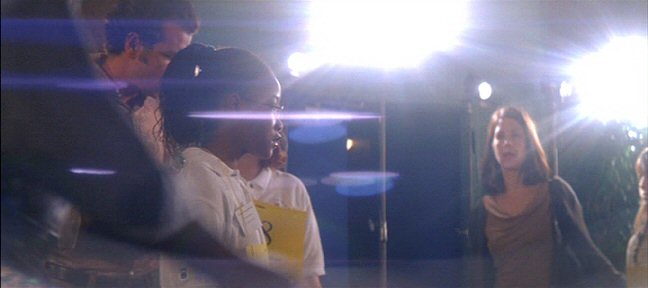
Here's a shot in "Akeelah and the Bee" where I had some great flares -- not sure what lenses it was, maybe the C-Series 60mm anamorphic (if it was on a Steadicam) or it was a Primo anamorphic, helped by a GlimmerGlass diffusion filter:

akeelah6.jpg
 
I really do not understand why the 1982 movie "Blade Runner" did not win the Best Cinematography award at the Oscars. Do you have an opinion on this? I assume, like myself, you view "Blade Runner" as one of the best looking films ever created. I also see "Legend" by Ridley Scott in this same category.

Regards,
Martin
 
Just one of those gross oversights or injustices, same as "Godfather 1 and 2" not getting nominations for Best Cinematography either.

The nominating branch tends to have a lot of retirees in it, which causes to skew towards conservative choices, though not always. "The French Connection" was nominated for Best Cinematography though it was very daring and atypical of studio photography in its day. But then they turned around and did not nominate "The Godfather" the next year (though "Cabaret" was also quite innovative and interesting photographically, and it won.)

The nominees in the year of "Blade Runner" were:
Gandhi - Billy Williams; Ronnie Taylor (WINNER)
Das Boot - Jost Vacano
E.T.: The Extra-Terrestrial - Allen Daviau
Sophie's Choice - Néstor Almendros
Tootsie - Owen Roizman

But I'm not going to debate or discuss who should have been kicked out to make room for "Blade Runner" because I know some of these people... so don't ask me!
 
Hi David,

I'll risk a couple more questions. I wanted to thank you for your previous response too (about learning pro equipment as a student), but didn't want to bog down this thread with too many "thanks" posts. Needless to say, your response helped tremendously.

1. You always have great screenshots available to make your points. Do you just grab screens from scenes that you like and categorize them somehow? Or do you have a photographic memory and just capture screens when a situation demands it? I have a ton of still photos bookmarked (though not very well organized) and want to try capturing / organizing movie stills soon. It's a little daunting, since there's so much great cinematography out there. If you do have a collection of screenshots and pictures, any tips for organizing and learning from them?

2. I'm pretty sure you're not hurting for job offers now, but what did you do early in your career between film shoots? Obviously a little vacation is nice, but it sounds like you also worked on projects (like indexing American Cinematographer) in between your shoots. What other activities, if any, did you work on to continue improving your craft off set?

3. Related to you tinkering with equipment. I've never worked on a union production, but it seems to me that people actually working on the ground (as opposed to union leaders) would be thrilled to see a DP get his hands dirty, right by their side, helping get the job done. On that note, how much control do you have over hiring grips / gaffers / electricians, etc.? Any tips for pulling strings to get solid workers on the set? I'm the same way when it comes to tinkering and I'm not sure if I could function without some of that freedom.

Thanks again.

Eric
 
David:

I have a Minolta Color Meter II that needs to be recalibrated. Apparently Sony purchased Minolta and is refusing to service Minolta products. Sony/Minolta sold the color meter division to Kenko and Kenko is also refusing to service any but its own color meters. Its a big mess. Do you know of anybody in the US (or the world for that matter) who will can recalibrate? Thanks
 
I've been grabbing frames from DVD's for years, so I have quite a collection by now, not organized unfortunately. So I have to look thru the pile. Some I have posted in forums so they are on my website, just there for storage so I can link to them -- that bunch is small enough (about 700 frame grabs) that I can rely on memory as to what is there. But the sizes are all over the map because I've shrunk them down from the original 720 x 480 pixel size because web forums used to not allow photos much larger than 600 pixels wide. But I could always dig up the original frame grabs, which are bitmaps on my PC.

If anyone knows of a good frame grabber for Macs, please tell me because I've tried several... and none of them look as good as what I can get on my PC using Nero or Power DVD. Most just grab the entire Mac screen, not the frame of video.

I often grab frames as preparation for a movie, so I roughly can find old frame grabs based on the time in my life --- let's say, in the fall of 2003 I did "x" film and I recall grabbing frames from certain movies, etc. At least the ones I colored and resized in Photoshop have been renamed to the title of the movie -- all my original grabs are a bunch of meaningless numbers for file names.

---

I spent a lot of my free time at film libraries, reading, or visiting vendors and rental houses, or going to trade shows, or hanging out on the internet (which didn't really take off until about five years after I graduated.)

My wife helped support me at the time, giving me the luxury of waiting for the next job, though I did have a part-time job for the first two years after graduation -- luckily they gave me time-off whenever I got a shooting job.

I still go down to the UCLA Theater Arts Library or the AMPAS Herrick Library once a month or so and just start pulling down old periodicals, or new ones, and read. But now the internet takes up more and more of my time.

My general education pattern was (and still is) to read, watch, and then, make movies -- repeat as often as possible!

I have a good memory for what I read so I am very good at finding info by skimming and searching quickly, whether thru stacks of old magazines or thru the internet. Probably the reason why I married a librarian...
 
Hi David you have become an invaluable source of information for me and others I'm sure. I am weighing my options with the impending arrival of the Sarlet and Epic series cameras. The economical 2/3" scarlet seems tempting. Do you shoot 16mm film or 2/3" HD? If you do, can you discuss the advantages or disadvantages of not using 35mm lenses on such projects.

Gregory
 
I've shot eight features in 2/3" HD and one in Super-16 -- the other 20+ features were in 35mm, or cameras with 35mm sensors.

I'd say that most of the time, because modern films rely so much on tighter shots, the extra 2.5-stop depth of field of 2/3" photography is not a big deal, not if you generally keep to an f/2.0 to f/2.8 stop.

It's the medium to wide shots in small spaces when the background is too close... that's where the extra depth of field is not quite as attractive-looking compared to the shallower-focus possible with 35mm.

Color is a form of information in the frame, just like light and shadow is, and the more in-focus everything in the frame is, the more the colors in the background compete for attention with the foreground, so if you can't control everything in the frame, it can look tackier compared to softening the background with shallow-focus. So it's partly an artistic and storytelling issue and how much control you have over everything in the frame. If the movie is very designed and controlled, you might not mind that more of the frame is in-focus.
 
How do you address this deep DOF issue with smaller formats? Because of my video background I don't have the good fortune of shooting with 35mm lenses, nor do I production designers to work with, so I tend to shade the backgrounds of long and medium shots with shadows. What your opinion on this?

Gregory
 
Don't know if they do color meters, but there's a small place in Hollywood that a lot of people use for servicing light meters:

Quality Light Metric Company
(323) 467-2265
7095 Hollywood Blvd, #550
Los Angeles, CA 90028

Thanks David. You hit the bullseye. They can recalibrate the Color Meter II (and appear to be the only ones in the country that I have found that can). BTW, its less than $100 and only takes 1-2 days. Thanks again, you saved me.
 
Thanks David. Have you tried using VLC on your Mac to grab frames? You can physically pause the video to get a capture or use a shortcut (I think it's command + s) in realtime. I'm not sure what else you've tried, so I'm not sure if VLC would be a step up for you. Luckily, VLC is free if you haven't tried it out yet.

One nice thing about the app is you can set a folder directory and standard prefix every time you watch a movie, and then have your frame grabs number themselves sequentially behind the prefix. So I have a default folder (called "Stills") and then I set the prefix to the title of the movie, e.g. Akeelah 1, Akeelah 2, etc. I'm thinking about file tagging software, but it seems like your approach of remembering grabs in the context of time and movie works just as well.

http://www.videolan.org/vlc/

Hope that helps.

Eric
 
How do you address this deep DOF issue with smaller formats?

I haven't shot much of anything with a camera that has sensors smaller than 2/3". I think the practical DOF difference between a 1/3" camera and 35mm is 4.5-stops, which is pretty significant. Other than long-lensed close-ups or macro shots, it's hard to mask that deep-focus look other than by using those 35mm depth of field adaptors.
 
Hi David,

I only have experience using HMI lights with electronic ballasts. The cost of new and used magnetic ballasts is very attractive, what compensations should one make when using them?

Gregory
 
You have to stick to HMI "safe" shooting speeds & shutter angles when using magnetic ballasts, and probably you have to be more concerned that your power supply is regulated.

It's not necessarily a big deal because half the time, you switch your electronic ballasts out of "flicker-free" mode just because they are quieter that way. But there will be situations where you will probably wish you had the option of a flicker-free mode, mainly for off-speed shooting.
 
Going back, briefly, to the talk on reflections...
In a recent night scene I had to shoot an over-the-shoulder of a guy looking into a deserted shop, with his reaction shown on his face in the reflection.
I was in a major rush at the time (sun was coming up), so had to hurry through, but it came out OK. The main problem is that in order to get the reflection at a decent exposure to actually see it, I had to shine a lot of light onto the guy's face, which then made the side of his face/shoulder area really too hot.
(Does that make sense?)
How would you go about dealing with this? I guess I could've used an ND grad filter with the gradient running left to right, that would have taken down his shirt and face, but not the reflection.
Any other ideas?
 
It's just a matter of balance -- yes, the object being reflected in the glass has to be hotter than normal in order to create a good reflection. At night, it's not so hard because you aren't fighting with a bright background -- the darker the glass is, the more it acts like a mirror.

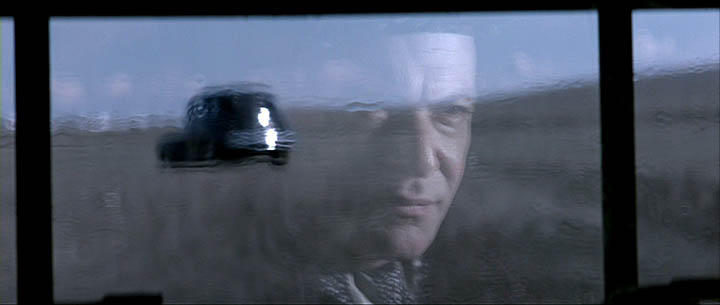
I had to do a shot like this with a daytime background in the glass, which was very hard -- even with ND.90 gel on the window, it meant that I had to light the person in the reflection to near sunlight levels, so he got roasted by an HMI right next to his face:

northfork3.jpg


You may need to use net flags and whatnot to control the light if it is too close to the actor in order to get the stop; otherwise, it helps to back off the light so the fall-off isn't so dramatic.
 
Back
Top