Welcome to our community

Be a part of something great, join today!

  • Hey all, just changed over the backend after 15 years I figured time to give it a bit of an update, its probably gonna be a bit weird for most of you and i am sure there is a few bugs to work out but it should kinda work the same as before... hopefully :)

Manure

I haven't tried that Chimera Birdcage yet but it looks interesting.

One cheap method of skirting Chinese Lanterns or taping skirts to the ceiling, instead of using heavy duvetine cloth, is the black plastic tablecloth material you can get a catering supply stores. Very lightweight.

Yes, probably there will be reports from the next movie when it starts shooting in late July, but it is a much smaller, contemporary movie -- small crew, small lighting package, lots of locations.
 
I know this comment is a little late but I just wanted to say that while i really like the look of the outdoor stage sets I really really really like the reshot version with the more heavily lit sky. You're striking this wonderful magical realism balance that is just fantastic.

Can't wait to see the office w/ animals.

J
 
Normally a day exterior scene would be shot outdoors, so it's rare to fake that inside because it is so difficult to be convincing. On "Big Love", we did the backyard scenes under a soundstage, day and night, because it allowed the actors to move freely from house to house by way of the backyard, a scenario that did not exist in any real locations that could be found. And while one could have shot these houses on an exterior studio backlot (as "Desperate Housewives" does) and gotten real sunlight, the downside is the lack of flexibility in shooting schedules, which is tough for television work.

But beyond that, the real question should be "what works better for the project?" when trying to decide whether to build a set or not. Both creatively and logistically, financially.

Generally daytime wooded scenes are a lot easier to fake on a soundstage than a scene that takes place in open space with a lot of sky, because it is so hard to fake a single sunlight source over a large area. With a wooded set, or a jungle set, multiple spotlights punching through the tree canopy can simulate the real sun more easily, plus you have less sky to fake.

thanks David, I understand your point on availability. few years ago I was on the universal lot taking the tour and the announcer mentioned that the "Desperate Housewife" set is open to public only on few weekends as its booked for shooting during the week.

Taking about what works for the project how do you go about decidng the look. Is that a factor determined by DP or really the Director's vision. Some moves like "Traffic" or even "21 Grams" have a very distinct look. Is that look arrived at after some field testing?

I have one final question. I am embarking on a horror/suspense short next week. We have some scenes inside a house (in the living room, dining room etc) where we have to simulate raining conditions to create the mood.
Do you have any pointers for us as to how to light for such a scene? we are totally low budget so you can assume that we will be prepared to throw buckets of water on window from outside if its necessary.

regards,

-Krish
 
I know this comment is a little late but I just wanted to say that while i really like the look of the outdoor stage sets I really really really like the reshot version with the more heavily lit sky. You're striking this wonderful magical realism balance that is just fantastic.

Can't wait to see the office w/ animals.

J

I love the stages.

Coppola's Dracula was shot on sound stages and it just has such a magical vibe to it.
 
The last three days were spent at DC Stages in Downtown LA, finishing up a lot of scenes in the Rose’s Manure factory labs, offices, hallways, etc. using modified existing sets.
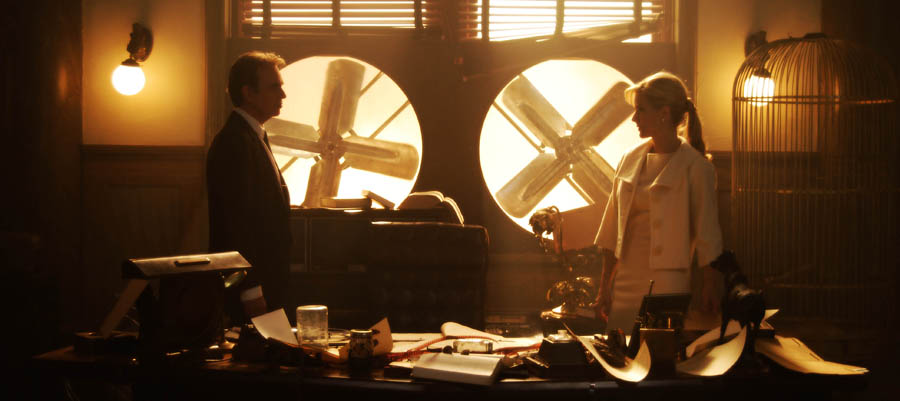
A number of the standing sets were quite large. A library was converted into a lab/office for a number of scenes. We put two large industrial exhaust fans at the bottom of the two main windows of the room. For story reasons, there couldn’t be any safety cage over the fans and when we turned them on, we found that they were way too powerful to be standing near, not to mention shoot dialogue scenes around. Putting them on a variac dimmer just caused them to stop working. As we scrambled to find a speed control for that model of industrial fan, we took off the motors and fan belts to see if we could manually spin them. But after a few minutes they started turning slowly by themselves at the speed we needed.

Turns out that the huge amount of light I needed right outside the window to both burn-out the brown backdrop hung plus create shafts of light through the big windows, generated so much heat that the temperature difference on both sides of the windows were enough to cause air to flow and turn the fan blades. So we cancelled the plan to find a speed control for the fans.

In most scenes, I had a 20K coming through the main windows & fans, and the two side windows had a 10K each. Plus I had three 5K spkypans outside to light the backing, plus two mini-9-lights. In other scenes, I added a 5K Molebeam to create a stronger shaft of light.

On hiccup was last night when we did two night scenes in the lab/office, and the fans stopped turning without all that heat outside the windows. We had to manually spin them before each take and hope they didn’t slow to a stop before the take was over.

I wanted one scene to have a sunset look, so I switched the RED camera to 5600K balance, and used HMI Source-4’s bounced inside the room for fill, but left the tungsten light coming through the window and lighting the backdrop.

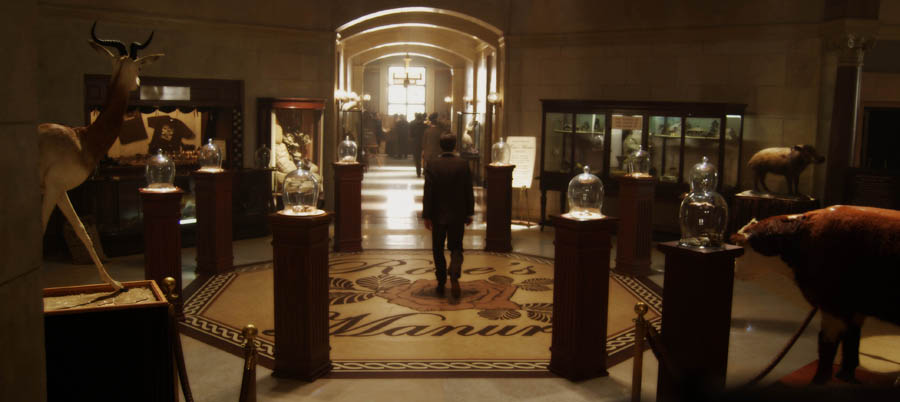
Perhaps our biggest pre-rig job for DC Stages was the main lobby area, a huge rotunda space with a big marble hallway connected to it. The center of the two largest areas (the rotunda and the end of the big hallway) was lit with a skirted 6K spacelight each, with dozens of Source-4’s spotted on various objects in the rotunda, which was a museum space in the movie. The large hallway was lit with a row of spot PARCAN’s.

I started using Kinos less and less for these tungsten scenes – the RED camera seems particularly sensitive to the green spike in these lights. In HMI-lit scenes, the daylight Kinos are fine because all the lights have some degree of green in them that can be timed out, but in tungsten-lit scenes, you can really see how off-color any other source is. So I mainly used bounced tungsten Source-4’s for fill, sometimes key, and bigger tungsten lamps through diffusion. I like bouncing Source-4’s around a space because I can quickly adjust the level by cutting the size of the pattern with the iris blades. And tungsten is the prettiest light I’ve ever seen on skintones.

As for the blue channel noise of the RED in 3200K light, I haven’t noticed it much generally, and truth is that this movie will be timed so warm and desaturated that I’ll probably be working closer to a 5600K balance in color-correcting when opening up the files and then taking down the saturation of the orange tungsten light, rather than trying to get 3200K light to look neutral. But I was playing around with some RED frames from the fake industrial documentary that we shot in the lab on both the RED camera (as a back-up) and on 16mm color negative 7219, and turned the RED frame to b&w to see how that would look (I lit the shot in a classic 1940’s style with hard tungsten light) and was surprised to see how much noise there was in some areas. I can see why you should stick to 5600K lighting for bluescreen work on the RED camera.

Otherwise, tungsten light is too beautiful to be dumped just because the RED prefers daylight, so I’m hoping that Build 16 has improved that aspect. The Macbeth chart tests that someone posted is very encouraging. It looks like the whole color space has been improved with Build 16. I’m just not sure it will be stable enough to switch to for the next RED feature I start for the Polish Brothers in only three weeks, not to mention that we will be shooting pick-ups for this Build 15-shot movie over the next few months probably.

This brings up another issue. On our day off last Friday, some of the camera crew (operator Theo Pingarelli, 1st AC Marcos Lopez, digital tech / b-camera operator Conrad Hunziker) went out to a wild animal ranch to shoot some efx plates (thanks guys!) and had a giraffe kick one of the RED cameras, damaging the mattebox, follow-focus, and perhaps tweaking the camera. So we rented a RED from a small company for some 2nd unit bluescreen efx work on Monday rather than trust the kicked-by-a-giraffe RED that we had yet to send out for a service check. But the RED that showed up had already been installed with Build 16, and we were shooting bluescreen elements for scenes shot on Build 15 and where some elements had already been shot on Build 15. So the efx supervisor did not want to risk dealing with the color differences of having some elements in a shot using Build 15 and others using Build 16. The efx unit (shot by DP Patrick Cady on that day) ended up using the giraffe-kicked Build 15 RED instead since it seemed to be working OK (a good endorsement for the RED camera… it can be trampled by African wildlife and keep working…) But this brings up all sorts of issue with renting RED’s from different companies and keeping track of the Build level that was installed.
 
My gaffer Keith Morgan (who I have worked with a few times before, notably on “Solstice” in New Orleans) and my long-time Key Grip Brad Heiner have pointed out some of the changes in my style in lighting over the years, since I’ve been out of town a lot lately, or was on “Big Love” for seven months with a different crew – I keep learning by watching other DP’s (most particularly Bill Wages, ASC on “Big Love”, who I consider one of the best DP’s working today) and by talking to crew people. Philosophically, the biggest thing has been to learn to light large spaces so that I don’t have to do much relighting on closer shots (until I turn around to look the opposite way.) This is one reason I prefer sets with ceilings so I can retain the natural ambience from light bouncing all around the room. I’ve also discovered 129 diffusion, which is heavier than 216 (more like Full Grid Cloth) and use it a lot. But the main thing is that I mix things up, I am not always consistent about lighting each scene in a similar manner. I may use Chinese Lanterns for one night scene but bounce a Source-4 in the same room for another scene, just for some variations in look, or because the change suits the action better.

I think one advantage of shooting digitally is that certain things when lighting a wide shot of a room can be judged by a monitor that your eyes don’t always catch – mainly in terms of fall-off. It’s hard in a large room with 20K’s shining through giant windows, flooding the room with light, to see with your eyes that some dark wood bookshelves in one part of the room are going pitch black because they are not catching any light. But looking at an HD monitor, that becomes immediate obvious. Plus I’m constantly running two cameras in these wide shots, and sometimes I catch problems with the backing outside the windows on the HD monitors, like in a high angle, seeing a couple of feet of stage floor on the B-camera. Of course this is all stuff that any traditional DP can deal with when shooting film, by eye and with a light meter, and by looking through the eyepiece, but as I operate less and less these days, it becomes more important to catch problems that are only visible from the perspective of the lens. So HD monitoring is simply a great help in this way. If only I could get a high-quality HD image on a monitor while shooting with a 35mm camera...

On the next movie, we will be moving from location to location constantly with a small lighting and grip package, so I will be putting the RED through the paces of dealing with less controlled situations, lighting-wise – more available light, more day exterior light, more we’re-losing-the-light-but-keep-shooting problems, etc. This tends to be where color negative film really saves you’re a--- because you can’t always balance things. You may end up shooting in full shade with a background in full sun, something that modern color negative film handles just fine most of the time, but most digital cameras have a problem with. I’ve shot some HD movies in this manner and generally there are workarounds, so we should be fine.

This is the part where I want to thank everyone involved with this movie. First, the fun cast – Billy Bob Thornton and Tea Leoni were a dream to work with, clever, inventive, but quick to jump in and get a scene in the can (so to speak) within a few takes, if not the first take. The rest of the main cast were wonderful too, all of them. My crew worked so hard on this one with (almost) no complaints and I’m incredibly grateful for that. Gaffer Keith Morgan and Key Grip Brad Heiner were organized and graceful under pressure, two critically important qualities in a department head. I want to particularly thank B-camera Operator / digital guru Conrad Hunziker and my prep-DP Jim Mathers (who brought Conrad onboard) for making this RED experience fairly painless and for doing my homework for me while I was in Canada shooting “Jennifer’s Body” right up until five days before “Manure” started shooting (so my body feels more like I’m on Day 68 instead of Day 26…) I was also happy to be working with my regular camera guys like operator Theo Pingarelli and 1st AC Marcos Lopez, plus 2nd AC’s Bianca Bahena (another RED shoot veteran) and Ken Tanaka, our data wrangler Eric Yu, and the B-camera focus pullers (alternating between Dominik Mainl and Tom Gleason). Thanks also to Jim Mathers and Patrick Cady for shooting some second unit stuff, as well as some inserts shot by operators Theo and Conrad.

Hats off to the producers, line producers, and production office folk for pulling this ambitious film off. I also want to point out the contribution of long-term Polish Brothers collaborator AD Andy Coffing, who is just as interested in how the movie looks as anyone else working on the show, constantly pushing everyone to do things better (not just do it faster).

The real tour de force work on this show was by Production Designer Clark Hunter, not just in terms of visual design and execution, but also achieving the impossible in terms of the number of high-quality sets built, struck, and built again, over and over and over again.

But primarily, I must thank Michael and Mark Polish for their amazing visual sense and imaginative screenwriting, and their dedication to artistic filmmaking no matter what the obstacles. I usually feel beat-up and exhausted by the feature filmmaking process, but at least when I finish one of their movies, I not only feel beat-up and exhausted… but I always feel I worked to my highest creative potential as a cinematographer, which is the most any artist/technician such as myself can ask for.

A few Nikon snapshots:

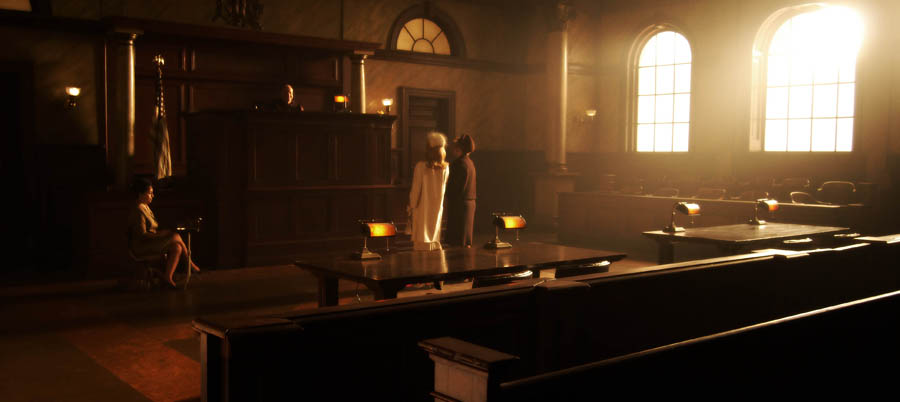
A courtroom, lit with 12-lights behind each window (this set had been built for some other show with only five feet of space between the windows and the stage wall, which is nuts...) I think we lit and shot this scene (three angles) in an hour total. I accidentally took this picture with the Nikon camera set to 5600K, but I like the warmth:
900manure183.jpg


The lab/office (with fans turned by the heat of lamps...) with tungsten playing for late afternoon by switching the camera to 5600K:
900manure182.jpg


The museum rotunda and great hall:
900manure184.jpg
 
Simply Wonderful

Simply Wonderful

David,

If the world had more generous folks such as yourself, it would be a much better place. Thank you for the terrific insights into this project. Leave it to you to turn manure into art. Please keep the lessons coming. They are most appreciated.
 
Oh, I forgot to mention an interesting artifact the other day...

I pointed a 16mm projector (showing the footage we shot on 16mm) right into the lens during a scene where some characters are watching the reel.

Not only was the purple dot from the sensor protection circuitry quite large, basically the size of the projector iris... but you can see the movie running as a negative image inside the purple dot. Basically whatever was clearish on the print caused the sensor to go dark, but the darker areas of the print cut the light level enough for the sensor to merely clip that area to white, so the result was a negative version of the print image running through the gate. Very bizzare-looking but simple to fix in post by burning out that area to white.
 
Congratulations, David.

I hope this film is your most successful to date with the Polish Bros.

Sounds like the next one will be very interesting with all that outdoor work. If you were shooting only landscapes I would say stock up on the grad NDs, but I guess you can't really use those on a narrative feature when you've got actors moving around in the frames. :)

Let us know what happens with Manure regarding distribution, the DI, filmouts, film fests, etc.
 
Oh, I forgot to mention an interesting artifact the other day...

I pointed a 16mm projector (showing the footage we shot on 16mm) right into the lens during a scene where some characters are watching the reel.

Not only was the purple dot from the sensor protection circuitry quite large, basically the size of the projector iris... but you can see the movie running as a negative image inside the purple dot. Basically whatever was clearish on the print caused the sensor to go dark, but the darker areas of the print cut the light level enough for the sensor to merely clip that area to white, so the result was a negative version of the print image running through the gate. Very bizzare-looking but simple to fix in post by burning out that area to white.

Sounds like a cool looking image.

Do you have any idea on the release dates/target festivals that the films will hopefully be screening at?

The images you put up look fantastic as well. It will be interesting to see the full result. Nice Job Mr. Mullen.
 
David,

Awesome thread, thank you a million times.

I really hope you will be able to use build 16 on this next project, it is remarquably stable, and the new color space and noise texture is well worth upgrading.

here is a thread with some low light footage under build 16:

http://www.reduser.net/forum/showthread.php?t=15501


Emmanuel
 
God, to be an up and coming camera person in your 20's and be able to ask a Hollywood Cinematographer questions about his work. I grew up in the 70's reading and re-reading each issue of American Cinematographer to try and learn some tricks of the trade. But back in those days the top guns held their cards pretty close to their chests, especially when being interviewed by A.C. My how times have changed.
 
It looks like the whole color space has been improved with Build 16. I’m just not sure it will be stable enough to switch to for the next RED feature I start for the Polish Brothers in only three weeks, not to mention that we will be shooting pick-ups for this Build 15-shot movie over the next few months probably.
.

David:

As always, you are a great read.

Jim has stated elsewhere that he thinks the current build 16 (v3.1.5) is already more stable than the release 15 and another update to squish a few remaining bugs comes in the next couple days. So you may want to consider it for the new movie.
 
Not that you need to hear this from me as well, but thank you yet again for being so open and sharing so much.

I was recently on a 21-hour day for an NBC promo...upcoming Christian Slater show...and it was brutal. Yet, we only had to deal with the schedule for a few days...not 26. Even then, everyone looked liked zombies at the end of it. So, I can't fathom how you were able to be so thorough in your posts after such a grueling schedule.

I also had the pleasure of working with another brilliant DOP Eric Adkins and he shares a similar, open approach. It's great to be around and learn from such creative visionaries. Truly.

Hats off David. Thank you.
 
David, again amazing stuff, love it, also enjoying the generousity of your sharing some behind the scene stuff, which I have to say I many times look more forward to it then the actual movie it self:)


On your week four of shooting you used several Blue screens, most on tubular frames, and one as a curtain set up, haver you used the MSE quick corner frames? the Square ones, appreciate the input as I'm out to buy few of them.

Thanks, and thanks again for sharing your work with us.

ciao
 
David, are you going to keep this thread going with Post stuff?

My guess is that people are actually as interested in post as they are in the shooting, since it's Red post that is so new and misunderstood.
 
Back
Top