Welcome to our community

Be a part of something great, join today!

  • Hey all, just changed over the backend after 15 years I figured time to give it a bit of an update, its probably gonna be a bit weird for most of you and i am sure there is a few bugs to work out but it should kinda work the same as before... hopefully :)

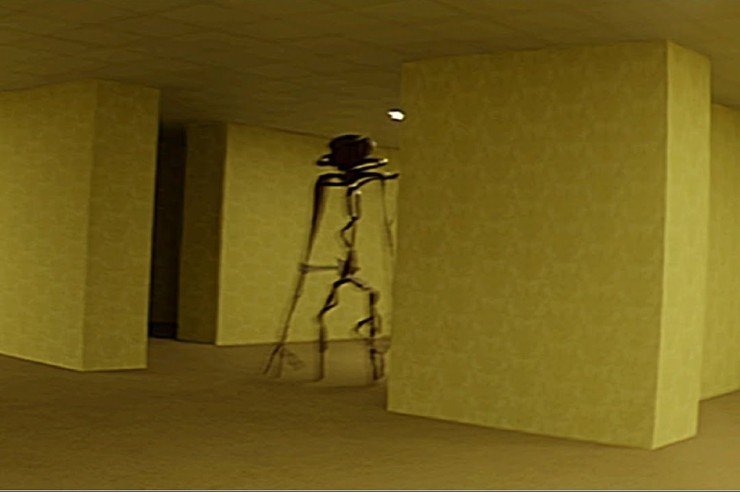
'The Backrooms' Is the Viral Horror Short Shaking the Internet Up

Karim,

You said it man! I wasn't expecting it to be that fucking scary. That's some far out shit !

EDIT:

The Backrooms (Found Footage)

Posted: Jan 7, 2022

Currently Viewed :
11,265,899 times and rising
 
Last edited:
If all those views where people either watching it for the first time or paying to go back to watch it again at the movie theater, At an average movie ticket price of about $13.00, that's $146,456,687 in revenues in less than a month.

These kids are about to get paid or ripped-off by Hollywood.
 
Last edited:
Whole time watching it I’m thinking where did he find this set? Insane what you can do with Blender.
 
Whole time watching it I’m thinking where did he find this set? Insane what you can do with Blender.

That is amazing then if this a Set from Blender. I feel stupid, I was wondering where this building he was shooting this in was located. I guess they disguised it with that "VHS" look.
 
Rand don’t feel bad. I’m over here thinking he built miniatures for those wide cubicle style shots.
 
Rand don’t feel bad. I’m over here thinking he built miniatures for those wide cubicle style shots.

I guess this just shows us both how talented the individuals whom made this film really are. :encouragement:
 
During this pandemic I've been working mostly in Blender as well as virtual studio setups. It's the most powerful 3D generalist software out there. People might argue against that, but the fact is that Blender incorporates so many different things that you can even edit with it and do compositing with 3D tracking. Together with a powerful rendering engine and that it's freakin FREE makes it far more worth anyone's time than subscribing to the money-draining Autodesk softwares. Just think of a show like "The Man in the High Castle" that used Blender as its main workhorse for 3D VFX work. It is far from being a free toy, it's a beast of a software.

I really like the craft that has gone into these shorts, however, it's an old creepypasta concept of liminal spaces that's been circulating the web for a while. So the concept isn't really new. And even if there's a hint at storytelling, it's not really good storytelling. The creator already has the craft skills to work with the concept, but if I were to recommend anything as constructive criticism it would be that he took some time drafting out a story that isn't as repetitive in its story beats as it is now. It could really use some editing and build-ups in some places.

But I know one thing... and that is that whenever a producer understands there's an audience for a horror movie about liminal spaces, there's gonna be a horror film about it. Creepypasta that gets a lot of attention rarely goes long before someone makes a movie or series based on it.
 
Christoffer,

Thanks for your input on this subject matter. I have never been or will be any good at VFX work, I haven't used Fusion but maybe one or two times with only the most basic of setups. I tried Discreet Combustion many many years ago just to see how it compared to Adobe After Effects. However it was just not my thing. I even tried Apple's SHAKE to see if that would help me gain any interest in VFX work, but again nothing. I have been hearing more and more about Blender and it seems to gaining popularity with the Newer VFX professionals.
 
Christoffer, I agree mostly with what you said. Blender is certainly worth knowing. But, alas, I don't really dig CGI much. But, when I see people spend all this time compositing photographs, I think, "Oh, FFS, just learn Blender you imbecile!" LOL

But, RE Backrooms, it was VERY effective, I thought. Even when I watch it again and I know what's going to happen, it still gets me.

Paintbox and Photoshop etc. were practical for a long time because almost nobody had the horsepower to do 3D. Now, everyone has. So, for people who love computer graphics, they really should consider mastering either Blender or one of the commercial 3D apps.

My brother was into 3D once. Back in the '90s, he bought an FPU card for his Amiga 1200 and started messing around with a 3D app. It wasn't Lightwave but I forgot which one it actually was. Those render times were SLOW. We both wished we had a Silicon Graphics workstation.

I played around with 3D studio back in the 90s but it was nowhere close to how easy it is now. The thing is that compositing software like Fusion is good for combining elements, but it's still 2D for things that are a 2D representation of 3D elements. If you film something, it's just the representation that is 2D, the elements have depth to them, so making any VFX benefits being in 3D space, even if it's a 2D element.

In essence, the key elements to any VFX are good camera trackings and good light matching. This is why I'm always mentioning that the next revolutionary camera should have an internal virtual camera track, synced with timecode to the footage. If you get a perfect virtual camera directly out of the metadata of the footage, then 75% of the job is done after stopping the recording. The power of such a solution is that anything placed within that solve will stick to the footage directly and VFX becomes extremely easy to manage. So far, no camera manufacturer is interested in this, which I think is downright stupid, both through a business perspective and brand recognition.
 
This is why I'm always mentioning that the next revolutionary camera should have an internal virtual camera track, synced with timecode to the footage.
So, I think that Red has half of this implemented already, right? Their cameras have a gyroscope or some such thing internally. An accelerometer I think. I have no idea what else you would need or how you would implement it.
 
So, I think that Red has half of this implemented already, right? Their cameras have a gyroscope or some such thing internally. An accelerometer I think. I have no idea what else you would need or how you would implement it.

It is not accurate and there is no metadata handling of that data outside of people making custom-made utilizations for stabilization. You would never be able to get a true virtual camera though. The implementation needs to track position data with more sensors and be able to generate a frame-accurate path for a virtual camera that exports and imports as an FBX or Universal Exchange Data with footage sync parameters set within that export so there's no matchmaking back between the footage and virtual camera.

None of this is impossible, it's pretty easy to implement in a $3000+ camera system. Sensors are not that expensive and the software handling of that data just needs a coder that can work on it for a while. But the implications of such a feature is much greater than people realize. Not only would it be the best system to do any kind of filmmaking that require VFX elements, but it would be the most effective way of shooting anything that would require even the smallest changes in post.

No one is looking into this. External gadgets that need to be synced up and prepared is not at all the same but seem to be an excuse people make to justify this feature... not being in cameras. I think people have lost touch with innovation these days. It has reached a stagnation where everything revolves around the same thing over and over again, sensor resolution, framerates, DR, RAW, s35, full-frame, autofocus etc. But features that would change how we actually film stuff seem to be low on the list for most manufacturers.
 
The Backrooms now has 20M views. Phew. If you haven't seen it yet, I recommend it. In fact, watch the entire channel.

Edit: The creator doesn't even want to be a VFX artist when he leaves high school. He wants to be a director.
 
Last edited:
So is this actually associated with creepypasta/claykid or the game? It looks *identical* to the 2019 indie game based on it (albeit with VHS filter). The sound/designer did a rad job given it was completely CG.

Not to derail the thread, but I'm kinda thinking what Chris is; as soon as a decent "plug n play" solution is built-in to a camera, a lot of lower budget productions will probably go the way of virtual+ as it expands possibilities with little/no additional money. You wouldn't even need a decent green screen, and would only need to light the subject accordingly (presuming an automated solution for that isn't created as well). And yeah, I think it'll be one of the consumer-level cameras that does it first (mirrorless), as it seems iPhone is currently the front runner with it's LiDAR implementation (that somehow *isn't* 24fps? facepalm)

Red Notice is a good example; during the RED talk the director/DP made a big deal about how they didn't use green screen and just rotod everything... Pretty soon you won't need to do the "rotoing" shot to shot -- it'll just be an "only display the focal plane" style command... No by hand highlighting, no rendering, no nothing. Background replacements in two/three clicks. Plus you use the camera's depth and gyro data of the shot to control blender/UE5/"world" movement automatically too... (Expect a lot of indie movies to take place on Mars. Ha!)
 
Red Notice is a good example; during the RED talk the director/DP made a big deal about how they didn't use green screen and just rotod everything... Pretty soon you won't need to do the "rotoing" shot to shot -- it'll just be an "only display the focal plane" style command... No by hand highlighting, no rendering, no nothing. Background replacements in two/three clicks. Plus you use the camera's depth and gyro data of the shot to control blender/UE5/"world" movement automatically too... (Expect a lot of indie movies to take place on Mars. Ha!)

Oh, that's absolutely inevitable. After that, 100% CGI everything, actors included. There will be romantic comedies made this way. The actors will be completely fabricated. If they become stars, they won't ever age. Imagine a 'Meg Ryan' who is forever 30. You can't put the cat back in the bag, as they say.
 
Red Notice is a good example; during the RED talk the director/DP made a big deal about how they didn't use green screen and just rotod everything... Pretty soon you won't need to do the "rotoing" shot to shot -- it'll just be an "only display the focal plane" style command... No by hand highlighting, no rendering, no nothing. Background replacements in two/three clicks. Plus you use the camera's depth and gyro data of the shot to control blender/UE5/"world" movement automatically too... (Expect a lot of indie movies to take place on Mars. Ha!)

Exactly.

About 15 years ago there was such a boom in camera technologies that changed how productions were made, not only going digital, but also stuff like highly advanced motion control systems, Phantom high speed etc. that changed what was possible on lower budgets.

There isn't really anything new today, just lower prices for higher quality images, motion control in inexpensive gimbals. Last real "revolutionary" concept was drones.

A Z-depth capable camera that removes the need for green screen, that's framerate accurate and pixel perfect for stuff like hair and such, would revolutionize the industry. Imagine the time and money spent on people rotoscoping, imagine if the same camera had a virtual camera recorded as well, no tracking, no interference with practical effects screwing up such tracking, no weeks of rotoscoping, no need to plan wardrobe around rotoscoping. All work goes into the creative side, lighting, modeling, animating, matte painting etc. All the unnecessary bullshit removed from post.

I'd just wish some camera manufacturer would understand the potential in this concept and the market for it. I think Red has a good position for this. They have always had R&D working on new concepts, they always try wild things to see how it might work and they are losing market share at the moment when everyone is catching up to 8K.

Red could do this camera and once again be leading in something, but I'm afraid they have gotten stuck in a repetitious cycle of "innovating what they know", taking existing concepts from the industry and implementing them instead of innovating concepts to lead with.
 
Red could do this camera and once again be leading in something, but I'm afraid they have gotten stuck in a repetitious cycle of "innovating what they know", taking existing concepts from the industry and implementing them instead of innovating concepts to lead with.
Sociologists have a saying: revolutions always stop half way. It's an exaggeration, but to exaggerate a problem is to clarify it.

Edit: Remember when 35mm couldn't be replaced by digital, and that digital would never catch up to film? Then, when mirrorless cameras got so good that they started to make DSLRs redundant, you got the crowd saying that DSLRs couldn't be replaced by mirrorless! Well, guess what's happening right before our eyes...
 
Back
Top