Welcome to our community

Be a part of something great, join today!

  • Hey all, just changed over the backend after 15 years I figured time to give it a bit of an update, its probably gonna be a bit weird for most of you and i am sure there is a few bugs to work out but it should kinda work the same as before... hopefully :)

My Fan audio test

Crazy question.

Top Fan?

Crazy question two.

DSMC Top Plate 2.0?


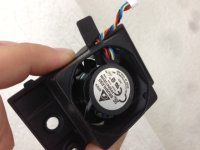
The new bottom fan "can be" louder when it needs to do heavy cooling, but that's mainly because it's a more powerful fan that pushes more air.

I'm only saying this because I've had three shoots running Adaptive @ 70° indoors. On my last commercial, even in a tight space like a hallways, our shotgun wasn't picking it up at all and I was less than 3 feet from talent.

There's another sneaky thing I think the new Top Plate 2.0 is doing. I think it's behaving like a heat sync to a certain degree now that I've put some hours in on the new setup.
 
Not so crazy your question Phil.

I would have loved to test the top fan but it was not available. Hope I'll get it when I come back to Switzerland and I'll finish my test with the RED top fan installed.

My bottom fan is louder at the same camera temperature as the original fan (as seen in the video I posted the link).

I'm asking : is it louder than the original one when used in the same heat conditions?

Mine is.

Pat
 
I'll have to rip my camera apart when I get some free time and test out various configurations. I have access some decent audio tools.

The biggest thing I've noticed with the new front fan is there is a slightly different noise that comes out of it, but I swear it sounds like film moving through camera when my head is next to it. Otherwise I've been rather impressed by the performance of the new algorithms and fans. So have the sound peeps.
 
When at top speed the bottom fan is indeed louder but that's not surprising because it moves way more air. But it moves way more air when operating in record mode at previous audio levels. So, overall there is much improvement with the combo of top and bottom fans installed. WIthout a doubt the camera stays cooler with less effort. So if the camera does go into crazy fan mode (which it hasn't for me) , just watch how quickly it cools.
 
I come to the same conclusion as you.

- New sound algorithm is a must have even if it has its pitfall :

a) switching on the camera, I have to wait until the fan gets it's working speed, it's not an instant process like when set to manual, this can take 30'' to 1 minute.
b) the ramping of the fan can cause problem if the top fan isn't efficient enough (or absent), in my case the top fan takes the most of the work to cool the camera, so I never heard any ramping.

A new positive thing about the algorithm is that the minimum fan speed is lower than the manual 25% when the body is much cooler than the desired target heat.

- The new Bottom Fan can moove much more air through the heat sink when used at the higher speed setting but I rarely use higher than 60%.


While shooting, I use the lowest fan setting I can without overheating the camera, and I usually work between 25% and 40%, 35% beeing my target. So at those lower speed setting, wich are my most used settings, the new Bottom fan is louder than the orignal one for the same camera heat. Bummer.

- You need to add the top fan as it is the one that takes most of the heat.

I'll test if the top fan from RED is better than the FanPlate. As I am a DP, I want the best solution out there. Be it mine or the competitor's ;-) .


Pat
 
I have two configurations that I use:

"super quite" ... for acoustic mic setups where I need the camera close to the mic that is recording a acoustic instrument - new top fan and the standard bottom fan.

"super cooling" ... outside in 105 degree weather in the sun - i use the new bottom fan and top fan (but that configuration gets loud).

I was wondering if we could run with just the top fan ? (this would be for things like trying to get closeups with a wide lens of a bird with my robotic camera setup).
 
I didn't try with RED's top fan but the (original) bottom fan is really quiet and does the job well if used with a top fan.

We could improove the sound emitted by the bottom fan by putting a "sound shield" (watch out I'll TM this!) ;-) in front of the fan. The noise emitted by the fan is sent towards the scene. We could cut it easily with a Sound Shield™ LoL.


Pat
 
I have only put in the top fan because for various reasons I could not put in the bottom fan but that turned out to be a lucky combination.

After several drama shoots, including two in a very confined spaces (car), I have decided that I don't need to put the bottom fan in. I have also decided that I will run the camera in manual mode. For quiet operation I generally try for about 36 degrees and the camera seems to be able to run comfortably at that temperature now for longer and is also pretty quiet. Cool and quiet = good combination.

The reason I don't choose adaptive mode is that I just can't accommodate myself to the idea of running the camera at 70 degrees as a general operating temperature. I kind of have it in my head that heat plus electronics means an early death for the camera...I have no empirical evidence to back this up. I know that that is within the operating temperature range of the camera but it seems to be near the maximum range. I tend to think that the intention was that you could occasionally go up to near the maximum range, not stay there for long periods. If someone at Red chimes in and tells me that that is rubbish I will be very glad.
 
New Bottom Fan Noise

New Bottom Fan Noise

Hello -

This may be a long shot, but it sure sounds like a fan blade (just) hitting something. The spece is pretty tight in there, and as the fan comes up to speed, the blades (from gyroscopic & aerodynamic forces) could move slightly from their lower RPM position(s). Move just enough to just hit a wire, for instance, should the wires not be completely out of the way.

It's a quick check - you might take the lower fan assembly out and make sure the myriad little wires are routed so as to avoid abrasion AND not coming near the blades. Could also be FOD that got pulled in. I can feel the air rushing in when I hand hold during Run-and-Gun shooting - not impossible something got pulled in.

FWIW -
Serge
 
Forgot to add to thank Patrick for the test. Very useful. I would have been very upset if I had put in the front fan even allowing for the proximity of the mic and the added gain for the purposes of the test. It is not just the absolute volume of the fan that matters - it is the particular noise and frequency that it produces and the front fan noise is just horrible.

On another but related issue, it will be interesting to see how the front fan combination plays with the pro i/o module which produces its own "distinctive" sound.

Overall I am pretty happy now with the audio solution for the camera body.
 
Great question Rob. I also wonder what is the max heat that electronics can handle. Board, cpu and other components that are designed with the certitude it will generate heat.

I would love to hear RED's ingeneering opinion but in the mean time someone with a ingeneering background is welcomed to answer your question.

i can get up to 45/69C in adaptive mode, is it too much?

Pat
 
Hello -

This may be a long shot, but it sure sounds like a fan blade (just) hitting something. The spece is pretty tight in there, and as the fan comes up to speed, the blades (from gyroscopic & aerodynamic forces) could move slightly from their lower RPM position(s). Move just enough to just hit a wire, for instance, should the wires not be completely out of the way.
Serge

Hello Serge thanks for your input.

I just looked at the fan. The desing is made so that no wire can get close to the fan blades. The sound is also present when the fan is not inserted in the heat sink. I think I may open a support ticket like Brent suggested and send the new Bottom fan in.
If any one could make a closeup sound record of the Bottom fan running at lowest speed and post it, it would resolve this thread quickly...

See you.

Pat
 

Attachments

  • photo(5).JPG
    photo(5).JPG
    85.9 KB · Views: 0
I have only put in the top fan because for various reasons I could not put in the bottom fan but that turned out to be a lucky combination.

After several drama shoots, including two in a very confined spaces (car), I have decided that I don't need to put the bottom fan in. I have also decided that I will run the camera in manual mode. For quiet operation I generally try for about 36 degrees and the camera seems to be able to run comfortably at that temperature now for longer and is also pretty quiet. Cool and quiet = good combination.

The reason I don't choose adaptive mode is that I just can't accommodate myself to the idea of running the camera at 70 degrees as a general operating temperature. I kind of have it in my head that heat plus electronics means an early death for the camera...I have no empirical evidence to back this up. I know that that is within the operating temperature range of the camera but it seems to be near the maximum range. I tend to think that the intention was that you could occasionally go up to near the maximum range, not stay there for long periods. If someone at Red chimes in and tells me that that is rubbish I will be very glad.

+1...
 
I have a problem with Fan Cooler, it is broken. Makes him banging noise when moving the camera. Has anyone had to change the cooler? Changed without triggering the RED?
 
I have been struggling with audio issues with Scarlet and my Epic MX. They included fan noise, grounding noise etc.
It was particularly bad when recording directly off a radio mic. I had sent the camera back to Red without much change.
To solve the problem, I tested a ROLLS PROMIX IV
http://www.bhphotovideo.com/c/product/294571-REG/Rolls_MX124_MX124_Portable_4_Channel.html
and using this cheap, very robust and very clean audio pre amp, plus some good quality audio cables, all my audio issues disappeared. I drilled 4 holes into the bottom of the preamp and added a protective plastic plate to the back of the camera.
The Rolls is screwed to the back of the camera and as it is the same width all is feels great. The advantages of this solution are that you can easily change the record volume manually without having to fiddles with menus.

I hope this inspires
 

Attachments

  • IMG_8700.jpg
    IMG_8700.jpg
    93.7 KB · Views: 0
  • IMG_8699.jpg
    IMG_8699.jpg
    93.7 KB · Views: 0
  • IMG_8695.jpg
    IMG_8695.jpg
    93.4 KB · Views: 0
If your new bottom fan is louder than your old in adaptive mode at same temp setting, them contact tech support at Red.

+1

I had exactly this situation on a new Epic-D front fan 2.0 (while using the top fan) and tech support swapped out the fans.

The replacement front fan was a definite improvement; however,
there was still a grounding electrical whine that isn't present in other EPIC/SCARLET bodies I've used.

I ended up just purchasing a new front fan 1.0 and use that for now(w/ the top fan) and have no problems.

If there is a video rental house near you, or you know a fellow local reduser, then make a side by side video "sanity test".

I intend to do the same and then contact tech support again myself - maybe there's an electrical grounding issue or bad board.
 
Back
Top