Welcome to our community

Be a part of something great, join today!

  • Hey all, just changed over the backend after 15 years I figured time to give it a bit of an update, its probably gonna be a bit weird for most of you and i am sure there is a few bugs to work out but it should kinda work the same as before... hopefully :)

Ask David Mullen ANYTHING

Thanks very much for all your input here David, it will make a difference on the final result for sure.

My biggest problem is that, not only I need the blue light to be blue, but I also need the warm light to be really warm.

I`ll keep testing, and I`ll post the final picture here!

Again, thanks very much!
 
Thanks very much for all your input here David, it will make a difference on the final result for sure.

My biggest problem is that, not only I need the blue light to be blue, but I also need the warm light to be really warm.

I`ll keep testing, and I`ll post the final picture here!

Again, thanks very much!

If there is a tungsten practical in the frame that you cannot gel, then you need to make the blue light bluer in relation, then you can set a higher color temp on the camera to warm up the tungsten practical (you could also put a brighter bulb in and dim it down warmer as well.)

Your biggest problem is the white bookcase right behind the actor. The background either needs to be painted blue, so that it always stays blue, or it needs to be far enough back that the warm light can be flagged off of it. It's also had to make a scene dark and moody in a white room because if you underexpose enough to make the wall look dark then the faces will be too dark.
 
Hi David,

I was wondering if you could talk a little bit about your opinions on selecting focal length to compress or expand the background.

For example, let's say I'm shooting a man walking through a stand of trees, and I can move where the camera is set up to keep the man's size constant regardless of focal length choice. So now deciding focal length seems to come down to how much compression or expansion I want in the background. I.e., using a long lens will result in larger but fewer trees in the b.g., while using a wide lens will result in more but smaller trees in the b.g.

So I think I understand the effect, but I'm wondering if there is some rule of thumb, logical or emotional reason to choose one composition over the other?

Thank you very much!


P.S. I guess a related ? would be your feelings on how you use focal length to distort perspective of objects and people's faces.

Thanks so much again!!
 
Hi David, I was wondering how you light night exteriors, trying to replicate moonlight. Would you use hard light or soft or both? And what direction to you aim the light? In just a single direction or multiple?
 
You could probably write a small book on the subject...

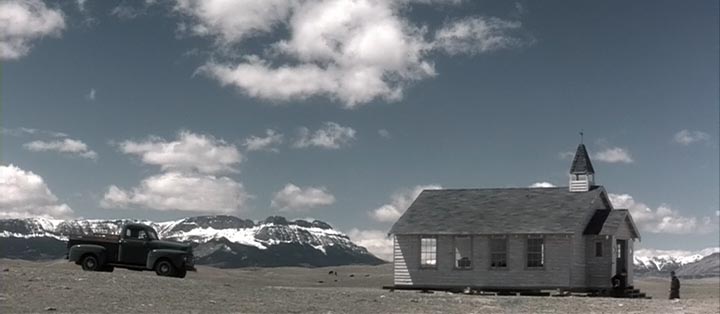
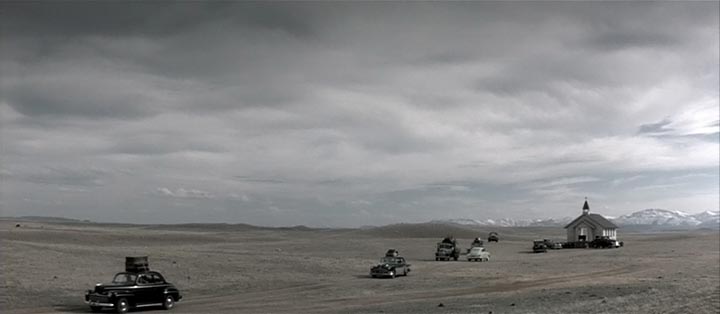
When I did "Northfork" in Montana, I was shooting at the base of the Rocky Mountains on the Great Plains. I had a lot of empty space so choosing a focal length was mainly a matter of how far did I want to back up the camera. When I wanted to make the mountains in the background more dominant, I often shot the wide shot on a 75mm or 100mm anamorphic, and when I wanted to make the vastness of the plains more dominant, I shot on a 40mm anamorphic. You can see the effect here in these shots around out church set:

75mm anamorphic:
northfork39.jpg


40mm anamorphic:
northfork40.jpg


So compression is the main factor, but if you add in a lateral dolly move, then this also affects motion -- a wide-angle lens will increase the sense of speed if the ground is stretching out towards the subject, but a long-lens may also increase the sense of speed as foreground and background objects blur past the subject if you parallel them on the dolly.

There is also the practical matter that any bumps in the dolly move will be exaggerated as the focal length gets longer. I know the move will be smoother on a wide-angle lens.

Also, a low or high angle will be more dramatic with a wider-angle lens.

All of these means that it depends partly on the surroundings and the foreground elements in terms of what the choice of lens will do to them.

If I can get the move smooth enough, I like long-lens lateral dolly moves, they remind me of Kurosawa, who often combined them with pans.
 
Hi David, I was wondering how you light night exteriors, trying to replicate moonlight. Would you use hard light or soft or both? And what direction to you aim the light? In just a single direction or multiple?

Depends on a number of factors. The moon is actually a hard source like the sun though because the cones in our eyes don't work as well in low light and the iris in our eyes is wide open, the feeling is somewhat soft and muted to our eyes. The color is daylight balanced, so relative to any tungsten-lit windows in view, the moonlight is cooler in color. But the truth is that moonlight has been a theatrical effect even pre-cinema and blue gels were even used in magic lantern shows to symbolize to the audience that the scene was in moonlight. So we have a lot of leeway as to how to play moonlight in something fictional, depends on the mood we want to create.

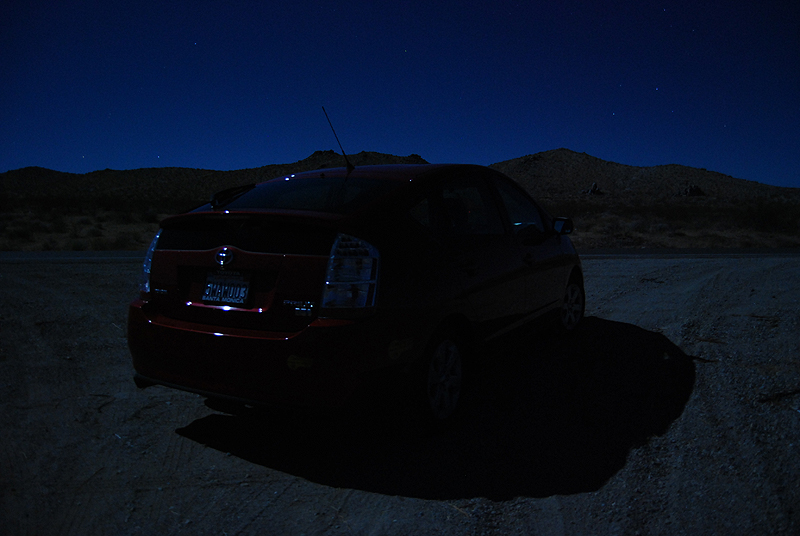
I've shown this before in this thread, but here's a picture of my car in the desert under a full moon, underexposed with the camera set to 3200K:
moonlit2.jpg


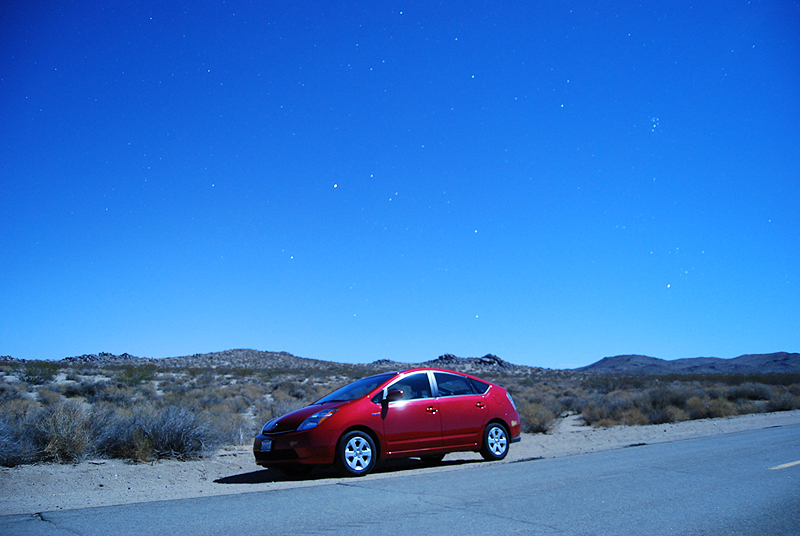
And here it is not underexposed:
moonlit3.jpg


One thing that struck me out there in the desert was that like the sun, the moon can be anywhere in the course of its arc, it could be dead overhead, it could be frontal. But in movies we try to keep hard moonlight at a backlit angle, or 3/4, just because it's moodier that way, creating a maximum amount of shadows.

You run into practical limitations all the time though, i.e. how far away, how high, how powerful can I get the moonlight units... I haven't had the budget yet for Muscos or BeeBee Night Lights, nor a construction crane, so generally the biggest and tallest thing I've worked with are two 18K HMI's on a 125' condor.

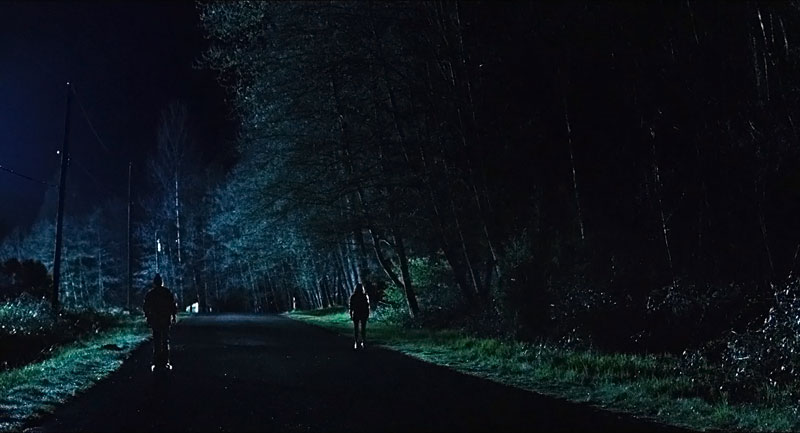
This was a very big area to light in "Jennifer's Body", a county road:
jenbody2.jpg

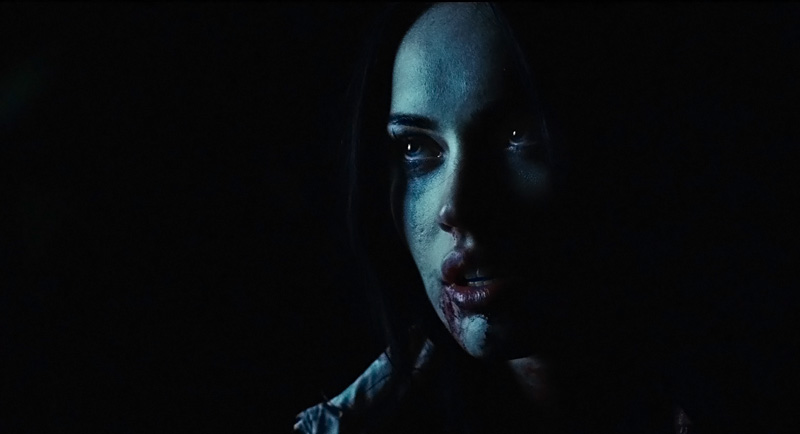
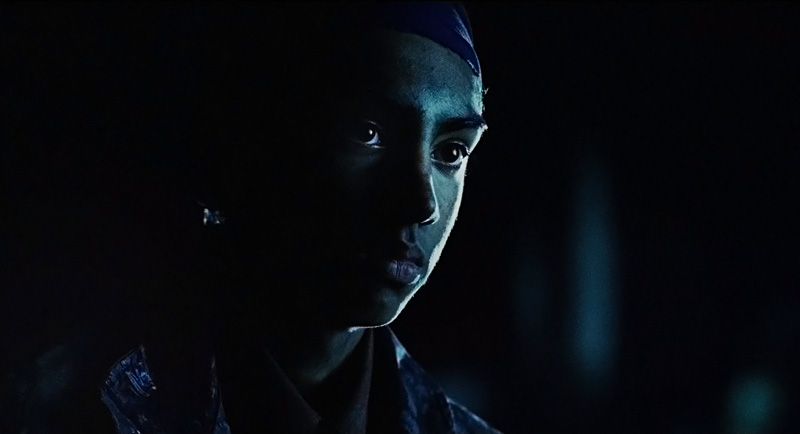
Again, it was lit with two 18K HMI's on a 125' condor way, way down the road at a slight bend in the road (which was good since at that distance, they weren't high enough to get out of the frame.) I remember I had to push the film, rating it at 640 or 800 ISO, and was shooting wide-open at f/2.0. The two characters meet in a 50/50, which means that the person on the right (the girl) was 3/4 front-lit in her close-up and the guy was 3/4 back-lit in his. I also hid two lights in the trees to the right, one up a hill to edge some of the tree trunks, and one near the road to create a kicker on the guy -- unmotivated but necessary just to see him better, otherwise he disappeared against the black roadway.

I ended up softening the key light in the close-ups:

jenbody3.jpg


jenbody4.jpg


This was uncorrected HMI or daylight Kinos. I pulled a little blue out of the timing. This was a flashback scene so I felt it was OK to be a bit stylized in the lighting since it was a memory. Plus this was a horror movie after all, some Expressionism in look was justifiable.

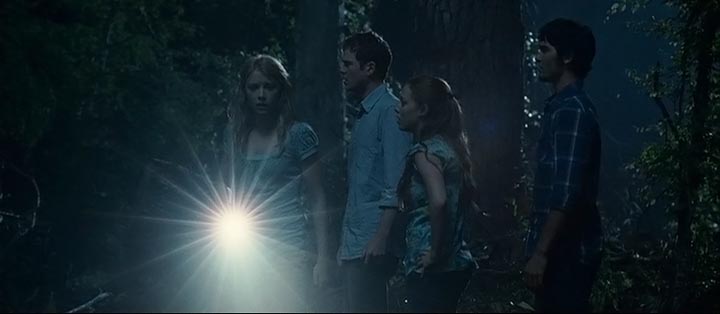
But I've done some movies with softer moonlight, though often that is because the moonlight isn't the only source in the scene and I just want a hint of soft dim moonlight in the area that doesn't compete for attention. Also, in some spaces like in the woods with heavy foliage, it had be difficult for hard moonlight to reach the subject, so softer sources may work better.

I had this scene in a swamp in New Orleans for "Solstice" that was lit with an overhead lighting balloon. In this case, I was also able to get a backlight from an HMI on some parallels but it wasn't easy -- many shots were just lit with the balloon. This was the only practical way of working in a swamp where there wasn't a lot of solid ground to park a condor:
solstice19.jpg
 
Last edited:
Always appreciate your knowledge and experience. Caught your cameo tonight on Smash David. Man of many talents.
 
Hey David, I've recently watched and loved Tim Burton's "Dark Shadows", and Soderbergh's just released "Behind the Candelbara". I love how each of them uses filtration, and I wonder if you can tell from the trailers what diffusion they may have shot with?

Here is Dark Shadows. My guess is they maybe used a light White Frost, but curious to see what you think:

And here is Behind the Candelabra. There is lots of halation on the lights, but not too much mist, so I was guessing maybe a strong Black Pro Mist or Black Frost? Soderbergh also seems to use a "star" filter during performances, something pretty nuanced like a Vector Star or Hyper Star? Curious to see what you think they used, as a I love that period look (the halation), but also appreciate that they didn't go too thick with any fogs, etc (as that's almost TOO period).

 
Last edited:
I think "Dark Shadows" added the diffusion in post by the way that both highlights and blacks have a soft glow to them. I noticed in "Behind the Candelabra" a number of shots were made with a Dior stocking on the lens, the star shape is similar in some shots in "War of the Worlds" which also used a Dior net:

wotw2.jpg
 
I think "Dark Shadows" added the diffusion in post by the way that both highlights and blacks have a soft glow to them. I noticed in "Behind the Candelabra" a number of shots were made with a Dior stocking on the lens, the star shape is similar in some shots in "War of the Worlds" which also used a Dior net:

wotw2.jpg

Fantastic answer. Thanks David!!
 
BTW, congrats to Mr. Mullen on the finale to Smash, which I thought looked tremendous. I fell out of my chair laughing at his surprise cameo in a key scene -- I won't reveal where it is, except to say that it's a very funny close-up.

If you don't get at least an Emmy nod for this episode, it'll be a crime. This was a tremendously good looking show.
 
BTW, congrats to Mr. Mullen on the finale to Smash, which I thought looked tremendous. I fell out of my chair laughing at his surprise cameo in a key scene -- I won't reveal where it is, except to say that it's a very funny close-up.

If you don't get at least an Emmy nod for this episode, it'll be a crime. This was a tremendously good looking show.

I noticed David listed as DOP but the cameo was a great surprise. Well done David.
 
Awesome, have to check it out! And thanks for your help as AWLAYS David! YOU ARE THE * ! ! MAN ! ! *
 
I often softened the light over the actors with Half Soft Frost on a large frame. It's similar to Opal diffusion gel but is a soft pliable material like a shower curtain uses (Opal gets very noisy in a wind, rather "rattly"). You seem to only lose about 1/3 of a stop under the Half Soft Frost so actors don't look like they are standing under the shade of a tree or building.
 
Hi David,

I hope all is well with you. I noticed on page 95 "Cinematography" mentions using a small hard light positioned near the camera's lens as an eye light/catch light. I was wondering if you could recommend specific brands/models of lights that you think work well for this?

I'm shooting some sit down interviews and have sometimes positioned a china ball or reflector low to the ground to add fill to the subject's eye sockets, but using a harder light might make the eyes pop more. So I'm interested in what lights you'd recommend trying as an eye light/catch light.

Thanks very much again!
 
If the light is too small and hard, like an undiffused Dedolight, the reflection in the eye is quite small... That can be useful if the person is wearing eyeglasses because the white dot reflection is not too distracting. But otherwise it's useful if the eyelight is a bit broader, like by putting diffusion on the barndoors of the Dedolight or Pepper or some other incandescent in the under-300w range. But then you may also want to use a black wrap snoot or something to control spill. Or a real metal snoot.

Lately I'm more likely to use something a bit larger and softer like a 1'x1' Litepanel or a Litepanel Micro or Chroma on the lens. Or a Rifa44 with an eggcrate. Truth is almost anything can create a reflection in the eyes.
 
Back
Top