Welcome to our community

Be a part of something great, join today!

  • Hey all, just changed over the backend after 15 years I figured time to give it a bit of an update, its probably gonna be a bit weird for most of you and i am sure there is a few bugs to work out but it should kinda work the same as before... hopefully :)

ANAMORPHIC ARTIFACTS & SQUEEZE RATIO QUESTION

Rick LaLonde

Well-known member
Joined
Dec 15, 2011
Messages
79
Reaction score
0
Points
0
In watching a Frankenheimer film which was shot Panavision anamorphic, I'm seeing round bokeh, not oval. Also, there is pretty deep focus in many of the shots and do split diopters to detect. This raises some questions to me:

- Does it mean the squeeze was 1:1.33X?

- Can achieve a good blend by shooting 2X ana and reverting to 1:1.33X when deep focus is desired?

Thanks to anyone with insight into this.
 
It depends which Frankenheimer movie you're referencing.

It was normal to use rear converted zooms back in the day, as the film process was analogue the image needed to be recorded/exposed as 2X onto the film plane. As a project would need to stay in 'scope all the way through post.

Some Directors (who like like zooms) would happily intercut front ana and rear ana lenses. You see this a lot on 70's movies particularly, as this era had a lot of zooms used as part of the visual style.

There are quite a few movies out there that are shot in scope (2X) but are on entirely rear converted lenses. So they're true 'anamorphic' in that they were squeezed correctly, but, when projected, they only display circular bokeh.

Also, bear in mind that the anamorphic abberations that we like now, were often not liked in the days of pre-digital, sphericals with rear ana were actually used a lot more than anyone thinks.

We forget a lot of the old reasons for things as our obsession with ovalur bokeh really is a post digital thing :)

I'm sure David M will elaborate with more details ;)

Watch something like Dirty Harry and they'll have zooms with rear anas - a movie that springs to mind that's scope and shot with rear converted anas is the Brit movie 'Daleks Invasion Earth' (mention both of these as they've been on the TV in the background recently).
 
Andy has given an excellent answer. Back in the 1970's, but also in the 80's and 90's, before Super 35 became popular once the film & duplicate stocks improved so much that it was possible to make good dupes and release prints (not to mention DIs, which eliminated the need for optical blow-ups to get theatrical prints), it was a very extended practice to mix rear adapted lenses, such as telephoto and zooms, with prime lenses.

Take a look at "The Poseidon Adventure" (Harold E. Stine, ASC) and "The Towering Inferno" (Fred Koenekamp, ASC and Joseph Biroc, ASC) as examples of pictures shoot almost 100% on rear adapted anamorphic zooms (such as the very popular Cooke Varotal 20-100mm, which appeared in 1971). Problem was that once these lenses were rear converted for anamorphic purposes, their sharpness, contrast and overall performance could suffer -as another group of glass was added to the lens- and specially, there was a significant loss of light, so the 20-100mm T/3.1 became a 40-200mm T/4.5 anamorphic zoom (while the 10:1 Cooke zoom became a 50-500 T/5.6 once rear adapted). This meant lots of shows only switched to prime anamorphic lenses when it wasn't possible or reasonable to light sets or locations to deep stops. Take a look at Vilmos Zsigmond anamorphic pictures from the 1970's and early 80's (such as "Obsession", "Close Encounters", "The Deer Hunter", "Heaven's Gate") and you will only see primes being used when he needed the exposure; otherwise, he sticked (and still sticks) to zooms all the time, and while the pictures still are anamorphic, they only show anamorphic artifacts in small bits. In general, during the 1970's, it was usual to use zoom lenses (anamorphic or spherical) for most day exterior work, and prime lenses for night and interior work. It's just that the mix shows up much more in anamorphic!
 
In watching a Frankenheimer film which was shot Panavision anamorphic, I'm seeing round bokeh, not oval. Also, there is pretty deep focus in many of the shots and do split diopters to detect. This raises some questions to me:

- Does it mean the squeeze was 1:1.33X?

- Can achieve a good blend by shooting 2X ana and reverting to 1:1.33X when deep focus is desired?

Thanks to anyone with insight into this.

Which one? His last few were shot in Super-35. I only see a couple of 35mm anamorphic movies in his credits -- "Black Sunday", "Prophecy", parts of "The Horsemen", maybe one other.

One thing to keep in mind is that most anamorphic zoom lenses have rear anamorphic elements and thus don't produce the classic squeezed bokeh.

Also, with regular 2X anamorphic primes, the amount of stretching in the bokeh is controlled by the f-stop -- it gets less stretched-looking as you stop down, mainly because there is less information out of focus.
 
Last edited:
I just watched "Prophecy" (don't ask why) and aside from an opening scene consisting of primarily just flares off helmet lamps, the movie looks like it's mostly on rear-anamorphic zoom lenses. Very little artifacting except some distortion on the occasional wider shots, and very very little flare. There are headlights and flashlights shined right into the lens at times without even a hint of flare.

And boy, for a studio (Paramount) monster movie released the same year as Alien with a director like Frankenheimer, it's really a fascinating watch (for all the wrong, and at times racist) reasons. It would be interesting to see the look of the flick on Blu Ray, as it stands now it's a murky mediocre transfer in SD.
 
Thanks guys! Great information and makes perfect sense.

David, the film is Ronan, late 90's. Filmed in Panavision. Wonderful character composition, particularly the warehouse scenes. I would like to be able to duplicate that depth but not lose the artifacts - probably asking too much.
 
"Ronin" was shot in Super-35, not anamorphic, using Panavision cameras and spherical lenses. Basically they tried to use wider angle lenses and deeper f-stops to increase depth of field.

Well, that would explain it. For some reason the DVD package states "widescreen anamorphic".

Thanks!
 
A "widescreen anamorphic" DVD means that it is a 16x9 anamorphic copy, a video term, not a photography term. A Region 1 DVD is standard def video at 720 x 480 pixels.

You'll note that this is a 1.50 : 1 aspect ratio, which means that a 4x3 full frame image has non-square pixels that are slightly stretched horizontally to fit 1.33 : 1 into 1.5 : 1. A 16x9 transfer can either be put onto a 4x3 DVD letterboxed (the 16x9 area letterboxed within a 4x3 signal) or become "anamorphic", the 16x9 signal filling 720 x 480, which means that the pixels are non-square and squeezed horizontally to fit 1.78 : 1 onto 1.5 : 1. On top of that letterboxing is used to create even wider aspect ratios like 1.85 or 2.40. For widescreen movies, an anamorphic DVD is preferred over 4x3 letterboxed because more pixels are devoted to the actual image (and is optimized for 16x9 monitors).

For example, here is a frame grab from a "widescreen anamorphic" (i.e. 16x9) DVD of "Astronaut Farmer". It was shot in 35mm anamorphic and transferred to HD with a 2.40 letterbox, and then a 16x9 (w/ a 2.40 letterbox) standard def version was created. The frame grab shows that 16x9 letterboxed signal squeezed into 720 x 480 pixels:
16x9_1.jpg


This is with the squeeze taken out, which is how it would appear on a 16x9 TV monitor:
16x9_2.jpg
 
Last edited:
This education is appreciated, David. It also explains why there is so much misinformation on various blogs like the one that confirmed Ronin to be shot in anamorphic. Still I wonder: Would 1.33X ana yield such deep focus capability with say, a wide angle lens stopped down and strong lighting?
 
Depth of field is a combination of focal length and f-stop more or less, the reason why 2X anamorphic lenses have less depth of field on average is that they "see" twice as much horizontally, so you end up using a longer focal length to get the same view. In other words, a 40mm anamorphic lens sees the same width as a 20mm spherical lens... and a 40mm lens has less depth of field than a 20mm lens.

So a 1.3X anamorphic would be somewhere in between the two formats in focal length and thus depth of field characteristics.... you'd probably use a 27mm focal length in 1.3X instead of a 40mm focal length for a 2X lens. Bottom line is that if you want a lot of depth of field, don't shoot anamorphic unless you have a lot of light so you can stop down.

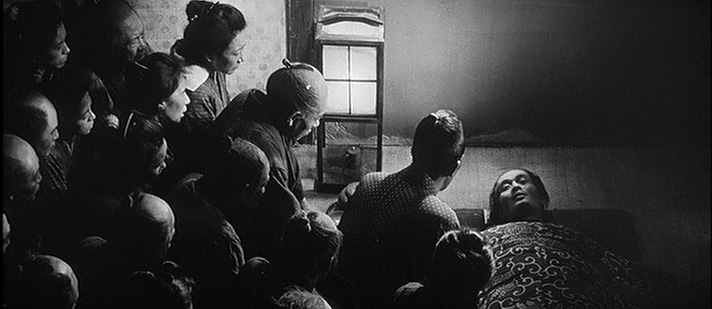
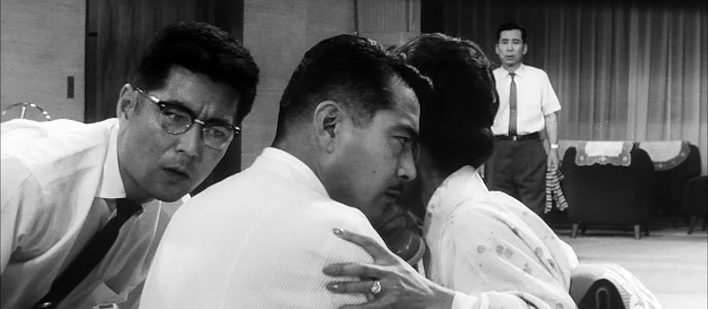
It's certainly possible to get deep focus with 2X anamorphic lenses, you just have to be willing to use enough light and stop down the lens. Kurosawa even managed to do it with telephoto anamorphic lenses, but he lit the sets to f/22 to get this deep focus look on long lenses:

redbeard2.jpg


highandlow2.jpg


The reason people who wanted deep focus put up with 35mm anamorphic is the larger negative area from using all 4-perfs of the 35mm negative. Since you don't have grain with digital, you don't really need anamorphic lenses to get a 2.35 image that is sharp and fine-grained anymore. Besides, stopping down a 2X anamorphic lens just minimizes all the unique bokeh that people today want from anamorphic lenses.
 
not to hijack the thread but I have a question about boka shape in anamorphic...

I understand lenses pretty well, and im no stranger to science.

My question is, why does boka remain "squeezed" even though we unsqueese the image? I never fully understood why that happens. Common sense would think that if everything is squeezed 2x and then un-squeezed 2x that all artifacts remain round. Now I do know that this is what gives anamorphic its lovely look, but the actual science behind whats happening with the lens elements and why it doest show up round has always been a question I've been meaning to have answered.

I think, I can explain this, but I might be wrong!

The bokeh is a function of the aperture of the lens. It's not a part of the actual scene, so the image in front of the lens gets squished, as the light passes through the anamorphic element. Then the light hits the aperture which is usually circular. This thus produces round bokeh on the film. Then the film gets unsquished for projection and the images on the screen get stretched out including the bokeh. This would also explain why projected bokeh appear to be circular with rear anamorphics as in that case the light hits the anamorphic element last, after the aperture. What I don't quite get is why the bokeh appears to be squished rather than stretched. I'm clearly missing something from my explanation! ;)

Freya
 
I don't know the exact mechanics but the squeezed bokeh is actually the byproduct of fixing a problem with early CinemaScope lenses, called the "anamorphic mumps". Basically what happened was that as you focused near minimum, like for a close-up on a 50mm anamorphic (the first focal length made for CinemaScope), the squeeze ratio dropped below 2X. But the unsqueezing is always a consistent 2X by the projector, so the end result was that faces looked slightly fat in CinemaScope.

Panavision solved this with some cams in the lens barrel that compensated as the lens rotated towards minimum focus so that the object in focus is always squeezed consistently by 2X -- but the side effect was that objects out of focus now got squeezed more than 2X and thus look skinny when unsqueezed by 2X during projection.

John Hora explains it in the ASC Manual. It has something to do with the fact that the vertical plane of focus is spherical and thus focuses at a different point than the horizontal plane of focus which comes from the anamorphic elements. Using two astigmatizers and counter rotating the anamorphic elements when focusing, Panavision kept a constant 2X squeeze on the subject but caused out of focus objects to get more than a 2X squeeze. So the squeezed bokeh effect is more obvious as you focus closer and when shooting at wide apertures, which is why the lens breathes as you rack focus.
 
Depth of field is a combination of focal length and f-stop more or less, the reason why 2X anamorphic lenses have less depth of field on average is that they "see" twice as much horizontally, so you end up using a longer focal length to get the same view. In other words, a 40mm anamorphic lens sees the same width as a 20mm spherical lens... and a 40mm lens has less depth of field than a 20mm lens.

I hate to bring this up, but David you are playing the part of an educator here and you should be accurate. Focal length does not play a part in DOF. It is aperture and image magnification. If you put a 25 on the camera at an f2, and frame a medium close up, you will have the exact same depth of field as if you framed the same shot on a 50 at an f2. You are effectively doubling the negative size when you shoot anamorphic, which means you are increasing image magnification, which is why there is less depth of field.

The statement that a 40mm has less depth of field than a 20mm is not correct. And should not be floating around in new photographers minds.

Sorry for the interruption, carry on ;-)

Nick

No because you don't have the same shot on a 50mm as a 25mm unless you moved closer and thus caused a drop in depth of field. Focal lengths affect field of view and thus distance from camera to subject. I know what you are saying technically but practically the reason you have less depth of field with larger formats is because you have to use longer focal lengths to match the same field of view as a shorter focal length on a smaller format.
 
John Hora explains it in the ASC Manual. It has something to do with the fact that the vertical plane of focus is spherical and thus focuses at a different point than the horizontal plane of focus which comes from the anamorphic elements. Using two astigmatizers and counter rotating the anamorphic elements when focusing, Panavision kept a constant 2X squeeze on the subject but caused out of focus objects to get more than a 2X squeeze. So the squeezed bokeh effect is more obvious as you focus closer and when shooting at wide apertures, which is why the lens breathes as you rack focus.

Wow that hurt my head a little but I think I slightly get it, but surely the anamorphic elements can't rotate during focusing or you would get that strange anamorphic acid trip/dream sequence effect? Unless theres more than one anamorphic element that move in sequence to maintain the constant 2x squeeze perhaps if one was rotating one way and another the other then they would correct for one another?

I do think there are a number of aspects of this where it reaches that point where science meets magic! ;)

Freya
 
The point here, is that focal length is not a factor in DOF. There are only two variables #1 f stop #2 image magnification. Focal length is irrelevant. Bringing it in to the equation only confuses the issue.

practically the reason you have less depth of field with larger formats is because you have to use longer focal lengths to match the same field of view as a shorter focal length on a smaller format.

That would be the image magnification part. An 18mm and a 300mm have the exact same DOF if the shot is the same.

Nick
 
Back
Top