Welcome to our community

Be a part of something great, join today!

  • Hey all, just changed over the backend after 15 years I figured time to give it a bit of an update, its probably gonna be a bit weird for most of you and i am sure there is a few bugs to work out but it should kinda work the same as before... hopefully :)

Ask David Mullen ANYTHING

The rules are the same as always -- shoot in back or crosslight, underexpose, avoid the sky, use ND's to shoot at a wide aperture for less depth of field... digital efx can make it even more convincing, allowing you to darken parts of the frame or replace the sky, or add headlights to cars, etc. Trouble is that if your budget is too low to light a night exterior, it may be too low for visual efx.

You may need more fill on faces for DFN because the shadows will fall to black faster when underexposed, so you almost want to overnight the faces a bit to survive the underexposed look.

DFN works best in situations where the moon would be the only source of light in the location, like in the countryside.

If it is overcast, you can mix DFN and dusk-for-night.
 
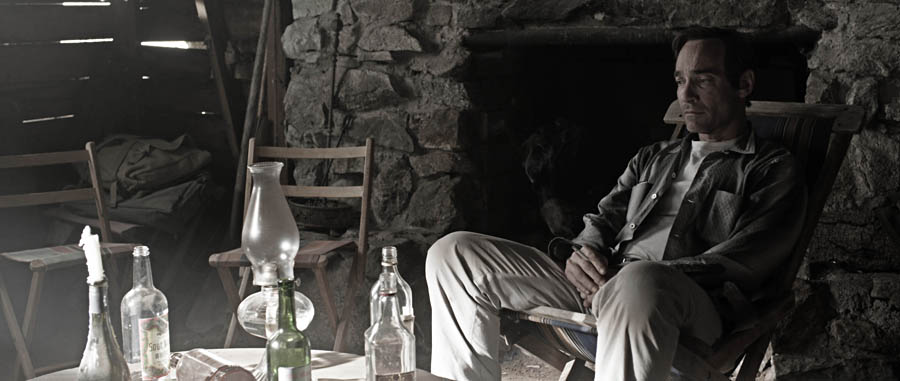
Hi David, I plan to read all 471 pages at some point. I'm sure there's a ton of resourceful information in them!I am wondering how these scenes from "The Covenant" were lit, more importantly how the light was so well controlled (ie. spill from hitting background)

DOP: Pierre Gill
Scene "A"
Covenant-Scene-A-001.jpg


Scene "A"
Covenant-Scene-A-002.jpg


Scene "A"
Covenant-Scene-A-003.jpg


Scene "B"
ScreenShot2013-01-26at73809PM.png
 
Last edited:
Basically a mix of a soft light and a hard slash of light coming from the same side of the room, the hot slash is bouncing back up into the faces. Now the soft and hard light could be the same light with a "soft topper" -- a diffusion frame cutting the light from above, the hard light leaking from below, or it's two lights. There is also a cooler soft backlight, from from a Kinoflo.

Considering how dark the wood panelling is, I don't think there is much flagging or netting of the side light off of the walls, you need more light than you think to get a dark wood panelled wall to not go black.

There is also smoke in the air that is softening the contrast a bit by spreading the light into the shadows more.

I did something similar here in "Big Sur":
bigsur34.jpg


In this case, it's a small space so I think the soft side light was from a 4-bank Kinoflo and the hard slash was from a Source-4 Leko HMI, which is bouncing back up into the shadows, wrapping the soft side light around more. Or instead of the Kinoflo, the soft side light might have come from a small window off-camera on the left, covered in Lt. Grid and lit from outside with an HMI. I think this was shot at night for a day scene, so I also had to drape Lt. Grid over the outside of the cabin and hit that with some HMI's so that the gaps between the slats would have bright light leaking through.
 
I didn't see the wide shot before, now that I have, it's clear that it was a small room with one window -- if on location (not a set, judging by the need to use such a wide-angle lens to get the wide shot, but maybe it was a set and they just didn't want to pull a wall), it makes it seem more likely that they had an HMI coming through the window and for the shot of the young man, they put a diffusion frame halfway down over the hard light to soften the top portion. Also, some of the soft light may be natural daylight if it were shot on location in the daytime. If it was a location, it makes it more likely that the soft backlight is from a Kino close to the ceiling, perhaps a 4' single or double-bank. This is all conjecture of course, it could be a set, it could be tungsten lighting, etc.
 
David - this "ask dave" thread is going to turn into a nasty habit for me, just to forewarn you. I hope you have a paypal donations page setup somewhere. :001_unsure:

Speaking of "X-Files" do you know much about the type of lighting Bill Roe used on the series and what film stock and ASA was mostly used? (back then)
 
I'd have to dig up my old magazines to find out about the stocks and whatnot, but they are in Los Angeles and I'm in NYC for a few more months. I vaguely recall the original season being shot on 200 ASA stock (5293?) pushed one-stop by John Bartley, if I recall correctly, before they switched to 500 ASA stock for the rest of the series. So they probably used 5298, then 5218, etc.
 
Don't go through any trouble. I was more curious what kinds of lights they would have used and what sensitivity of the stock.

I remember reading how the first 5 years of X-Files were shot in Vancouver where it was typically duller looking since largely overcast and when they moved to LA to shoot the rest of the seasons they had and brighter look due to all the sun.
 
Source Four lighting advice

Source Four lighting advice

Hey David in your Abel Cine Tech lecture you spoke of the other DP Bill on “Big Love” using Source Four leco lights. I am interested in using these lights because I am in the wilds of China and the type of projects I will be doing are with a small crew and in locations where they would probably be the best option. For control of the throw, is it essential to get the long barrel HPL lights?


I have checked into purchasing them in China and they have some different instruments labeled as ETC Source Four. They have some that have daylight balanced bulbs. Below is a picture of a couple of their offerings, the last pic being of the ballast units. Any feedback would be appreciated.

source42_zpsbfc70c41.jpg


source4_zpsf46e9941.jpg


source43_zps63787932.jpg


Also, I have been researching the Red One for the last two weeks, baffled by the huge color variations on my monitor switching from RAW/RC and REC709 view and researching exposure. As I've made the rounds I have seen your posts pretty much everywhere. I think it's quite amazing that with the workload you carry you still find so much time to help out the indie filmmakers and are such a vital resource on the forums. So, my hats off to you and thanks for making yourself available.
 
The Source-4 Leko is the one I was talking about:
http://www.etcconnect.com/product.overview.aspx?ID=20080&lang=us&region=1

The smaller fixture is a Source-4 PAR.

I rent a few HMI versions of the Source-4 Leko, made with an adaptor to hold the 800w Joker HMI bug light ("Jo-Lekos"). Those aren't sold by ETC but are an after market adaption.

You need to carry an assortment of lenses for the Leko to control the size of the projected light.
 
Hi David,

I’m wondering about middle gray, the 18% card thing. Can you elaborate on how this affects your exposure decisions?

Perhaps 18% is what the middle gray value would be when converting from linear to logarithmic space (as opposed to 50%)? Is that true? And do you always try and get faces to register near that point?

How do “ratios” come into the equation? How are they calculated generally?

Anyone can weigh in if they know the subject.
 
David, just a brief update on the Source 4 lights - I managed to buy an HID version which is 120 volts and best part beam adjustable from 20-50 degrees! It has pretty good photometrics for what it is so I'm excited to try it out.. down the road I'll look into the modified version Source 4 pars.
 
Last edited:
Hi David,

I’m wondering about middle gray, the 18% card thing. Can you elaborate on how this affects your exposure decisions?

Perhaps 18% is what the middle gray value would be when converting from linear to logarithmic space (as opposed to 50%)? Is that true? And do you always try and get faces to register near that point?

How do “ratios” come into the equation? How are they calculated generally?

Anyone can weigh in if they know the subject.

18% grey means 18% reflectance, which means 100 footcandles falling on an 18% grey card will produce 18 footlamberts. Vision is logarithmic, meaning it's not the absolute difference between footlambert values that counts in determining perceived brightness difference but the footlambert difference in relation to the brightness register, which means that a set amount of footlambert difference will correspond to a much greater perceived brightness difference in dimly lit areas than in brightly lit areas. This is called a logarithmic response. Because of this, exposing an 18% grey card so that it falls on Zone V, i.e. the density that lies in the middle of the densitometric range of the negative, will produce a negative that looks 'normal' in exposure.

The above theory is used to calibrate lightmeters such that if you set your exposure to what your incident meter reads for an evenly illuminated area, an 18% grey card placed in that area will photograph as Zone V, and a spot reading of an 18% grey card under even illumination is equal to an incident reading of said illumination.

A ratio is just the difference between incident readings of the 'key side' and 'fill side' of an object, or more generally, the difference between any two incident readings. Ratios are sometimes expressed as x:1 eg 4:1, 8:1, 16:1 etc, to translate this into stops just take the base 2 logarithm of 'x' so for 16:1, log2(16)=4 so 16:1 is a 4 stop difference between two incident readings. A 16:1 ratio on a face means the fill side reads 4 stops under the key side.
 
How would you go about lighting a night scene with those Home Depot clamp lights in a small bedroom where the actor is on a bed?
 
Hi David,

I’m wondering about middle gray, the 18% card thing. Can you elaborate on how this affects your exposure decisions?

Perhaps 18% is what the middle gray value would be when converting from linear to logarithmic space (as opposed to 50%)? Is that true? And do you always try and get faces to register near that point?

How do “ratios” come into the equation? How are they calculated generally?

Anyone can weigh in if they know the subject.

I used the 18% grey card more when I was shooting film, either as a reference to shoot at the head of a roll for the timer, or to point a spot meter at (though I mainly used an incident meter.)

In terms of spot metering, I think of an 18% grey card as being middle grey, Zone V, and typical caucasian skin tone being more like Zone VI, one-stop over. In terms of how the Zone System should look on a Rec.709 signal on a waveform, read:

http://provideocoalition.com/aadams/story/does-the-zone-system-apply-to-hd-cameras

Some people place a lighter-toned person in "full exposure" lighting (i.e. high key) just below 70 IRE in Rec.709, like for a newsroom type setting, which is why often people set zebras to appear at 70 IRE so the brightest parts of the face would start to zebra.

I never calculate ratios myself, not when shooting, I tend to just decide how many stops under or over "key" I want things to be when lighting by meter for film (which I do less of now in digital.) I've always tried to light by eye and then adjust by meter when concerned about when things were going to fall off or burn out on film.
 
Hi David

Do you think you've become much more fearless and a risk taker whilst shooting digitally? Can you relate that to working on a particular production/s?
 
I don't think the lighting aesthetics and how they relate to both storytelling and making actors look good have really changed, what looked worked before still works, so in a sense, nothing has changed, you still have to think about where the light is coming from, how soft or hard, high or low, what color, how much fill, etc. no matter how you are creating that light, or whether you can use a practical source or not.

But from how I go about doing that, a lot has changed in that I can light by eye and then check by monitor without relying so much on metering, so the process is a bit less technical in approach, which is more fun. The biggest change is mainly that I don't fear dim locations so much anymore, I know that, if pressed, I can shoot in almost any light level depending on how much noise I can take or want. But the downside is that sometimes producers look at you funny when you actually need to order some big lights for a location, they just assume that anything can be lit with almost nothing.
 
Back
Top