Welcome to our community

Be a part of something great, join today!

  • Hey all, just changed over the backend after 15 years I figured time to give it a bit of an update, its probably gonna be a bit weird for most of you and i am sure there is a few bugs to work out but it should kinda work the same as before... hopefully :)

Shoot movie set in 1920

I think shooting at 48fps will give your movie a "hyper reality" that won't look at all like a VINTAGE 20's movie. If anything, you may want to shoot some scenes at 16 or 18fps, which is what a lot of silent movies used as their FPS.

But everything is a creative choice, so who knows...maybe 48fps will be AWESOME. Do some tests and find out.
 
Hello nick, thank you for your replay, what i mean is not exactly look like the video (Vintage) only the atmosphere are the same, what inside that video is my ancestor i think the dutch was shoot it with 16 mm camera. i want to make story in that time frame and i want to make it as authentic as it is, my reference is Apocalypto by Mel Gibson but that was shot in film, and that would be outside my budget. 48 fps might be "too real" i was thinking to color grading in semi BW or somekind of Bolex look. it just a thought.
 
I don't think shooting at 48fps would add to feeling of being set in the 1920's. And would not serve you well. As well as creating additional data wrangling challenges.

Good luck whatever frame rate you choose.
 
I thought Apocolypto was shot in HD on the Panavision Genesis?
 
Hello nick, thank you for your replay, what i mean is not exactly look like the video (Vintage) only the atmosphere are the same, what inside that video is my ancestor i think the dutch was shoot it with 16 mm camera. i want to make story in that time frame and i want to make it as authentic as it is, my reference is Apocalypto by Mel Gibson but that was shot in film, and that would be outside my budget. 48 fps might be "too real" i was thinking to color grading in semi BW or somekind of Bolex look. it just a thought.
Apocalypto was shot on the genesis, if Im not mistaken.
 
I guess Panavision Genesis it is, when i check at the ASC site, the DOP use ARRI 435 only at the begining in slo mo, he didn't use Genesis at that time because he afraid the Animal (Tapir) may have a change hit the camera, Upgrade Genesis at the time only 3 in the worl, he said.
 
You have likely done your online research already so please ignore these clips if you have. Here are some links to some old vision from the general times you seek. Better brains than mine can advise you on how to achieve a vintage look. The really early vision from 1910 of thereabouts would likely have been 35mm. This will be a similar frame size to the 4K RED. Closer to WW2, some of the home movie style stuff was possibly shot on 16mm cameras. 2K on the RED cameras will more closely represent the look and perspective of those cameras.

The Charlie Chaplin footage is mentioned as shot on 16mm. There were some 9.5mm gauge cameras around. The actual image area on the film was closer in width to 16mm than to standard 8mm. The pulldown claw engaged in holes in centre of the film between frames and home movies tend to have a scratch pattern down the centre from home projection of original prints.

As others have mentioned, older film was shot at a slower frame rate. After sound films began, amateur and home footage was sometimes still shot at the slower frame rates to make the film last longer in the camera.


Older cine lenses like the Series 1 Cookes by Taylor, Rank and Hobson may give you closer to the look of the times. You can find these on eBay but it seems every man and his dog wants any sort of 35mm glass they can get now that RED cameras and Digital SLR camers are breeding ujp into a large population faster than lenses can catch up. The lenses may be overpriced for what they are and the condition they are in.


http://vpro.openbeelden.nl/media/16...lp_in_Pangkalpinang_tinbewerking_op_Bangka.en

http://www.britishpathe.com/video/batavia-dutch-east-indies/query/01375200

http://www.youtube.com/watch?v=XcfSkjyM-mY&feature=related

http://www.youtube.com/watch?v=aSBi3eHznvs&feature=relmfu

http://www.youtube.com/watch?v=KufHOfdtNHM&feature=relmfu

http://www.youtube.com/watch?v=NcZIIWDSO_E&feature=relmfu

http://www.youtube.com/watch?v=TQmZ3iPfA5A&feature=related

http://www.youtube.com/watch?v=3CjEGeFA9BY&feature=related

http://www.youtube.com/watch?v=f7IfN4rz3aY&feature=related

http://www.youtube.com/watch?v=HTM4dWHk0Hc&feature=related


Mark Toia who posts prolifically here shot a commercial for Indonesia which depicts passage of time from before WW2 to present. I vaguely recall that according to his post, he used Canon stills primes.
 
Last edited:
Thanks for this great info, your're right for the old lens, for example old Lomo lens, they have good coating and better chromatic aberration, but what they sell on Ebay have a lot of scratch in the body or lens not to mention the fungus inside the lens, that seem obvious because its an old lens. but i hearded if we lucky to find the clean glass and we can do rehousing in china and also we can request to make it bigger F-stop. but the cost to send it back and forth are the same price for the new lens now.

And i've seen Mark Toia commercial about WW2, he did a great job there, i really love the set he put in there. i heard he use EPIC to shoot it.

for my movie, I'm thingking to get the look like this https://www.youtube.com/watch?v=B92MnoPVtGs&feature=related
what is the reciepie for RED EPIC to get this color image. thank you
 
I would hope that more qualified people back up or knock down my following observations if they are right or wrong.

The colour documentary on coffee houses you linked to looks to have been shot on 16mm film, my guess a non-reflex camera with three prime lenses on a rotating turret. I arrive at that notion by the combination of the occasional missed focus, mostly locked off shots, a few bumped tripods which suggest cameras positioned as far back in a confined room as possible in a tight corner to get a wide view and the apparent deep depth of field in the lighting conditions.

The lenses may have been prime lenses. On the 16mm turret cameras, the common lenses were 16mm, 25mm and 75mm. The brands which seem to have been around for these cameras that I saw as a youngster were Kern Paillard and Schneider-Kreuznach. I also saw an early Angenieux zoom 28mm - 112mm. If you shoot 2K, these old lenses may vignette as they were just wide enough for a standard 16mm frame.

If you shoot 4K or higher with a RED camera, then to faithfully replicate the "style" you would limit yourself as the cameramen of the times were apparently limited, to three commonly available focal lengths/fields of view for 16mm. You would also use more locked off or pan/tilt tripod shots instead of more fluid and handheld modern styles. Better cameramen can advise you here. My estimate of the equivalent 35mm format lenses for the similar field of view would be in the ballpark of 28mm, 50mm and 135mm.

If you end up using a zoom lens, you would limit yourself to those focal lengths and move your camera to frame up rather than trim your frame with the zoom. This will add to your workload and slow you down. You may become frustrated by these restrictions like the original shooters may have been. This may in turn force you into a similar shooting style of the older times.

An uncommon Nikon stills lens which might confer a similar vintage look might be the Nikon 45mm f2.8 "pancake" lens. Their fundimental design is apparently an old one. Voigtlander do a 40mm f2 lens in Nikon and Canon mount. Nikon did a 50mm "pancake" lens. These very short barrelled lenses may be difficult to focus in the recessed Scarlett/Epic mounts.

http://www.ebay.com/sch/i.html?_odk...73.m570.l1313&_nkw=nikon+45mm+f2.8&_sacat=625


As for the colour, my recall as a child/teenager was that colour vision shot in the UK seemed to have a more natural brighter look about it. The film brands that I recall from reading end-credits were Eastmancolor (Kodak) and Gevacolor (Agfa). Film prints of the times seemed to lose their greens and blues after a few years. The coffee shop documentary may have been restored before posting on Youtube. Italy I recall had a film stock called Ferrania color. My recall is that this stock had a distinct red/brown bias. I am unsure if this stock was used for 16mm and 35mm motion picture camera stock but I think I recall seeing the brand in some movie end-credits.

What you are seeing in the Youtube clip may not be representative of how it looked at time of first exhibition.


I cannot speak for the RED Epic as I do not own or operate one. I am one of those enemy aliens who shoots with the SI2K. However based on my time with that camera, my personal preference would be to shoot with a neutral low contrast look and grade off the raw image. The film stocks in those days were very slow by today's standards. You are in a bit of a bind here because the digital cinema cameras have such a high sensitivity. My personal preference would be to use ND filters to derate the camera performance to about ISO100, so that you are forced to lens iris, focus performance and any added lighting similar to what happened in those times.

Other discussions here have suggested that the native ISO of the RED cameras of about 800 should not be lowered by camera settings. For this reason alone is why I would use ND to derate the camera's light performance. I am really out of my league here so please again, take notice of the more competent people who contribute to this discussion. If you are using heavy ND outdoors in your bright morning sunshine before the cloud cover moves across, you may need the Schneider IR 750 infrared filter.

I hope these comments are helpful. Please take notice of the better operators and knowledged people than I who will comment here.
 
Last edited:
Read the back issue of American Cinematographer with "The Assasination of Jesse James" (the one with Brad Pitt). They used some interesting lens choices if I recall and delved into getting a unique period look. I believe they used a few older lenses for a majority of the work including a Kinoptik 9.8. The other issue I thought of if it's not the same issue is the one that had "There Will Be Blood".
 
Thank you Robert, its very kind of you for sharing me this info.
i kind of interested of your camera S12k, do you still own it? how you digitalize the footage if you want to? and one other thing, what do you think about Digital Bolex? please have a look this video. thank you http://www.youtube.com/watch?v=Ubzg-A3_rKM
 
"I kind of interested of your camera S12k, do you still own it?"

Yes I do.


"How you digitalize the footage if you want to?"

The camera works like the RED cameras and records its vision and sound to data files on a laptop drive or SSD, no capture needed. The clips are already fit to go in editing software. Like the RED camera, you need to have the special codec to play and edit the clips. The SI2K exists as a camera-recorder or small mini camera with a link to a Windows computer which works as a recorder.

Not like the RED camera family, the SI2K recorders operate as Windows XP computers.

I think Rob Lohman who is a RED man, worked on the original custom operating system for the SI2K. RED has "redcode". The SI2K uses "cineform". The SI2K sensor is the digital equivalent of Super16mm motion picture film. The RED camera family are the digital equivalent of 35mm motion picture film cameras.

Unlike the RED camera family, you will not find many SI2K cameras for sale used. Those who own them invested a chunk of cash. With resale prices on all cameras being depressed, SI2K owners will likely just keep on using them because they are now very matured and reliable. Like the RED camera family, the firmware is still being revised and improved. It cannot do 35mm digital cinema imaging except with a 35mm groundglass adaptor.


And one other thing, what do you think about Digital Bolex? please have a look this video.

I can't speak for the Digital Bolex as I have not kept myself informed. I understand it is not yet released. After it is released it will have to prove itself. I understand it is to perform like the SI2K and will have similar dynamic range. As a Super16mm film camera replacement, it will be up against the well matured and proven SI2K systems, Blackmagic camera, Ikonoskop Digital A-Cam, SinaCam HDC-1D and the matured Kinor DC2K/HS. Not all are in the budget price range.


I hope other people who know better about what I have mentioned will add to my comments and correct any errors.
 
Last edited:
Hello Robert, I'm sorry for long replay

The camera works like the RED cameras and records its vision and sound to data files on a laptop drive or SSD, no capture needed. The clips are already fit to go in editing software. Like the RED camera, you need to have the special codec to play and edit the clips. The SI2K exists as a camera-recorder or small mini camera with a link to a Windows computer which works as a recorder.

Last time i check on google, S12K looks like mini Film camera with film stock on top, but now i check again its call Si 12K, do you have picture of your camera?


@Zack Birlew

Read the back issue of American Cinematographer with "The Assasination of Jesse James" (the one with Brad Pitt). They used some interesting lens choices if I recall and delved into getting a unique period look. I believe they used a few older lenses for a majority of the work including a Kinoptik 9.8. The other issue I thought of if it's not the same issue is the one that had "There Will Be Blood".

do you have the link for this?, thank you
 
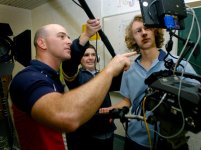
I have attached here the only image I have of my full camera-recorder. The SI2K mini camera head docks into the front of the recorder body. Someone had posted on Facebook a behind-the-scenes image from a shoot at our local high school that I loaned the camera to. Yes - I know. The viewfinder eyepice is pointed at the sky where the sun can burn into it, a momentary oversight on my part. A shower of rain had come down and we hastily moved the camera under cover. It had just been brought out again.

The power cord hanging off the rear is from a stacked charger/power supply and battery. There is an AB mount built onto the rear of the camera body. They had been shooting indoors earlier.

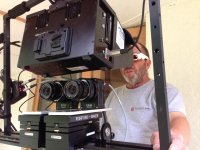
The other image is two SI2K Mini heads as a 3D side-by-side arrangement owned and operated by Steve Rice.

The camera-recorder arrangement is much heavier and much larger than the Scarlett/Epic cameras. It can be used on the shoulder without any add-ons but it does become a bit brutal after a while.

My camera was dressed up in a rain cover to look like an old SP Betacam news camera for a media foot chase scene in the recent telemovie "The Great Mint Swindle". The actor was wrecked by the time it was finished.

The SI2K was released before the original RED One camera. RED have moved to a new generation with the EPIC/Scarlett. The SI2K was updated with an improved recorder body and a second generation sensor. The basic system was not changed. The cost of the original DVR1 operating system was included in the purchase price. There came a major revision of the operating system, issued as DVR2. This licence has to be separately purchased. So too must the SI3D licence. Updates to both DVR1 and DVR2/SI3D are free. The RED operating system and firmware updates have been continuous from purchase and free to registered owners.

The SI2K Mini head with PL-Mount is about the size of two Gudang Garam cigarette packs stacked together. When it is used alone, it must be connected to either the recorder body or a computer with a LAN cable. If the Mini is connected to a computer, it must be supplied with power as well. There are other recorders which the Mini can be connected to, the Cinedeck and 1-Beyond. These are powerful enough to record 3D and they also supply power to the camera head. The special versions for the SI2K must be chosen.

http://www.youtube.com/watch?v=O1V5L_i5-KQ
 

Attachments

  • SI2K IMAGE.jpg
    SI2K IMAGE.jpg
    98.2 KB · Views: 0
  • SIDE BY SIDE RIG.jpg
    SIDE BY SIDE RIG.jpg
    90.5 KB · Views: 0
Last edited:
I forgot I had this one of Steve Rice's camera at an earlier workshop at the high school and one of Ricey using the pole for an in-car-in-motion shot with actor James With driving.

At the high school Steve Rice had his camera rigged with a Canon HD B4-Mount lens with servo controlled on the tripod handle. Mine was set up with traditional lenses. followfocus, mattebox.

The polecam was built for shooting within the confined space of a light aircraft cabin in flight. The pole was anchored at the front in a deep foam socket so the pole end could not fly about and hit anyone. The foam anchor is out of the shot in the attached image. T

he lens in the aircraft was a Kinoptik 5.7mm which just covers Super16mm. In a car there is much more workroom and that lens is a CP Ultra T* 9mm. I sat in the rear passenger area of the aircraft with the battery, sound mixer, the recorder unit and operated through the gap between the front seats for close-ups and reverses of actors in flight.

You also could do this with a stripped down Epic/Scarlett but you would need longer monitor, power supply leads and maybe a remote trigger.


Offtopic - the third image may interest you from an Indonesia historical viewpoint.
 

Attachments

  • polecam2.jpg
    polecam2.jpg
    64.1 KB · Views: 0
  • roley01.jpg
    roley01.jpg
    71.1 KB · Views: 0
  • MANADO COMPARISON.jpg
    MANADO COMPARISON.jpg
    88.1 KB · Views: 0
Last edited:
Hello Robert,

Thats a cool camera, what kind of movie that already shot with S12K, i just want to see the finish movie result.
By the way, i got a movie from Bali that inspire me to make new one with the today technology but the Set setting atmosphere are identical, please have a look http://www.youtube.com/watch?v=HVomkQOq3QI

Let me know what you think, thank you
 
Back
Top