Welcome to our community

Be a part of something great, join today!

  • Hey all, just changed over the backend after 15 years I figured time to give it a bit of an update, its probably gonna be a bit weird for most of you and i am sure there is a few bugs to work out but it should kinda work the same as before... hopefully :)

mattebox vs screw on filter

Victor Nguyen

Well-known member
Joined
Jul 2, 2012
Messages
62
Reaction score
0
Points
0
Do you prefer to have a mattebox with 4x4 ND or do you like screw on filter for your lenses? I'm mostly talking to people who use photography lenses here.
 
For mobile work using 35mm still lenses on Epic (and Red One), me and my crews have always used screw-on filters. It keeps the rig lighter, and more streamlined, thus increasing mobility. Plus in terms of security it gives the camera a much lower profile - eliminating the "Come and steal me" notion, or the "Come and ask me for a permit" annoyance.

We keep a waist pack of filters for the lenses on our belts for quick changeout of the screw-on filters. We shoot mostly in natural light, so the most common filters in the filter pack are ND3, ND6, ND9, and a polarizer.

Pure cine style shooters will almost always use a matte box and drop in filters, but then again they also almost never use 35mm still lenses either. The camera filtration setup simply needs to match the needs of the style and genres you shoot. No need to try and fit a round peg in a square hole or vice versa. Form follows function with camera setup and use - especially with a modular camera like Epic or Scarlet which was designed to be used in cine, hybrid, or EFP style work.
 
For mobile work using 35mm still lenses on Epic (and Red One), me and my crews have always used screw-on filters. It keep the rig lighter, and more streamlined, thus increasing mobility. Plus in terms of security it gives the camera a much lower profile - eliminating the "Come and steal me" notion, or the "Come and ask me for a permit" annoyance.

We keep a waist pack of filters for the lenses on our belts for quick changeout of the screw-on filters. We shoot mostly in natural light, so the most common filters in the filter pack are ND3, ND6, ND9, and a polarizer.

Pure cine style shooters will almost always use a matte box and drop in filters, but then again they also almost never use 35mm still lenses either. The camera filtration setup simply needs to match the needs of the style and genres you shoot. No need to try and fit a round peg in a square hole or vice versa. Form follows function with camera setup and use - especially with a modular camera like Epic or Scarlet which was designed to be used in cine, hybrid, or EFP style work.

Listen to Steve :)

My 2¢ - If you are looking to invest in one or the other, think about what style of shooting you will most likely be doing, what lenses you will be using and what you intend to do with the filters.

- I shoot a large portion of my work in remote or technical locations. For this I rely on still lenses for their size and functionality. 100% screw on filters, the realities of the situation and locations (and budget) im in will not allow for cinestyle decked out camera
- When working on broadcast projects, I generally have an AC to share the load, a split between shooting on cine lenses and still glass. But I always try to use rails & Matte Box. I love to be able to stack filters and use grad ND filters to capture the exact look I want in camera.

-dane
 
Was wondering the same.
I'm prepping a shoot with the Epic in a ENG style done with some nice old Nikon AI and AIS lenses.

Would a Vari ND do the job? Any experience wich one holds best optical quality to go par with the EPIC (if even possible...)?

http://www.bhphotovideo.com/c/produ...68_031177_77mm_True_Match_Vari_ND_Filter.html

http://www.bhphotovideo.com/c/search?Ntt=Vari+ND&N=0&InitialSearch=yes&sts=ma&Top+Nav-Search=


How do you manage to cut the IR? Do you use any of them?

Heliopan IR CUT ?

http://www.bhphotovideo.com/c/searc...&N=0&InitialSearch=yes&sts=ma&Top+Nav-Search=

Or Schneider IR cut

http://www.filmtools.com/schneider-optics-77e-infrared-cut-filter-486-65-031976.html

Thanks for your input.


Patrick
 
hmm I'm mostly do gunning and running so I guess I'll keep it light. I have the light craft workshop right now and it's complete crap. Any you guys would recommend that doesn't soften the image?
 
I'm with Steve on this. I use a full set of 77mm screw on for still lenses (and I still use a matte box even). I'm using mostly Formatt Hot Mirror/ND filters, but there are a couple Hoya in the set.
 
I'm with Steve on this. I use a full set of 77mm screw on for still lenses (and I still use a matte box even). I'm using mostly Formatt Hot Mirror/ND filters, but there are a couple Hoya in the set.
and how good are those hoya, do they soften up the image?
 
Wich IR screw on filter do you use?

I'm using mostly Formatt Hot Mirror/ND filters

I'm a big advocate of the Formatt Hot Mirror/ND Combo filters on Red cameras. Especially the 1.8. Others prefer Tiffen or Schneider Platinum.


and how good are those hoya, do they soften up the image?

I have the NDx2, x4, and x8 as well as the ND400. They perform well. Around the NDx8 (3 stops) I feel the need for an IRND or HMND solution. That's a preference thing and it can still be graded out at this point.


I have 3 VariND filters from different brands and those are different story. I don't use those at all. Especially past 85mm.
 
We use Formatt Hot mirror and setperate ND filters which work well on Epic.

Hoya filters are also excellent, Im told Hoya make most of the worlds optical glass which says something also their filter coatings are amongst the very best.
 
While I agree with Steve here... BUT... There is really a secret behind using Screw in filters, which brings back why the MB is a must on any PRO shoot in Cinema... Shading... Yes because the most important thing is not only to filter the light with ND's or filters of any choice or like, but to properly Shade the front element of your lens, in order to control your flare and also get a much more properly exposed image, so as some of us might give this for granted that even with screw in filters we almost always use some kind of Shade depending on lens and filters, some might not thing about it, yet it is an extremely important piece of equipment, even those made at the moment, or even an Umbrella or a Hat, or what ever else available to shade your shot... ;)
 
Good point Ketch. But when I use screw-on filters, for shading I use them with the stock lens hood with each particular lens. After all, those lens hoods were designed by the lens makers themselves for the purpose of effectively shading the front of their lenses. Best of both worlds - the lightness and low bulk of not using a matte box, along with the filtering of the screw-on and shading of the lens hood. When a matte box is added onto a rig the bulk and heaviness of the rig is increased, so mobility and type of shots possible also diminishes. Security risks also increase when using a matte box - potential thieves and permit police notice bigger and more expensive looking cameras. I don't use a matte box so I can "fly beneath the radar" so to speak.

For those who love drop in filters, but want to retain mobility of the rig, several manufacturers also make lightweight snap-on lens hoods which will accept 4x4 drop in filters. That saves them the bulk/weight of a regular matte box, but still gives them the mobility of a lightweight, streamlined rig.

I usually just smile when I see people with a DSLR (or Epic) that has a giant matte box on the end of their 35mm still lenses. I get the feeling a lot of them are trying real hard to look like a supposed "real cinematographer", when a simple screw-on and lens hood setup or snap on lens hood with drop in filters setup would be way more practical for what many of them trying to shoot. Peer pressure to supposedly "look like a pro" does interesting things to people - quite often it makes them spend a lot more money on equipment than they really need to for getting the shots they're after ;)

Most of my screw on filters are Hoya and I love them. I do have a few B&W and Tiffen filters too, and they're very good. I shoot a lot of natural light, so I don't usually use IR filters - just ND and polarizer. In shooting raw if there is a slight problem with IR it seems easy enough to neutralize in post.

Exactly Dane and Phil - you have it figured out great for the work you do. If someone shoots a lot of cine style using cine lenses, or they're shooting more stationary productions in controlled and secure environments, then by all means they should use a matte box. But if they shoot a lot of mobile hybrid style and mobile EFP style using 35mm still lenses, then screw on filters and stock lens shades, or snap on lens shades with drop-in filters make the most sense.

Nothing should go onto a camera unless it absolutely needs to be there to enable the type of shots you're after. A small form factor allows us to get shots we simply couldn't get with an accessory-laden behemoth of a camera. Smallness unlocks mobile creativity.

As the song lyrics say - "Different strokes for different folks".
 
Could be an age thing Steve, after trying various setups and seeing what works and what's a hassle, you know I agree with you and shoot similarly. Today I was out getting some B roll footage and would have stuck out like a sore thumb if I was trying to use the matte box. I have both setups and find I rarely use the really nice Pancros in the kit. Much of the time I'm screwing on a pola or an ND and working much more discreetly, well as discreet as one can be using an Epic. Had two "kids" in their twenties walk by then one stopped, spun around and said, "Hey, is that a RED? Is that a Canon mount?" There's no hiding from those who know their cameras.
 
Had two "kids" in their twenties walk by then one stopped, spun around and said, "Hey, is that a RED? Is that a Canon mount?" There's no hiding from those who know their cameras.

I know the feeling ;)

To further my anonymity and privacy when shooting in crowded or sensitive areas, I've actually at times put some black gaffer's tape over the "RED" letters on the side of the camera. Then they REALLY have to know their camera shapes to call it out as an Epic and not some kind of DSLR ;)

As you know, Red One is much bigger than Epic and Scarlet so it was even much harder to avoid questions in the field and maintain anonymity. Very early on with my Red One cameras (in fact as early as September 2007) I'd be out shooting by myself somewhere with one of my Red's, using no matte box or follow focus on my Red 18-50 (screw-on filters), and some young guys would ask me the same thing - "No way! Is that a Red camera?".

In a controlled set shooting cine style in front of a bevy of people (clients, EP's, etc) security and anonymity isn't really a big factor, so the bigger and more "professional" you can make the camera look with every accessory on the planet flies just fine - in fact is beneficial. But as you know, mobile, small crew hybrid and mobile EFP work call for the exact opposite mind set - small camera, minimal crew, only necessary accessories, mobility, security concerns, etc.

I'm singing to the choir with the above though Mark, because I know that your work and shooting style needs parallel mine - and thus you accessorize and shoot very similar to how I do. The end product determines the tactics to achieve it.
 
(and I still use a matte box even).

which brings back why the MB is a must on any PRO shoot in Cinema... Shading..

for shading I use them with the stock lens hood with each particular lens. After all, those lens hoods were designed by the lens makers themselves for the purpose of effectively shading the front of their lenses.

Yeppers. Here's a shot of a Formatt HMND 77mm screw-on with the OConnor O-Box WM:
M1010026.jpg


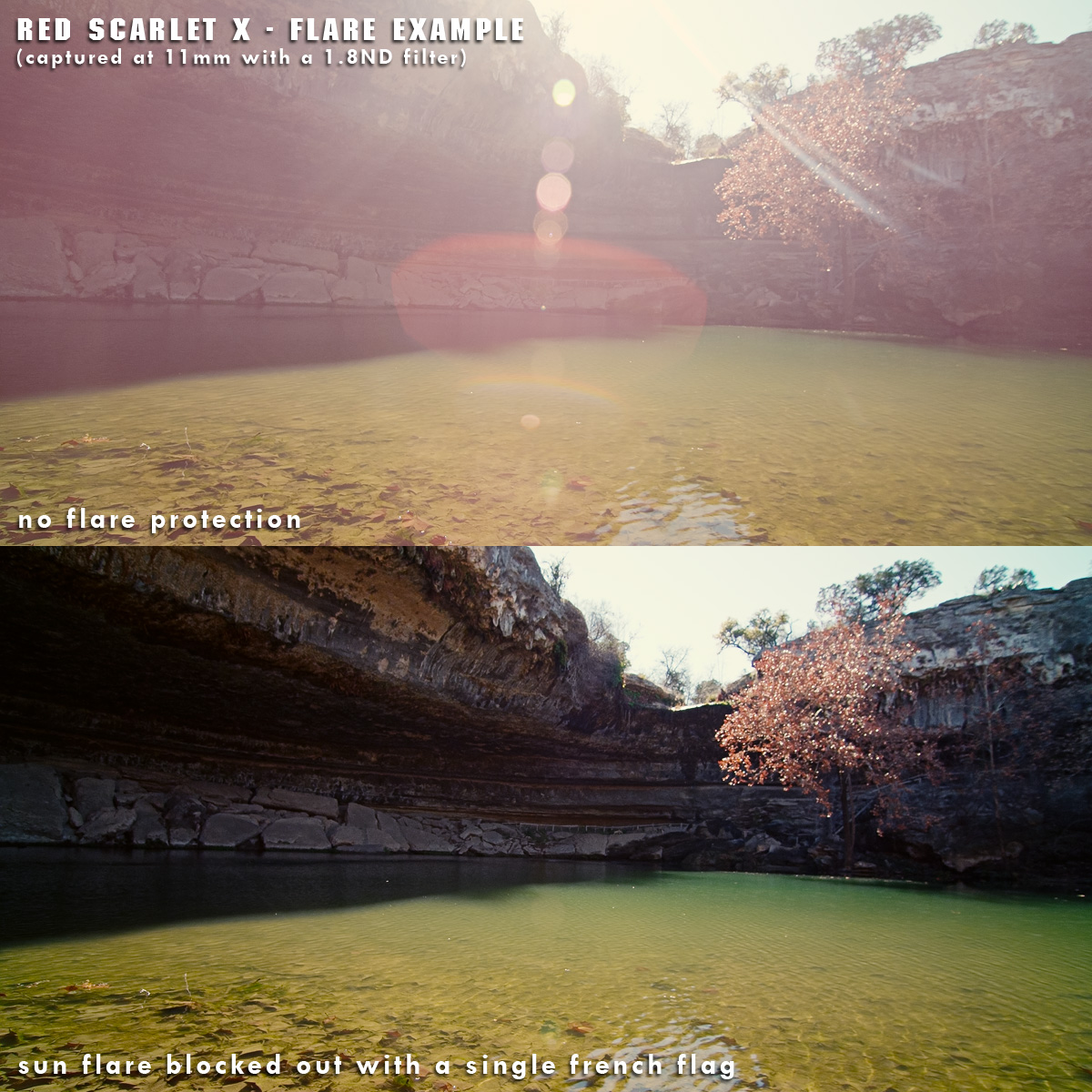
And here's why Ketch and Gibby are exactly correct about just how important shading is:
redScarletFlareExample.jpg


Something I see a lot of folks these days forgetting when using matte boxes is that in conditions with uncontrolled light or cameras close to the ground, like shooting in the desert or beach, there's certainly a reason to introduce a bottom flag to help block out potential interference. Good light protection increases the contrast and color accuracy within the shot.

I'm big fan of flare and glare incorporated when appropriate as well, but that's another conversation.
 
Very good example pics Phil...

Bottom line: however we achieve it, shading to eliminate flares, and increase contrast and color, is critical.

In essence what we've been tossing around on this thread is that "there is more than one way to skin a cat". I guess my best advice to someone would be to figure out the best way to filter and shade for their shooting styles and lenses they use, and go with it. Lots of options out there now...
 
Steve said it best. I'm still trying to get the weight down on our Epic package with the mattbox attached.

For mobile work using 35mm still lenses on Epic (and Red One), me and my crews have always used screw-on filters. It keeps the rig lighter, and more streamlined, thus increasing mobility. Plus in terms of security it gives the camera a much lower profile - eliminating the "Come and steal me" notion, or the "Come and ask me for a permit" annoyance.

We keep a waist pack of filters for the lenses on our belts for quick changeout of the screw-on filters. We shoot mostly in natural light, so the most common filters in the filter pack are ND3, ND6, ND9, and a polarizer.

Pure cine style shooters will almost always use a matte box and drop in filters, but then again they also almost never use 35mm still lenses either. The camera filtration setup simply needs to match the needs of the style and genres you shoot. No need to try and fit a round peg in a square hole or vice versa. Form follows function with camera setup and use - especially with a modular camera like Epic or Scarlet which was designed to be used in cine, hybrid, or EFP style work.
 
Sorry to blow life into this old topic. But does anybody have any experience with those rubber lens hoods you can place onto the lens. Are you still able to place filters on the lens in combo? like 77mm pro mists, polarizers, VARNI ND, IRCUt,...
 
Sorry to blow life into this old topic. But does anybody have any experience with those rubber lens hoods you can place onto the lens. Are you still able to place filters on the lens in combo? like 77mm pro mists, polarizers, VARNI ND, IRCUt,...

The rubber hoods that I have used are screw-in, so you have to unscrew it to swap filters, then screw the shade back on. Also, I have noticed that the ones that are expandable tend to tear on the folds. My feeling is that if you’re constantly swapping filters or stacking filters, then a matte box is easier to use.

If I’m trying to avoid the weight of 4x5.65 filters but still want a lens shade, sometimes I will use a lightweight matte box like the Bright Tangerine Atom on rods without the donut. Since there’s no glass in the matte box, it doesn’t matter if there’s a gap between the clamp back and the front housing of the lens, but the shade still does it’s job.
 
Rubber hood are a good solution for lightweight and flexible shoot (one man band) You will have to check your framing as they soemtimes change shape (pressure) or size when it's a collapsable hood. Screwing them in and out will affect the metal housing of the lens/filter and eat them with time, even more if you do it in a hurry. On Rokinon lensens I use UV filter as the lens and thread is in plastic and worsen the wear effect. Using the Kippertie Revolva has changed the way I use hoods as I only use the original (Rokinon) hood on the lens without filters (or with the Pola if needed).
Mattebox still is the best tool for the job, if you can handle it.
 
Back
Top