Welcome to our community

Be a part of something great, join today!

  • Hey all, just changed over the backend after 15 years I figured time to give it a bit of an update, its probably gonna be a bit weird for most of you and i am sure there is a few bugs to work out but it should kinda work the same as before... hopefully :)

Ask David Mullen ANYTHING

Yes, a blue filter like the 80C will reduce the noise in the blue channel if you can compensate for the light loss from the filter, which is actually cutting back on the opposite color wavelengths so that the blue channel is more equal or balanced, but the noise is improved only if you then compensate for the exposure loss from the filter.

However I don't think the blue channel is that noisy any more on the MX sensor, I'd only bother with the 80C for chroma key work or whenever you need a cleaner blue channel.

Great, that's what I was hoping. I do agree the MX blue channel is better than the R1, however to me its still too noisy (e.g. as a test, every time I push the blue curves up, I see grainy blue, as opposed to when I push the R or G which is a lot smoother color).

Thanks as always !!
 
Stage set. Apologies for the oversight.

You said "set" originally and I missed it, sorry. If you have a lack of space outside the windows, then at least a bunch of tungsten 750 Source-4 Leko's with, let's say, 19 or 26 degree lenses would give you the effect of parallel rays of light, but you may need a lot of them. Yes, some mirrors and then lights farther back (like a 5K Molebeam or PAR) would work, or even some 9-lights (since the lattice work would create multiple patterns anyway), if you can get a good bounce angle in that limited space. For a sunset effect, I would warm up the lights but cool down the fill or soft daylight to get the two-tone orange-blue effect at sunset.
 
I am going to be doing my first shoot with a RED ( Scarlet ) coming up in July for 2 days. It will be a talking head shot outside durring the day using silks and bounce for lighting, perhaps an HMI if needs be. Since it will be my first time working with a RED ( FINALLY! ), do you have any words of wisdom, warnings, tips, etc.?
Thanks!
~Dean

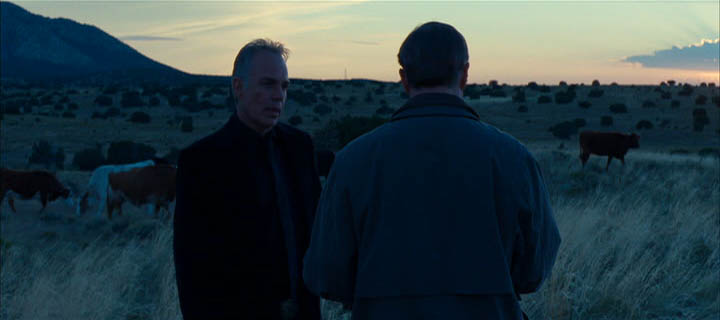
Sounds pretty basic, I don't know what could go wrong. Just have a good system for downloading & backing up the SSD's, especially if you need to empty them during the shooting day and get them back to the camera.
 
Hello David

I have a question regarding fluid heads. If you have a head that will support a maximum of 50 lbs, what is the minimum weight needed to have the head perform properly? I have been told it is roughly half the maximum load, in this case 20-25lbs.

Can you please elaborate?

Thanks
 
Sounds like a question for an operator, sorry -- I don't know why there would be a minimum weight requirement for a fluid head, just a maximum weight requirement. If your camera is lightweight, there's just no reason to lug around the heaviest fluid head, that's all.
 
Hi David,

I was talking to a DP the other day who told me about a scene he had day-for-dusk. He was shooting on digital (Alexa I think) and underexposed 1.5 stops to create the day-for-dusk look. However as they were shooting the sun actually began to set, so in order to maintain the 1.5 stop underexposure he had to keep cranking his ISO up, all the way to 3200. I would think that when shoot digital you would always want to expose properly to get as much information as possible and then create the day-for-dusk look in post, and once it had become actual dusk it seems odd to maintain the same level of underexposure that was being used to make day look like dusk, particularly at the expense of image quality. What are your thoughts on this?

Thanks,
 
First of all, one can debate whether exposing a magic hour scene 1.5-stops below key is really "underexposing" in the sense that it is the correct exposure for the look, it's not underexposed with the idea to lift it in post back to normal brightness, the correct look is dimmer than normal.

Think of a scene where you have a dark, dim room and early into the scene, someone turns on the room lights. Would you expose the room so that before the lights came on, it was at full exposure, and then reset the exposure when the lights came on so that they were also at full exposure? Of course not, if you did that, you wouldn't see a dark room become a lit room when the lights came on.

So if you have a magic hour exterior scene that you don't want to look like a normal overcast day scene, you are probably going to decide that the correct look is below key exposure. 1.5-stops below is pretty safe and conservative, and fairly common as a choice. So knowing that that's the look, then as the light changes from day to dusk, by exposing 1.5-stops under, the footage will be consistently exposed and have the dimmer look you want. Sure, you could expose fully but you have a finite dynamic range to work in so if the correct look is 2-stops below key, for example, and you expose normally at key, you're sacrificing two-stops of highlight information that you could use since the correct look will be darker. On the other hand, you don't want to overdo the underexposure either because what if you made a mistake? You have less room for error if you go too far. The other reason to pick something like 1.5-stops under is that once you hit true twilight, getting full exposure is going to be hard anyway, and like I said, it's not the look you want.

The inconsistency comes in how far you are willing to shoot into fading twilight by compromising with the gain and shutter. To be completely consistent, you'd pick one ISO rating for the whole scene and stick to that. Let's say that you were happy with the noise at ISO 1600, so to be consistent, you start out in the daytime with your 1.5-stops underexposure and you use a ton of ND to maintain that exposure, knowing that as magic hour comes, you'll be removing the ND and opening up the lens to maintain the same exposure.

At some point, you hit wide-open on the lens. Now what do you do? Maybe you decide you can live with a 270 degree shutter angle, so you go with that. At least the noise is the same because your ISO hasn't changed and you still are exposing the same amount. But now it gets even darker. What do you do? At some point, the cinematographer has to tell everyone that there is no more light to shoot. But maybe you decide to live with a little consistency, just as a DP shooting film might if he had been using ISO 500 stock and decided to start push-processing to ISO 1000 for the later shots, accepting a bit more grain. So you change your ISO 1600 setting to 2000, 3200, etc. At what point do you stop? That becomes a judgement call because now you have more noise in the images than you did before. At honestly, at some point there is no twilight anymore and it is pure night, there isn't any skylight falling onto the scene at all no matter how much you crank up the gain, and now the light is just different.

But we've all been there, trying to squeeze one more set-up in the failing light. Sometimes we proceed because maybe we'll get something magical, but sometimes we just get some crappy shots. It's a tough call, but at some point you just have to tell the director that the stuff won't match anything anymore, it won't intercut, and it won't look like magic hour, at which point the director has to decide whether to make it a night scene and reshoot the earlier stuff.

I had this twilight scene in "Astronaut Farmer". My plan was to shoot both sides of the coverage, medium and then tight, simultaneously with cameras shooting cross-coverage. So one camera was pointed at one actor and the other was getting the opposite angle, that way the light would match in both directions hopefully. I used Fuji 500 stock (which I normally rated rated at ISO 320, but maybe here it was rated at ISO 400) without the 85 filter, but I started out with some ND filters because early in the evening I had something like f/16 (once I underexposed by 2-stops I think) for the first take, but just after ten minutes, it had dropped to f/4 and then started dropping even faster. My lenses were T/2.1-ish (Primo anamorphics) and I had the consistent 2-stop underexposure so I knew I could shoot until my meter was telling me something around T/1.0 because that would be a T/2.1 on my lens.

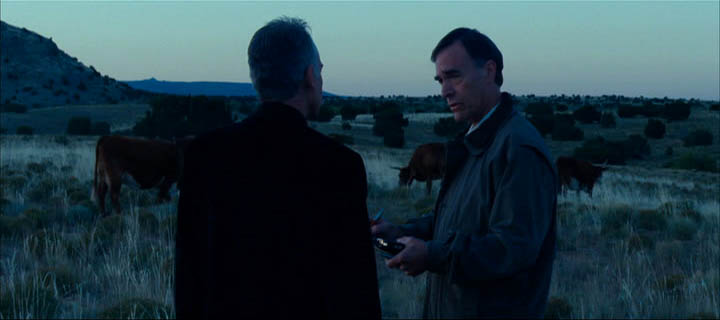
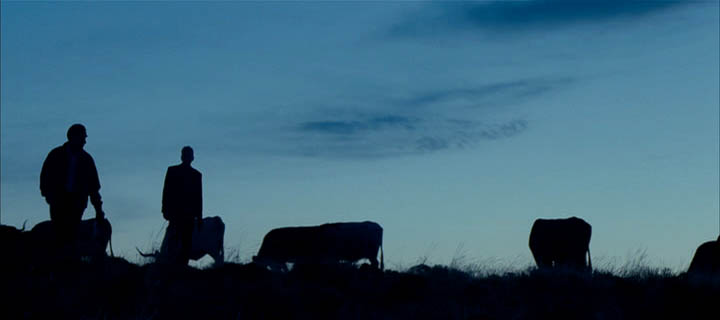
But I knew it would get even darker than that so I planned to shoot the widest shot last when I could silhouette the actors against the last glow in the sky long after the ground itself was too dark. So that was the plan. Here are some of the shots:

You can see that the faces and ground are around 2-stops under but it balances well against the sky:
af22.jpg


af23.jpg

We shot one size tighter on the actors by switching lenses on both cameras.

Then we fell back and downhill to get this wide shot:
af24.jpg


By now, the faces and ground are un-meterable, maybe five stops under or more, but the sky was still bright enough to get an image.
 
I apologize in advance if this is slightly off topic.

Can anyone recommend a reliable company in Los Angeles or points beyond that services lenses? I have a set of Super Baltar primes that need a full CLA. They have been in storage for about 10 years and the lubricants have completely dried up.

My initial research has yielded the following candidates (Any feedback would be appreciated):

Duclos

Focus Optics

Visual Products


Thanks in advance
 
I apologize in advance if this is slightly off topic.

Can anyone recommend a reliable company in Los Angeles or points beyond that services lenses? I have a set of Super Baltar primes that need a full CLA. They have been in storage for about 10 years and the lubricants have completely dried up.

My initial research has yielded the following candidates (Any feedback would be appreciated):

Duclos

Focus Optics

Visual Products

Use Duclos. You won't be sorry.
 
Lighting a classroom

Lighting a classroom

Hey David,

I'm shooting a spot in which a teacher is speaking to a room of students. I wanted to get your take on how you'd light it and see if our train of thought matched.

Here are the variables:
  • Shot during daylight hours w/ windows
  • 20 or so students sitting in desks, 1 teacher moving around
  • Classroom may or may not have drop ceiling
  • Camera position behind students at back of the room on dolly shooting towards teacher and the flip of that to get reactions
  • Shooting digital (C300 or DSLR)
Here's what I was thinking. Keep the look soft, neutral and flattering therefore go with a big source. M18 through an 8x8 of 1/4 grid. Maybe menace arm in a joker 400/800 in the back to edge out the students. I'd like the natural daylight to play but not overpower.

Thoughts?
 
If the windows are to one side, it should be easy to use a mix of natural window light plus a big softened HMI. You probably don't need fill if the walls are light-toned, but if you do, you might get away by bouncing something smaller off of the ceiling (or put daylight tubes in overhead flow and just turn one row or something). You can try putting something like a 12'x12' or 20'20' double net at a right angle to the windows to knock down the view to camera without knocking down the window light, but you may have to be prepared to add greens to one edge of the frame to hide it if you are dollying forward. The other alternative is to just put a bunch of green trees in pots or something, green foliage sucks up a lot of light and is harder to burn out.
 
You could try Kino 55 tubes or Chroma 50's, etc. I have found though that some older fixtures don't like Kino tubes so you'd be safer with the Chroma 50's, which are cheaper anyway. They have a touch more green in them than Kinos and are slightly warmer at 5000K instead of 5600K.
 
You could try Kino 55 tubes or Chroma 50's, etc. I have found though that some older fixtures don't like Kino tubes so you'd be safer with the Chroma 50's, which are cheaper anyway. They have a touch more green in them than Kinos and are slightly warmer at 5000K instead of 5600K.

Thanks man. Really appreciate commenting on this! Your opinion is always appreciated and respected!
 
poor man's steadicam

poor man's steadicam

Hi David,

I have a film coming up that I'm shooting that involves a boy and girl riding bikes. I would like to follow them in a very fluid way. I don't think we can afford a steadicam and definitely cannot afford a real camera truck, but I was hoping to still achieve this in a cheaper way. My thought was to rig a jib to the back of a pickup truck in order to have some stabilization to fight any bumps and still get a fluid way to follow the kids as we ride in front or alongside them. I'd love to hear any ideas you have for creating this smooth and stabilized shot.

Thanks.
 
Mr. Mullen,

I've got a bar scene coming up and I was wondering if you could provide some advice? The location is an actual bar. There is a decent amount of floor space in front of the bar, but it's tight behind the bar. There is no way to hang lights from the ceiling. The windows are permanently blacked out, so no way to shoot lights through them. All the lights in the bar are on dimmers. The ceilings are about 9-10 feet high. Lots of dark wood used in the bar.

Also, are there any bar scenes from movies that stand out to you?
 
Back
Top