

- Moderator
- #21

Jeff Kilgroe
Well-known member
Just like Peter Majtan says, that's the order you want. And you're not going to get effective IR blocking at the level you need in front of the OLPF. Not going to happen because it would need to be a hot-mirror style filter and would be reflective. Let's also not forget that some newer lens designs made for mirrorless systems (like the Angenieux DP zooms) already place their rear elements very close to the OLPF layer as it is. You're not going to stick another filter in there.
Filtration works best IN FRONT of the lens. If you want to put anything behind the lens, that's best reserved for diffusion or distortionary materials; netting the lens and whatnot. The exception being lenses with drop-in trays or rear-mount filter holders that are designed to accommodate an extra optical layer at those positions.
When shooting any digital camera at high ISO (320~800 and up) you are going to be more susceptible to IR contamination with heavy ND, this is not a problem unique to RED. But the way RED captures the image and floats ISO as a meta-quality in RAW without using analog limitation or gain as many other cameras do, we find ourselves reaching for more ND when shooting in intensely lit environments. Not all environments have the same amount of IR bouncing around. And not all lenses transmit IR the same way. So you need to test with various combinations of lenses in your intended shooting environments or approximate them as close as you can. And test different filters and combinations. Yes, this can get expensive at times... I often shoot in some pretty intense IR and UV environments and don't usually encounter many problems. I have the best luck with Formatt IR+ND filters.
Also, one thing to note in regards to polarizers. They often lose their effect or can cause undesired results when used in combination with IR or hot mirror style filters. Polarizers are one of those filter types that like to be up front and work best when they are. Unfortunately that isn't compatible with IR-cut or hot-mirror filters. Test.
Final thought / opinion. When it comes to stacking filters in front of a lens... less is always more.


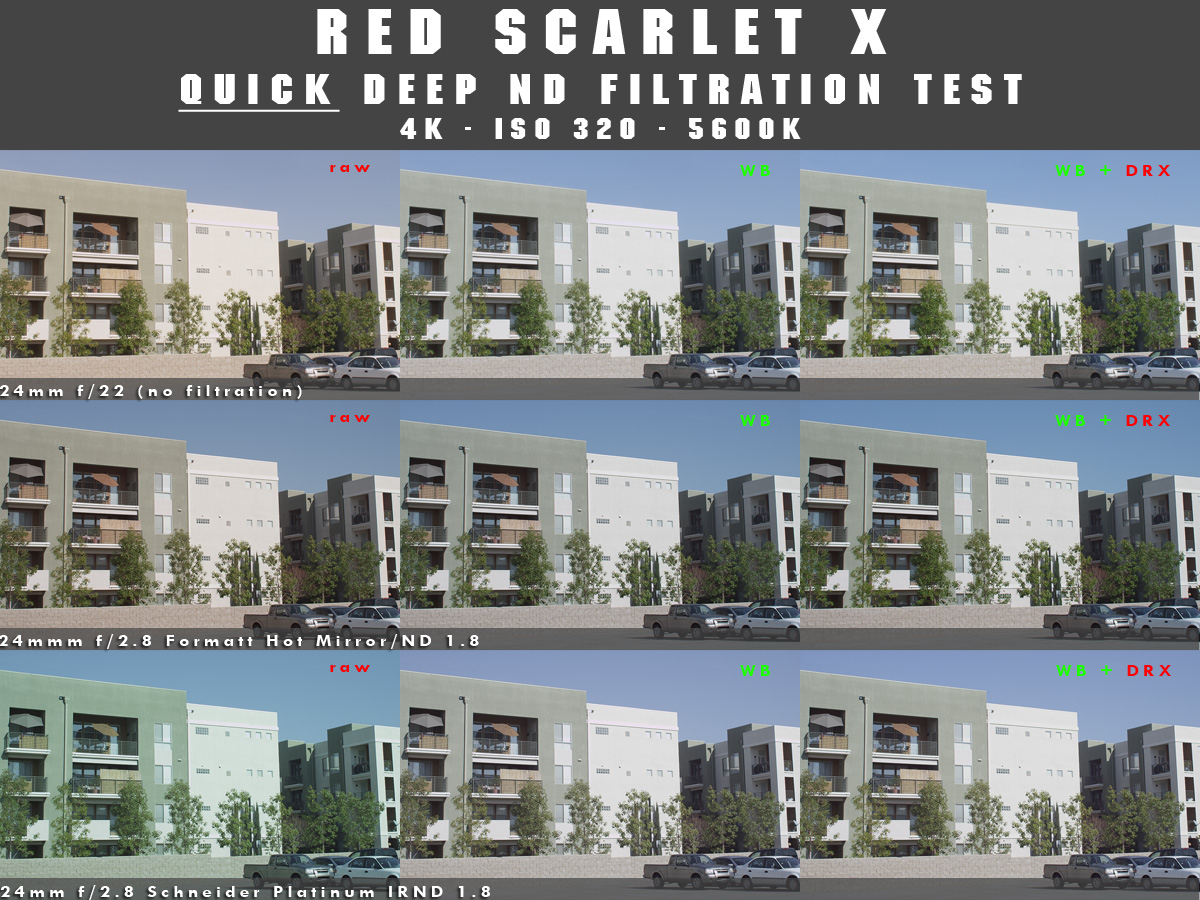
 )


