Welcome to our community

Be a part of something great, join today!

  • Hey all, just changed over the backend after 15 years I figured time to give it a bit of an update, its probably gonna be a bit weird for most of you and i am sure there is a few bugs to work out but it should kinda work the same as before... hopefully :)

Are there True "Tungsten" or "Daylight" LED diodes?

Joined
Sep 20, 2009
Messages
149
Reaction score
0
Points
0
I really like these CINESOFTS … Using true tungsten and Daylight Diodes …..

You have to be wary of all the claims made by head manufacturers. Whenever a new lighting technology comes on the market, the manufacturers put a little spin on the scientific data which has a tendency to cloud issues such as color output. For instance, if you compare the spectral power distribution graphs of LEDs below to that of a Tungsten source you can see that there is no such thing as a true “Tungsten” LED diode (the same is true of Daylight LED Diodes – see my newsletter article for details.)

LED_Comp_Sprectrum.jpg

A spectral power distribution of a lamp indicates how much energy is present in each part of the spectrum. As you can see above, Tungsten lamps have a continuous spectrum. Given how they produce white light, even high CRI Phosphor White LEDS have a discontinuous spectral quality that is unlike that of Tungsten lights. In the case of the 3200K Phosphor White LEDs above, the phosphors added shape the spectral distribution by enhancing certain colors in the spectrum to simulate the spectral distribution of incandescent light. As a result, the spectral distribution of Phosphor White LEDs resembles a series of peaks and valleys. There is a big spike at about 465nm (the blue LED) and a broader bump between 500 and 700nm produced by the phosphors. Even though the spectral power distribution has these peaks and valleys, the human eye perceives the light as white light.

While the discontinuous spectral distribution of high CRI Phosphor White LEDS may appear white to the eye, and the color of objects illuminated by it appear natural to the eye, to film emulsions and digital imaging systems designed to reproduce accurate color under continuous spectrum light sources (like daylight or incandescent lamps), the color of the same objects will appear unnatural on screen (as the illustrations below make clear.) That is, the hue of an object being illuminated by this "white light" can be drastically different than expected when it appears on the screen. For example, below is a "Macbeth chart" contrasting the resulting effect upon different color swatches of studio tungsten light and a representative high CRI Phosphor White LED lighting instrument.

LED_Macbeth_Tungsten-WhPhos.jpg

Split Macbeth chart: each color patch shows the visible effects of studio tungsten light in the top half of the patch, and a representative Phosphor White LED lighting instrument in the bottom half.

A common test chart used for assessing color performance of motion picture imaging systems, the chart above would be more accurately called a "split Macbeth chart" because each color patch shows the visible effects of the two light sources; studio tungsten in the top half of the patch, and the Phosphor White LED instrument in the bottom half. Although your computer display is not likely to be a calibrated reference monitor, the wide variations in color patch hue caused by the discontinuous spectral distribution of the Phosphor White LED should be readily apparent.

What accounts for these results? First, as you can see from its' spectral power distribution above, Phosphor White LEDS, compared to continuous light sources, have no output at wavelengths shorter than about 425nm, which means that violet colors don't render well. Second, there is minimal output in the medium blue-cyan-turquoise range from about 465-510nm, which is why the aqua-type colors don't render well either. Lacking these complementary colors within the spectrum, skin tones and warm, amber-yellow colors don't stand out. Third, with the long-wavelengths cutoff in the high-600 nm range, pinks, reds, oranges, and other long wave-length colors tend to look a little dull under Phosphor White LEDs, compared with how they look under continuous spectrum light sources (daylight, HMI, Tungsten) which extend all the way out on the long-wavelength end. Finally, as you can see from the gray scale at the bottom, this particular Phosphor White LED Luminary has an overall magenta bias. While you can white balance out/time out this magenta bias in digital video cameras/digital film intermediate, the camera/timer is not able to replace the parts of the spectrum that are missing all together. And since gels only rebalance the spectral distribution of a light source by passing the wavelength of the color that they are, gels cannot correct for these deficiencies because there is not much light of those wavelengths to pass in Phosphor White LEDs to begin with.

LED_Model_Comp.jpg

Left: Tungsten source, Right: White Phosphor LED source.

This inability of Phosphor White LEDs to render color accurately is very visible in tests recently performed by The Academy of Motion Picture Arts and Sciences (AMPAS) as part of their “Solid State Lighting Project Technical Assessment.” (see http://www.screenlightandgrip.com/html/emailnewsletter_generators.html#anchorHigh Output AC LEDs for details.) In one (above) a model was photographed wearing a dress that had a number of different blue tints. Footage was shot with both a true tungsten source and a White Phosphor LED source. The tungsten-lit footage displayed all of the subtle differences in blue tones in the fabric, while the LED-lit footage, lacking cyan output, showed just a nice blue dress, without the same richness of hue. You can also see above that, absent cyan, the skin tones don’t stand out because that complementary color (cyan) within the spectrum is not present. Since the light doesn’t put out much cyan, the camera/film simply can’t record it. And, as Cinematographer Daryn Okada, ASC, discovered the hard way, color gel packs, camera white balance, or digital intermediate timing can’t bring it out if it isn’t there to begin with.

Like many of us, Daryn Okada uses LEDs as “touch up” lights to add a little something where key lights don’t cover. Needing to touch up a face on one talent mark, he once hid a small LED unit behind a chair, to add some glow to an actress’s face when she reached a mark where the keys had fallen off. “The manufacturer claimed the unit to be a ‘tungsten LED source’” he recounts. “She stopped right in the doorway, where I had this LED, and looked fine. But when I got the dailies back, her face was totally magenta.”; What’s worse, Okada says the image could not be repaired in post, because there wasn’t enough of the right color of light in the scanned negative for a color timer to bring out. This is a good example of the fact that, the bottom line is that, simply by nature of their discontinuous spectral distribution, even high CRI Phosphor White LEDs will never accurately reproduce colors on screen regardless what can be done in post. To make matters worse, common color meters, like the Minolta III F, are completely useless with LEDs in determining what gels to use. The meter makes its calculation of the color temperature based on an assumption that the light source has a continuous spectrum. Color readings of an LED have been shown to be misleading for both correlated color temperature and green/magenta shift. And, manufacturer’s CRI ratings are not necessarily the best indicator to judge the color rendering capability of LED fixtures because it is a measurement that can be messaged by manufacturers to give high readings without giving good results.

I really like these CINESOFTS ….. you can change the color temperature to like 2600 to 6500k using the on board dimmer.

The idea that you can achieve a nominally correct CCT for any color temperature from tungsten to daylight using only two sets of LEDs is also a bunch of marketing hype. While it intuitively makes sense that you can achieve an intermediate color balance by balancing the output of “Tungsten” and “Daylight” LED diodes, this approach does entail a compromise non-the-less.

LED_Blenders.jpg

If on the chromaticity diagram above, you were to plot the color point of two illuminants, all the colors that are possible by mixing the two colors of light will be located on the straight red line drawn between the two points. However, the line (black line above) that would be charted by heating a black body radiator (as it turns red, orange, yellow, white, and finally blue as it is heated) is not a straight line, so it is not possible to create light that remains neutral in terms of their green/magenta shift, while mixing only the two colors.

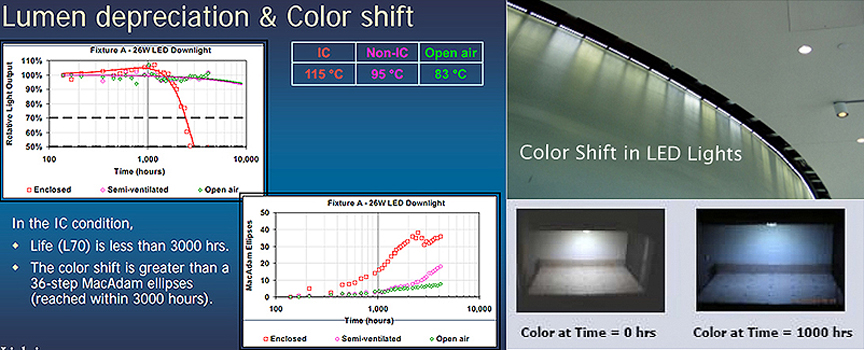
Another drawback to White Phosphor LEDs that broadcast studios lit exclusively with them are finding out is that, as illustrated below, their output depreciates overtime and their color shifts much faster than the manufacturers say.
LED_Lumen-Color_Shift_A.jpg

As I said at the outset, you have to be wary of all the claims made by head manufacturers. Whenever a new lighting technology comes on the market, the manufacturers put a little spin on the scientific data which has a tendency to cloud issues. For this reason, to pick the right LED luminary for a particular job it helps to have a thorough understanding of the technology. For our company newsletter I have put together an overview of the technology and what LED products are available for motion picture lighting (available at http://www.screenlightandgrip.com/html/emailnewsletter_generators.html#anchorHigh Output AC LEDs.)

Guy Holt, Gaffer, ScreenLight & Grip, Lighting Rental and Sales in Boston.
 
Hi Guy, I'm just wondering something. You've written your very detailed deconstructions on the qualities or lack thereof on LED and Plasma lights in many places I've seen on the web, but I also note that your company rents and sells fluorescent lighting fixtures. Do you somehow feel that these lights have better performance than the other technologies?
 
  • Thread starter
  • Banned
  • #3
Hi Guy, I'm just wondering something. You've written your very detailed deconstructions on the qualities or lack thereof on LED and Plasma lights in many places I've seen on the web, but I also note that your company rents and sells fluorescent lighting fixtures. Do you somehow feel that these lights have better performance than the other technologies?

No, the color rendering capability of Kino Flo lamps is well established. I believe in knowing the advantages and disadvantages to each lighting technology so that I can pick the right one for my job or make intelligent recommendations to my rental/sales customers depending on the requirements of their job. My recommendations are based upon extensive research I have done on the available lighting technology and its use on portable gas generators in motion picture production. My goal has been to leverage the advances being made in lighting technology and power generation, to create clean stable set power that is capable of reliably operating larger lights (HMIs up to 6kw or Quartz lights up to 5kw), or more smaller lights (7500 Watts), off of portable gas generators.

In order to maximize the light output that can be had from a portable generator, I have come up with a package of lights, based upon my research, that offers the highest output (lumens/watt), the most feature style production capability, and the lowest line noise. The lights that make up this package reflect the rapid technological advances being made in lighting and production technology and include:

1) More efficient and compact HMI, Quartz, and now Fluorescent Par Lights.
2) Brighter and more efficient "short arc" HMI bulb designs and Reflector designs.
3) Brighter and more efficient Plasma Lamps, & LED Emitter Arrays.
4) 120/240V Electronic small HMI and Kino ballasts with Power Factor Correction.

If it sounds like I’m hyping certain product lines it is not because we rent and sell them exclusively. We are dealers and rental agents for all the major brands. The equipment I recommend, I recommend as a professional Gaffer. Like any working Gaffer I have my preferences when it comes to what lighting instruments to use. When it comes to a Key source I prefer fluorescent lights, particularly the Kino Flo Parabeam fixtures, over other sources.

While I love the output of Tungsten Fresnels, I don’t recommend them for use on portable generators for two reasons. The first reason is that incandescent lights are the least efficient of all the available light sources. Since eighty percent of the energy consumed by an incandescent light goes into the generation of heat, they generate less lumens per watt of any other light source. Add to that, the fact that the Full CTB gel required to convert incandescent lights to daylight has a transmission factor around .3 (it takes a 1000 Watt incandescent source to generate 300 Watts of day light balanced light) make them the most impractical light source from an efficiency standpoint to operate on a portable generator.

A second reason is that in HD Digital Cinema, the quality of light is more critical than ever. In High Def every detail of on camera talent is rendered clearly on the screen – even the imperfections. Where traditional tungsten hard light and LED panels can exaggerate textural details, they need to be heavily diffused to serve as Key source in HD production which makes them even less efficient. I think fluorescent light is generally better for lighting talent in High Def productions because it can subdue those same textures and render a more cosmetic appearance. I generally recommend the Kino Flo Parabeam fixtures, over other fluorescent lights, to replace tungsten soft lights and LEDs as a Key source because they are more suitable for this purpose than any other conventional fluorescent movie light fixture.

Conventional fluorescent movie lights (Kino Flo’s included) have a very broad soft light output that is hard to control. The light also tends to drop off rapidly which means that to serve as Key source, the units need to be positioned close to the subject they are lighting. These characteristics make them best suited to serve as Key sources in documentary interview set-ups where the Keys are typically positioned close to the interview subject. In that capacity they generate a wonderful soft light that wraps around the interview subject without wilting them. But, given these characteristics, conventional fluorescent movie lights have only limited applications as Fill sources in dramatic set lighting – that is until the development by Kino Flo of their ParaBeam fixtures.

The ParaBeam fixtures have computer aided designed (CAD) parabolic reflectors that focus the light output where it is needed most for lighting dramatic scenes - at a medium distance – making it an ideal Key source for HD Digital Cinema. If you compare the photometric tables of the Parabeam 400 and the Diva 400 (which uses the same four lamps), you will notice that at 16’ the Parabeam 400 puts out almost three times the light level (28FC) than the Diva 400 (10FC) even though they both use the same tubes. In fact a Parabeam 400 generates as much light at 16’ as the 4’ 8-Tube Kino Flathead 80 fixture, yet uses less than a quarter of the power (2 Amps verses 9.2 Amps.) While the seven amp difference is not a major consideration when using house power, it can make a difference when your power is limited (coming from a portable generator) because you can use four Parabeam 400s for the same power as a 4’ – 8 Bank Kino Flathead 80. Kino Flo Parabeam ballasts also include Power Factor Correction (PFC) circuitry to reduce the return of harmonic currents into the power stream. The Parabeam fixtures have Power Factor ratings of over .9 making them an especially suitable fluorescent light for use on small portable generators.

Not only are the Parabeam fixtures efficient, but they are also easily controlled – an essential requirement in a Key source. Parabeam fixtures are controlled by interchanging Kino Flos’ innovative Honeycomb Louvers. Louvers are available in 90, 60 and 45 degrees. Swapping louvers provides beam control similar to that of swapping lenses on an HMI Par. These features enhance the production capabilities of the Parabeam fixtures and make them suitable to serve as a key or backlight source where conventional fluorescent movie light fixtures will spill all over the set. And, the power you save by not using tungsten instruments for keys and backlights, enables you to power more lights on the generator than you could otherwise. These features make the Parabeam fixtures the best candidate of all fluorescent lights to replace incandescent soft lights in their roll as dramatic Key sources in HD Cinema productions in general. And the fact that you can lamp them with 5500K tubes, make them an especially good Key source when filming with the Red One.

As discussed elsewhere in this forum, since the Red’s native color balance is 5000K, it looks best when the lighting package consists of 5500K sources. The Kino Flo Parabeam 400 fixture is similar to a 2,000 Watt incandescent softlight in both quality and intensity. But unlike a 2k softlight, they can operate both 5500K (daylight) & 3200K (quartz) lamps and use 1/10th the power of comparable incandescent soft lights. These characteristics make Kino Flo Parabeam fixtures a cost effective alternative to HMIs as a Key source for the Red. Not only do Parabeam fixtures provide beam control similar to that of swapping lenses on an HMI by interchanging their honeycomb louvers; they are even more efficient sources than HMIs. When using 5500K tubes to light for the Red’s 5000K native color balance, you can warm the lights without losing output to CTO gels by simply mixing in 3200K tubes with the 5500k tubes. Compared to LED Fixtures, Kino Flo Parabeam fixtures offer greater versatility. Able to interchange different color temperature tubes, and vary beam spread with their interchangeable honeycomb louvers, one Parabeam fixture can do what it takes four different LED fixtures to accomplish – Spot and Flood in both 5500K and 3200K. Offering great light quality, output, beam control, and versatility, the Kino Flo ParaBeams makes an ideal key or back light source for Red cinema productions as well.

For my other recommendations on what lights to use to maximize the production value that can be had from what will run on a portable gas generator see my newsletter article on the use of "Portable Generators in Motion Picture Lighting”.

BoxBookForumLinkGenSetMed.jpg

This article is cited in the just released 4th Edition of Harry Box's "Set Lighting Technician's Handbook" and featured on the companion website
"Box Book Extras." Of the article Harry Box exclaims:

"Great work!... this is the kind of thing I think very few technician's ever get to see, and as a result many people have absolutely no idea why things stop working."

"Following the prescriptions contained in this article enables the operation of bigger lights, or more smaller lights, on portable generators than has ever been possible before."

The article is available online at http://www.screenlightandgrip.com/html/emailnewsletter_generators.html.

Guy Holt, Gaffer, ScreenLight & Grip, Lightng & Grip Rental and Sales in Boston
 
Back
Top