
Navigation
Install the app
How to install the app on iOS
Follow along with the video below to see how to install our site as a web app on your home screen.

Note: this_feature_currently_requires_accessing_site_using_safari
More options
Welcome to our community
Be a part of something great, join today!
You are using an out of date browser. It may not display this or other websites correctly.
You should upgrade or use an alternative browser.
You should upgrade or use an alternative browser.
Daylight Source Question
- Thread starter dannymac
- Start date
Nick Gardner
Well-known member
For all practical purposes a 1.2k HMI. You should be able to run the new arri 1.8k hmi's as well, but they are not available everywhere yet. How many amps it pulls will depend a little on your ballast. Electronic vs mag, old vs new etc. But 11 to 13 amps is in the range.
Nick
Nick

David Mullen ASC
Moderator
First of all it depends on the circuit and how many other things are on that circuit, but most households have 20A circuits, so you can round-off and say that 1K = 10A, so a 2K is the biggest thing you can put on a 20A circuit. But remember that multiple outlets may be on the same circuit, and some houses have some 10A and 15A circuits.
Since there are no 2K HMI's, and they draw a bit more power when striking, generally I'd say that a 1.2K is the biggest HMI you can plug into a 20A circuit.
Since there are no 2K HMI's, and they draw a bit more power when striking, generally I'd say that a 1.2K is the biggest HMI you can plug into a 20A circuit.

Taylor Morrison
Well-known member
- Joined
- Apr 17, 2007
- Messages
- 443
- Reaction score
- 3
- Points
- 18
- Location
- North of NYC
- Website
- www.regentstreetfilms.com
Arri Makes a great 1.8K bulb for its new parHMI thats 1.2K or 1.8K depending on Bulb.
I believe its called the Arri AS1.8K It is the brightest plug in (Edison) fixture out there that I know of.
And it's bright!
I believe its called the Arri AS1.8K It is the brightest plug in (Edison) fixture out there that I know of.
And it's bright!
- Banned
- #5
Guy Bryan Holt
Banned
- Joined
- Sep 20, 2009
- Messages
- 149
- Reaction score
- 0
- Points
- 0
What is the highest wattage daylight source I can plug into a normal (North American) household electrical outlet and how many amps does it draw?QUOTE]
It depends on how you define “normal household electrical outlet.” If you expand the definition to include 240 Range and Dryers plugs that you will find in most North American households, you can power a much bigger light than a 1800W HMI. You can safely and legally power any 2.5 & 4k HMI on a 240V wall outlet if you use a 240v-to-120v step down transformer like the one we manufacture for our modified Honda EU6500is inverter generator. A transformer converts the 240 volts supplied by industrial and household 240V receptacles back to 120 volts in a single circuit that is the sum of the two legs of the circuit. For instance, a transformer can make a 60A/120v circuit out of a 30A/240v dryer circuit that is capable of powering bigger lights, like a 4k HMI. What makes it safe to plug a step town transformer into three wire 240V outlets is that the transformer automatically splits the load of whatever you plug into it evenly over the two legs of the 240V circuit so that you have 100 percent phase cancellation. In other words, where there is no high leg, the loads on each leg of the 240V circuit completely cancel out and there is no return that would require a separate neutral.
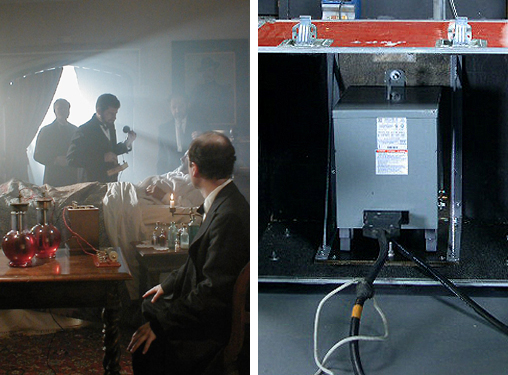
(Scene from "Unsolved History" powered from 50A/240V range outlet through step-down transformer/distro at the Ames Estate)
I use transformers to power bigger HMIs (2.5-4Kw), or more smaller HMIs, in situations where a tie-in is not an option and the budget doesn’t permit for a tow generator. If you outfit the transformer like our Full Power 60A Transformer/Distro, with a 60 Bates receptacle, you can use 60A GPC extension cables, 60-to-60 Splitters, and fused 60A GPC-to-Edison Breakouts (snack boxes) to run power around set - breaking out to 20A Edison outlets at convenient points (rather than one central point.) The best part about using a transformer with a 240V receptacle in this fashion is that no matter where in the distribution system you plug in, the transformer automatically balances the additional load, so that you don't have to be an experienced Spark to distribute power on set. For example, I have used this same package repeatedly at a historical mansion in Easton MA called the Ames Estate that has served as a location for a number of PBS historical biographies.
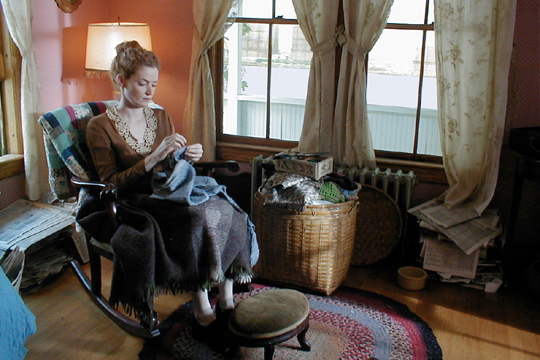
(Typhoid Mary in quarantine on an island in New York's East River. Note the view out the window of the East River shoreline at the turn of the century.)
A popular state fee free location, the Ames Estate, like many historical house/museums, does not permit tie-ins and the electrical wiring in the house is so antiquated that it is unusable. Fortunately, they have a 50A/240 volt circuit in the carriage house for a welder they use to repair the mowers they use at the park. Our standard mode of operation when shooting there is to run 250V extension cable from the welding receptacle to a 60A Full Power Transformer/Distro placed in the entry hall of the house. Using a 60A Siamese at the Transformer/Distro, we then run 60A 6/3 Bates extensions, down to the library, to the second floor, and back to the maid’s pantry. At the end of each run we put another 60A Siamese. A 60A snackbox on one side of the Siamese gives us 20A branch circuits. The other side we leave open for a large HMI or Tungsten Light. Now we can safely plug 1200 - 4000W HMIs (or even a 5k Quartz) into our own distribution anywhere in the house to balance the interior levels to the exterior. A good example of this approach is an American Experience program titled “The Most Dangerous Women in America” about Typhoid Mary that I lit for PBS. For part of her life Typhoid Mary was quarantined on an island in New York's East River.

(The actual exterior of Mary’s cottage was the backyard of the house where we rigged a 30’ blow up of a picture of New York’s East River shoreline at the turn of the century.)
Because New York’s East River today looks nothing like it did when she was in quarantine, we used a 30' blowup of a picture of the East River at the turn of the century rigged outside the windows of a house in Arlington MA. We had to strike a delicate balance between the interior and exterior levels. We wanted to overexpose the exterior by one stop so that it would look realistic and hide the fact that the exterior was a blow-up. As you can see in the production still of the exterior of the actual location used for the quarantine island, we rigged a solid over the porch windows and the blow-up to keep the sun off both. That way we could light the blow-up and interior so that it remained consistent even though the sun moved on and off the porch in the course of the day. To take the edge off the blow-up, we used a single scrim outside the window to help throw it out of focus.

(A child dying of Typhoid Mary filmed in a bedroom of the Ames Estate)
To maintain continuity between shots, we brought a 4kw HMI Par in a window on one side of the room as a sun source and a 1200 par through a window on the other side as a northern light source. We powered both heads off a dryer plug in the laundry room of the house using one of our transformer/distros. The two 2.5k Par lights used outside to light the blow-up were powered by a Honda EU6500is through a second 60A Full Power Transformer/Distro. Since the Honda EU6500is could be placed right on the lawn, we were saved from running hundreds of feet of feeder back to a tow generator.

(The New York City Health Inspector filmed in the library of the Ames Estate)
We have been able to use this same basic package at numerous museums and historical houses throughout New England including Sturbridge Village. Fortunately for us, to make ends meet, many historical houses rent themselves out for events and weddings. For that reason, they usually have at least one updated service with 30 or 50 Amp 240 volt circuit for the warming ovens of caterers.
For those who would like to see samples of what can be accomplished with this basic package, I have attached these links to production stills of the PBS and History Channel historical documentaries shot entirely, or in part, with just a couple of transformers and a Honda generator.
The History Channel’s “Unsolved History” episode
“Presidential Assassins”
American Experienes Typhoid Mary Biography "The Most Dangerous Women in America"
WGBH’s Ben Franklin Biography
“Franklin”
Or, use this link for more details about using step-down transformers on set: . By giving you safe and legal plug-in access to more house power through common 240V house outlets, a transformer can quite often eliminate the need for tie-ins or generators to power larger HMIs.
Guy Holt, Gaffer, ScreenLight & Grip, Lighting & Grip Equipment Rental and Sales in Boston
Michael Dearworth
Well-known member
- Joined
- Dec 25, 2010
- Messages
- 185
- Reaction score
- 0
- Points
- 0
It depends on how you define “normal household electrical outlet.” If you expand the definition to include.....
Incredibly helpful post! Thank you!

Richard Foster
Well-known member
- Joined
- Jun 10, 2010
- Messages
- 656
- Reaction score
- 0
- Points
- 0
- Location
- USA, Caribbean, England
- Website
- www.fosterent.com
Thank you Guy. Great information.
- Banned
- #8
Guy Bryan Holt
Banned
- Joined
- Sep 20, 2009
- Messages
- 149
- Reaction score
- 0
- Points
- 0
For all practical purposes a 1.2k HMI. … How many amps it pulls will depend a little on your ballast. Electronic vs mag, old vs new etc. But 11 to 13 amps is in the range.
Unless of course the 1200 Electronic ballast is non-Power Factor Corrected (which is likely to be the case in this country) in which case it will draw upwards of 19 Amps and will drop a 15 Amp breaker every time.
[FONT="]Because HMI ballasts have seen several technological improvements since they were first introduced, it is complicated to say what current they will draw. As Nick correctly notes it depends on whether it is Electronic vs Magnetic, Old (Non-PFC) or New (PFC). And, as David points out, on top of their constant load, you also have to take into account the load they place on the circuit when they are striking. Magnetic ballasts draw more current during the striking phase and then they “settle down” and require less power to maintain the HMI Arc. For this reason you can’t load a wall circuit or a generator to full capacity with HMIs with magnetic ballasts because you must leave “head room” for their higher front end striking load. By contrast, an electronic ballast “ramps up.” That is, its’ current draw gradually builds until it “tops off.” But, unless the ballast is Power Factor Corrected (PFC), an electronic ballast will draw more current than a magnetic ballast of the same wattage. Why ballasts of the same wattage will draw appreciably different current has to do with the Power Factor of the ballast.[/FONT]
[FONT="]Since Power Factor Correction is not mandatory in this country as it is in Europe, you will encounter not only many non-Power Factor Corrected HMI ballasts, but also Kino, CFL, & LED power supplies. And since, the adverse effects caused by a poor Power Factor go beyond an inefficient use of power, it is well worth understanding Power Factor and why it should be corrected. [/FONT]
[FONT="]Since you won’t find many magnetic ballasts these days, to understand Power Factor lets look at a non Power Factor Corrected electronic HMI ballast in detail. In an electronic HMI ballast, AC power is first converted into DC. Then, a high-speed switching device (micro processor controlled IGBTs) turns the flat current into an alternating square wave. Hence, they are commonly referred to as square wave ballasts. Electronic square wave ballasts utilize solid state electronic components which use only portions of the input power sine wave. Put simply, they place a disproportionately larger load on the peak values of the power waveform. These devices then return the unused portions to the power stream as harmonic currents. [/FONT]
[FONT="]

[FONT="]As illustrated above, these harmonic currents stack on top of one another creating harmonic distortion that likewise creates an opposition to the flow of current, pulls the voltage and current out of phase, and when the power is supplied by a generator can lead to severe distortion of the voltage waveform in the power distribution system. For example, the power waveform below left is typical of what results from the operation of a 2500W non-Power Factor Corrected load (electronic HMI & Kino ballasts) on a conventional portable generator (a Honda EX5500 with a Barber Coleman Governor.) The severe harmonic noise exhibited here can cause overheating and failing equipment, efficiency losses, circuit breaker trips, excessive current on the neutral return, and instability of the generator's voltage and frequency. This harmonic distortion is called capacitive reactance. Since an electronic ballast also puts current and voltage out of phase with one another, it also has a power factor. An electronic square wave HMI ballast typically has a power factor less than .6, meaning the ballast has to draw 40 percent or more power than it uses. Where a typical 1200W non-power factor corrected electronic HMI ballast takes 18.5 Amps at 120 Volts to generate 1200 Watts of light the power factor is .54 (18.5A x 120V= 2220W, 1200W/2220W= .54).[/FONT]
[FONT="]

[FONT="] Left: Conventional generator power w/ pkg. of non-PFC Elec. HMI Ballasts & Kino Flo Wall-o-Lite. Right: Inverter generator power w/ Pkg. of PFC Elec. Ballasts & Kino Flo Parabeam 400.[/FONT]
[FONT="]Power Factor Correction can be of tremendous benefit when operating HMIs and Kinos on both limited house power and portable gas generators because a PFC circuit realigns voltage and current and induces a smoother power waveform at the distribution bus. PFC circuits successfully increase the power factor to as much as .98, making ballasts with it near linear loads. As a result, the ballast uses power more efficiently with minimized return current and line noise and also reduces heat, thereby increasing their reliability. A typical 1200W power factor corrected electronic HMI ballast takes 11 Amps at 120 Volts to generate 1200 Watts of light the power factor is .91 (11A x 120V= 1320W, 1200W/1380W= .91).[/FONT]
[FONT="]For example, the power waveform above on the right, is the same 2500W load but with Power Factor correction operating on our modified 7500W Honda EU6500is Inverter Generator. As you can see, the difference between the resulting waveforms is startling. Even though the load is the same, the fact that it is Power Factor Corrected, and the power is being generated by an inverter generator, results in virtually no power waveform distortion. What this means is that the circuits of an inverter generator or house can be loaded to capacity with PFC HMI and Kino Flo ballasts because they use less power and don’t require that you leave head room for a high front end striking load. In the case of portable generators, the substantial reduction in line noise that results from using PFC ballasts on the nearly pure power waveform of an inverter generator creates a new math when it comes to calculating the continuous load you can put on a portable gas generator (in the case of our modified Honda EU6500is generator a capacity of 7500 Watts.) [/FONT]
[FONT="]Danny, if you are still unclear on Power Factor, I would suggest you read an article I wrote for our company newsletter on the use of portable generators in motion picture lighting. In it I cover some of the basic electrical engineering principles behind poor Power Factor, the harmonic distortion it can generate, and how it can adversely affect generators and limit the the lights that you power from a household circuit.[/FONT]

[FONT="]This article is cited in the just released 4th Edition of Harry Box's "Set Lighting Technician's Handbook" and featured on the companion website "Box Book Extras." Of the article Harry Box exclaims: [/FONT]
[FONT="]
"Great work!... this is the kind of thing I think very few technician's ever get to see, and as a result many people have absolutely no idea why things stop working."
[/FONT][FONT="]
"Following the prescriptions contained in this article enables the operation of bigger lights, or more smaller lights, on portable generators than has ever been possible before."
[/FONT][FONT="]The article is available online at http://www.screenlightandgrip.com/html/emailnewsletter_generators.html.[/FONT]
[FONT="]Guy Holt, Gaffer, ScreenLight & Grip, Lightng & Grip Rental in Boston[/FONT]
- Banned
- #9
Guy Bryan Holt
Banned
- Joined
- Sep 20, 2009
- Messages
- 149
- Reaction score
- 0
- Points
- 0
... generally I'd say that a 1.2K is the biggest HMI you can plug into a 20A circuit.
I would qualify David’s comment above as follows: a 1.2K is the biggest HMI you can RELIABLY plug into a 20A circuit. As Nick mentions, Arri now provides, in fact, two 1800W HMI Heads – one a Par (the AS18) and another with their new super efficient ARRIMAX reflector (the M18.) The problem with these 1800W lamps is that their power draw is too near the threshold of a 20A circuit for them to operate reliably without you taking several necessary precautions.
When Arri first released the 1800W M18 (also called the Baby Max) they claimed it was the “the brightest light that you can plug into the wall.” Lately, they have been footnoting that claim as follows: “Into the wall” denotes a single, 20A 120VAC electrical outlet on a single circuit.” The reason for the footnote is that as David pointed out many wall outlets are on 15 Amp circuits, and those that are on 20 Amp circuits probably use receptacles only rated for 15 Amps. This is a problem because the Arri 1800W ballast has an Apparent Power of 2250VA which means it will draw 19.5 amps at 115V. It will always trip the common 15 Amp house circuit and will trip a 20 Amp circuit if there is something else on the same circuit. Where you can't always know what else is on the same circuit, or even if it is a 20 or 15 Amp circuit, it is risky to plug the Baby Max into the wall.
So the first precaution you must take is to find a dedicated 20A circuit – it is a safe bet that the outlet that the refrigerator is plugged into is a dedicated 20A circuit. If there is an outlet directly below a window, it is likely to have been wired for a window air conditioning, so it too is likely to be a dedicated 20A circuit. But, even if you are able to find a dedicated 20 Amp circuit the draw of the 1800W Baby Max is just too close to the threshold of the circuit to operate reliably if you need to run AC Extension to the ballast. The reason being that line loss from a long cable run, or increased resistance from an overheated plug end, will cause the ballast to draw more than 20 Amps. It has been my experience that quite often the stinger plug-ends overheat because they are only rated for 15 Amps. The increased resistance that results from the heat causes the voltage to the ballast to drop and so it has to draw more power to maintain the 2250KVA Apparent Power load. At 110V it will draw 20.5 Amps. So the second precaution to take is, if you can, plug the ballast directly into the wall outlet and use additional head feeder cable to reach the light rather than using AC extension to reach the ballast placed next to the light.
The same is true of operating 1800W Baby Maxs on the 20A circuits of portable generators. To the problem of line loss and overheating plug ends, you have the added problem that as you add load on portable generators their voltage output drops. It is not uncommon for a generator to drop 10-15 volts under full load. The 1800W ballast that drew 19.5 Amps at 115 Volts will draw 21.4 Amps at 105 Volts to maintain the 2250KVA Apparent Power load.
The Arri 1800W Baby Max was really designed for 230V markets like the European Union where its’ Apparent Power of 2250KVA fits comfortably in a 230V/16A circuit. In 120V markets like the US it works best on a real film distribution system where every circuit is 20 Amps, you know what is on the circuit because you are loading it yourself, and because you are distributing the power yourself from a tie in or generator, you can bring the receptacle to the light and thereby eliminate under-rated plug ends and minimize line-loss. When you can run a 60A whip and drop a Snack Box next to the ballast you won’t have a problem. But, if your style of shooting requires that you run multiple stingers to plug into a wall or generator outlet, you will likely have problems with the plug ends or receptacle overheating.
If you take the precautions I suggest above, you will be able to run an 1800W Baby Max reliably on wall outlets for the most part. I have found that the only full proof way to power an 1800W Baby Max on wall out-lets or on portable gas generators is from a 240V circuit through a 240v-to-120v step down transformer. A transformer will convert the 240V output into a single large 120V circuit that is more than capable of powering the 19.5A load of a 1800W Baby Max. And, if the transformer is outfitted with a 60A Bates receptacle like the one we manufacture for our 7500W modified Honda EU6500is generator, it will enable you to use a film distro system that will enable you to minimize line loss over a long cable run, and provide plug-in pockets conveniently close to the ballasts.
- Guy Holt, Gaffer, ScreenLight & Grip, Lighting & Grip Rental and Sales in Boston
- Banned
- #10
Guy Bryan Holt
Banned
- Joined
- Sep 20, 2009
- Messages
- 149
- Reaction score
- 0
- Points
- 0
A transformer will convert the 240V output into a single large 120V circuit that is more than capable of powering the 19.5A load of a 1800W Baby Max. And, if the transformer is outfitted with a 60A Bates receptacle like the one we manufacture for our 7500W modified Honda EU6500is generator, it will enable you to use a film distro system that will enable you to minimize line loss over a long cable run, and provide plug-in pockets conveniently close to the ballasts.
A good example of this approach is an independent film that recently shot in our area that we equipped. The film is loosely based on a “This American Life” radio segment about a family that lived year round in the boatyard of a marina because they were fugitives from the FBI because of the father’s drug conviction for raising marijuana. Finding usable power in the boatyard and on the marina’s docks was a problem for the production because most of the 20A Edison receptacles had GFCI protection. This was a problem because, like common household GFCIs, marine style GFCIs are prone to tripping when used to power HMIs and Kino Flos (use this link for the reasons why that is.) But they needed the GFCI protection because they were shooting in, on, and around the water.
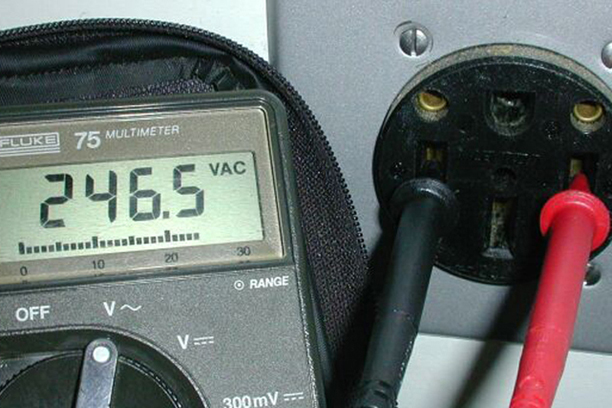
The 50A/240V Nema 14-50 receptacle that supplied power to the Transformer/Distro
The solution to their problem was to use one of the 60A Full Power Transformer/Distros, that we manufacture for our 7500W modified Honda EU6500is generators, to step down the 240V power from a 50A Nema 14-50 receptacle (pictured above) wired into a little shed on the deck of the marina’s guest house for the water heater of a hot tub/Jacuzzi. Our Transformer/Distro stepped down the 50A 240 output to a single 60A/120V circuit that was capable of operating not only their 1800W Baby max, but also a 4k HMI Par. And, because our Transformer/Distros are outfitted with standard film style Bates receptacles, they could use a GFCI that is specifically designed for the type of lighting loads we use and so not prone to nuisance tripping from the harmonics that HMIs and Kinos can kick back into the power stream (use this link for details.)

(photo courtesy of Isabelle Landers)
The cart outfitted with 60A Transformer/Distro, 100A Shock Block, and 4/2.5kw & 1800W ballasts that the crew called the E-Cart.
Note: that the 1800W Ballast is plugged directly into a 60A Woodhead w/3 20A circuits.
As an added benefit, the heavier-gauge Twist-lock cable we use to supply the transformer, eliminated the voltage drop they would have experienced if they ran multiple stingers to wall outlets. And, unlike 15 Amp U-Ground Edison plugs, the 30A/250V twist-lock plug-ends of our cable don’t overheat – adding to the voltage drop that is already unavoidable in long cable runs. To assure that the supply voltage on set does not drop far below 120V, we design a slight voltage boost into our Transformer/Distros (use this link for details.) This slight boost enabled the crew to run 200’ or more of Twist-lock cable to the cart from the shed, yet assure that the supply voltage on set did not drop below 120V and cause the 1800W ballast to draw more than 19.5 Amps.

(photo courtesy of Isabelle Landers)
A 100A Shock Block provides reliable GFCI protection to a 4/2.5kw HMI Ballast and 60A Woodhead supplying the 1800W ballast and audio cart
And, since our 60A Transformer/Distro is compatible with standard film distribution equipment, the crew could use 60A Bates Extensions to run power down to the lights on the docks (breaking out to 20A Edison pockets next to the ballast with 60A Splitters and 60A Snack Boxes), rather than having to run multiple stingers from the ballast back to the Transformer/Distro. By eliminating the line loss from long cable runs, increased resistance from overheated plug ends, and voltage drop in this fashion, our 60A Transformer/Distro assured that their Arri 1800W Baby Max operated reliably throughout the production.
For more detailed information on using transformers on set, I would suggest you read an article I wrote on the use of portable generators in motion picture production.
Guy Holt, Gaffer, SceenLight & Grip, Lighting and Grip Rental in Boston.
- Thread starter
- #11
Ask a simple question....lol...you guys are great.
Actually the setup is going to be very similar to the photograph above of the east River backdrop setup outside the house. Only in our case it is a false brick wall.
We are shooting in the living room of a very similar I story bungalow type house set up to look like a tenement apartment looking out at another brick building around 8-10 feet away. We were hoping ambient light (the house faces south) would be enough for the false wall although I think we will need muslin or similar to prevent direct sunlight falling on the wall if it's a sunny day and we needed the daylight sources to provide some illumination through the window into the living room. Inside we will use 1ks or smaller reflecting off bounce cards to provide some shadow fill. The important thing of course, is to try and maintain a steady level of illumination as the sun moves across the sky during the shoot. The question is, with the wall there where to put the HMI's outside the window? From the sides? Top? Any ideas?
Actually the setup is going to be very similar to the photograph above of the east River backdrop setup outside the house. Only in our case it is a false brick wall.
We are shooting in the living room of a very similar I story bungalow type house set up to look like a tenement apartment looking out at another brick building around 8-10 feet away. We were hoping ambient light (the house faces south) would be enough for the false wall although I think we will need muslin or similar to prevent direct sunlight falling on the wall if it's a sunny day and we needed the daylight sources to provide some illumination through the window into the living room. Inside we will use 1ks or smaller reflecting off bounce cards to provide some shadow fill. The important thing of course, is to try and maintain a steady level of illumination as the sun moves across the sky during the shoot. The question is, with the wall there where to put the HMI's outside the window? From the sides? Top? Any ideas?
David Mullen ASC
Moderator
Ask a simple question....lol...you guys are great.
Actually the setup is going to be very similar to the photograph above of the east River backdrop setup outside the house. Only in our case it is a false brick wall.
We are shooting in the living room of a very similar I story bungalow type house set up to look like a tenement apartment looking out at another brick building around 8-10 feet away. We were hoping ambient light (the house faces south) would be enough for the false wall although I think we will need muslin or similar to prevent direct sunlight falling on the wall if it's a sunny day and we needed the daylight sources to provide some illumination through the window into the living room. Inside we will use 1ks or smaller reflecting off bounce cards to provide some shadow fill. The important thing of course, is to try and maintain a steady level of illumination as the sun moves across the sky during the shoot. The question is, with the wall there where to put the HMI's outside the window? From the sides? Top? Any ideas?
You could just put a silk over the false wall to keep it from getting hard sun on it, though the sun hitting the silk will give you a warmer color than skylight hitting the wall. There are some grid cloths that are dyed blue if that worries you.
Where the HMI is outside the window just depends on what it's hitting inside the room, and what the effect you want is, and where the camera is pointed. I doubt that one position will work for everything.
- Thread starter
- #13
I think we will try and avoid the hard source look. The film has a depressed atmosphere so I was thinking a flatter cloudy day winter light type light coming in the window with a color temp tipping into the blue for a colder feel to the scene.

Roberto Lequeux
Well-known member
So douvetine from the house to the brick wall like in the photo posted covering the warmer sunlight, but with a "thick silk" (solid, not letting light through) under. Then hit the "silk" from the sides with as many 1.2k (or 1.8k) pars as needed, using the widest beams possible and flagging them carefully so there isn't any direct spill onto the wall or living-room?
David Mullen ASC
Moderator
When the window is not in frame, you basically soft light from that direction, you can out a frame of grid cloth in front of the window and fill it with the HMI, and/or do some soft lighting inside the room from a similar direction to wrap that key around faces, etc.
The trick is when you are looking right at the window creating the source of light in the room. In that case, it's hard to get the same effect of that window lighting the whole room without just blowing it out (i.e. covering it with tracing paper and lighting it up... which would give a nice backlit glow on everything in the room but not necessarily look realistic in terms of detail outside the window.) If you want to see that wall outside the window but make it look like all the light is coming from that window, then it takes some work... you'd first want to have soft light coming from almost every direction just off-camera outside the window (at least from above and from each side, sometimes even from below if for some reason your shot starting looking at a mural on the ceiling and tilted down.)
Whether it is easier to do that with bouncing or shining through diffusion just depends on what is easier to rig. Sometimes you can put a 4x8 beadboard or foamcor above the outside of the window, angled at a 45 degree angle pointed into the room, and hit it from below with HMI's, then have an HMI also coming from each side of the window just off camera, probably through smaller diffusion frames just to keep the view clear.
Then inside the room, you can augment the soft backlighting with a light above the window frame, if off camera, like a Kino or a white card with a bounce into it -- I like using Joker HMI Source-4 Lekos for that since they are self-flagging and easy to control spill. See this behind the scenes photo from one of my shoots:
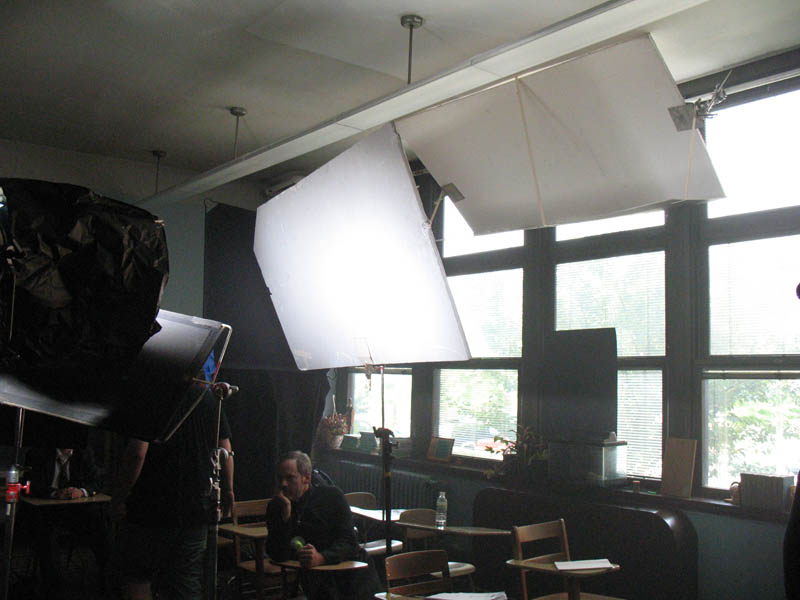
Joker 800 Source-4 Leko hitting the white card:
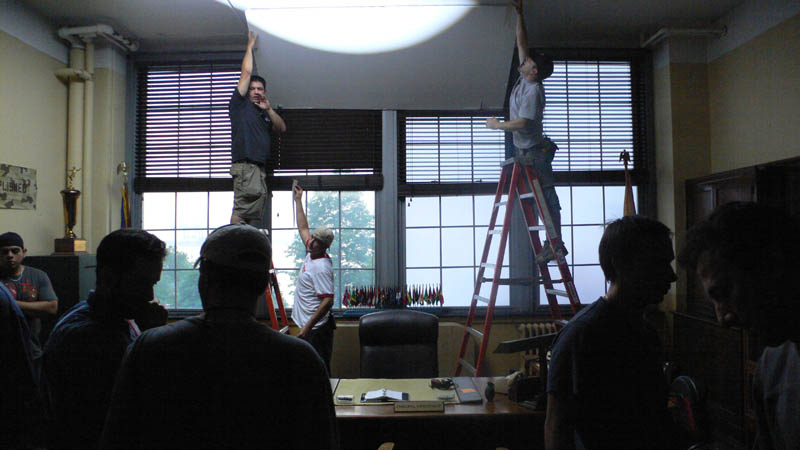
We weren't finished rigging when the photo was taken, so the light is misaimed, but when they were finished, the Leko filled the card and was squared off to match the shape of the card, creating a soft backlight on the desk.
The trick is when you are looking right at the window creating the source of light in the room. In that case, it's hard to get the same effect of that window lighting the whole room without just blowing it out (i.e. covering it with tracing paper and lighting it up... which would give a nice backlit glow on everything in the room but not necessarily look realistic in terms of detail outside the window.) If you want to see that wall outside the window but make it look like all the light is coming from that window, then it takes some work... you'd first want to have soft light coming from almost every direction just off-camera outside the window (at least from above and from each side, sometimes even from below if for some reason your shot starting looking at a mural on the ceiling and tilted down.)
Whether it is easier to do that with bouncing or shining through diffusion just depends on what is easier to rig. Sometimes you can put a 4x8 beadboard or foamcor above the outside of the window, angled at a 45 degree angle pointed into the room, and hit it from below with HMI's, then have an HMI also coming from each side of the window just off camera, probably through smaller diffusion frames just to keep the view clear.
Then inside the room, you can augment the soft backlighting with a light above the window frame, if off camera, like a Kino or a white card with a bounce into it -- I like using Joker HMI Source-4 Lekos for that since they are self-flagging and easy to control spill. See this behind the scenes photo from one of my shoots:
Joker 800 Source-4 Leko hitting the white card:
We weren't finished rigging when the photo was taken, so the light is misaimed, but when they were finished, the Leko filled the card and was squared off to match the shape of the card, creating a soft backlight on the desk.
Roberto Lequeux
Well-known member
If I am not mistaken that is from "Assassination of a High School President" (2008), which looks beautiful from start to finish.
- Thread starter
- #17
- Banned
- #18
Guy Bryan Holt
Banned
- Joined
- Sep 20, 2009
- Messages
- 149
- Reaction score
- 0
- Points
- 0
I think we will try and avoid the hard source look. The film has a depressed atmosphere so I was thinking a flatter cloudy day winter light type light coming in the window with a color temp tipping into the blue for a colder feel to the scene.
Another approach to consider is what we did for the American Experience program titled “The Most Dangerous Women in America” about Typhoid Mary that I mentioned above.
(The actual exterior of Mary’s cottage was the backyard of the house where we rigged a 30’ blow up of a picture of New York’s East River shoreline at the turn of the century.)
If you rigged a B/W Griffloyn or Ultrabounce between the window and the wall with the white side down as we did on that show, you could bounce HMIs outside into the white side and into the widows. This approach would give you the very even, diffused light quality that you are looking for, and will keep the light on the wall outside consistent throughout the day.
Guy Holt, Gaffer, ScreenLight & Grip, Lighting & Grip Equipment Rental and Sales in Boston