Welcome to our community

Be a part of something great, join today!

  • Hey all, just changed over the backend after 15 years I figured time to give it a bit of an update, its probably gonna be a bit weird for most of you and i am sure there is a few bugs to work out but it should kinda work the same as before... hopefully :)

Anatomy of a RED SHOOT - National Geographic's Great Migrations Golden Jellyfish

Ken Corben

Banned
Joined
Jan 26, 2007
Messages
769
Reaction score
0
Points
16
Location
Los Angeles, CA
The Golden Jellyfish segment shot on RED Premieres in Great Migrations Episode 3: Need to Feed Sun Nov 14 @ 8PM on Nat Geo Channel
Link to NGTV promo:http://channel.nationalgeographic.com/channel/great-migrations-animals-golden-jellyfish

In this thread, I want to share an anatomy of a RED SHOOT on The Golden Jellyfish segment I produced for the 7-hour original National Geographic Series Great Migrations airing starting Sundays at 8PM Nov 7th.

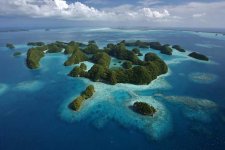
Our Mission was to head for a tiny group of rock islands in the South Pacific known as Palau and plunge into a lake filled with 5 million jellyfish. All to tell a story about new science - cool.

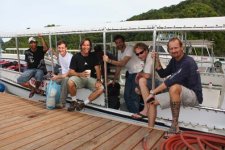
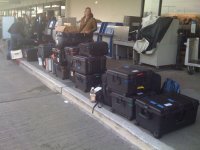
The following posts will share how 4 REDUSERS departed LAX with over 30 cases and lived on a rock in the middle of the Pacific Ocean for 10 days with 3 RED ONEs. The results are awesome.

http://channel.nationalgeographic.com/channel/great-migrations-animals-golden-jellyfish

Sharky

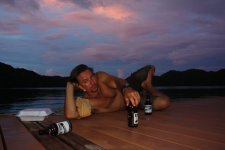
Palau Team: Ken Corben, Johnny Friday, Mark Thorpe, Stewart Mayer & Adam Ravetch


Great Migrations is a 7 hour epic television event that airs on consecutive Sundays beginning Nov 7 at 8PM.
More than 2 years in the making and narrated by Alec Baldwin - this is good TV :-)

Production traveled 450,000 miles on 83 individual
shoots, telling the stories of 20 incredible migrations.
These stories range from Antarctica to the North Pole to the Sahara to the
Grand Tetons. We are all very, very proud of the work. In fact, the head of
National Geographic Channel said, "...it's the best film National
Geographic has ever made."
 

Attachments

  • LAX_PALAU.jpg
    LAX_PALAU.jpg
    89.3 KB · Views: 0
  • Mark_Thorpe_Photo.jpg
    Mark_Thorpe_Photo.jpg
    35.4 KB · Views: 0
  • MerryREDMen.JPG
    MerryREDMen.JPG
    59.9 KB · Views: 0
  • Jellyfish_lake_view.jpg
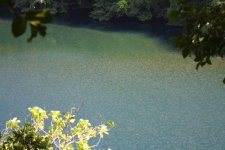
    Jellyfish_lake_view.jpg
    97.2 KB · Views: 0
  • RED_Jungle_Lab.jpg
    RED_Jungle_Lab.jpg
    61 KB · Views: 0
WOW! That is amazing footage! Congratulations to all of you!!!

Makes me feel depressed as I am a DOP specialising in television commercials and my work is so mundane by comparison.

If you guys ever need a RED guy in Australia look me up and Ill come on an adventure with you! Your series looks absolutely amazing and makes me jealous!!
 
Superb!
 
  • Thread starter
  • Banned
  • #4
STEP 1 - Story before technology...Do not let the tail wag the dog.

STEP 1 - Story before technology...Do not let the tail wag the dog.

The Golden Jellyfish segment shot on RED Premieres in Great Migrations Episode 3: Need to Feed Sun Nov 14 @ 8PM on Nat Geo Channel
Link to NGTV promo:http://channel.nationalgeographic.com/channel/great-migrations-animals-golden-jellyfish

Story -

After hearing the new story idea from Nat Geo about jellyfish lake, Director Adam Ravetch and I broke out our pencils and started writing. We had both filmed in this location before but over a decade ago. The results of our research yielded the final approved 4-page shooting script below for the interested.

Always entertaining to see what ends up as the final cut from the "shot in the wild" script -
the jellyfish are non-union after all.

Camera Dept
John Friday and I had already proven the RED camera technology and workflow for Nat Geo's first RED approved production with Icy Killers: Alaska's Salmon Sharks. We both knew the RED ONE was the right tool for this mission.

After all, script calls for the underwater shot of the deadly sulfur layer at night.
What camera would you take that can shoot time lapse, minimum 1080p HD all in a tropical jungle and mostly underwater?

A: none, I'll watch it on tv
B: 900's
C: HVX
D: R1

Rig and shot set ups and power tools in the jungle next,

Sharky


Treatment:

JELLY FISH LAKE, PALAU
THE NEED TO FEED
INTRO:
IN ONE CONTINUOUS SHOT: From darkness, we fade up to a night sky revealing stars moving in time lapse across a darkened lake. Slowly, with smooth precision, the camera tracks forward. As the sun rises, objects below the lake’s surface fly by filling the frame. Tracking forward, we submerge underwater, still in time-lapse, to find thousands of gelatinous structures moving at high speed. Suddenly, we are jolted into real-time and are immersed among millions of jellyfish that are stuck in a land locked lake, unable to escape to the open sea.

In March, DPP will deploy a small crew to Palau to document the unique Pacific Island Jelly Fish Migration using state of the art filming techniques to illustrate this Migration like it has never been shown before.

ACT 1:
• We will establish the Jelly Fish in Jelly Fish Lake by using a high tech time-lapse, modular motion control system camera, with an “interleaving” hot head with multiple SIMULTANEOUS time-lapse capabilities (One example described above). This is a brand new technique and will be a television first.

• Aerial photography combined with a 30-foot repelling chair and various time-lapse shots with RED Cameras, we will reveal Jelly Fish Lake, the Jelly fish & their Dilemma.

•Evolution of Jelly Fish Lake: The golden jellyfish were trapped in this JF Lake millions of years ago after a tunnel that connected the lake to the open sea collapsed.
Re-enacting the collapse of a tunnel, we will track through a narrow undersea cave, dodging debris falling about as we head to the entrance of the lake. The entrance of the cave will act as a natural blue screen plate, which we will replace with millions of jellyfish pulsating in it.

•From an aerial bird’s eye view dissolving into a massive dense layer of jellyfish, we will pose the question: Now trapped in a lake without escape, how can millions of animals find food.


ACT 2:
•The Jelly Fish of JF Lake initially survived by feeding on the prey that were stuck with them in the Lake. This was done by traditional stinging techniques. We will illustrate this by using the POV of a jelly fish swimming into schools of fish, dissolving to a shot of prey caught in the tentacles of a jelly fish (These shots might already exist in Nat Geo Library).

Eventually we will dissolve to open water shots void of any life at all. After eating themselves of any food that existed in the lake, the jelly fish were forced to evolve or die.

•They began to grow algae in their bodies. Essentially turning themselves from active hunters, as their ancestors were, to Farmers as they are today. Macro and aquarium techniques will be used to show.

•Jelly Fish don’t have eyes, but exhibit positive photo taxis, moving towards light. But for the Jelly Fish of JF Lake, there is more too it then that. The Jellies are actively making choices and decisions.

Purposely exposing themselves to sunlight during the day, through photosynthesis they soak in the sun’s rays to cultivate the algae in their bodies. They must do this or die.

This will be shown by using Time-lapse techniques to play up the sun’s movement and the movement of the masses of jellyfish underwater, as well as traditional techniques.

•Utilizing the time-lapse - modular motion control system camera technique, underwater time-lapse, and using a jib arm looking down with a polarizer onto the lake, we will reveal a mass exodus of migrating Jelly Fish across the lake. Starting at day break in the Western basin of Jelly Fish Lake, they pulsate in mass across to the Eastern Part as the day progresses. An event that repeats itself twice a day.

•However, if they go too far east it would mean certain death. Dolly around, up and through the Mangrove forest, and eventually submerging underwater, at the line where the shadow of the trees is cast into the sun lit waters; we introduce the jellyfish’s main dilemma.

•The Obstacle: Jellyfish-eating-Anemones line the eastern shores of jellyfish lake. When the jellyfish reach the shadows of the mangroves trees in the Eastern part of the lake, the jellies must make a life or death decision.

Most jellyfish stop, and reverse course immediately, heading back west to soak up the suns rays before repeating this behavior on the western shore of Jelly Lake again. But for some, they are confused. Colliding into the mangrove roots, tumbling up, down and around, individual after individual jellyfish swim right into the grasps of the Jellyfish eating anemone

Techniques used here are a combination of traditional underwater filming, as well as close up macro photography in the lake and in controlled aquarium.

•Panning up from a jellyfish being consumed by an anemone jellyfish killer, the site of millions of jellies that gather at the illuminated shadow line is extraordinary.

ACT 3
•As the sun sets on Jelly Fish Lake, the diurnal Nighttime Vertical Migration begins as the jellies shift to deeper waters. The Jelly Fish are forced to make another life threatening decision.

Every night the jellyfish bob from the surface to a nutrient rich pink bacterial layer, 45 feet below the surface of the lake. Here the oxygen is very thin and the jellies must be cautious. If they drop beneath the layer they risk death in waters without oxygen, but if they don’t approach at all they risk the death of the algae in their body. The algae are their only source of survival..

Millimeters above this layer of bacteria, the jelly fish stop in their tracks soaking their bodies in the nitrogen rich waters, providing a midnight snack of nutrients to their symbiotic algae. Using their positive light sensing abilities the jellies teeter on a thin line between life and death maintaining their position by picking up the hue illuminated from the pink bacteria. Layer after layer of jelly fish descend and mass at the pink layer. As the night pushes on and the sun is about to rise once more, the jellies begin to rise. For some though they descended too far, for too long, and their fate is sealed. Our camera team will enter this dead zone to find jellies lifeless floating in the hydrogen sulfide depths of Jellyfish Lake.

Techniques used for Night filming will include traditional underwater filming techniques with underwater lights. We also intend to try a black light on the jellies in the sulfur layer. Different visible spectrum may highlight the bacteria in the gelatinous bodies making it appear to glow neon. We will also use a surface light beaming down into the waters to provide a moon light scenario as the jellies descend down the focused rays of light. We will also shoot close on jellies in an aquarium.

•Jelly Fish in beautiful sunlight in all their glory. A series of artistic and beautiful underwater shots of masses of Jelly Fish in gorgeous light. Front lit, back lit, sun burst behind. All seems fine in Jellyfish Lake, but is it?

CONCLUSION
•In 1998, during the La Nina, the medusa population was completely eradicated due to the elevated temperatures. Completely absent from the lake for one year. Recovery was only possible because jellyfish polyps were able to tolerate the temperatures.

But what will happen to the jellies if they experience multiple seasons with temperatures increasing? Will the jellies be forced to evolve once again? We cut to an underwater shot of masses of jellyfish pulsating. Suddenly it kicks into time lapse as millions of jellies fly by. We dissolve to an underwater frame void of life. Slowly we descend up and out of the water 30 feet above the lake, using our repelling chair rig to reveal Jelly Fish Lake, and finally dissolving to a reverse reveal aerial over the top of the JF lake to the end.
 

Attachments

  • Power_tools.jpg
    Power_tools.jpg
    53.9 KB · Views: 0
  • Thread starter
  • Banned
  • #7
Step 2 - SOLD IT! Now how do I shoot it? My First Call - Element Technica

Step 2 - SOLD IT! Now how do I shoot it? My First Call - Element Technica

The Golden Jellyfish segment shot on RED Premieres in Great Migrations Episode 3: Need to Feed Sun Nov 14 @ 8PM on Nat Geo Channel
Link to NGTV promo:http://channel.nationalgeographic.com/channel/great-migrations-animals-golden-jellyfish

If you did not read the shooting script from Step 1 here is the skinny on the rigs needed for the ambitious 10 day shoot with a crew of 5:

* 3 RED ONE's
* Three underwater RED ONE systems
* Two surface RED ONE systems
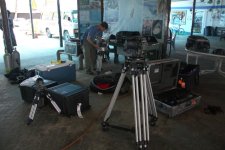
* ARRI 8R, Red 18-50 w/diopters, Cooke 10x, Zeiss 14, Duclos 11-17
* R1 underwater time lapse system/tripods/brackets/lights
* Surface time lapse 3 -axis
* Vertical and horizontal dolly track ABOVE and BELOW water
* Surface supplied underwater lighting systems
* Underwater blacklight system


So -
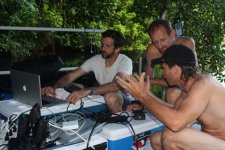
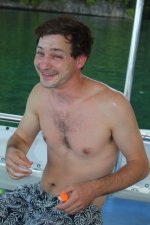
Deal memos inked, permits issued, carnets, vaccinations, yada yada - producing aspects all covered in less than 2 weeks, I then find myself standing on the shore of a tiny rock in the middle of the Pacific Ocean with 3 of my talented veteran filmmaking friends PLUS, the "New Guy." We called him New Guy until he proved his worth. This side story is very funny - you'll see.

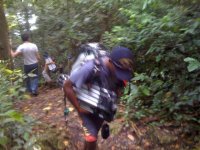
Crew and all the cases arrived, check. Now it needed to be ported over a hill on a slippery jungle trail in 100 deg heat. At least there were no bleedin' mosquitos... I loved this place already.

[/B]A Camera (R1) - Hydrocane Deployed by Astar into Jellyfish Lake.[/B]
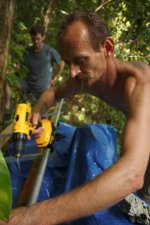
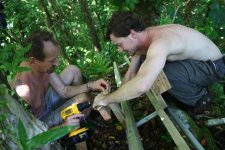
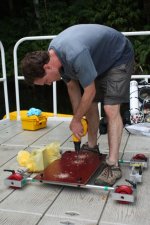
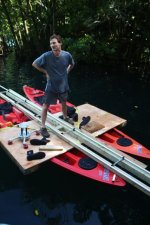
Ya right, that did not fit the budget either so we had to build our own solution and thus, The Red Battleship was born. I tell you, give me a DeWalt drill and I can build anything and who the heck is Archimedes?

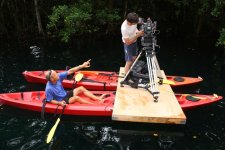
Aboard command central on Red Battleship 1, Director/Operator Adam Ravetch was easily maneuvered by one "dolly grip" with an oar. Rolling camera while gliding over the jellies with a pola was a very cool shot.

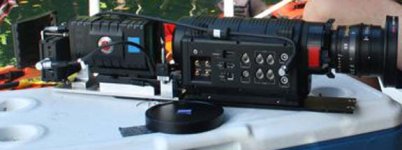
B Camera (R1) - This is the underwater time lapse R1 rig.
The result of brilliant last minute engineering and machining from Steve and Hector over at ET's Skunk Works (the R&D lab at Element Technica). They made the gear work for what I needed - very cool.

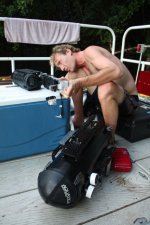
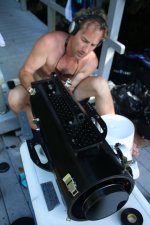
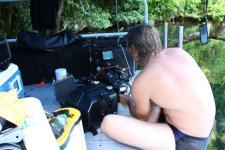
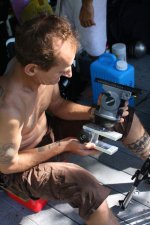
The set up called for a CFWA (close-focus-wide-angle) long run time underwater time lapse shot so I set the puzzle on the bench at ET. The design modification to my housing called for the switronix dual batt plate with 2 RED bricks, RED Drive and 5" LCD. The order was tall but delivered on time and it leak checked perfect the first test - as usual from them.

The camera plate was laid out to accomodate the dual batteries behind the R1 then the HDD then the monitor. Stacked and packed, but it worked like a charm...in the Los Angeles test pool, 3 days before anyway.

The rig assembled and leak checked in Palau, Johnny and I then deployed underwater with it and headed to the scouted spot which was of course across the lake. But hey, swimming a custom RED ONE underwater camera system for an hour each way underwater on a rebreather through 5 million jellyfish is a much better commute than Hollywood Hills to the Pacific Palisades on the 10 and 405, no?

The time had arrived - exhale. A critical money shot for the entire segment depended on about $50K of gear stuffed into an aluminum tube working way outside the design envelope (even from Ted). All of it placed strategically by 2 rebreather divers into the kill zone. Roll camera.

We waited on the sun..and our calculated run time/battery power.

The results will be featured in EPISODE 3: NEED TO FEED Sunday Nov 14th at 8PM.

Next, how the heck do you build a 12' horizontal track 100 feet over the water in a jungle to run the time lapse MOCO shot? And whose RED camera goes on this rig?

Sharky

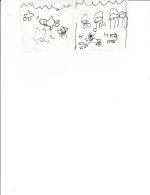
BTW - Story board by Kai Corben (6 years old).


GREEN NOTE: John Friday and I utilized rebreather systems and extreme care to film the underwater segments of the jellyfish under special permit from the Koror Government. Their commitment to protecting this incredible place is appreciated. We had scientists and wardens helping us to really minimize any impact on the lake during our filming efforts.
 

Attachments

  • gear_hump.jpg
    gear_hump.jpg
    68.4 KB · Views: 0
  • Battleship_RED.jpg
    Battleship_RED.jpg
    55.3 KB · Views: 0
  • timelapserig2.jpg
    timelapserig2.jpg
    50.8 KB · Views: 0
  • Jellyfish boards.jpg
    Jellyfish boards.jpg
    29.9 KB · Views: 0
  • New Guy.jpg
    New Guy.jpg
    42.8 KB · Views: 0
Last edited:
  • Thread starter
  • Banned
  • #9
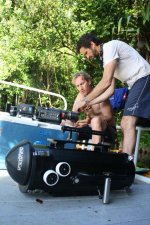
Red one underwater time lapse rig assembly...

Red one underwater time lapse rig assembly...

Here is the DAY ONE assembly/design/set up on location of the RED ONE underwater time lapse rig.

I designed the shot around the ZEISS/ARRI 8R for a specific result.

Sharky
 

Attachments

  • R1TL_Built.jpg
    R1TL_Built.jpg
    36.3 KB · Views: 0
  • R1TL-ET_Gears.jpg
    R1TL-ET_Gears.jpg
    51.1 KB · Views: 0
  • assemblyR1TL.jpg
    assemblyR1TL.jpg
    43 KB · Views: 0
  • System_BootUp.jpg
    System_BootUp.jpg
    96 KB · Views: 0
  • 8RKC.jpg
    8RKC.jpg
    40.9 KB · Views: 0
The Birth of 3D Time Lapse 3-Axis MOCO and The New Guy

The Birth of 3D Time Lapse 3-Axis MOCO and The New Guy

New Guy Back Story

I needed a reliable 3-axis moco unit and operator for the remote location on set shots I had designed so I started calling around,
"Hey, I need a rig for 2 weeks. Ya, in Micronesia with an operator."
Loads of offers but no where near my budget. Then my dear friend GOOGLE delivered a possible solution...New Guy.

I called New Guy and asked if his "invention" was ready for Prime Time?
Specifically, if he could deploy in 1 week for Palau's Jelly Fish Lake and make the little science experiment work with REDs for a National Geographic Special.

He said Yes.

I asked if the rig could handle 2 REDS and if he had ever shot 3D and could he make it work underwater? After a moment of silence, "3D...underwater?"

After that call I'm fairly certain he did not sleep for the 3 or so days before he departed Dallas to audition the 3D modified system for me in LA.

It worked :-)

Now, I had to get New Guy and his mad science experiment, parts and pieces on to a remote rock island in the Pacific.
His first Nat Geo shoot was going to seriously kick his ass and he had no idea.

In the remaining time before departure, New Guy completed an underwater prototype and the portable systems I asked for all fit into four 70lb cases.
I was impressed.
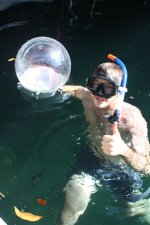
In Palau when he unpacked the sight unseen Willy Wonka Bubble my first thought was every Pilot's famous last words before they crash and burn, "Oh Shit."

"Oh" meaning you have recognized there is a serious problem and the latter meaning you realize there is nothing you can do about it.

New Guy Proved me wrong.

Over the 10 days of production New Guy worked tirelessly to make the shots happen. I asked for 3D time lapse MOCO set ups I had never seen before and he built them and made it work. In caves, on precipices and even his mad scientist underwater tests worked.

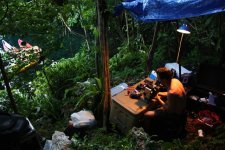
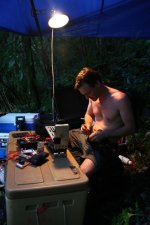
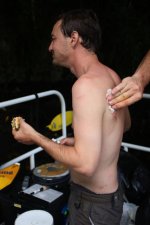
Then, when New Guy built a desperately needed replacement battery plate out of a tin can and some parts from the trash in the rain at night under a dripping tarp that critically saved the day, we started calling him Stewart and sharing the chocolate chip cookie rations.

Stewart Mayer will be the first to admit he could not have done it with out Mark Thorpe.

(I hired Mark first, as usual , to be field producer/fixer and camera operator both surface and underwater for the Palau shoot. When I go deep into the wild I always take Mark as my wingman. One tough dude and a pleasure to work with under stress.)

The Birth of 3D Time Lapse 3-Axis MOCO Rig
I will share the set ups and results in a subsequent post that outlines the birth of a shot I dubbed "eye candy for the soul". The portable "In the Wild" 3D 3-Axis time lapse motion control system was born on that rock island during production field testing in April '09.

It is something to see.

We now call Stewart a Digital Motion Control Artist.

Next shot is the deadly sulphur layer at night...send in Johnny Friday and DEEP RED.

Sharky
 

Attachments

  • NewGuy_JungleLab.jpg
    NewGuy_JungleLab.jpg
    71.1 KB · Views: 0
  • NewGuy_solder2AM.jpg
    NewGuy_solder2AM.jpg
    42.9 KB · Views: 0
  • NewGuy_fed&nursed.jpg
    NewGuy_fed&nursed.jpg
    32.9 KB · Views: 0
  • Willy's_Bubble.jpg
    Willy's_Bubble.jpg
    42.1 KB · Views: 0
  • NewGuy_Day5_OnTheRock.jpg
    NewGuy_Day5_OnTheRock.jpg
    32 KB · Views: 0
Step 3 - The Sulfur Layer Money Shot with an R1

Step 3 - The Sulfur Layer Money Shot with an R1

The Golden Jellyfish segment shot on RED Premieres in Great Migrations Episode 3: Need to Feed Sun Nov 14 @ 8PM on Nat Geo Channel
Link to NGTV promo:http://channel.nationalgeographic.com/channel/great-migrations-animals-golden-jellyfish

The underwater R1 time lapse system working flawlessly and running all day, it was time for the next money shot.

The deadly sulphur layer...at night.

Ya, I thought it was a bit dramatic and corny when I first heard it, but turns out it is true. http://en.wikipedia.org/wiki/Jellyfish_Lake

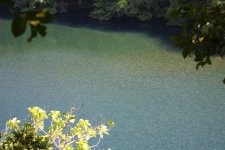
The ancient marine lake we call Jellyfish Lake is very old and unique in its formation and life cycle.
As a result of its ice age origins, there is a "boundary layer" in the lake at around 50 feet deep..and it will kill you.

The super high concentrations of sulfur dioxide (SO2) and ammonia in the water existant in this chemocline layer below 50 feet are absorbed thru your skin into your blood and attach to your hemoglobin. You then literally die from hypoxia while fully conscious and awake.

"Johnny ready with his rig yet?"

So at 50 feet is this visible layer, a pink ribbon-like warning sign created from the merging of the purple sulfur bacteria and the poisonous SO2 dissolved in the salt water. http://en.wikipedia.org/wiki/Purple_sulfur_bacteria

New science indicated there is a vertical migration by the Jellyfish to the boundary layer to replenish on SO2 for their on board life giving algae. That is what we call the money shot in this genre. New science + cool images = neilson ratings.

We came supplied with an arsenal of lighting solutions.
Red Battleship 1 provided a geni and surface supplied underwater lighting system. UW battery powered lights on camera. Surface supplied UW blacklight.
Jokers/PARS/C-stands on the Battleship with CTOB. We were all set. A Xenon would have been AMAZING!


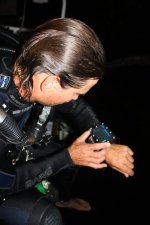
The first night time attempt was successful. Johnny Friday, utilizing his rebreather diving skills, successfully navigiated to the boundary layer, filmed it, returned and had a beer (or two).
That is on page 1 of the Johnny Friday Rebreather Deep Red User's guide. "Beers accelerates the offset of post-dive sulfur dioxide exposure."
Maybe it was "accentuates" ?

The shot is truly eerie.
His lighting technique reveals the purple ribbon layer and the black water of death awaiting the jellyfish below it.
Money shot #2 in the can.

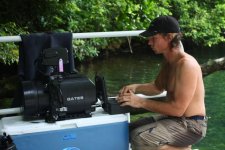
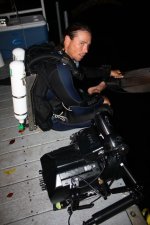
Johnny used his DEEP RED housing from GATES with a R1 recording 23.98/16:9/4K at ISO 500.
That housing from John Ellerbrock is a work of art that functions as a core tool.
We know. We put it to the test on this production.
http://www.gateshousings.com/housings/deep-red-underwater-video-housing/

The lens he selected was the RED 18-50 with his secret diopter set up.
The lighting was a combination of Green Force lights from GATES and a proprietary light system on loan from Bob Cranston.

Always better to be lucky than good. J was both.
This shot was all about preparedness and trainng way in advance.
Our official request to utilize hazmat dive gear to film the layer was denied.
It was rebreathers for a few minutes and we knew it.

The post-dive r3d playback with REDCINE in our jungle video village later that night had us all jumping for joy.
That statement and capability tickles me to the core.

J smiled and had another beer...on me.

Now to that pesky suspended MOCO set up.
Whose stupid ideas was this anyway?

Sharky
Jellyfish Segment Premieres Sun 11/14 at 8PM only on the Nat Geo Channel - shot entirely on REDs.
 

Attachments

  • JFpre-diveDeepREd.jpg
    JFpre-diveDeepREd.jpg
    51.1 KB · Views: 0
  • JF_DeepRedPrep.jpg
    JF_DeepRedPrep.jpg
    57.1 KB · Views: 0
  • JF_DeepRED.jpg
    JF_DeepRED.jpg
    45.7 KB · Views: 0
  • JF systemsCheck.jpg
    JF systemsCheck.jpg
    39.4 KB · Views: 0
  • JS_Post_Money_Shot.jpg
    JS_Post_Money_Shot.jpg
    28.8 KB · Views: 0
Great stuff ..Thanks for posting!!

I'd love to be involved in your next shot! Call me!
 
Step 3 (CONTD) - The Sun Tracking 5 Million Jellyfish Master

Step 3 (CONTD) - The Sun Tracking 5 Million Jellyfish Master

The Golden Jellyfish segment shot on RED Premieres in Great Migrations Episode 3: Need to Feed Sun Nov 14 @ 8PM on Nat Geo Channel
Link to NGTV promo:http://channel.nationalgeographic.com/channel/great-migrations-animals-golden-jellyfish

The call for shot #3 was a master shot of the lake and jellies.
It had been done before very well.

We decided to up the ante by adding a 3rd axis to the motion of the time lapse shot by utilizing a horizontal track that moved along the +Z axis during the move.

The 3 simultaneous shots for the one run, when the weather and the jellyfish Gods permitted, were designed to follow the 5 million jelly fish as they track E to W with the sun across the lake with "interleaving".

And we added 3D.

The rigging required EXTREME care.
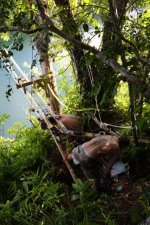
We could not and would not so much as bend a leaf with our rigging in this magical place. Mark and Stewart built the smartest system we could on location. Then came the bad news.

No matter what, they could NOT get the rig to fly 2 REDs in a parallel stereo pair configuration as designed. To much weight and the slightest movement in the dolly track destroys the stereo shot. We had worked hard to get here and now had no choice but to activate Plan-B for this shot - Canon 5D's.

Stewart's system DOES and DID support and operate the RED ONE in 2D mode and works like a charm. Just could not get the 3D RED rig to fly and time was ticking. I knew I'd be back with EPICs to redo the shot in the future.

INTERLEAVING
Named/created by Stewart Mayer's Associate(?), Stewart incorporated the capability into his software to program 9 simultaneous moves during the same run. I used this feature A LOT. For example, during the suspended track shot, the system tracked the jelly fish, the sun and the clouds on the horizon during the same 10 hour move. Three shots interleaved during the same time lapse run.

He then wrote the software that extracts the interleaved frames for POST creating the appropriate shot time lines.
Now you know why we share our cookies with Stewart.
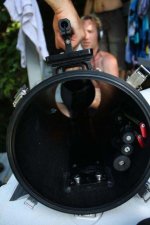
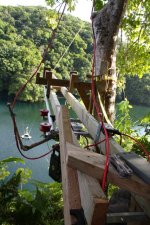
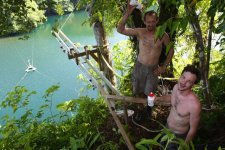
The 2D R1 time lapse MOCO rig running on horizontal dolly track over the water in the mangrove swamps was a sight to behold.

Now it was time for Wonka's Bubble to perform.
I've done some crazy stuff with RED and underwater cinematography - this, if it worked was going to be way cool.

Sharky
 

Attachments

  • rigging2.jpg
    rigging2.jpg
    62.5 KB · Views: 0
  • rigging.jpg
    rigging.jpg
    84.9 KB · Views: 0
  • FromTheMindOfMarkThorpe.jpg
    FromTheMindOfMarkThorpe.jpg
    80.5 KB · Views: 0
  • 100 deg.jpg
    100 deg.jpg
    79 KB · Views: 0
  • 5 million jellies.jpg
    5 million jellies.jpg
    54.7 KB · Views: 0
These are amazing stories! Thank you very much for sharing in such detail and please keep them coming...

Sean
 
Hahaha, just found this. Great write up Ken, thanks for posting.

Currently doing battle in the surf of Indonesia with 5DMkII's on photographic mission. All good.

Cheers bud.
Mark.
 
STEP 3 (CONTD) - Bubble Boy and The Motion Time Lapse Underwater Shot

STEP 3 (CONTD) - Bubble Boy and The Motion Time Lapse Underwater Shot

The Golden Jellyfish segment shot on RED Premieres in Great Migrations Episode 3: Need to Feed Sun Nov 14 @ 8PM on Nat Geo Channel
Link to NGTV promo: http://channel.nationalgeographic.co...lden-jellyfish


It was time for the bubble shot.
Short on time and money, Stewart hatched a genius plan - on the napkin at Burger King it looked great.

Let me just point out that this was a very ambitious shot attempt.
One that would enhance the predation story in my opinion.
We threw the kitchen sink at it from our remote jungle island outpost.
The crew was now calling base camp the Hanoi Hilton.
It was only day 5 of 10.

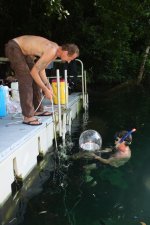
The bubble was designed to perform a 3-axis underwater time lapse interleave move in 2D. We designed it as a test platform for the EPICs. We learned a lot on this one.

The key lesson was that heat generation and moisture are a underwater housings achilles tendon. Fogging of the acrylic dome plagued us in the warm tropical water no matter what trick we used. We activated Plan B again.

Stewart and Mark leak checked it twice before building and deploying the system. It worked in 2D. The results were very cool. The jellyfish migration became a speeding highway.

Is it time to dive in the ocean yet?

Sharky
 

Attachments

  • bubble-boy.jpg
    bubble-boy.jpg
    54.1 KB · Views: 0
  • leakCheck.jpg
    leakCheck.jpg
    49.3 KB · Views: 0
  • sacrificial_UW-Head.jpg
    sacrificial_UW-Head.jpg
    49.1 KB · Views: 0
  • track_master.jpg
    track_master.jpg
    55.9 KB · Views: 0
  • Track_deployment.jpg
    Track_deployment.jpg
    53.7 KB · Views: 0
I loved the name of the one picture:

sacrificial_UW-Head.jpg

I've got a few of those oceanic sacrificed fluid heads ... :)
 

Attachments

  • sacrificial_UW-Head.jpg
    sacrificial_UW-Head.jpg
    49.1 KB · Views: 0
Back
Top