Welcome to our community

Be a part of something great, join today!

  • Hey all, just changed over the backend after 15 years I figured time to give it a bit of an update, its probably gonna be a bit weird for most of you and i am sure there is a few bugs to work out but it should kinda work the same as before... hopefully :)

MX vs Alexa

jonnycom

Banned
Joined
Oct 1, 2008
Messages
438
Reaction score
0
Points
0
We've been doing some side by side test with the Alexa and the MX. The Alexa is very impressive even in it's kinda beta state with no way to record anything on board, we are feeding a Kona 3 and recording Prores 444, the sensor is very good.

The 1080p resolution sucks especially for 3D but if they get a 4k sensor working watch out. The Arri is a lot heavier then the Red but that might be because of the crazy heat control system that is built in.

I will post some frames soon.
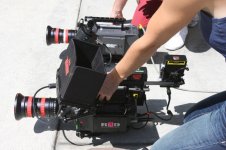
 

Attachments

  • AlexMX.jpg
    AlexMX.jpg
    79.6 KB · Views: 1
Also doing side by side tests, with all recording options...

Won't comment on results untill further analysis, but it will be published with RAW files...
 
Waiting!

And to show this test comparison @ 1080p footage that matters to me only and something that is below 1080p I can't get that the test is a serious.

Also Log C ProRes 422/4444 and ARRI RAW together with R3Ds for download would be the best and fair play option that we can see by our own eyes what is going on there...
 
Sure San. Have you shot Alexa? -:)

But fullrez comparisons are also relevant here for keying and DCP projection in a Country which is rapidly going 4k...
 
No need to test Alexa vs R1-MX for many reason.

I'll wait for Scarlet S35 (if it has HDRx enabled) to have an appropriate test between the two 3K sensors.

Why?

Alexa sensor sucks at the 3 following points:

1. Aliasing/Moiré issue.

1279365934.jpg

RED Team comparison test: Alexa on the left and Epic on the right side.

2. Bright daylight low ISO shots.

Some reports told us that Alexa had IR issue and that was solved using Tiffen IR ND filters

but other reports told us that some people still shooting daylight with D21 and night shots with Alexa.

So that means Alexa still has a certain issue at a low ISO bright daylight shooting.


3. Luck of detail because of the lower resolution.

1279347594.png

RED team comparison test: Alexa resolution.

1279325808.png

RED team comparison test: EPIC MX resolution.

Also you could add:

4. Heavier body than R1-MX.

5. Overpriced in a comparison with other cameras starting in a range from with R1-MX to HDDSLRs...
 
You guys might be right, but it shouldn't be that way. (And I am NOT talking about the moderators, but the discussions...)
Both these cams have significant strong-points that they don't share, and both these cams have issues.

I look at them as beautifull interrim cams, both will have things that follow, and I have thought for a while that we're a long way from "standardisation" in the image capture area (like we have in the audio world).

Thus I think it is interesting and relevant to discuss differences in approach, image and workflow, rather than saying this is the best or worst cam. Where do they excell...

I am more or less "brought up RED", have worked RED, love RED for the oportunities they have given me and many other and how RED has changed and is changing the industry.

That said, it is strange if I should feel unfaithfull by testing out differences for those I work for who need to use cameras now for productions now.

I do apprechiate technology and development. Rather than saying: This is the best for any occation allways, without checking what is on the table, I will search an informed opinion.

RED is cool.
Even Michael Bravin is open to that...

Alexa is cool.
Even Jim has stated that.

Shooting R1 MX and Alexa together, confirms that.
AND that they are very different indeed.

Simplifying along the lines of:
But R MX has more resolution

&

Alexa has more latitude

is not really giving any of the camera systems a fair credit. Conceptually they are way to thoroughthought and different for such statements to be the only relevant.
And a camera-system is much more than the sensor...

As to the above, Jim said: We want both latitude and resolution.

And I agree with him, and could add: and then some...

But comparing technoligies, is just that.
Comparing the signal we get from each cam at a given shooting situation and comparing postworkflows and trying to make the best out of both. And how easy it is to work with them.
It's not about going in with a preconfigured mind and decide what you had already decided.

I must say that both cams so far have given me some surprises. Some good, some bad.
But both are very loveable.
That's why I test. To find the surprises...

And when I find odd results, I contact the companies to get an answer before publishing.
There's far too much invested for both of them to do a simple writeoff after finding strangeness which maybe is due to my testing incompetence.

And please San, both companies are involved in marketing in their different ways, and they pit the products against eachother in a way that you need to see for yourself what is most relevant for you...

It's a bit like saying that: Because I sometimes work for Apple (which I do) I MUST have all the Apple gadgets (which I don't)

Technology interest is about discovery and curiousity, not brand loyality.
Art is about applying technology that you manage to controll, be that a DVcam, an iPhone or an Epic.

Brand loyality can be fine, too, but that's more of an emotional thing, which is not really relevant for tests.

And that's just fine with me!

Cheers!

Gunleik
 
Gunleik,

everyone has their own story.

Now I tell mine:

for a certain reason I sold my RED1-MX two months ago because to get a better price then before the sales prices of used R1MX

became lower when Epic starts to ship. All that thanks to my experiments that caused me lost of RED warranty and EPIC/Scarlet

upgrade discounts...

I've got about 33.000 Euros for my package and actually didn't lose any money with selling my old R1-MX.

Then I was thinking about WTF Alexa could give it to me with its 3x times higher price

(means Prores SxS cards recording plus a full HD-SDI enabled Alexa configuration) than my R1-MX package.

My answer is: Nothing.

Third person question: How?

My answer: Wait, tell you in a minute!

One more third person question: What about Alexa's better latitude?

My question: WTF latitude?

My answer: I already showed here how you can squeeze more DR from existing R1-MX

footage without losing so much or even nothing from image quality especially if you have to deliver at 2K/HD resolution.

For me Alexa is definitely a game over.
 
As I said, we all need to find our own priorities.

I have an Epic on order. So do my employers. (Several each...)

But my employers are going in production NOW for year long shooting schedules.

There are many more factors to take into account than the ones you list for many. Not for you maybe, but for many others.

Have you clicked on the XML from an Alexa prores magazine and seen what happens?

It's pretty sweet.

And the time it takes to implement a workflow to achieve a result is also a factor. I've seen your 6400 ISO results and am duly impressed. Working like that with significant amounts of footage isn't really relevant, though. Turnaround is short, data-amounts are huge, manual labour is expensive, and so are backup/diskspace solutions in the pro world.

There are many things to factor in.
 
Gunleik makes good points. There ARE many variables to factor in when working in the professional realm.
I've done a couple of jobs with Alexa already and it is a terrific camera. I even got a demo of the onboard recording (they are waiting for Apple to finalize the ProRes approval before Arri officially enables SxS recording) which is, indeed, pretty sweet.
We were shooting a day interior in a Manhattan loft, with minimal lighting (Image 80 and a couple of 4-foot Kinos) and a relatively open stop of 2.8/4. The sunlit buildings outside had a surprising amount of detail, and people's faces looked gorgeous. And remember that we get paid largely to shoot people's faces.
The camera is small, relatively light, and dovetails perfectly into the Arri accessory product line. It is built like a TANK. You can onboard record in an editor-ready format, or you can off-board record to broadcast friendly tape formats and uncompressed formats to OB-1 or CODEX recorders. You can record Arriraw or Log C offboard. You can even record Log C to the cards! In short, it is a very flexible piece of equipment.
Yes, Red wins on resolution. But that is not the whole story.
I think Red MX is great. I think EPIC will be even better, and I plan on getting two EPICs to replace my Red Ones. The HDR on EPIC sounds AMAZING, and I hope Red really takes their time with Tattoo and makes it all rock-solid. But I like having options, and I think Alexa is a terrific option.
I should hopefully have mine next week, or the following week at the latest. When I have more time (and my own camera) I'd be happy to shoot and post test footage, if people have a specific request about something.
But this IS reduser, not ARRIUSER, so probably not appropriate to discuss Alexa in great detail. I think the comparison discussions are fine, as long as they don't get out of hand, and I think the mods have done a good job of policing this.
Just my opinion. I know everyone has their own...
Cheers,
Harry
 
but other reports told us that some people still shooting daylight with D21 and night shots with Alexa.

So that means Alexa still has a certain issue at a low ISO bright daylight shooting.
]

Less ND Needed & perhaps some people lile to use an optical finder.
 
Yes, the reduser forum is, among other things, always entertaining...
Cheers,
Harry
 
I am really looking forward to some side-by-side HQ grabs. Or, better, still, footage. I just hope the thread survives till then.
 
One more thing!

Simplifying along the lines of:
But R MX has more resolution


Yes, Red wins on resolution. But that is not the whole story.

(The next lines are about a possible scenario that could happened).

Resolution matters!

How?

They said Alexa has a film image quality!

Yes, I saw it on a couple of samples but only at the smaller internet container picture sizes>>>

Let's say I've shot feature on Alexa, everything was fine, have got a film image quality

and at the end want to print to film and to store my negative in archive.

Then went to a lab and guy told me that 2K resolution is OK for today's theater release but to store it in a film archive I would need minimum 4K resolution.

I said go on because I need it anyway.

Then we managed to resize Alexa's footage at 4K and then have got a soft image.

And the lab guy suggest to use an older negative stock to get image more grainy to get rid of softness (means lack of resolution).

Then in that resizing mess Alexa's footage looked pretty much as it was shot on S16mm film camera but with 35mm DOF.

That means Alexa is just fine @ 2K/HD but not a future proof film print archive or 4K digital projection solution.

So with this above I said all my points with Alexa.
 
Sanjin.

Of course you're right.

you may have noticed that I live in a country which is going 4k DCP at a rapid pace, and have thrown most of its filmprojectors out. Of course that is one of many factors...

I am just saying that there is more to workflows, gradeability a films longlivedness, fun on set, ease of use to accomplish those results, effective ways to protect what you actually recorded throughout the production than measurable dynamic range and resolution, at least if you're actually working on productions going to cinema or drama for TV. If you put up single parameters, a single camera wins. I just happen to think working with images is slightly more complex than that.

But as you say: We disagree on this, and that's fine with me.

I feel so terribly for spilling my beans here... -:) but I have promised myself and those for whom I test, that I won't do that untill the analysis is done and the companies have had a chance to respond on odd results.

So I'll have to wait.

I CAN say, though that I find the differences in approach and results more significant than the similarities, for better and worse on both cameras behalf.
 
Sanjin,
Yes, you are right, that is a possible scenario. For a movie. In theory.
I'm speaking of a broad base of work: TV commercials, corporate films, episodic TV. I'm speaking of docs. I'm speaking of sports and nature. And yes, some theatrical films.
I work with a member of the ASC who is strongly considering the Alexa for a movie that starts in a month. We will see 2K and filmout versions of our tests today or Tuesday (both film and Alexa, captured with SxS, OB1, and Sony HDCAM SR. And both film and Alexa with Hawk 1.3x squeeze anamorphics and spherical S4's) of a test we conducted Monday. I will let you know my impressions.
I think the argument here should not be which camera is better (because we will never resolve that argument) but whether or not there is room for more than one kind of camera, used in different scenarios for different reasons. I think there is room for different kinds of cameras. I think the folks at Red and ARRI would agree that this is true. My impression of your argument is that Red is the only camera to use for everything, and I must disagree (if this is indeed your position)
Cheers,
Harry
 
Back
Top