Welcome to our community

Be a part of something great, join today!

  • Hey all, just changed over the backend after 15 years I figured time to give it a bit of an update, its probably gonna be a bit weird for most of you and i am sure there is a few bugs to work out but it should kinda work the same as before... hopefully :)

Angenieux 24-290 issue

15mm rods work just fine if they are the right kind. Heavy duty 24" rods with a proper low-bridge would definitely do the trick. Also best to make sure that the flange is set properly on your Optimo. They are amazing works of engineering that require consistent maintenance to work properly.
 
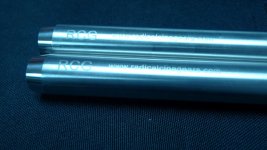
Sorry, no. Angenieux is very specific that 15mm rods are not strong enough. I've seen hardened steel rods in 15mm flex enough to throw the lens flange out by about 30 microns. There are bridgeplate systems that support the rods out in front of the lens as well as in back and when used this way, 15mm steel rods will work. But otherwise 19mm steel rods are what should always be used with the Optimo 24-290.

Yes, we do sell this stuff by the way.
 

Attachments

  • P1000215.jpg
    P1000215.jpg
    95.6 KB · Views: 0
19mm came about because 15mm wasn't robust enough to support some of the heavier lenses coming out. ARRI created the standard (just like they did 15mm). They did it at the same time they debuted the 535 camera (or was it with the 765?). ARRI wanted it to become the new standard but because a few of the big LA houses (Denny & Otto) had spent millions on 15mm accessories they were none too keen on switching over. So both supports exist in parallel.

But 19 is more robust and you should see some of the contraptions of secondard support feet and wedges that have been devised to shore up 15mm systems.
 
I agree with Mitch...when using the Optimo 12x, a good under-lens support, and 24" 19mm rods are a very good idea indeed. The lens itself weighs 24 pounds - before adding on follow focus and matte box. Its a beast to carry around!

Though I'm known for mostly using 35mm stills lenses on Red One, and keeping my mobile camera setups as light as possible, I do occasionally use cine lenses - and usually its an Angenieux 24-290.

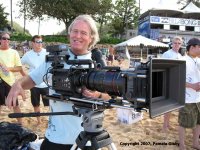
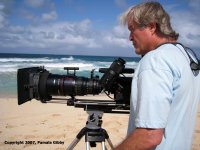
I've attached two pics of me using an Optimo 12x on one of my Reds in early December 2007. The occasion was the Pipeline Masters ASP World Contest Tour surfing contest on Oahu. I was working as a combination field producer, director, and cinematographer. For the production we were using three of my Red cameras - one in a helicopter, one in the water (inside the first Red One water housing ever made), and myself shooting the long-lens, land based footage.

In these photos the EVF and Red Drive I was field testing were among the very first to be used on a Red camera - this was 12/7/07. The Optimo 12x, 19mm steel rods, matte box, and 24" Arri Dovetail plate were rented from Otto Nemenz. The Red camera, 19mm base plate, Miller 55 tripod, and all the camera accessories were mine. In these photos the lens dwarfs the rods - but yes they were 19mm.

The assembled rig weighed 55 pounds - right at the load limit of the Miller 55 head. But the Miller 55 handled it really well, with very smooth head action - and that tripod combo was much easier to carry the long walking distance than an O'Connor 2575 would have been. I screwed the Miller head claw, which drops down into a slot on top of the plate, onto the bottom of the Arri Dovetail, so that with a flip of a lever on the back of the Miller plate the entire rig as a whole could be easily lifted off from the head and then be carried to each shooting location on the beach - where it would be simply snapped back down onto the Miller plate via the claw receptacle. Each day of the event we had to hike several hundred yards through deep sand to each sequential camera location - I had two young PAs carry the rig down the beach, one on each end of it :)

You'll notice there is no follow focus on the rig. The natural lighting was consistently between T4 and T11, I did all focusing by eye, naturally I don't use an AC or focus puller, and I operated all the gears on the lens quickly and efficiently by hand. That worked really well - and the 4k and 2k images (3k wasn't in the R1 spec yet) shot over the 4-day event were excellent.

Again to agree with Mitch - 19mm steel rods and a solid under-lens support are very important with a lens as heavy as the Optimo 12x. With all my other long lenses (stock Canon 150-600, Red 300, Nikon 400, etc), each of which weigh under 10 pounds, I use either 18" or 12" 15mm aluminum alloy rods (ET Super Rods), and occasionally steel rods with the 150-600 (10 pounds), but with the much heavier Optimo 12x (24 pounds) I always use 24" 19mm steel rods.
 

Attachments

  • Optimo-12x,-2.jpg
    Optimo-12x,-2.jpg
    95.6 KB · Views: 0
  • Optimo-12x,-1.jpg
    Optimo-12x,-1.jpg
    96.7 KB · Views: 0
Thank you Steve. I found this old thread when looking for something else. You should be on commission; you've just sold me on a Miller 55!

Mike
 
If the mattebox rods are only retained on the baseplate at a single point near the front I would expect that sag might be a problem no matter what diameter they are. The limited surface area of this type mounting is problem onto itself. A larger baseplate where the rods are clamped front and rear would be much preferable. Also if the baseplate was of such a length to incorperate this design it would allow for a sliding function to and fro which would make for easier balancing on whatever tripod head.
 
Back
Top