Welcome to our community

Be a part of something great, join today!

  • Hey all, just changed over the backend after 15 years I figured time to give it a bit of an update, its probably gonna be a bit weird for most of you and i am sure there is a few bugs to work out but it should kinda work the same as before... hopefully :)

Filming with an HD DSLR…”The things they don’t tell you”

"All films are made with very expensive prime lenses, a prime lens has one focal length eg. f=50mm…why…because zoom lenses are not as sharp as prime lenses"

Except for the ones made with zooms: Angenieux, Cooke, RED......

"Because your HD DSLR does not record the same usable codec as your Sony EX-3 you have to transfer then encode the footage to a usable editing format and that takes time, then for every interview re-sync the sound with the PCM sound further adding time to your edit…possibly time you don’t have."

One my customers had an early EX1 and had to give it back because there was no way to edit for a while - I believe the 5D and probably already the 7D have sold far more than the EX1 and EX3 so high level editing capability won't be far behind. I just got my 7D a few weeks ago and haven't shot much, but it seems that iphoto/quicktime were working with it right off the bat. Didn't try final cut yet.
 
"I was amazed at the number of times the prime lens was changed, we had about 7-9 scenes a day so that would be a minimum of 14 lens changes mainly from wide to tight"

I'm amazed at how little knowledge many bloggers have about how movies are actually made.
 

Attachments

  • 531332.jpg
    531332.jpg
    19.7 KB · Views: 0
"I was amazed at the number of times the prime lens was changed, we had about 7-9 scenes a day so that would be a minimum of 14 lens changes mainly from wide to tight"

I'm amazed at how little knowledge many bloggers have about how movies are actually made.

Lol snort.

Everyone with a blog is an expert, dontyouknow.
 
Forgot I was a member...SNORT

Forgot I was a member...SNORT

I like to educate as well as inform with my blog because I take on board there are many younger eager media students who may also be reading. Many younger people would not realise what goes on behind the scenes of a BBC drama so try not to be so high and mighty with your replies...remember there is always someone better than you.PS. Thanks for the compliment Ryan.
 
IMHO you're missing something:
These cameras are no HD camcorders or something similar,
They are photo cameras with the ability to shoot motion.
But their main purpose is to shoot pictures.
 
Well from what I've seen so far - I would rather shoot on a 7d than an ex3. and Ive tried both. and seen both on television.

in fact if not for RED, i would rather shoot on a 7d than any other videocamera out there. - although I did like the look of IMX with a pro-adaptor.

I think its great blogs can teach people about how films are made...
 
Since the blogger is here in person...

Can't agree with you that you need L lenses. You just need good lenses...

While I have not shot the Canon 50mm 1.2 L, I just did a head-to-head-to-head of my Rokkor 58mm f/1.2, Canon 50mm f/1.4, Canon 50mm f/1.8, and Canon 24-70 f/2.8 L.

The Canon f/1.4 was sharpest till about f/2.8, when the Rokkor caught up. At f/4 and beyond, nothing touched the Rokkor.

But - both Canon 50s are sharper than the 24-70 L.

Another but - all were well above the acceptable level, and this was viewing 100% crops of stills from the 7d (nearly a 6k image).

I would defy anyone to tell the difference between any of these lenses (ranging in price from $150 to $1200) at f/2.8 in video mode on the 7d or 5d. In fact, the difference is pretty marginal at any f/ stop. The primes are just faster.

The main benefits of L lenses are weather sealing and build quality. Optically, they are quite good, but you can find non-L Canon lenses that perform as well.

Anyway, I feel like I'm picking on you, and I'm posting while hungry, so I apologize if I'm being rude. I do realize that your blog post was aimed at laying a groundwork of understanding for n00bs.
 
I like to educate as well as inform with my blog because I take on board there are many younger eager media students who may also be reading. Many younger people would not realise what goes on behind the scenes of a BBC drama so try not to be so high and mighty with your replies...remember there is always someone better than you.PS. Thanks for the compliment Ryan.

Phillip,

I think you wrote a bad article. You specifically disclaim it, but I think you do have a bias against HD DSLR film making.

I realize that you were talking to people who have little to no production experience, but a lot of what you wrote was misleading or confusing- some of it just isn't relevant because there are solutions in place in film making.

For example people mention the sound input of these cameras. Sure there are adapters, but the "traditional" solution is second system sound.

Instead you mentioned only an external recorder being used by a single person alone. You carried on about having to turn on the mic and set up the recorder. Even on an ENG camera, you have to turn on the mic, or make sure its phantom power is on, make sure the correct audio channel recording is enabled and set levels.

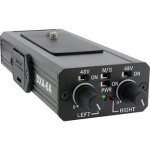
Why didn't you mention audio adapters like the Beachtek and Juiced Link? Mentioning them could have segued into a short discussion of the compromises and difficulties with the "solutions." Of course there are advantages to the alternatives: second system sound with a proper crew almost always produces better sound recording than in camera sound. Its worth mentioning.

Primes- I shoot with a combination of both primes and zooms in cine workflow. Sure changing a prime takes some time, but with a practiced crew it never eats into production time.

That's because as DP/Operator I'm talking with the director and setting blocking, while the camera crew is setting the lens I called for.

I find that at the end of the day zooms save me very little time, and they can compromise the image quality- so unless a scene calls for a focal length I don't have in a prime, or requires a zoom during the take, I stay off the zooms.

Why didn't you mention that part of how a film crew works?

Shallow depth of field and focus... you carry on about how difficult it is and how careful you must be. For some reason you never mention follow focus and the first assistant camera (focus puller). That is a huge oversight and completely fails to do justice to an entire professional category.

It goes on.

I think you could have done more research before writing your article. You have a responsibility as an article writer to present well researched and thorough information.

You didn't cover a lot of the image issues on the current crop of DSLR cameras. Moire and aliasing occupy a lot of attention for users, but you don't mention it.

A couple of times you mention issues with using the in camera LCD, but you never go so far as mentioning external monitoring. I routinely use external monitors on almost every camera I shoot with, including ENG and "prosumer" video cameras.

I've shot a feature on a 7D now, and episodes of series on RED, Panasonic HVX, HPX series and Sony EX series cameras, both with and without a Letus adapter. The 7D is a pain to use, but can deliver great results. RED is a different pain, different great results.

The video cameras are easier to use in some ways, but the codecs and the sensors limit some of my creative options in ways I don't want to accept. Put on a Letus with the video cameras and you are often back to essentially the same workflow you have on a 7D, with the same crewing requirements but lower image quality and light sensitivity than a camera with a "35mm" sensor.

There is a lot you could have written, and frankly I feel you blew an opportunity to shed some real light for your readers.

I would like to have seen discussions about how a film crew solves the problems you chose to focus on. I also would have like for you to mention that the cameras are well suited to some types of work, and not others- and for you to talk about why. Instead you make unspoken assumption that these cameras will always be used by one person crews, hand held or shoulder mounted with a loupe on the camera LCD.

Finally, and inexcusably, you insult your readers by dismissing their work and aspirations to "youtube" and then presume to tell them they have no desire to do a particular thing. (make "hollywood" movies) Now in this forum you claim they are film/media students, people who presumably have decided to study for a profession doing the very thing you declaim.

I hope that next time you'll keep the best of these criticisms in mind and produce a better article, that way the entire film community benefits from your work.
 
Last edited:
Since the blogger is here in person...

Can't agree with you that you need L lenses. You just need good lenses...

I agree with this sentiment.

I will say that my choice of lenses for low end video/film work with "35mm" imagers is Zeiss.

I actually find that the Canon EOS L glass in particular (especially the zooms) is finicky with a follow focus. I prefer the feel and full manual operation of the Zeiss lenses.
 
http://www.flickr.com/photos/39961373@N07/4241564989/in/photostream/


First we put the 7D with a 10-20mm on a 12' Jimmy Jib provided by Black Dog Jib www.blackdogjib.com on a insert camera car and did a few hood mounts, dolly tows, and free riding. The moves are pretty cool and the small form factor of the 7D allowed for some up interesting perspectives we probably wouldn't have been able to do with a RED and a 17-80mm Optimo.

Besides the camera car we used a fully built 30' Jimmy Jib and a 12' for more standard performance setups.

from

http://www.cinematography.com/index.php?showtopic=43754

maybe you are just using it wrong?

can always purchase Bloom's how to video if you need it


imagine how great scarlet would have been for this :Drool:
 
I'm more amateur than 99% of the people on these forums, so it's not my place to contradict the article, but it certainly didn't feel like a balanced analysis of an expert.

I have a couple of real questions for the group to help clarify...

Don't still photographers change lenses all the time during their work? Isn't that part of the point? One must be careful, but are we really supposed to try and change lenses as seldom as possible on DSLRS?

Also, wouldn't using really expensive glass with 35mm adapters reduce the effectiveness of those lenses? I mean obviously you'd want the best glass you can get, but isn't it likely that a decent lens directly to sensor would compete with a really expensive lens to an adapter?
 
I could not agree more with Alexander. And while I do not have enough time to spend writing up a short novel trying to explain myself as well as Alexander did, I will say that after having performed countless hours of research, and owning a 7D myself, this blog post could not be more biased and misleading as Alexander has said, than it already is...

Looks like what some of the writers over at PC World do all the time.
 
I could not agree more with Alexander. And while I do not have enough time to spend writing up a short novel trying to explain myself as well as Alexander did ...

Thank you for the support. I can say it didn't feel like I was writing a novel. Perhaps its best to say I had no time to be brief.

The thing is, speaking as a happy 7D owner, there are definitely times when its the wrong camera. Of course, as someone who bought the camera for video use, there are also times when its the right camera. Ask any Canon rep who has met me, I always tell them "The 7D is the best video camera Canon has ever manufactured."

I would have loved it if the article helped people decide when the camera worked, and when it would be problematic. There are certainly things "they" don't tell you about these cameras.

On my recent feature, the choices that would work were Canon 7D and RED One. RED was out of budget. So, 7D it was.

I had principally the same support gear though as I would have used with a RED, and very much the same crew and workflow.

The author's conclusions are right, its just the reasoning in the article is ... wanting.

"Real" video and Dcinema cameras are coming down the pike that will marginalize the current crop of DSLR cameras. Scarlet is a great example. If Canon has any sense they should be cranking out dedicated video cameras using the sensor of the 7D and 1Dmk4 with EOS mounts.

I suppose I should just write the article I want to have out there.
 
These days any camera will render great results as long as you have someone good behind the camera. I have seen footage shot on a PD150 that blows your mind and untreated stuff shot on a Z1 that many thought was shot on HDCAM. The problem is never the camera, it is the people/ crew using the camera. You just have to do with what you got for the job and get on with it.

The 5D and the 7D, as long as you use a good set of lenses, in the hands of a DP who is willing to use it and that knows the pros and cons of the camera will give you incredible results. Budgets are budgets and not everyone can afford to use high end gear all the time. The main thing is to get a DP that is really good and willing to work with these cameras, get pass the psychological dissapointment of having to use lower end kit and you will be sure to get excellent results.

As someone mentioned before, some people would be shocked (not necessarily for bad practices but because some people assume they shoot with top end cameras all the time and that is far from the truth) at what sometimes goes on behind scenes at some BBC productions and some of the most trusted broadcasters in the world. The perfect camera doesn't exist, each camera has a market purpose, it's good and not so good things and the 5D/7D have shot some incredible stuff, a lot of music promos and corporate stuff. We have half a dozen of each of those cameras and they are always out. You can add a MB and a FF and many prefer them over a 35mm adaptor....

My opinion, don't blame the equipment, blame the person using it...
 
I like to educate as well as inform with my blog because I take on board there are many younger eager media students who may also be reading. Many younger people would not realise what goes on behind the scenes of a BBC drama so try not to be so high and mighty with your replies...remember there is always someone better than you.PS. Thanks for the compliment Ryan.

It's good that you want to educate Philip, it really is. But please don't take umbrage if people don't like your article.

To suggest people are being "high and mighty" reflects badly on you. We are all allowed our opinions. You posted yours in your blog, we have all responded with ours. But that's all they are, opinions.

I thought your article was more of a rant than an educative piece. It was misleading with too many contradictions and inaccuracies for it to be taken seriously.

I'd be more than happy to explain why I take that view, but only if you wish to have the debate.

Anyway, sorry if you feel a bit beat up over comments here, but it's only the internet:)
 
It's just a matter of choosing the right hammer to drive the nail.
HDSLR cameras are not right tool for every shot, just like the Red One is not the right tool for every shot. But then again I have shot crappy footage with some of the best cameras out there! If every shot was perfect there would be a bunch of unemployed editors. I will say that even with their limitations, and what camera doesn't have them, that I have been using a GH1 with very pleasing results. They are perfect for location scouting, and long pack hikes on remote shoots with limited crew. And just recently I picked up a restaurant as a client, who's competitor uses a very large ad agency which bought out a local film co. "Our food shots suck compared to the other guys"... I explained that the other guys food shots were shot on 35mm film, had a great lighter, a food stylist, and a huge budget. But I felt that I could give them a comparable look and stay within their budget. Utilizing my GH1 with Zeiss lenses mounted to a jib, and a motorized turntable, I was quickly able to replicate the competitors shots for this no budget demo and win their account.
IMHO, the new crop of HDSLR cameras have got a great bang for the buck!

All the Best!
 
I think the article is reasonable in certain contexts

my mythical BBC mate who does local news with a sony camera , one lens, servo zoom, massive DOF , steady shot and decent onboard sound and flip screen pieces to camera would be lost with a DSLR

Those from production background will have no problems what so ever that are not well documented

I often question myself 'why are you using this pile of hassle when you own a sony EX1

- my answer is that my even tech disinterested girlfriend prefers the footage from the DSLR on 'blind tests'

and glass, IMO even Stigma etc is good enough if you stop down a couple

S
 
Back
Top